Copyleaks vs Crossplag
Copyleaks and Crossplag both aim to verify content authenticity, but they serve vastly different clients. Copyleaks is designed as a compliant, paid solution built for enterprise volume and features. Crossplag offers a simple, free tool best suited for checking very short, individual English texts. Choosing the right one depends entirely on your budget versus your critical feature requirements.
Best for: Enterprise organizations with strict SOC 2/3 and GDPR compliance needs., Educational institutions requiring LMS integration for verifying student assignments.
Best for: Individual bloggers needing rapid, zero-cost checks of short paragraphs., Users needing quick, temporary checks of English text without any commitment.
Flawed Detection, Challenging User Experience
We observe a significant gap between Copyleaks’ marketed technical claims of over 99% accuracy and the frequent, severe false positives reported by professional users. Currently, the platform requires improved transparency regarding its complex credit-based pricing model and must urgently address widespread complaints about unhelpful customer support. Overall, while the core AI detection technology may hold promise, its poor implementation leads to frustrating and costly uncertainty for users.
Pros
- Validated by Cornell Tech researchers for LLM detection accuracy.
- Supports advanced features like cross-language translation detection.
- Provides strong enterprise compliance with GDPR and SOC 2/3 certifications.
- Detects AI outputs and plagiarism across over 100 languages.
Cons
- Reported high false-positive rates frequently flag human writing as 100% AI.
- Detection sometimes easily circumvented by minor content changes.
- Credit system and billing practices are perceived as misleading and costly.
- Customer support is often cited as unresponsive or automated.
Accuracy concerns make it unreliable.
We find that while Crossplag offers a free and fast AI detection tool, the reported severe accuracy problems detailed by users cannot be ignored. Overall, we cannot recommend relying on this product until major improvements are made to its core detection algorithm, despite the attractive zero price point.
Pros
- Completely free to use with no hidden fees or subscriptions.
- Fast, almost instant, real-time text analysis.
- Simple interface; easy to use (paste text and check).
- User data is not stored, ensuring high privacy.
Cons
- Reliability is severely inconsistent according to user reports.
- Fails to accurately detect AI-generated text, defeating its purpose.
- Incorrectly flags human-written text as highly AI-generated.
- Character limit for checks is restricted to 3,000 characters.
AboutCopyleaks
Copyleaks is a robust platform focusing on digital authenticity. It uses advanced AI technology to analyze unique text patterns.
This focus allows the system to flag content created by various Large Language Models (LLMs), including GPT-5, Gemini, Claude, and dozens more. The tool helps you clearly identify AI writing because it looks for signals left behind by statistical modeling.
You can also get detailed reports that separate elements written by humans from AI-generated text, even when both are mixed. The platform is truly built for accuracy and scalability.
AboutCrossplag
The Crossplag AI Content Detector is a tool designed to determine the origin of your text. It tells you whether content was genuinely human-written or created using an AI chatbot, like platforms generating emails, articles, or product descriptions. This detector uses a blend of sophisticated machine learning algorithms and natural language processing techniques 💡.
It analyzes text patterns based on training data that includes over 1.5 billion parameters for precise results. Since the model is trained with English language datasets, currently, that's the only language that is supported. However, they are planning on adding more languages as the detector develops further.
Highlights
Feature Comparison
Features Overview
We highlight the main differences and pick a winner for each feature.
Pricing Structure
Crossplag is 100% free; Copyleaks uses a paid, credit-based subscription model.
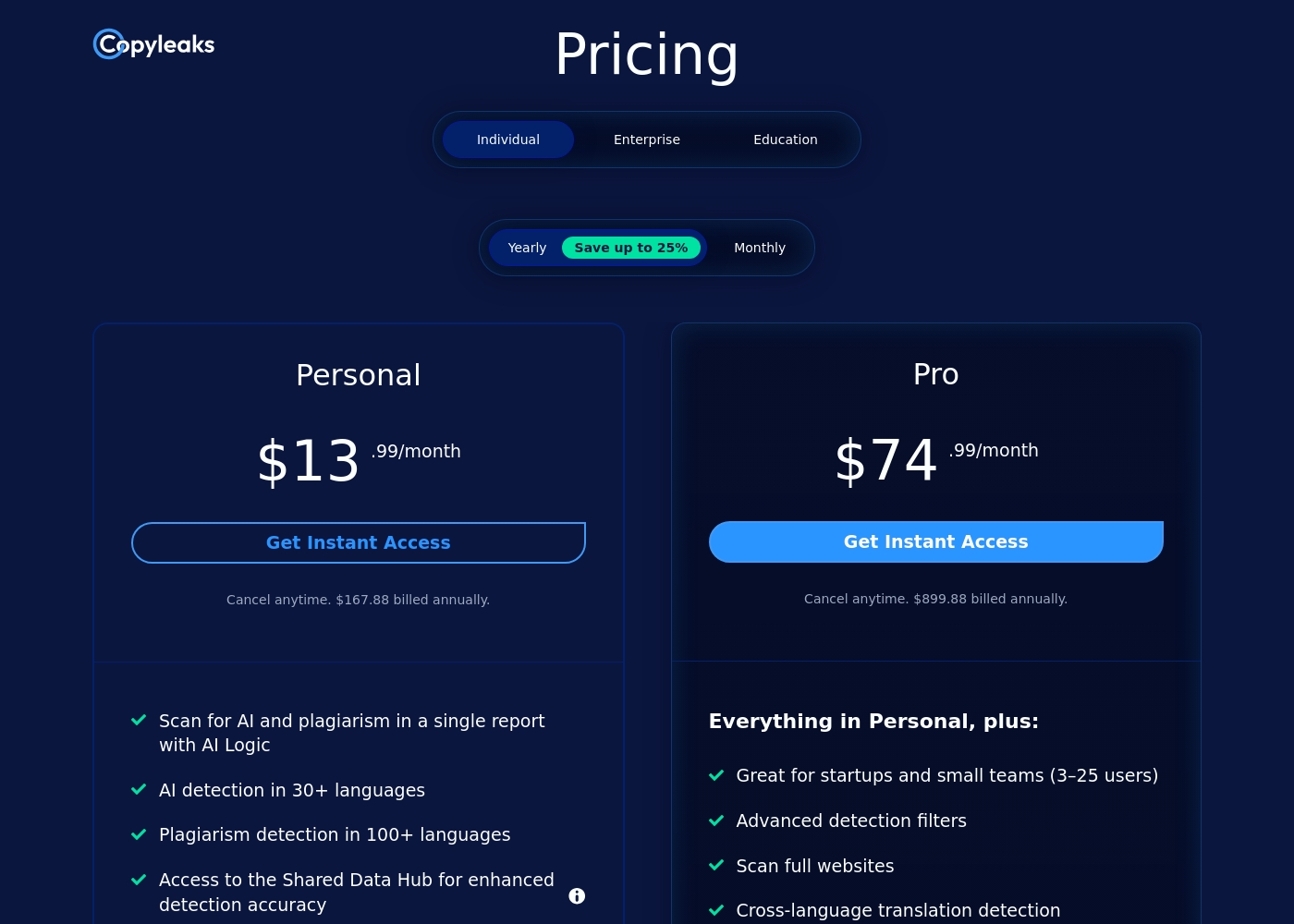
Copyleaks runs on a credit system for Personal and Pro plans, which covers 250 words per credit. Annual plans start at $13.99/month, but costs can accumulate unexpectedly. Customers frequently complain the credit system used by Copyleaks is confusing and costly. The AI Content Detector offered by Crossplag is entirely free to use with no subscription needed. This makes Crossplag the essential choice for any user focused purely on budget. If you need any other features or large volume, you must pay for Copyleaks. Crossplag’s zero cost is compelling despite its fundamental limitations.
Max Content Volume
Copyleaks scans massive documents; Crossplag is limited to micro-sized checks.
The Copyleaks web platform can handle extremely large documents up to 2,000 pages in a single scan. This supports academic administrators or large publishing agencies. Copyleaks is built to handle professional volume efficiently. Crossplag enforces a strict maximum limit of just 3,000 characters per single submission. This is suitable only for checking short emails or paragraphs. You cannot effectively check a full article or thesis using Crossplag due to this limit. Only Copyleaks can manage the required scope for organizational or educational auditing. If your content exceeds 3,000 characters, Copyleaks is the only available option out of the two.
Language Coverage
Copyleaks is highly multilingual; Crossplag only supports the English language.
Copyleaks supports AI detection in over 30 global languages for broad coverage. It also offers advanced cross-language plagiarism detection in 100+ languages. This feature set supports global teams effectively. Crossplag is currently limited only to the English language for its AI Content Detector. The model was trained using only English datasets, limiting its market. Organizations working in any non-English language must select Copyleaks. Crossplag's English-only restriction severely limits its usefulness for international users.
Enterprise Integration
Copyleaks offers API and LMS tools; Crossplag offers no integration options.
Copyleaks offers custom solutions for Enterprise and Education, including full API access. This allows automated scanning and integration into existing platforms. It also supports direct integration with Learning Management Systems (LMS). Crossplag does not state any API access or integration options for its free detector. Users must manually paste content into the web tool every time. If institutional or large-scale automation is necessary, Copyleaks is required. This makes Copyleaks the clear choice for schools or businesses looking to streamline their workflow.
Compliance & Security
Copyleaks has official SOC 2/3 certification; Crossplag focuses on non-data storage.
Copyleaks adheres to stringent international standards, including GDPR compliance and SOC 2/3 certifications. These certifications are essential for enterprise data security assurance. Crossplag ensures privacy by stating that submitted text is processed in real-time and not stored once the analysis is complete. However, Crossplag lacks the verifiable enterprise-grade compliance of its competitor. Companies handling sensitive data that require certified compliance must opt for Copyleaks. Copyleaks provides the necessary legal and security safeguards for regulated industries.
Detection Accuracy
Both tools face heavy user criticism regarding consistency and high false-positive rates.
Copyleaks claims a validated accuracy over 99% and a low 0.2% false positive rate. However, external user reviews frequently report human text is mistakenly flagged as 100% AI. Crossplag also receives many reports that it fails to verify authenticity reliably. Users found the tool inconsistent, sometimes labeling AI-written text as human-generated. Both Copyleaks and Crossplag struggle to deliver reliable detection when measured against user reports. If accuracy is truly paramount, both tools require caution and secondary verification checks.
Combined Checks
Copyleaks scans for AI and plagiarism together; Crossplag requires two separate tools.
Copyleaks offers a single, comprehensive report that simultaneously covers AI detection and traditional plagiarism checks. This simplifies the content verification process. The AI detector in Crossplag is a free, standalone tool for AI checking only. Plagiarism detection is a separate, potentially paid service offering from Crossplag. Copyleaks provides superior efficiency by unifying the process into one report. For academics or publishers needing both checks, Copyleaks saves significant time and effort.
Copyleaks costs between $13.99 and $99.99 per month for individuals with four main pricing paths: Personal at $13.99/month, Pro at $74.99/month, and custom solutions for Enterprise and Education.
We provide detailed information about the individual subscription tiers below, based on the lower annual pricing.
Personal
Price: $13.99/month (billed annually at $167.88) Refund Policy: Limited 10-day conditional guarantee Other Features:
- Scan for AI and plagiarism in a single report with AI Logic
- AI detection in 30+ languages
- Plagiarism detection in 100+ languages
- Access to the Shared Data Hub for enhanced detection accuracy
- Scan for AI and plagiarism in a single report with AI Logic
- AI detection in 30+ languages
- Plagiarism detection in 100+ languages
- Access to the Shared Data Hub for enhanced detection accuracy
- Everything in Personal, plus:
- Great for startups and small teams (3-25 users)
- Advanced detection filters
- Scan full websites
- Cross-language translation detection
- Custom-tailored solution
- Includes API access and LMS integration
- Designed for large teams, institutions, or districts
- Custom-tailored solution
- Includes API access and LMS integration
- Designed for large teams, institutions, or districts
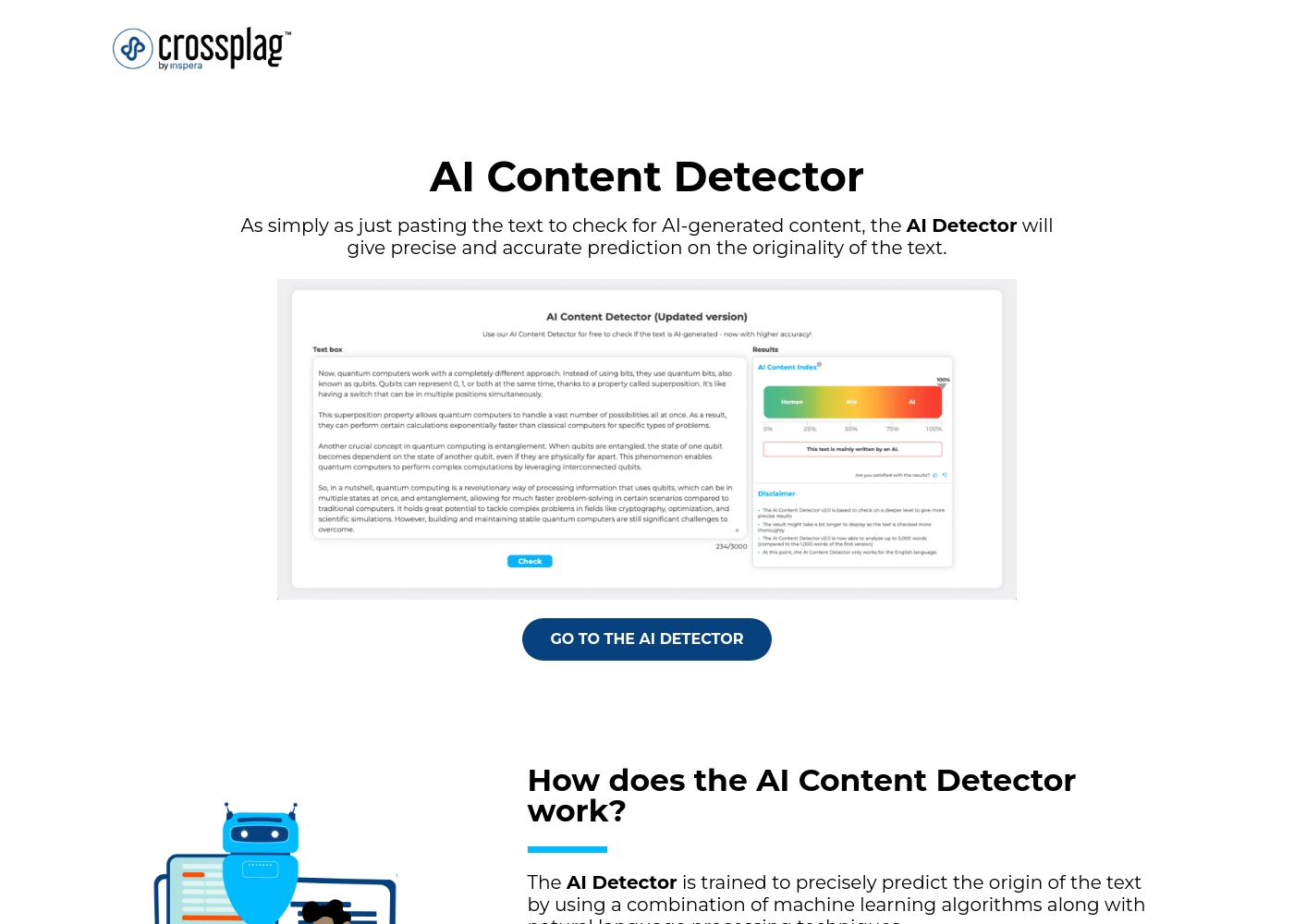
Crossplag's AI Content Detector is available for free with 1 plan: Free AI Content Detector at $0.00.
Here’s a breakdown of the single, accessible option for checking your content's originality.
Free AI Content Detector
Price: $0.00 Best For: Anyone needing fast, accurate verification of text authenticity (e.g., bloggers, educators, recruiters) Refund Policy: Not applicable (Free service) Other Features:
- Fast and almost instant verification
- Accurate prediction using machine learning
- Easy to use: paste text and click "Check"
- Supports the English language
- Submitted text is not stored by the detector
- Fast, almost instant authenticity verification
- Accurate prediction using machine learning
- Easy to use: paste text and click 'Check'
- Real-time analysis
- Submitted data is not stored
Pricing Notes
- The AI Content Detector offered by Crossplag is completely free, making it the top budget choice for individuals.
- Copyleaks utilizes a credit-based structure where costs scale rapidly; 1 credit covers only 250 words or less.
- Copyleaks users frequently cite the complex credit system and billing as misleading or costly in user reviews.
- Copyleaks offers substantial savings for Personal and Pro users who choose annual billing over monthly payments.
Pricing Head-to-Head
User Reviews
Copyleaks reviews present a sharply divided user experience, reflected in its overall low Trustpilot score. The main criticism involves the tool's core function: accuracy.
Many users, including long-time professional writers, report frustrating experiences where clearly human-written content—even text drafted before LLMs existed—is flagged as 100% AI. These extremely high false-positive rates strongly undermine confidence in the tool’s reliability, causing users to call it a "fake AI detector." Furthermore, users highlight significant issues with the credit system and billing practices.
I have 35 years of writing experience, and when I put my journal entry into Copyleaks, it returned 100% AI content. Every other competing software says 100% Human. Copyleaks is an epic fail.
The external feedback for Crossplag is currently very limited and overwhelmingly negative. The most serious concern reported by early users relates to the severe lack of reliability and accuracy in the AI detection service.
While the tool is offered for free and promotes fast processing, user reports indicate fundamental flaws in its core function. Specifically, users report that content written entirely by a human was consistently and incorrectly flagged as 100% AI-generated.
This tool returned very poor results for me. I recently checked content written entirely without AI, and Crossplag flagged it as 100% AI-generated. If the results are not accurate and reliable, I simply cannot use it for professional work.
Our Verdict
Copyleaks and Crossplag represent two extreme ends of the AI detection market. Your final decision depends entirely on your specific needs and tolerance for reported inaccuracies. If you run a large institution or business, Copyleaks is your only option. Copyleaks is the enterprise powerhouse, offering crucial SOC 2/3 compliance and API access. It supports over 30 languages and can scan massive documents up to 2,000 pages. However, be prepared for a confusing credit-based billing system that users report as costly and problematic. Crossplag's superpower is its price: it’s 100% free for short checks. You can analyze snippets up to 3,000 characters instantly without any financial commitment. Unfortunately, Crossplag provides very limited functionality and only supports the English language, severely restricting professional use. The deciding factor should be use case scope, not reliability, as both face steep user criticism regarding accuracy. If you need institutional features and volume, choose Copyleaks. If you check only a few paragraphs occasionally and need zero cost, use Crossplag. Choose wisely, and always consider a secondary verification method.
Frequently Asked Questions
Which is better for multilingual content: Copyleaks or Crossplag?
Copyleaks is far better for multilingual needs, supporting AI detection in over 30 languages. Crossplag’s free detector is strictly limited to checking content written in English only. If you need foreign language checking, choose Copyleaks immediately.
Does Copyleaks combine plagiarism and AI checks in one report?
Yes, Copyleaks offers a single, comprehensive report scanning for both AI generation and traditional plagiarism. The free detector offered by Crossplag only checks for AI. Plagiarism checking is a separate service from Crossplag.
Can I check long documents with Crossplag like I can with Copyleaks?
No, this is a major difference between the tools. Copyleaks can scan documents up to 2,000 pages, supporting academic theses. Crossplag imposes a strict limit of just 3,000 characters per analysis.
Does Copyleaks use a credit system, and is Crossplag truly free?
Copyleaks uses a credit-based subscription where one credit covers 250 words or less. Crossplag's AI Content Detector is indeed 100% free to use and requires no credit purchases. This makes Crossplag the clear winner on simplicity and cost.
Which offers better security compliance: Copyleaks or Crossplag?
Copyleaks offers enterprise-grade security, including SOC 2/3 and GDPR compliance. Crossplag focuses on the positive practice of not storing submitted content data. For verifiable legal compliance, Copyleaks is the safer choice.
Is the accuracy of Copyleaks really better than Crossplag?
Both Copyleaks and Crossplag face heavy user complaints about accuracy and reliability. Copyleaks claims high scientific precision but users report constant false positives. Crossplag also receives criticism for failing to detect known AI content.
Ready to Choose?
Both tools have their strengths. Choose based on your specific needs.