Cognism vs Demodesk
Cognism and Demodesk solve two very different problems for sales teams. Cognism is your source for verified B2B contact data, especially in Europe. Demodesk uses AI to automate the admin work after you make the call. It's not a simple apples-to-apples choice.
Best for: B2B sales and marketing teams targeting European markets., Mid-market and enterprise revenue operations teams scaling pipeline.
Best for: Sales teams and their managers focused on automating administrative tasks, Organizations looking to provide AI-powered coaching and conversation insights
Strong European Data, But Pricy
We found Cognism to be a robust platform for B2B sales teams targeting Europe, with its phone-verified data and compliance focus standing out. Overall, it delivers real value for pipeline building, but the custom pricing and onboarding curve require careful consideration.
Pros
- Excellent phone-verified contact data for higher connect rates.
- Strong compliance and GDPR/CCPA adherence for European markets.
- Generally easy-to-use interface after initial setup.
- Responsive customer support is frequently praised.
Cons
- Pricing is opaque and generally considered expensive.
- Onboarding process can be challenging for new users.
- Data accuracy can be inconsistent or outdated in some cases.
- May not be ideal for very small teams or non-European markets.
AI-powered sales efficiency with a learning curve.
We found Demodesk offers a promising AI-driven solution to automate sales admin and provide conversation insights. Its core value lies in freeing up time for revenue-generating activities. However, our assessment is limited by a lack of accessible external user reviews to validate its real-world impact on support, reliability, and overall value for money. Overall, it's a compelling tool for teams focused on automating workflows, but further due diligence on user feedback is recommended before committing.
Pros
- Automates note-taking, follow-up emails, and CRM updates.
- Provides personalized coaching feedback after calls.
- Captures and analyzes conversations from various channels, not just formal meetings.
- Offers AI agents for building autonomous sales workflows.
Cons
- Specifics on integration reliability and depth are unclear without user reviews.
- Ease of use and onboarding experience are unverified externally.
- Pricing beyond the starting tier and its value perception are unknown.
- No accessible user feedback on customer support responsiveness.
AboutCognism
Cognism is a B2B data and sales intelligence platform designed for revenue teams selling into European markets. 🎯 It focuses on providing accurate, compliant contact data—especially phone-verified mobile numbers—to help sales and marketing teams identify and reach decision-makers. The platform is built for SMBs, mid-market, and enterprise teams who need to navigate Europe's complex regulatory landscape and diverse local markets.
AboutDemodesk
✨ Demodesk is a platform with AI sales agents. It's built for sales teams and their managers. The AI listens to conversations, writes notes, and studies what was said. This gives you back your time and clear insights into every deal.
Highlights
Feature Comparison
Features Overview
We highlight the main differences and pick a winner for each feature.
Core Functionality
Cognism provides verified B2B contact data. Demodesk uses AI to automate post-call sales work.
Cognism is built for sales prospecting. It provides a database of company and contact records, with phone-verified mobile numbers. The goal is to give you accurate data to start conversations. Demodesk is an AI sales agent. It listens to your calls, transcribes conversations, and automates tasks like note-taking and CRM updates. The goal is to save time after the conversation. The key difference is input vs. output. Cognism helps you find the person to call. Demodesk helps you after you've called them. They solve different parts of the sales cycle. You might use Cognism for outbound prospecting and Demodesk to handle the follow-up work for any call.
Data & Accuracy
Cognism focuses on third-party contact data accuracy. Demodesk creates first-party data from your conversations.
Cognism's value is data quality. It refreshes director-level data every 30 days and uses a data fusion engine. Customers report 30% better data quality with their service. Demodesk doesn't provide contact data. Its accuracy is about correctly transcribing and summarizing your live conversations. It captures the raw truth of what was said. The trade-off is external vs. internal data. Cognism gives you data about the market. Demodesk gives you data about your own sales process. For building an outbound list, Cognism is the tool. For analyzing your team's call effectiveness, Demodesk is the tool.
Automation Capabilities
Cognism automates data enrichment. Demodesk automates entire post-call workflows.
Cognism automates CRM data hygiene. Its CRM Enrichment feature can automatically update contact records and fill missing fields. New leads can be enriched as they enter your CRM. Demodesk automates the post-call admin. After a call, it can generate notes, draft follow-up emails, and update your CRM. It aims to handle several repetitive tasks. The scope is different. Cognism automates data fields. Demodesk automates communication and data entry tasks. Demodesk's automation directly impacts a rep's daily time. Cognism's automation improves the underlying data quality over time.
Analytics & Reporting
Cognism reports on data quality and usage. Demodesk reports on conversation and team performance.
Cognism provides dashboards for data usage and prospecting activity. In its Pro plan, you get advanced dashboards. The focus is on measuring data consumption and campaign performance. Demodesk analyzes conversation content. It provides insights on deal health, coaching opportunities, and patterns across team calls. The focus is on sales performance and strategy. Cognism tells you how much data you're using. Demodesk tells you how effectively your team is selling based on conversations. For data-driven marketing teams, Cognism's analytics help. For sales managers coaching a team, Demodesk's analytics are more relevant.
Ease of Use
Cognism has a learning curve after onboarding. Demodesk is designed for simple, automated workflows.
Users note Cognism can have a challenging onboarding process. Once set up, the platform is designed for quick list building. The interface aims for simplicity after the initial setup. Demodesk's value is in automation. The AI should handle complex tasks, making the rep's experience simpler. The goal is less manual work, not more complex software. The difference is complexity of purpose. Cognism is a powerful database with many filters. Demodesk is an agent that works in the background. A rep using Demodesk spends less time in the software itself. A rep using Cognism actively builds lists and researches within the platform.
Pricing & Value
Cognism is premium and opaque. Demodesk offers transparent tiers and a free option.
Cognism uses custom-quoted pricing. The cost is generally considered high and not transparent upfront. It combines a subscription with a credit-based model. Demodesk has clear pricing. The Coaching & AI plan is €49 per user/month. The AI Crew plan is free per seat with usage charges for workflow runs. The value calculation is different. Cognism's value is in pipeline generation from data. Demodesk's value is in time saved per rep per week. Cognism is a significant investment. Demodesk offers a lower entry point and a free trial to test ROI.
Customer Support
Cognism offers account managers. Demodesk support details are less public.
Cognism provides live chat support and an account manager with Pro plans. External reviews frequently praise their responsive support team. For Demodesk, support responsiveness is not explicitly detailed in external reviews. The Enterprise plan offers 'Prio Support.' General support details are not public. Cognism has more visible and praised support. Demodesk's support structure is less transparent from public data. If direct, responsive support is critical, Cognism's model is more proven. With Demodesk, you'd need to inquire about support specifics during a demo.
Integration Ecosystem
Cognism has specific, deep CRM integrations. Demodesk offers unlimited, flexible connections.
Cognism integrates with major CRMs like Salesforce, HubSpot, and Pipedrive. You can enrich records directly within these systems. The integrations are core to its workflow. Demodesk's AI Crew plan includes unlimited integrations and API access. You can connect it to your existing tools. The focus is on flexible, custom connections. Cognism's integrations are focused on data flow into your CRM. Demodesk's integrations are about feeding its AI data from your calls. For a standard CRM stack, Cognism's pre-built integrations work well. For a custom tech stack, Demodesk's API offers more flexibility.
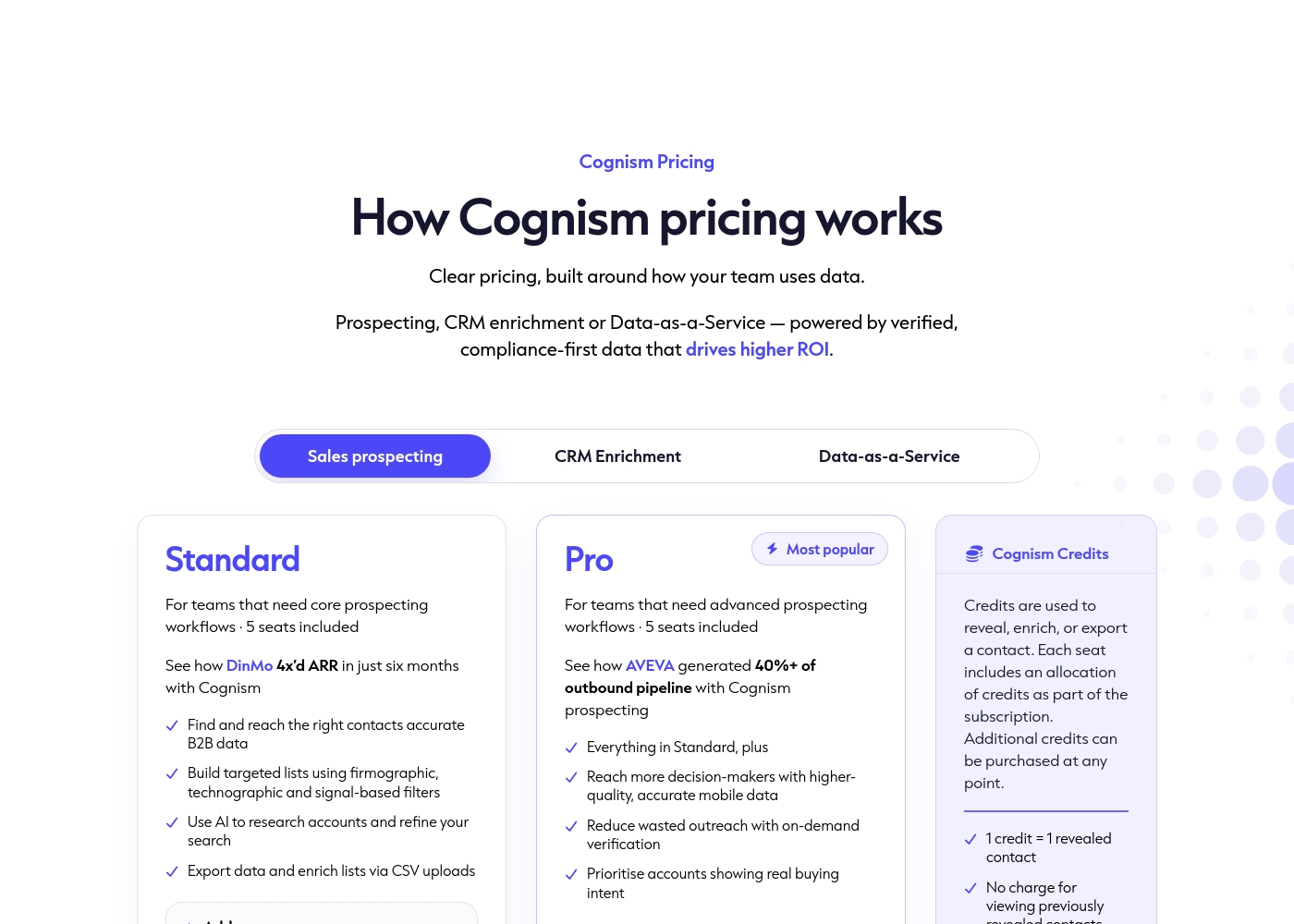
Cognism pricing: Cognism offers custom subscription-based pricing tailored to your team size and data needs. The platform features two core prospecting tiers, Standard and Pro, alongside available add-ons for CRM enrichment and API access segments to ensure you only pay for what you use.
All pricing and seats are designed to scale with your team's growth and data volume requirements. Please contact their sales team for a personalized quote tailored to your specific goals and seat requirements.
No prices are publicly listed, as each plan is custom-tailored to the business needs of the user. Their platform uses a credit-based model for revealing, enriching, or exporting company and contact records to keep your team up to date with the latest information.
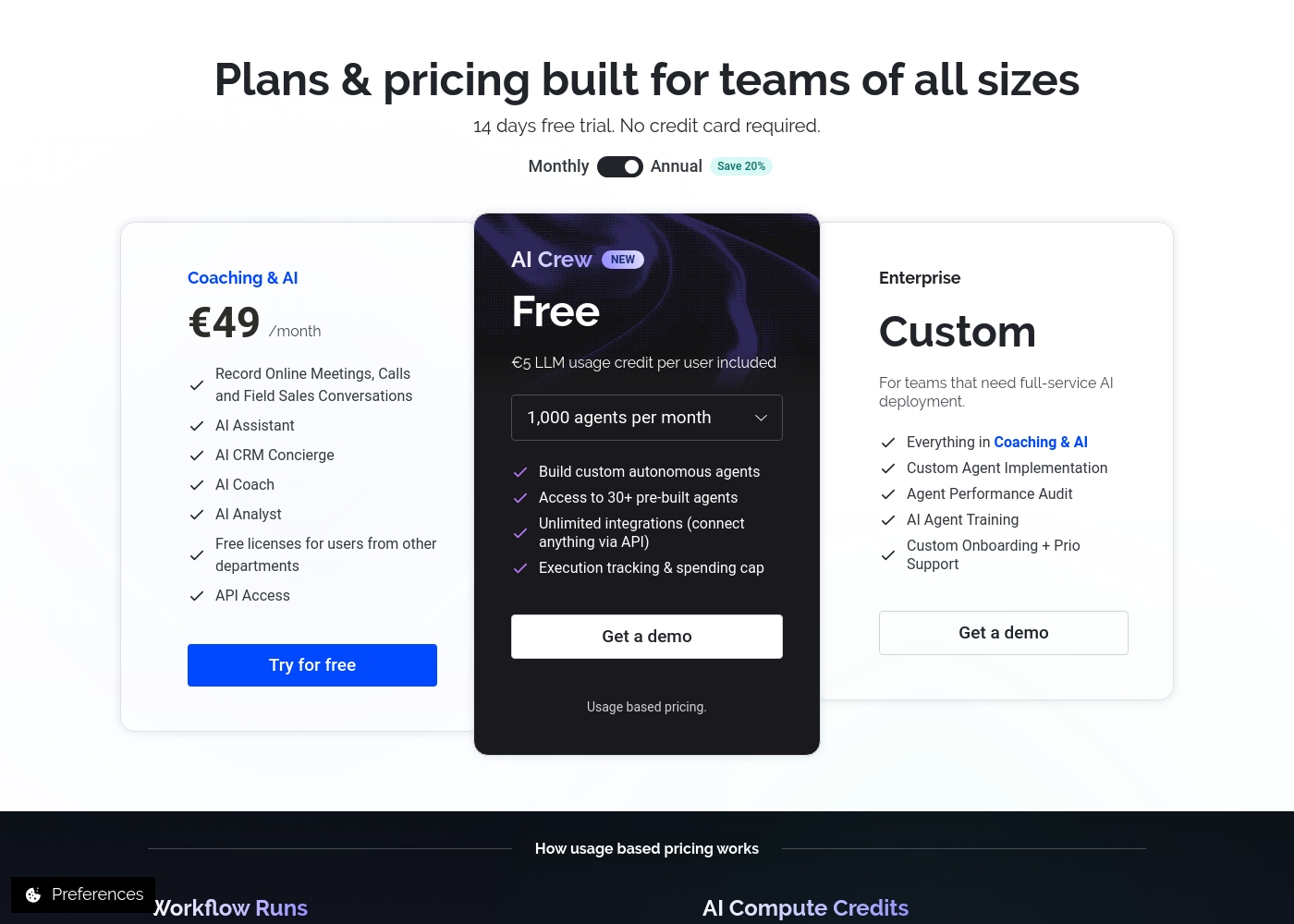
Demodesk pricing: Demodesk offers a flexible pricing model starting at €49/month per user, alongside a free AI Crew tier for building autonomous agents. The platform scales based on feature requirements and usage-based workflow runs.
building autonomous agents. The platform scales based on feature requirements and usage-based workflow runs.
building autonomous agents. The platform scales based on feature requirements and usage-based workflow runs.
Pricing Notes
- Cognism pricing is completely opaque and requires contacting sales for a custom quote.
- Demodesk offers a transparent free tier (AI Crew) and a clear €49/user/month paid plan.
- Cognism's pricing is generally considered high and is a common point of friction in reviews.
- Demodesk provides a 14-day free trial with no credit card required for the Coaching & AI plan.
- Cognism's credit system means you pay to reveal or export records, adding to the subscription cost.
Pricing Head-to-Head
User Reviews
We found mixed sentiment in external reviews for Cognism. Users consistently praise the high accuracy and quality of phone-verified data, which helps connect with decision-makers.
Many also highlight the platform's ease of use and strong customer support. However, recurring complaints focus on high pricing that isn't transparent, onboarding challenges, and occasional data reliability issues, like outdated contacts.
The data quality is top-notch, especially the mobile numbers. It's made a real difference in our outreach. Support has been helpful whenever we had questions.
Based on our review of external sources, we were unable to access user reviews on Trustpilot or Capterra for Demodesk. The Capterra link returned a security error, preventing us from gathering specific sentiment on accuracy, ease of use, support, or pricing.
Without accessible review data, we cannot synthesize a balanced external summary at this time. We recommend checking these platforms directly for the latest user feedback.
We reviewed Demodesk's website and found a clear focus on automating sales admin. The promise of capturing conversations anywhere is strong, but without user reviews, we can't confirm how well it delivers. The AI agents feature is intriguing for advanced workflows.
Our Verdict
This isn't a direct fight between similar tools. Cognism and Demodesk solve two different, critical problems for sales teams. Cognism's superpower is building a high-quality pipeline. Its phone-verified data for European markets delivers up to 3x higher connect rates. If your team wastes time on bad data, Cognism is the surgical fix. Demodesk's superpower is reclaiming lost time. Its AI handles note-taking, follow-ups, and CRM updates after every call. It promises to free up hours each week for your reps to sell. The deciding factor is your biggest pain point. Is it 'We can't find the right people to call'? That's a Cognism problem. Is it 'Our reps are buried in post-call admin'? That's a Demodesk problem. For most teams, the choice is clear. Pick Cognism if you need better data to start more conversations. Pick Demodesk if you need to automate work to close more deals. They could even work together in a sales tech stack.
Frequently Asked Questions
Which is better for small teams: Cognism or Demodesk?
Demodesk is likely better for small teams. It has a free tier and lower entry cost. Cognism is geared towards mid-market and enterprise teams targeting Europe, with higher, opaque pricing.
Can I use Cognism and Demodesk together?
Yes, they serve complementary purposes. You could use Cognism to find and research prospects, then use Demodesk to automate the follow-up workflow after calling them.
Is Demodesk worth the extra cost over Cognism?
The cost comparison is complex. Cognism is generally more expensive but provides prospecting data. Demodesk is cheaper but automates post-call work. Value depends on whether you need better data or more time.
Does Cognism have AI features like Demodesk?
No. Cognism focuses on providing accurate data. Demodesk is an AI platform that records, transcribes, and analyzes sales conversations. Their AI applications are entirely different.
Which has better CRM integrations?
Cognism has deep, pre-built integrations with Salesforce, HubSpot, and Pipedrive. Demodesk offers unlimited integration flexibility via API on its AI Crew plan. Cognism is more plug-and-play; Demodesk is more customizable.
Can I try before I buy?
Cognism does not offer a free trial. You must request a discovery demo. Demodesk offers a 14-day free trial with no credit card required for its Coaching & AI plan.
Ready to Choose?
Both tools have their strengths. Choose based on your specific needs.