Bramework vs Outranking
Bramework and Outranking are both elite AI SEO tools for writers. Bramework focuses on pure speed and high content volume output. Outranking targets ranking precision and deep SERP analysis for E-E-A-T. Picking the right tool depends entirely on your scale and content standards.
Best for: Freelance writers needing to scale content output fivefold., High-volume content teams needing unlimited AI words.
Best for: Agencies managing client content needing deep competitive analysis., Marketers optimizing diverse web content (LPs, product pages).
Powerful AI, Inconsistent Support.
We found Bramework offers a powerful toolset for scaling content, utilizing high-end AI models and targeted SEO features like the Blog Booster. However, we note a stark division in user feedback, where recent users report critical deficiencies and neglect in customer service resolution. Overall, highly effective features are currently undermined by significant support and stability concerns.
Pros
- Generates comprehensive, SEO-optimized long-form content (up to 5,000 words).
- Uses multiple advanced AI models (GPT-4o, Claude 3 Opus) for high-quality results.
- Includes robust SEO tools for keyword research and performance tracking.
- Blog Booster feature helps identify “quick win” improvement opportunities in old posts.
Cons
- Recent reports indicate significant issues with customer support responsiveness.
- Long-running technical issues have reportedly remained unresolved for months.
- Users report high friction in account management, including persistent unsolicited emails.
- No free trial is currently offered for any of the main subscription tiers.
Powerful SEO AI with pricing caveats.
We find Outranking offers excellent technical features for content optimization, emphasizing E-E-A-T compliance and leveraging powerful data sources like GPT-4. It performs deep competitive analysis using live SERP data, giving writers a significant edge. Overall, while its content features are strong, we must caution new users about potential issues with evolving billing terms and customer support quality.
Pros
- Leverages GPT-4 and live SERP data for generating factual AI content.
- Provides deep competitive intelligence (PA, DA, NLP analysis).
- Confirms originality to help meet Google's E-E-A-T standards.
- UI is simple and intuitive with helpful onboard guides.
Cons
- Advanced AI generation requires purchasing separate character add-ons.
- Pricing uses a complex, document-based credit usage system.
- Unused monthly credits reset and do not roll over to the next cycle.
- Users reported poor support responsiveness, sometimes described as 'very rude'.
AboutBramework
Bramework is designed and built specifically for bloggers. The platform takes pride in its laser-focused approach toward content creation and search visibility. ✨
This AI-powered suite offers an all-in-one workflow for generating effective content. It moves you from initial keyword research all the way to analyzing performance data.
The tool is perfect for solo bloggers, freelance writers aiming to handle more clients, and agencies needing scalable team controls. Business owners can also use it to consistently drive organic traffic and establish helpful online authority.
AboutOutranking
Outranking is a specialized SEO content optimization software. It focuses on swiftly streamlining your entire content creation process. This robust tool is powered by cutting-edge data, including Google NLP and OpenAI GPT-4 technology.
It goes beyond simple keyword suggestions, prioritizing SEO writing and optimization. If you need to produce content with a high probability of ranking, Outranking is built for you. It serves managers, agencies, and e-commerce owners who need to scale their written output quickly and effectively. 💡
Highlights
Feature Comparison
Features Overview
We highlight the main differences and pick a winner for each feature.
AI Content Generation Speed
Bramework is built for pure speed and high-volume output; Outranking focuses on slower, precise generation.
Bramework uses First Draft PRO to instantly deliver comprehensive 5,000-word articles. For maximizing output, the Bramework Pro plan offers unlimited AI words. This allows teams to handle massive content volumes quickly. Outranking uses its factual 'Concepts' feature based on deep SERP data. Generating full drafts often requires purchasing an extra 'AI characters add-on.' Outranking content is accurate but creation is intentionally slower for precision. **Winner: A**
SEO Optimization Depth
Outranking provides deeper SERP analysis and active E-E-A-T guidance. Bramework offers solid core optimization.
Outranking’s outline builder analyzes the top 20 ranking pages before the draft starts. It constantly checks against 10+ SEO metrics in real-time. Outranking specifically guides users toward meeting E-E-A-T standards. Bramework uses the Blog Booster to analyze up to 12 months of old content data. Bramework optimization focuses on identifying fast 'quick win' content opportunities. Outranking forces a structured, highly optimized approach from the first word. **Winner: B**
Pricing Structure & Volume
Bramework’s Pro plan is a better value for high volume; Outranking requires costly add-ons.
Bramework offers a flexible Pay As You Go option for intermittent usage. The Bramework Pro plan provides genuinely unlimited AI-generated words monthly. Outranking limits usage by 'SEO Documents' (max 30 documents monthly). Outranking requires a crucial, separate ‘AI characters add-on’ for full draft generation. This significantly increases the true cost of using Outranking for high-volume drafting. **Winner: A**
Workflow and Collaboration
Outranking is better integrated for editorial teams using Google Docs and custom style guides. Bramework's features are basic.
Outranking offers one-click exporting to Google Docs, simplifying content handoffs. It supports creating custom style guides for brand voice consistency during generation. Bramework provides team management up to eight users on the Pro plan. Bramework's collaboration centers mainly on controlling user word limits. Outranking fits into existing editorial processes more smoothly than Bramework. **Winner: B**
Content Revival/Audits
Bramework has a powerful, data-driven tool for optimizing old content. Outranking lacks a comparable feature.
Bramework’s dedicated Blog Booster analyzes 12 months of performance data. It identifies underperforming posts and provides personalized SEO tips instantly. This makes Bramework essential for content maintenance. While Outranking offers functions to update internal links, it focuses primarily on new content creation. Outranking does not offer the same data-driven auditing capabilities as Bramework. **Winner: A**
Content Focus and Versatility
Outranking handles diverse web content types; Bramework is laser-focused exclusively on blogs.
Bramework is built specifically to address blog content creation and optimization. The platform advises users not to use Bramework for marketing materials like whitepapers. Outranking handles blogs, landing pages, product pages, and local service guides. If you need AI SEO help across an entire website portfolio beyond blogging, Outranking offers necessary versatility. **Winner: B**
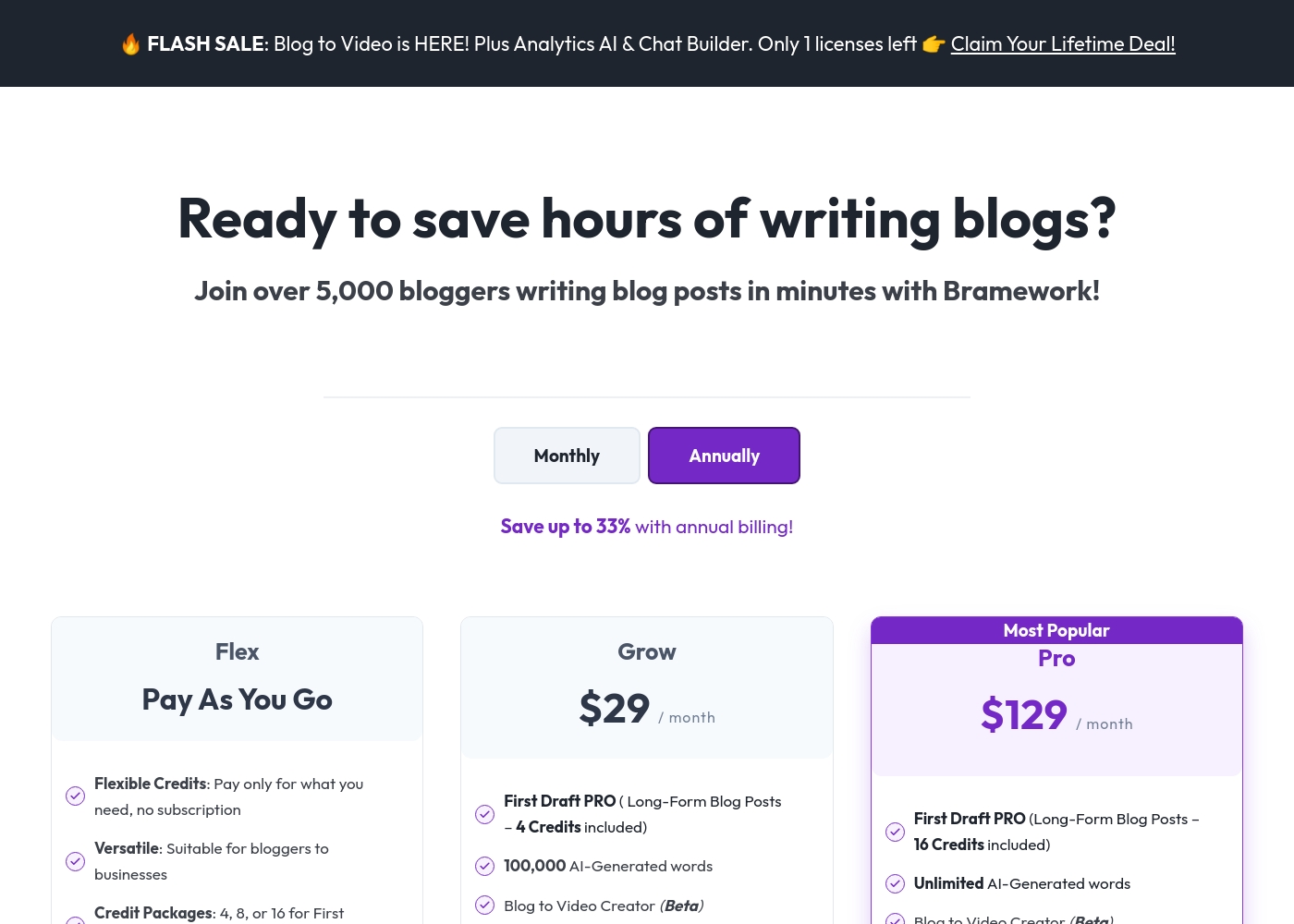
Bramework costs between $19 and $99 per month when billed annually, with four main options: Flex Pay As You Go (credit-based), Grow at $19/month, Pro at $99/month, and Agency (custom pricing).
Here’s a clear breakdown of each plan, focusing on the features that help you scale your blogging.
Flex Pay As You Go
Best For: Bloggers to businesses (Versatile) Other Features:
- Flexible Credits: Pay only for what you need.
- Credit Packages available: 4, 8, or 16 for First Draft PRO.
- AI Words are purchased in 2,000-word increments (up to 100,000).
- Plagiarism checks are also available in 2,000-word increments.
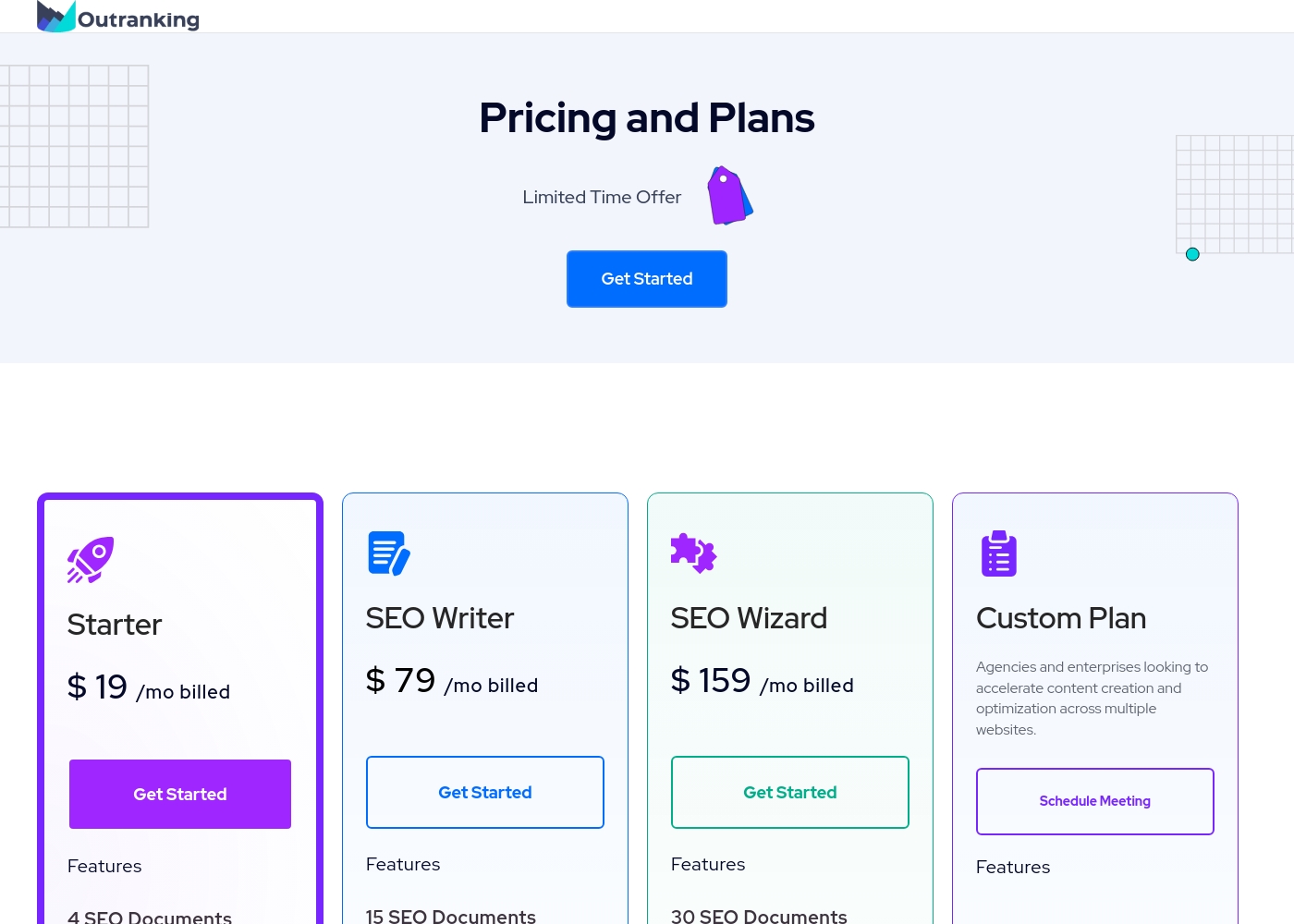
Outranking costs between $19 and $159 per month with three standard plans: Starter at $19/mo, SEO Writer at $79/mo, and SEO Wizard at $159/mo, plus a Custom Plan option.
Let's look closely at what each subscription tier offers so you can pick the best fit for your SEO strategy. Each plan includes fundamental AI functions like Title Generation and Auto-Optimization.
Starter
Price: $19/mo billed Refund Policy: Partial refund available (less $9 charge) Other Features:
- 4 SEO Documents per month
- Includes fundamental AI functions
- Advanced AI functionality requires add-ons
- 4 SEO Documents per month
- Fundamental AI functions included (Title Generation, Outlines, Auto-Optimization)
- Advanced AI functionality requires purchasing AI characters add-on
- 15 SEO Documents per month
- Fundamental AI functions included (Title Generation, Outlines, Auto-Optimization)
- Advanced AI functionality requires purchasing AI characters add-on
- 30 SEO Documents per month
- Fundamental AI functions included (Title Generation, Outlines, Auto-Optimization)
- Advanced AI functionality requires purchasing AI characters add-on
- Designed for agencies and enterprises
- Accelerate content creation and optimization across multiple websites
Pricing Notes
- Bramework offers both monthly subscriptions and a flexible Pay As You Go option.
- The Bramework Pro plan provides unlimited AI words, offering massive value for high output teams.
- Outranking requires purchasing separate 'AI characters add-ons' for generating full drafts, increasing the real cost.
- Outranking usage is limited by 'SEO Documents' which, unlike Bramework's word credits, do not roll over monthly.
- Neither Bramework nor Outranking offers a free trial to test the full services before subscribing.
Pricing Head-to-Head
User Reviews
Users have reported sharply mixed feedback on Bramework. Early reviewers (2022) praised the tool for amazing output quality, particularly for informational blog articles, often favoring it over notable competitors.
They highlighted the supportive team and the value of included SEO features, confirming the content generation engine works well. This initial positive sentiment, however, contrasts strongly with recent experiences (2023/2024).
It's one of the best AI content writing tools for bloggers. The free unlimited SEO tool inclusion is a key feature. You will likely forget other copywriting tools after using this.
The external reviews for Outranking display a highly polarized user experience, primarily focusing on its core functionality versus customer service practices. Users praise the tool's effectiveness in generating SEO-friendly content, often highlighting the simple and intuitive user interface 🧑💻.
Inbuilt guides effectively help users maximize their productivity, confirming the tool’s strength as a powerful content optimization solution. However, the positive remarks sharply contrast with severe criticism regarding support and pricing transparency.
The terms of service changed recently, and it really limits how much I can use the tool now. It's not nearly as valuable as it was when I first signed up. I see this change limiting my account greatly.
Our Verdict
Bramework and Outranking are locked in a tough AI SEO comparison. The fundamental choice hinges on content volume versus deep analytical precision. If you need pure speed and massive word count, Bramework is your best bet immediately. If securing high ranking chances and E-E-A-T compliance matters most, then Outranking is superior. Bramework excels at sheer volume output and workflow efficiency. Its First Draft PRO generates robust, 5,000-word SEO articles fast. For high-production users, Bramework Pro offers truly unlimited AI words. Bramework is the champion for pumping out blogs and reviving old posts using its crucial Blog Booster tool. Outranking dominates in pre-publication SEO analysis and compliance. Outranking meticulously analyzes the top 20 existing SERP results. This allows it to create unique outlines based on complex search intent. Its focus on E-E-A-T signals helps ensure factual, authoritative content and trust. Look closely at your budget and process requirements before committing. Bramework has clearer, high-volume pricing but lacks advanced editorial features. Outranking forces expensive add-ons but supports efficient team workflows via Google Docs export. You must decide if unlimited content (Bramework) outweighs precise, multi-page competitive analysis (Outranking). Choose Bramework if you write 50+ articles monthly and want fast drafts and great volume pricing. Choose Outranking if you manage diverse content types and must hit E-E-A-T benchmarks consistently for client ranking success.
Frequently Asked Questions
Which tool is better for high-volume content production: Bramework or Outranking?
Bramework is significantly better for volume and speed. The Bramework Pro plan offers unlimited AI-generated words. In contrast, Outranking limits usage by 'SEO Documents' and requires costly add-ons.
Does Bramework focus on Google's E-E-A-T standards like Outranking?
Outranking specifically focuses on E-E-A-T using advanced originality suggestions and SERP analysis. Bramework provides solid core SEO and plagiarism checking. Outranking gives you more tools for demonstrating expertise and authority.
Which platform integrates better with existing editorial teams?
Outranking is designed for better collaboration workflow management. It provides one-click Google Docs export for sharing final drafts. Bramework's collaboration features are limited mainly to assigning user seats and managing word limits.
Can I optimize landing pages or product descriptions with Bramework?
No, Bramework is focused exclusively on blog content creation and optimization. Outranking is more versatile. It supports optimization for blogs, landing pages, product pages, and other guides.
Do both Bramework and Outranking offer a free trial?
Neither Bramework nor Outranking currently offers a true free trial before purchase. You must commit to a paid plan or use Bramework’s Flex Pay As You Go option to test the service.
Why are both Bramework and Outranking criticized for poor customer support?
User reviews for both Bramework and Outranking consistently cite issues with support. Users report unresponsiveness and receiving unsatisfactory, generic replies for complex technical problems.
Ready to Choose?
Both tools have their strengths. Choose based on your specific needs.