Bigstock vs Monster One
Bigstock and Monster One both offer subscription access to digital assets, but their libraries are completely different. Bigstock focuses purely on high-volume stock images and vectors for content creators. Monster One is the ultimate digital toolkit for web developers needing themes, plugins, graphics, and full design resources.
Best for: Content teams needing consistent, high-volume image/video downloads daily, Marketers prioritizing guaranteed royalty-free licenses for purely visual media
Best for: Web development agencies managing unlimited client projects across various platforms, Freelancers building and maintaining multiple WordPress sites annually (9,160+ themes)
Affordable stock media with highly flexible plans.
We found that Bigstock offers competitive tiered pricing and flexible daily or monthly subscription models for both images and videos. Overall, users praise the selection and value, but we noticed serious, recurring concerns about confusing cancellation processes and unresponsive customer support that potential buyers must carefully review.
Pros
- Massive library of royalty-free images, vectors, and videos.
- Flexible pricing plans ($79–$99 per month) with daily or monthly limits.
- Offers high-value plans, reducing the cost per asset to $0.33.
- Includes vectors (AI or EPS) in high-volume subscription tiers.
Cons
- Frequent, severe complaints about unauthorized charges post-free trial cancellation.
- Customer support is often unresponsive to billing inquiries and refund requests.
- Users report difficulty logging in or accessing accounts to cancel memberships.
- Support frequently refuses refunds, citing non-refundable terms of service.
Pros
Cons
AboutBigstock
Bigstock offers a wide library of Stock Photos, Images, Vectors, Stock Videos, and Footage. It's designed to provide "Images and Video for everyone." They focus on providing royalty-free media across a stunning array of top categories. This gives you plenty of legally safe options for any visual project you might be tackling. 💡
AboutMonster One
Monster One is an unlimited subscription service for digital creatives. It provides a massive library of assets like WordPress themes, HTML templates, graphics, video, audio, and 3D models. It's designed for web designers, developers, content creators, and anyone who regularly needs high-quality digital resources. 💡
Highlights
Feature Comparison
Features Overview
We highlight the main differences and pick a winner for each feature.
Library Focus
Bigstock is pure stock media; Monster One is a universal digital asset toolkit.
Bigstock provides a massive, high-quality library focused strictly on visual stock media. You get royalty-free images, videos, and vectors suitable for commercial use. This specialized focus ensures deep selection in key photo categories. Monster One offers an entirely different, enormous resource library of 547,400+ assets. This includes web themes, presentation decks, fonts, and graphic elements. Key Difference: Bigstock is excellent for filling daily visual content needs, but Monster One builds the entire digital infrastructure. Monster One is perfect if you need foundational assets like WordPress templates alongside media clips.
Usage Limits & Licensing
Bigstock limits daily usage; Monster One allows unlimited downloads for unlimited projects.
Bigstock runs on a restrictive credit system with strict daily download caps (e.g., 5 or 10 per day). Licensing is standard royalty-free, making usage simple and commercial-ready. Monster One offers unlimited downloads for all 547,400+ assets. Importantly, you can use these assets across an unlimited number of client projects. Key Difference: Monster One's usage flexibility for agencies is superior to Bigstock's rigid consumption model. This unlimited project licensing in Monster One reduces licensing complexity drastically for high-volume users.
Web/Design Assets
Monster One includes thousands of themes and plugins; Bigstock has none.
Bigstock's library halts at visual media—it provides no structural assets whatsoever. You will not find templates, themes, or code assets for web development here. Monster One's value is dramatically multiplied by its web resources. This includes 9,160+ top-rated WordPress themes and plugins. Key Difference: Monster One empowers web creators; Bigstock only provides image filler for existing websites. If you are building an e-commerce site, Monster One includes templates for Shopify, BigCommerce, and more.
Pricing Flexibility
Monster One offers Lifetime access; Bigstock is limited to monthly subscriptions.
Bigstock only offers monthly tiered subscriptions ranging from $79 to $99. They do not advertise any explicit annual discounts. Monster One offers a choice between Monthly, low-cost Yearly ($14/month equivalent), or Lifetime access for a $499 one-time fee. Key Difference: Monster One caters to every budget and commitment level, unlike Bigstock’s narrow monthly focus. The Lifetime plan from Monster One secures permanent asset access, hedging against future price increases.
Trial Availability
Bigstock has a true 7-day trial; Monster One requires payment before access.
Bigstock provides a genuine 7-day free trial on most plans. This allows users to download and test assets completely risk-free. Monster One does not offer a free trial period. Its 14-day refund is void if you download even a single item. Key Difference: Bigstock enables proper quality assessment; Monster One demands financial commitment upfront. If inspecting asset quality before paying is critical, Bigstock provides the necessary access.
Billing and User Trust
Bigstock has major billing complaints; Monster One appears functionally stable.
Bigstock has widespread, severe complaints regarding hidden charges and difficulty canceling free trials. Users report being charged $79 monthly even after cancellation. Monster One's policy requires cancellation before renewal to avoid charges, but it lacks the widespread documented billing crises Bigstock features. Key Difference: Bigstock exhibits a major flaw in customer protection and billing integrity based on overwhelming feedback. Choosing Monster One minimizes the severe financial risk associated with Bigstock's reported poor cancellation and refund practices.
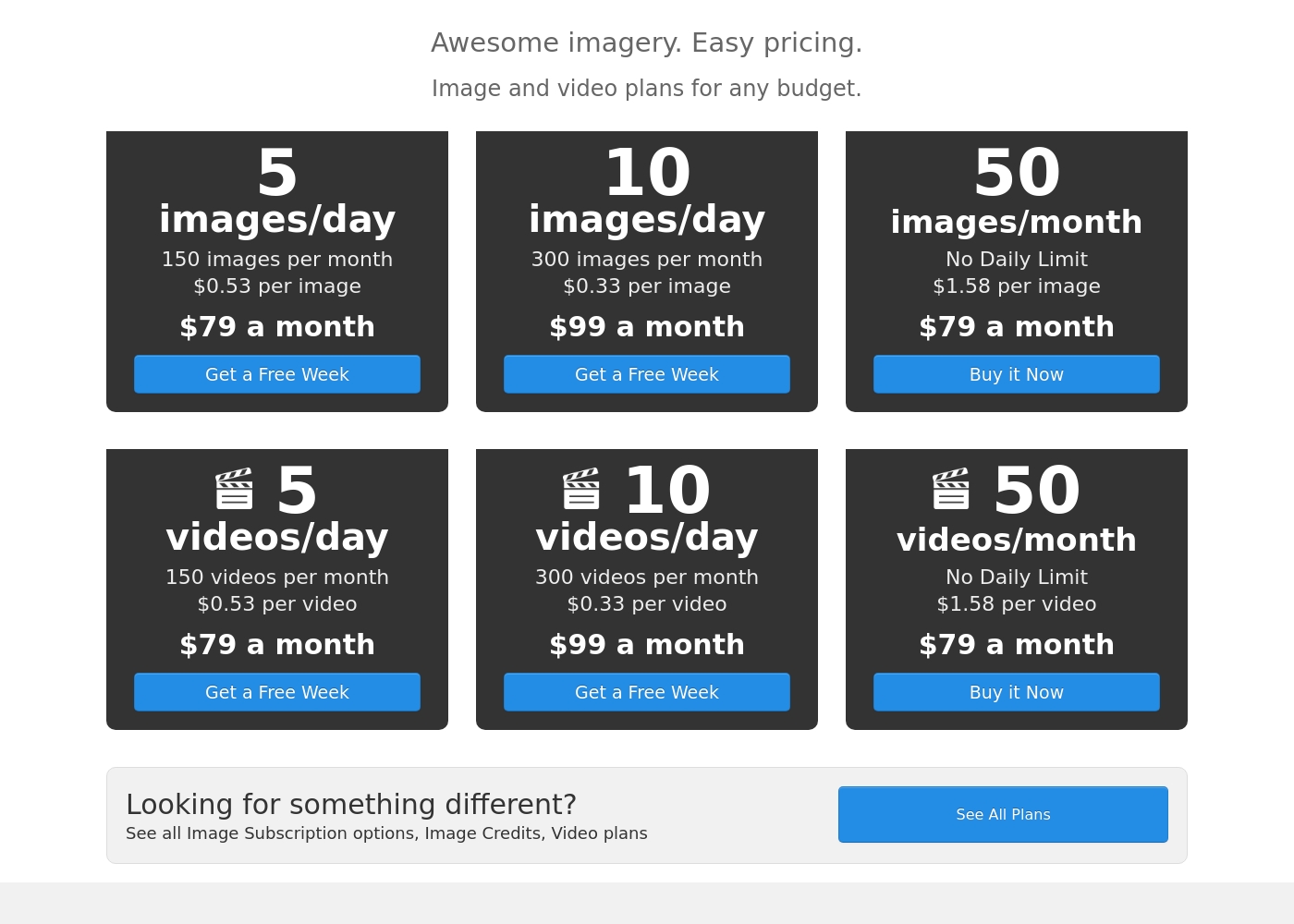
Bigstock costs between $79 and $99 per month with six plans: 5 images/day at $79, 10 images/day at $99, 50 images/month at $79, 5 videos/day at $79, 10 videos/day at $99, and 50 videos/month at $79.
Bigstock provides several popular subscription options tailored for both image and video content creators. These plans are identical in structure and price, letting you select the exact assets you need for your projects.
5 images/day (Most Popular)
Price: $79 a month Best For: Users needing consistent, daily image access Other Features:
- 150 images included per month
- Cost is about $0.53 per image
- Includes a free week trial
- Assets are provided under a royalty-free license
- 150 images per month
- $0.53 per image
- Get a Free Week Trial
- Royalty-free license
- 300 images per month
- $0.33 per image
- Get a Free Week Trial
- Includes vector files (AI or EPS)
- 50 images per month
- $1.58 per image
- No Daily Limit applies
- All sizes included (JPG, Vectors)
- 150 videos per month
- $0.53 per video
- Get a Free Week Trial
- Royalty-free license
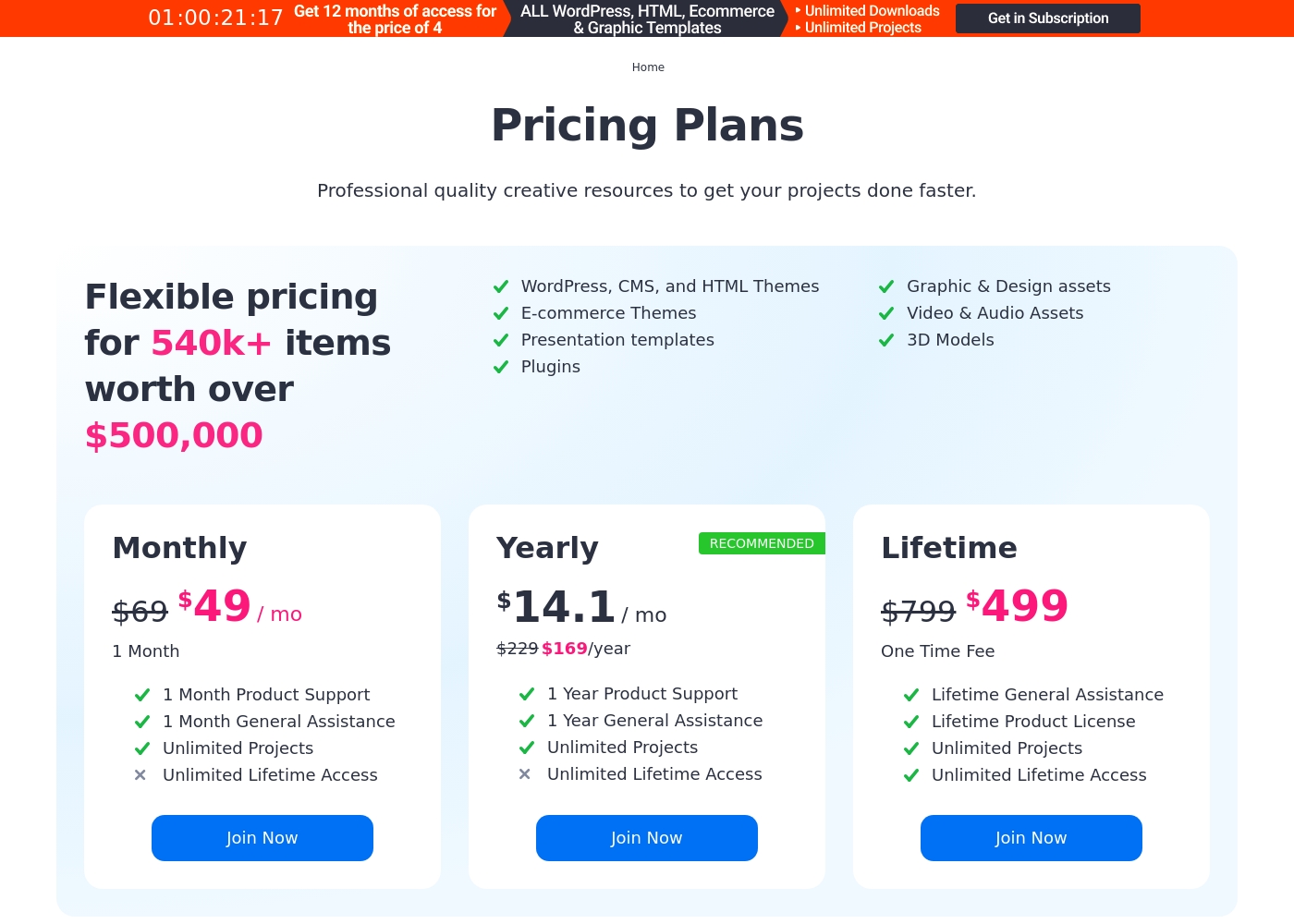
Monster One pricing: Monster One offers flexible subscription plans starting at $14.1/month (billed annually). You can choose between monthly, yearly, or lifetime access to over 540,000 creative assets and themes with unlimited downloads for your projects.
All plans include product support and a simple licensing model to help you build websites faster and more efficiently. You can cancel your subscription anytime and take advantage of a 14-day money-back guarantee if you haven't downloaded any items yet.
This straightforward pricing ensures you have the tools you need for any project without hidden costs or complex restrictions. Explore the right plan for your professional creative needs today and start building amazing websites with ease.
Pricing Notes
- Monster One offers a Lifetime payment option ($499), securing permanent access, a feature Bigstock lacks completely.
- The cheapest entry point is Monster One’s Yearly plan, which works out to about $14/month total.
- Bigstock tiers are based strictly on consumption volume (up to 300 assets/month) costing $79 to $99 monthly.
- Bigstock offers a true 7-day free trial; Monster One’s 14-day money-back guarantee is void if you download any assets.
Pricing Head-to-Head
User Reviews
Bigstock holds a 3.5-star average on Trustpilot, but the user feedback is heavily polarized. A primary concern revolves around the cancellation process and billing accuracy, especially related to the 7-day free trial.
Many users report being charged the $79 monthly subscription even after canceling immediately or weeks in advance, leading to unexpected recurring charges for months. Reports of subsequent refusal to refund, often citing strict non-refundable terms, are common.
I thought I didn't cancel my free trial correctly and expected to be charged. I contacted them, and they immediately promised a full refund even though it was my fault. I was relieved and grateful for their quick service resolution.
Our Verdict
Choosing between Bigstock and Monster One is actually very simple: they serve fundamentally different creative professionals. Bigstock is strictly for pure visual media consumption, while Monster One is an entire web creation ecosystem. If your primary need is consistently filling blog posts and social media with unlimited stock images and videos, choose Bigstock. Bigstock excels at providing specialized, licensed, royalty-free stock media volume quickly. You can get 300 assets monthly for just $99, optimizing your cost per image for production needs. They uniquely offer a legitimate 7-day free trial to test asset quality first. However, potential buyers must exercise extreme caution tracking Bigstock’s highly criticized cancellation and billing policies. Monster One’s 547,400+ asset library is vastly broader, including over 9,160 WordPress themes and plugins. The unlimited projects license is invaluable for professional agencies and busy freelancers. Crucially, you can secure permanent access to these resources with the valuable $499 Lifetime plan, a feature Bigstock does not match. The deciding factor depends entirely on your product needs. If your work requires infrastructure—templates for PowerPoint, Shopify, or WordPress—Monster One wins easily. If you only need visual library depth and can handle Bigstock's billing risk, Bigstock specializes in that area. For maximum utility and value across design, web, and media creation, Monster One is the stronger overall investment.
Frequently Asked Questions
Which platform is better for web developers and designers: Bigstock or Monster One?
Monster One is explicitly superior for web development and design professionals. It includes over 9,160 WordPress themes and plugins. Bigstock offers no structural web assets, focusing only on photos and videos.
Does Bigstock offer a Lifetime purchase option like Monster One?
No, Bigstock only provides flexible tiered monthly subscriptions between $79 and $99. Monster One offers a $499 one-time payment for permanent, Lifetime access to its entire library.
Can I use assets from Monster One on unlimited client projects?
Yes, Monster One allows users to utilize assets across an unlimited number of client projects. Bigstock licenses are based on strict daily or monthly download limits.
Which service provides a real free trial before charging my card?
Bigstock provides a true 7-day free trial so you can download assets and test quality first. Monster One requires payment upfront; its refund is void if you download any product.
Is Bigstock a better value for high-volume stock image downloading?
Bigstock is specialized for stock image consumption, selling 300 images for $99. However, Monster One's yearly plan is only $14/month and includes unlimited downloads of graphic assets.
What are the major user concerns about unauthorized charges?
Bigstock has widespread user complaints alleging unauthorized monthly charges after canceling a free trial. Users report difficulty getting refunds and unresponsive support. Monster One does not share these severe public billing complaints.
Ready to Choose?
Both tools have their strengths. Choose based on your specific needs.