Bigstock vs Getty Images
Bigstock and Getty Images target wildly different stock photo markets and budgets. Bigstock is perfect for high-volume, budget-conscious users seeking consistent, affordable downloads. Getty Images provides unmatched professional exclusivity and critical editorial coverage at a premium price.
Best for: Budget-focused agencies needing 150-300 images per month consistently, Small businesses or bloggers prioritizing high-volume, affordable stock content
Best for: Major media outlets requiring immediate, exclusive editorial and news coverage, Large marketing firms demanding highly exclusive creative assets for brand campaigns
Affordable stock media with highly flexible plans.
We found that Bigstock offers competitive tiered pricing and flexible daily or monthly subscription models for both images and videos. Overall, users praise the selection and value, but we noticed serious, recurring concerns about confusing cancellation processes and unresponsive customer support that potential buyers must carefully review.
Pros
- Massive library of royalty-free images, vectors, and videos.
- Flexible pricing plans ($79–$99 per month) with daily or monthly limits.
- Offers high-value plans, reducing the cost per asset to $0.33.
- Includes vectors (AI or EPS) in high-volume subscription tiers.
Cons
- Frequent, severe complaints about unauthorized charges post-free trial cancellation.
- Customer support is often unresponsive to billing inquiries and refund requests.
- Users report difficulty logging in or accessing accounts to cancel memberships.
- Support frequently refuses refunds, citing non-refundable terms of service.
Premium content, unacceptable customer practices.
We recognize Getty Images provides an unmatched library of exclusive editorial and creative assets, including modern AI features and flexible UltraPacks. However, we must heavily weigh the severe and consistent external complaints regarding billing dishonesty and non-existent customer support. Overall, the significant risk of billing issues and the failure to resolve customer concerns prevent us from recommending this platform despite its high-quality content.
Pros
- Access to exclusive creative photos, videos, and vectors unavailable elsewhere.
- Comprehensive editorial coverage across global news, sports, and entertainment.
- Ability to use Generative AI tools for commercially safe content creation.
- UltraPacks offer flexible, one-time credit bundles for versatile licensing.
Cons
- Extremely poor customer service responsiveness that fails to resolve disputes.
- Higher per-download prices ($130–$499) compared to standard stock photo sites.
- Reports of double-billing and failure to issue refunds for purchased assets or credits.
- Allegations of deceptive subscription renewal practices with complex cancellation requirements.
AboutBigstock
Bigstock offers a wide library of Stock Photos, Images, Vectors, Stock Videos, and Footage. It's designed to provide "Images and Video for everyone." They focus on providing royalty-free media across a stunning array of top categories. This gives you plenty of legally safe options for any visual project you might be tackling. 💡
AboutGetty Images
Getty Images acts as your global resource for impactful visual content. You gain access to a massive library covering everything from creative stock art to up-to-the-minute editorial needs.
They provide royalty-free images, high-definition videos, illustrations, and vectors across all popular categories. You can also explore Getty Images Music, powered by Triple Scoop Music, for comprehensive audio and sound effects. Professionals rely on this service to access iconic moments and trending visuals that leave a lasting impact. 💡
Highlights
Feature Comparison
Features Overview
We highlight the main differences and pick a winner for each feature.
Pricing & Value
Bigstock offers high-volume subscriptions under $100; Getty Images charges $130-$499 per single download.
Bigstock provides value subscriptions, like 300 images per month for $99, reducing the cost to just $0.33 per asset. This is optimal for users needing huge volumes of reliable, royalty-free content consistently. Bigstock guarantees royalty-free usage across all their varied media types. Getty Images employs an UltraPack system where costs are based on volume and size; a large image can cost up to $499 individually. Even buying in bulk, the cheapest image (small) sits at $130, making Getty Images extremely costly. The trade-off is volume versus uniqueness; Bigstock sacrifices exclusivity for cost-effectiveness. Getty Images prices reflect its premium and exclusive content library. If volume matters most, Bigstock is drastically cheaper. A small business needing 50 images monthly would pay $79 with Bigstock. They might pay over $6,500 using comparable UltraPacks from Getty Images.
Content Exclusivity
Getty Images ensures highly unique assets; Bigstock content is widely available across many platforms.
Bigstock relies on a massive standard library, focusing on providing reliable, royalty-free media across trending categories. The content is designed for consistent, high-volume operational needs for budget users. Getty Images’ core value is its unmatched exclusivity, ensuring millions of creative photos, videos, and vectors are unique to their platform. This content minimizes the chance of seeing your visuals used elsewhere. Getty Images wins easily because its content is specifically curated to be unique, offering a true competitive content advantage. Bigstock images are generally available across other stock sites. Marketing agencies use Getty Images to guarantee campaign originality. Budget users choose Bigstock knowing their visuals might be common.
Editorial Coverage
Getty Images is the global leader for news media; Bigstock does not provide any live editorial content.
Bigstock focuses exclusively on royalty-free creative stock assets, supporting general business and marketing needs with photos and videos. It does not provide breaking news or specialized media coverage. Getty Images is the industry standard for editorial content, covering global news, sports, and entertainment events immediately. It also holds the world's largest digital historical archive. For publishers or major news organizations requiring journalistic content, Getty Images is essential. Bigstock cannot compete in this crucial, specialized arena. A media company reporting breaking news must use Getty Images for timely, exclusive visuals. A small marketer can use Bigstock for general hero images.
Generative AI Tools
Getty Images offers commercially safe AI creation tools; Bigstock does not offer creation or modification features.
Bigstock does not currently list any features involving generative artificial intelligence for content creation or automated modification. Its platform focuses solely on licensing pre-existing media assets. Getty Images offers a robust Generative AI solution, allowing users to create commercially safe, ready-to-license assets from simple text prompts. You can also modify existing images quickly. Getty Images incorporates advanced technology for content customization and generation in-house. This gives its users powerful creative capabilities that Bigstock currently lacks. Designers can instantly modify or create unique visuals using Getty Images' AI tools, saving considerable search time compared to Bigstock.
DAM & Asset Management
Getty Images provides a specialized DAM system; Bigstock offers only basic personal account portals.
Bigstock provides standard account settings to manage subscription changes and view simple download histories. These controls are sufficient for single users or small teams with low organizational needs. Getty Images offers the professional Media Manager system, a best-in-class tool for large organizations. This tool organizes, controls, and efficiently distributes licensed content across global teams. For enterprise clients, the integrated Digital Asset Management provided by Getty Images is a substantial operational platform. Bigstock is not designed for organization-wide asset control. A large company using Getty Images Media Manager avoids buying the same license multiple times across departments, reducing legal risk.
Billing Transparency
Both platforms face severe user complaints regarding billing practices, refunds, and high-friction cancellation processes.
Bigstock offers clear monthly subscription costs but faces frequent complaints about charges post-free-trial cancellation. Users often report unresponsive support when trying to seek refunds after being charged. Getty Images users complain broadly about opaque UltraPack billing, unexpected double-charges, and immediate loss of credits upon cancellation. Their pricing structure is high-cost and complex. While the root causes differ (trial vs. UltraPack), the overall user sentiment is strongly negative for both tools concerning financial ethics and refund processing. Customers must be meticulous with their records and cancellation documentation regardless of whether they choose Bigstock or Getty Images.
Support and Service
Bigstock lists structured weekday support; Getty Images customer service is widely reported as non-existent and failing.
Bigstock guarantees customer support operating hours from Monday through Friday, 9 am to 5 pm EST. This provides a clear, defined pathway for users seeking general account or license assistance. Getty Images receives overwhelming condemnation for its support response, with users reporting unanswered emails and inability to resolve crucial billing disputes. Customers often resort to credit card chargebacks. Bigstock's structured, though sometimes slow service is far more functional than the service failures reported by the majority of Getty Images users. Bigstock is the safer bet for reliable help. If you encounter a billing error, Bigstock provides an accessible contact window; Getty Images might leave the issue unresolved for weeks.
Flexibility of Purchase
Getty Images UltraPacks cater better to project-based, burst usage; Bigstock requires a fixed monthly commitment.
Bigstock operates purely on a subscription model, offering fixed, recurring monthly limits that appeal to consistent content needs. You are locked into paying monthly to retain access to credits. Getty Images UltraPacks are one-time credit bundles that allow mixing all content types, including videos and vectors. These credits can be utilized whenever they are needed, regardless of the month. UltraPacks from Getty Images offer superior flexibility for users with unpredictable content needs because the credits do not expire monthly. No forced recurring payments are required. A project-based designer prefers Getty Images UltraPacks for occasional high demand. A content writer prefers Bigstock’s predictable monthly subscription cost.
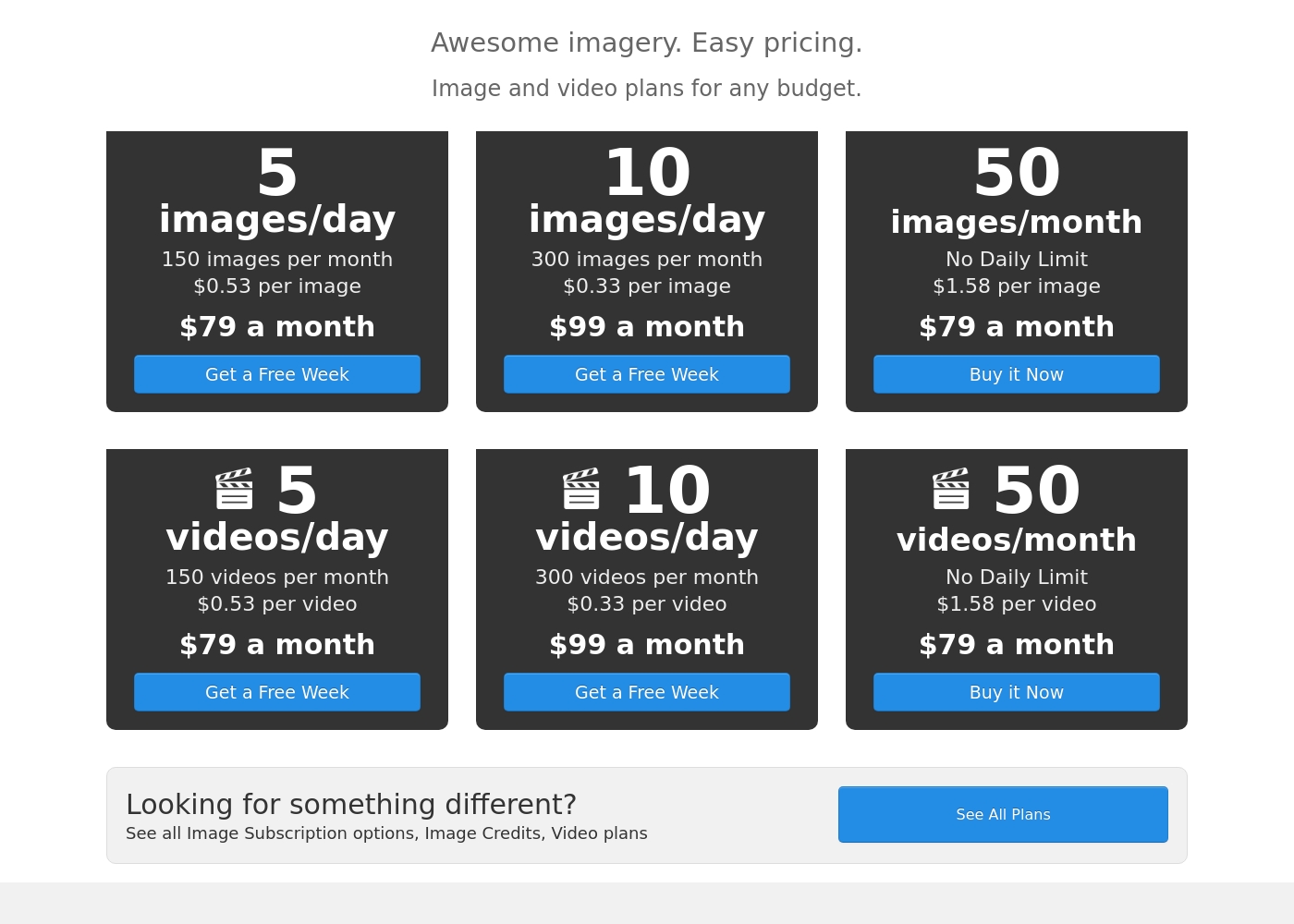
Bigstock costs between $79 and $99 per month with six plans: 5 images/day at $79, 10 images/day at $99, 50 images/month at $79, 5 videos/day at $79, 10 videos/day at $99, and 50 videos/month at $79.
Bigstock provides several popular subscription options tailored for both image and video content creators. These plans are identical in structure and price, letting you select the exact assets you need for your projects.
5 images/day (Most Popular)
Price: $79 a month Best For: Users needing consistent, daily image access Other Features:
- 150 images included per month
- Cost is about $0.53 per image
- Includes a free week trial
- Assets are provided under a royalty-free license
- 150 images per month
- $0.53 per image
- Get a Free Week Trial
- Royalty-free license
- 300 images per month
- $0.33 per image
- Get a Free Week Trial
- Includes vector files (AI or EPS)
- 50 images per month
- $1.58 per image
- No Daily Limit applies
- All sizes included (JPG, Vectors)
- 150 videos per month
- $0.53 per video
- Get a Free Week Trial
- Royalty-free license
Getty Images costs between $130 and $499 per download when purchasing UltraPacks, offering nine specific pack sizes across three image sizes: Small, Medium, and Large.
These UltraPacks let you mix and match royalty-free images, videos, and certain editorial content. Buying in bulk helps you achieve substantial savings on your per-download cost. You choose the resolution level that meets your project needs.
Large Images, 4K and HD Videos UltraPacks
Price: $499 per download (single) down to $300 per download (15-pack) Best For: High-resolution requirements like large print or premium video production. Other Features:
- Single download price is $499
- 5-pack cost is $1,750 total ($350 per download)
- 15-pack cost is $4,500 total ($300 per download)
- 1 download included
- Large creative images, 4K and HD videos
- 5 downloads included
- Price equivalent to $1,750 total
- Large creative images, 4K and HD videos
- 10 downloads included
- Price equivalent to $3,300 total
- Large creative images, 4K and HD videos
- 15 downloads included
- Price equivalent to $4,500 total
- Large creative images, 4K and HD videos
Pricing Notes
- Bigstock provides exceptional value, with bulk pricing down to $0.33 per asset for high-volume content creators.
- Getty Images UltraPacks remain drastically more expensive, with the cheapest asset costing $130 even when bought in bulk.
- Bigstock offers a lower financial barrier to entry with its monthly subscription model, compared to high-cost Getty Images UltraPack purchases.
- Be warned: users of both services report serious difficulties regarding subscription cancellation and obtaining refunds for unexpected or erroneous charges.
- Getty Images also offers Enterprise Premium Access plans for large organizations requiring annual commitments.
Pricing Head-to-Head
User Reviews
Bigstock holds a 3.5-star average on Trustpilot, but the user feedback is heavily polarized. A primary concern revolves around the cancellation process and billing accuracy, especially related to the 7-day free trial.
Many users report being charged the $79 monthly subscription even after canceling immediately or weeks in advance, leading to unexpected recurring charges for months. Reports of subsequent refusal to refund, often citing strict non-refundable terms, are common.
I thought I didn't cancel my free trial correctly and expected to be charged. I contacted them, and they immediately promised a full refund even though it was my fault. I was relieved and grateful for their quick service resolution.
Getty Images receives exceptionally poor feedback across Trustpilot, holding a critical 1.3-star “Bad” rating based on over 100 reviews. The sentiment is almost universally negative, focusing heavily on billing practices and non-existent customer support. Users frequently report being charged twice for single images or losing credits immediately upon cancellation, stating the company often refused refunds, even for unused assets. Support responsiveness is described as "terrible" and "non-existent."
Pricing is consistently labeled as economic "highway robbery," with examples citing individual images that cost hundreds of dollars more than similar stock libraries. Customers also complain of deceptive subscription practices, noting there is no functional cancellation option on the website. Furthermore, contributing artists express major frustrations regarding extremely low royalty rates (15–20%) and a systemic lack of respect or communication. For these reasons, reliability and ethical business practice failures dominate the user experience narrative. 🚩
We bought one image for $499 but were charged twice on our card. After nearly a month and several emails, we received no refund and couldn't resolve the billing error with staff. Our credit card company thankfully overturned the unwarranted charges.
Our Verdict
Bigstock and Getty Images cater to extremely different markets; your choice depends entirely on budget and content needs. If you prioritize maximum volume and the lowest cost per image, Bigstock is the clear, practical winner for most users. For professional-grade content consistency and savings, Bigstock is undeniably effective. Bigstock’s superpower is affordable, high-volume access under a simple monthly subscription model. You can get up to 300 assets monthly for just $99, achieving unparalleled cost efficiency. Bigstock includes a crucial free 7-day trial to review the library before any fee is charged. Use Bigstock if your main goal is consistently feeding a high-volume blog or social media calendar. Getty Images’ superpower is unrivaled exclusivity, essential editorial coverage, and advanced technology integration. It features unique creative collections, up-to-the-minute news photos, and powerful Generative AI tools for creation. If your brand absolutely must use unique visuals without generic repeats, Getty Images delivers the required premium content. The deciding factor is exclusivity and specialized content versus pure volume. If you need breaking global news or the integrated Media Manager DAM system, only Getty Images is suitable, despite the premium. However, if you need hundreds of good, reliable, royalty-free images for marketing, Bigstock is far more affordable. Start with Bigstock for incredible savings and volume, but carefully track its free trial renewal date. Only switch to Getty Images if you need its specific, high-end editorial, AI, or advanced asset management capabilities for enterprise use.
Frequently Asked Questions
Which is better for small teams: Bigstock or Getty Images?
Bigstock is better for small teams due to its low-cost subscription model and high-volume limits. Getty Images’ high per-download cost is often prohibitive for small or budget-conscious organizations. Bigstock also offers a structured support channel if issues arise.
Can I find vectors (AI/EPS) on both Bigstock and Getty Images?
Yes, both platforms offer access to vector files for use in graphic design projects. Bigstock includes vectors in its highest-volume subscription plan. Getty Images includes vector downloads via its flexible UltraPacks.
Is Getty Images worth the extra cost over Bigstock?
Getty Images is worth the cost only if you require exclusive content, essential editorial news coverage, or integrated Generative AI tools. For general marketing, stock photos, and video volume, Bigstock offers significantly better value.
Which tool is better for high-volume content creation?
Bigstock is superior for high-volume needs because the cost per image drops to $0.33 on bulk plans. Getty Images remains very expensive, potentially costing $130-$499 per piece of content. Bigstock offers much better operational cost efficiency.
Does Bigstock have Generative AI like Getty Images?
No, Bigstock does not currently offer Generative AI tools for content creation. Getty Images provides a feature allowing users to create commercially safe and ready-to-license images using text prompts.
Which platform has better user sentiment regarding customer service?
Bigstock has better user sentiment regarding support compared to Getty Images. Bigstock provides specific weekday support hours. Getty Images users frequently report support as non-existent, especially concerning billing disputes and refunds.
Ready to Choose?
Both tools have their strengths. Choose based on your specific needs.