Bigstock vs Dreamstime
Bigstock and Dreamstime are top contenders in the high-volume stock media space. Dreamstime boasts better customer support and advanced AI search tools. Bigstock focuses on offering straightforward, high-value bulk image subscriptions.
Best for: Creators needing predictable, bulk daily image download limits (5 or 10 assets/day)., Users prioritizing the lowest possible cost per image (as low as $0.33) and consistency.
Best for: Agencies or teams requiring multi-seat licenses and managing various media types (photo, video, audio)., Occasional users needing high-quality assets via flexible, one-time credit purchases.
Affordable stock media with highly flexible plans.
We found that Bigstock offers competitive tiered pricing and flexible daily or monthly subscription models for both images and videos. Overall, users praise the selection and value, but we noticed serious, recurring concerns about confusing cancellation processes and unresponsive customer support that potential buyers must carefully review.
Pros
- Massive library of royalty-free images, vectors, and videos.
- Flexible pricing plans ($79–$99 per month) with daily or monthly limits.
- Offers high-value plans, reducing the cost per asset to $0.33.
- Includes vectors (AI or EPS) in high-volume subscription tiers.
Cons
- Frequent, severe complaints about unauthorized charges post-free trial cancellation.
- Customer support is often unresponsive to billing inquiries and refund requests.
- Users report difficulty logging in or accessing accounts to cancel memberships.
- Support frequently refuses refunds, citing non-refundable terms of service.
Great Value with Excellent Support
We found Dreamstime excels in offering a massive asset library paired with highly responsive customer service, often resolving thorny issues like accidental double charges instantly. However, we caution new users about the automatic renewal practices and a growing prevalence of AI-generated images that clutter search results. Overall, the platform delivers strong value for high-volume content creators who prioritize helpful human support.
Pros
- High quality and vast selection of stock photos, videos, and audio.
- Exceptional and responsive customer service that promptly handles refunds.
- Simple and efficient image uploading process for contributors.
- User-friendly platform that is easy for most users to navigate.
Cons
- Subscription system lacks clarity regarding automatic renewals and cancellation.
- High volume of difficult-to-filter, low-quality AI-generated content.
- Search functionality sometimes struggles to return relevant results.
- Photographers report significant recent drops in sales and high payout threshold ($100).
AboutBigstock
Bigstock offers a wide library of Stock Photos, Images, Vectors, Stock Videos, and Footage. It's designed to provide "Images and Video for everyone." They focus on providing royalty-free media across a stunning array of top categories. This gives you plenty of legally safe options for any visual project you might be tackling. 💡
AboutDreamstime
Dreamstime is known as the world's largest stock photography community. It was established in 2000 and has since grown immensely. Talented contributors worldwide enrich the vast collection daily. This resource is perfect for everyone, from large corporations to small magazines and personal blogs. You'll find professional assets regardless of your budget. 💡
Highlights
Feature Comparison
Features Overview
We highlight the main differences and pick a winner for each feature.
Customer Support & Billing
Dreamstime boasts excellent support; Bigstock faces severe recurring billing complaints.
Users consistently struggle with Bigstock's cancellation process after free trials. Complaints allege automatic $79 charges and support refusing refunds, citing strict policy. Dreamstime users praise support for being highly responsive and professional. They often process full refunds efficiently if the downloads remain unused. This is a major difference: Dreamstime provides peace of mind regarding billing issues. If quick issue resolution is crucial, Dreamstime is the clear priority.
Pricing Flexibility
Dreamstime offers credits and cheaper entry plans; Bigstock sticks to fixed bulk subscriptions.
Bigstock's primary focus is fixed monthly subscriptions ranging from $79 to $99. These plans offer high value per image or video download. Dreamstime offers small monthly plans starting at $25, plus one-time credit packages. Credits are valid for an entire year. Dreamstime supports users with occasional needs or very tight budgets more effectively. Bigstock is strictly budget-oriented towards heavy, consistent users. If you only need 5 images a month or want pay-as-you-go, Dreamstime makes more sense.
Technology & Search
Dreamstime uses advanced AI tools to refine search; Bigstock features are more basic.
Bigstock relies on standard search functionality common to most stock libraries for discovery. No advanced features like ML or AI are explicitly marketed. Dreamstime heavily incorporates AI and Machine Learning into its systems. This powers tools like PhotoEye™ and smart keyword suggestions. Dreamstime aims to streamline the creative workflow using modern technological enhancements. Bigstock is strictly a distribution platform. If you need help sifting through millions of images quickly, Dreamstime's AI is a huge advantage.
Media Types & Library Depth
Dreamstime offers a wider range of media types, including audio and editorial content.
Bigstock offers photos, vectors (AI/EPS), and video footage through parallel subscription tracks. It leverages the Shutterstock network. Dreamstime provides photos, vectors, 4K videos, illustrations, and unique audio/sound effects. It also has a dedicated Editorial section. Dreamstime provides a true 'all-in-one' media solution for complex projects. Bigstock primarily focuses on visual assets. Creative professionals needing music or specific event photos will find Dreamstime much more useful.
Download Management
Dreamstime guarantees download rollover; Bigstock uses strict daily limits on many plans.
Bigstock offers plans limited to 5 or 10 downloads daily, which can be restrictive for burst projects. They do offer a flexible 50/month plan. Dreamstime subscriptions feature unused download rollover automatically into the next month. This prevents lost value from slow creation periods. Dreamstime’s rollover feature significantly protects your investment monthly. Bigstock makes you download consistently or pay for the flexible plan. If you have unpredictable monthly usage, Dreamstime ensures you never waste a paid download.
Team Use & Mobile Access
Dreamstime offers specific multi-seat licenses and a mobile app; Bigstock does neither explicitly.
Bigstock's plans are based strictly on download volume, meaning team access must be managed manually. There is no official mobile app listed. Dreamstime provides dedicated Multi-seat licenses starting at $59 per month for teams. They also have an official iOS and Android mobile app. For agencies and larger teams, Dreamstime offers structured management tools. Bigstock is best suited for individual users or small operations. Teams requiring external access or formal user licensing should strongly prefer Dreamstime's features.
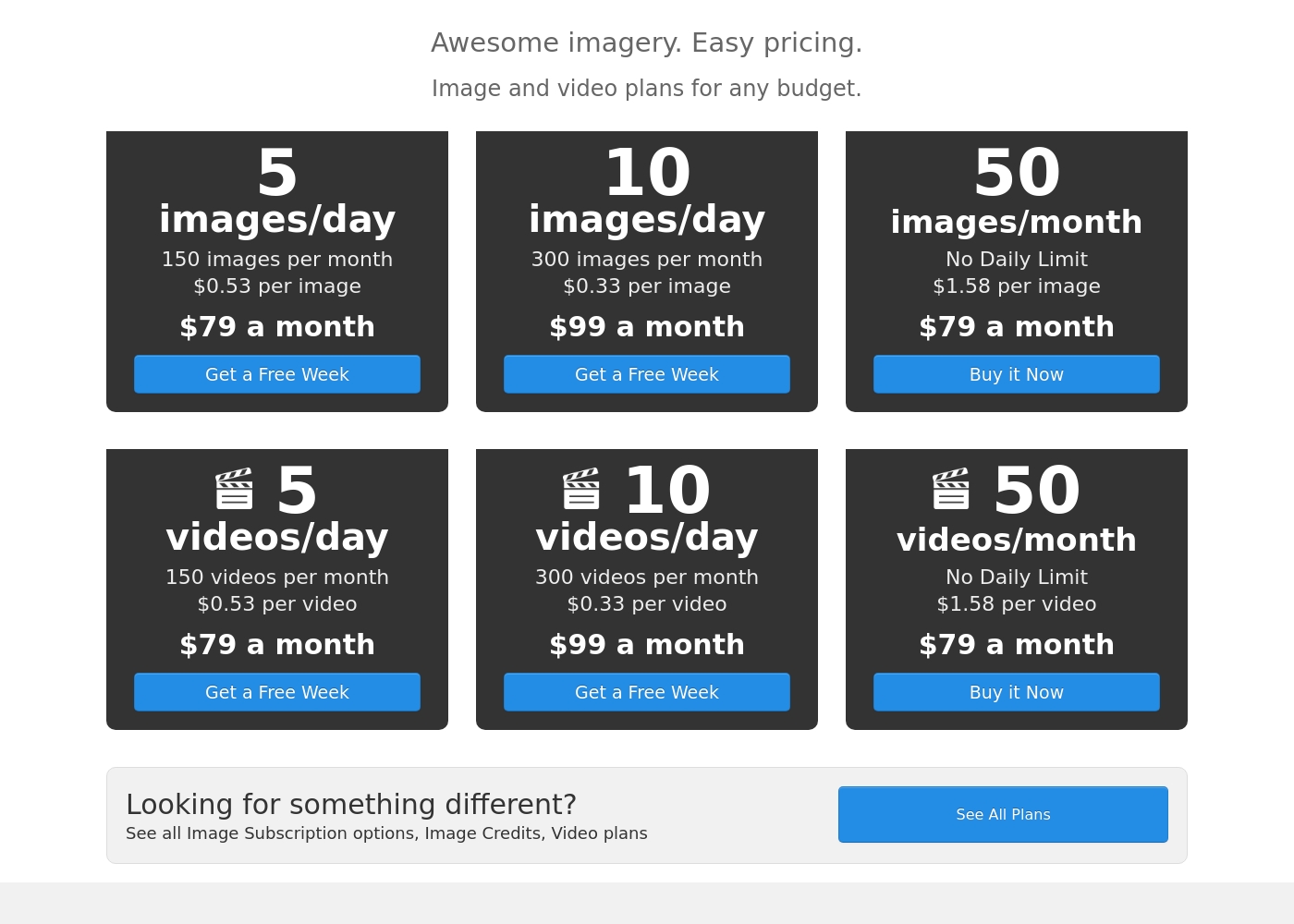
Bigstock costs between $79 and $99 per month with six plans: 5 images/day at $79, 10 images/day at $99, 50 images/month at $79, 5 videos/day at $79, 10 videos/day at $99, and 50 videos/month at $79.
Bigstock provides several popular subscription options tailored for both image and video content creators. These plans are identical in structure and price, letting you select the exact assets you need for your projects.
5 images/day (Most Popular)
Price: $79 a month Best For: Users needing consistent, daily image access Other Features:
- 150 images included per month
- Cost is about $0.53 per image
- Includes a free week trial
- Assets are provided under a royalty-free license
- 150 images per month
- $0.53 per image
- Get a Free Week Trial
- Royalty-free license
- 300 images per month
- $0.33 per image
- Get a Free Week Trial
- Includes vector files (AI or EPS)
- 50 images per month
- $1.58 per image
- No Daily Limit applies
- All sizes included (JPG, Vectors)
- 150 videos per month
- $0.53 per video
- Get a Free Week Trial
- Royalty-free license
Dreamstime costs between $14.99 (one-time) and $219 per month with several plans available: 5 images at $25, 10 images at $39, up to 750 images at $219 per month, or $2,028 billed annually.
Dreamstime offers flexible pricing through credit packages or standard time-based subscriptions. Let's explore the best fit for your content needs.
Credit Packages (Pay per Download)
Price: Starts at $14.99 (for 3 credits) Best For: Users who need images occasionally or high-value media Other Features:
- Credits are the site currency for all downloads.
- Credits are valid for one full year from purchase.
- Use credits for RF, EL images, videos, and professional audio.
- Prices differ depending on media size, level, format, or license.
- Pay per download (using site currency)
- Used for RF, EL images, videos, audio
- Valid for 1 Year
- 5 total downloads per month
- Unused downloads roll over
- Automatic renewal
- Includes lifetime license
- 200 downloads per month
- Unused downloads roll over
- Includes lifetime license and unlimited online usage
- Gives unlimited printed and electronic copies
- 750 downloads per month
- Automatic renewal
- Downloads roll over
- Includes lifetime license and unlimited online usage
Pricing Notes
- Bigstock provides high-volume plans ($79-$99) offering a low cost per asset (as low as $0.33 per download).
- Dreamstime offers a much cheaper entry point ($25/mo) and flexible credit purchases for low usage.
- Bigstock billing attempts three days before renewal; users report difficulty cancelling free trials without incurring charges.
- Dreamstime offers significant savings on its large annual commitment (750 images/month plan at $2,028/year).
- The unique Dreamstime Zero Gravity plan offers unlimited downloads from highly specific, newer collections for $40/month.
Pricing Head-to-Head
User Reviews
Bigstock holds a 3.5-star average on Trustpilot, but the user feedback is heavily polarized. A primary concern revolves around the cancellation process and billing accuracy, especially related to the 7-day free trial.
Many users report being charged the $79 monthly subscription even after canceling immediately or weeks in advance, leading to unexpected recurring charges for months. Reports of subsequent refusal to refund, often citing strict non-refundable terms, are common.
I thought I didn't cancel my free trial correctly and expected to be charged. I contacted them, and they immediately promised a full refund even though it was my fault. I was relieved and grateful for their quick service resolution.
Dreamstime generally receives positive feedback from its large user base, scoring a 3.6/5 on Trustpilot. Customers frequently praise the high quality of the images available and the platform's user-friendly nature, noting that uploading and navigating the site is straightforward and easy.
Exceptional customer support is a standout feature; reviewers often highlight the staff's professionalism, quick response times, and efficiency in handling issues like accidental double billing or subscription problems. Contributors enjoy the strong sense of community and the fast approval process for their work.
I accidentally upgraded my free trial and was charged immediately. Dreamstime customer service efficiently processed my cancellation and provided a full refund quickly since I hadn't used any downloads. I really appreciate their prompt support!
Our Verdict
Choosing between Bigstock and Dreamstime comes down to trust, flexibility, and required features. Dreamstime is the safer, more robust choice for most creatives today. Bigstock offers incredible bulk value, but its serious billing complaints are a major drawback. Bigstock’s superpower is affordable, high-volume daily downloads for core image users. Plans start at $79, sinking the cost per asset very low for heavy users. If your needs are strictly consistent, cheap daily image consumption, Bigstock offers excellent pricing. Dreamstime excels by providing comprehensive media types, including video, audio, and editorial content. Their use of AI in search streamlines discovery significantly. Most importantly, Dreamstime has highly responsive customer support and offers credit packages for maximum flexibility. The deciding factor should be customer support and billing management. Dreamstime ensures easy refunds and manages automatic renewals professionally. Bigstock users frequently report unauthorized charges and difficulty getting assistance or refunds. For large teams or anyone needing flexible pricing and reliable service, choose Dreamstime. If you only need cheap, high-volume image subscriptions and accept the risk of poor customer service, Bigstock might save you a few dollars monthly.
Frequently Asked Questions
Which stock service is better for flexible, occasional users: Bigstock or Dreamstime?
Dreamstime is much better for occasional users because they offer credit packages. These credits are valid for a full year, letting you buy assets when needed. Bigstock only offers monthly subscriptions starting at $79, which is too much for light users.
Does Bigstock offer rollover if I don't use all my monthly downloads?
Bigstock does not explicitly state that unused downloads roll over between months. Dreamstime, conversely, guarantees automatic rollover on standard subscriptions. This ensures you maintain the value of your monthly payment with Dreamstime.
Which platform has better customer service for billing issues?
Dreamstime is the clear winner for customer service and billing reliability. Reviews confirm their support team quickly and professionally handles refunds and accidental charges. Bigstock has historically received severe and frequent consumer complaints regarding billing and free trial cancellations.
Can I download audio and sound effects from Bigstock or Dreamstime?
You can download audio clips and sound effects only from Dreamstime, alongside photos and videos. Bigstock focuses exclusively on visual assets like photos, vectors, and video footage. Dreamstime is superior for multimedia project creation.
Which service is best for agencies needing multiple users?
Dreamstime is more suitable for agencies because it offers dedicated Multi-seat licenses starting at $59 per month. Bigstock operates on a strict download volume model without explicit team management features. Dreamstime scales better for organizations.
Does Dreamstime offer something similar to the daily download limits Bigstock has?
Dreamstime generally uses monthly allocations without strict daily caps, which offers more flexibility. Bigstock offers popular plans restricted to 5 or 10 downloads per day. Dreamstime allows you to use your monthly quota whenever you need it.
Ready to Choose?
Both tools have their strengths. Choose based on your specific needs.