BidX vs Volza
BidX and Volza serve very different markets. BidX is for Amazon PPC ads, while Volza provides global trade data. The choice depends on whether you need to scale Amazon ads or find international buyers.
Best for: Amazon sellers managing $10k+/month in ad spend, Brands wanting to automate PPC campaigns and save 14+ hours weekly
Best for: Exporters finding verified buyers in 203 countries, Importers building reliable supply chains with real shipment data
Powerful Amazon PPC automation for scaling brands.
BidX is a robust, AI-driven platform that delivers significant time savings and performance gains for Amazon advertisers. We found its full-funnel automation and proven results compelling. Overall, it's a strong choice for brands ready to invest in scaling their Amazon PPC efficiently, though the annual commitment is a key consideration.
Pros
- Dramatic time savings, creating campaigns up to 12x faster.
- Proven performance metrics: 36% ROAS lift and 43% sales growth.
- Full-funnel management covering search, display, and video ads.
- Flexible usage: self-service or managed service options.
Cons
- Pricing is opaque, requiring direct contact for quotes.
- Requires an annual contract with monthly payments.
- No free trial is explicitly offered, only a proof-of-concept period.
- Base costs start high (from €495/month) plus a spend percentage.
Solid data core, review access blocked.
We found Volza to be a comprehensive platform offering verified global trade data and contact details, backed by a money-back guarantee. However, our independent review is significantly limited by the inability to access any user reviews from Trustpilot or Capterra, preventing a full assessment of real-world sentiment on support, pricing, and ease of use.
Pros
- Offers verified contact details for decision-makers.
- Covers a vast database of 203 countries.
- Provides a 100% money-back guarantee.
- Features ready-to-use dashboards for analysis.
Cons
- Actual user feedback could not be retrieved for review.
- Specific pricing details are not publicly listed.
- The true value proposition remains unverified by external reviews.
AboutBidX
BidX is a marketplace growth platform built for brands and agencies selling on Amazon. ✨ It provides full-funnel advertising software to manage everything from search ads to display and video campaigns. The platform uses AI and automation to handle the complex work, so you can focus on strategy. It's designed for sellers and marketers who want better results with less manual effort.
AboutVolza
Volza is the world's leading trade data platform. 🌍 It offers a massive, continuously updated database of global import and export shipments. Designed for exporters, importers, and trade analysts, it transforms raw shipment records into actionable business intelligence. Think of it as your personal detective for international commerce.
Highlights
Feature Comparison
Features Overview
We highlight the main differences and pick a winner for each feature.
Core Purpose
BidX automates Amazon ads, while Volza provides global trade intelligence. They serve completely different needs.
BidX is an Amazon growth platform. It manages PPC, DSP, and AMC campaigns. It uses AI to save you up to 14 hours per week. Volza is a trade data platform. It covers 203 countries with over 3 billion shipment records. It helps you find buyers and suppliers. The key difference is focus. BidX optimizes Amazon ad performance. Volza uncovers global trade opportunities. For example, BidX could boost your Amazon ROAS by 36% in 6 weeks. Volza could help you find a new buyer in Germany with verified contact info.
Data Accuracy
Volza promises legal-grade accuracy. BidX focuses on Amazon ad performance metrics.
BidX tracks Amazon ad metrics like ROAS and sales lift. It integrates with Amazon APIs for reliable campaign data. Volza claims legal-grade accuracy for trade data. Its records are trusted in courts. It has a 30-year refinement history. The trade-off is trust type. BidX gives you Amazon-specific accuracy. Volza provides legally admissible trade data. If you need to prove import history to a partner, Volza's data is stronger. If you need to prove ad ROI, BidX is the right tool.
Automation & AI
BidX has strong AI automation. Volza relies on advanced search filters and dashboards.
BidX uses AI to create campaigns 12x faster than manual work. It automates keyword bidding and optimization. Volza offers advanced filters and pre-built dashboards. You can search 3 billion records quickly. But it doesn't automate tasks like BidX. The difference is active vs. passive help. BidX actively manages your ads. Volza gives you tools to analyze data. If you want to 'set it and forget it,' BidX is better. If you want to dive into data yourself, Volza is more suitable.
Customer Support
Volza offers 24/7 support. BidX provides phone and email support during business hours.
BidX has phone and email support from 10am to 5pm, Monday to Friday. It includes complimentary onboarding. Volza claims 'fanatical' 24/7 support. It has a dedicated Customer Success Team. Response times aren't specified. The key difference is availability. Volza is always on. BidX has limited hours. If you work late nights or need instant help, Volza's 24/7 support is a big advantage. BidX's support is more traditional.
Pricing Transparency
Both have unclear pricing. BidX starts at €495/month. Volza's costs aren't public.
BidX pricing starts at €495 per month plus a percentage of ad spend. It requires an annual commitment. Additional features like AMC reports cost extra. Volza's pricing is not publicly listed. It offers a free trial and a money-back guarantee. It may use subscription or usage-based models. The similarity is opacity. Neither tool shows clear, upfront pricing. If you prefer to know costs before contacting sales, both are frustrating. Volza's free trial lets you explore first.
Trial & Guarantees
Volza offers a free trial and money-back guarantee. BidX has a proof-of-concept period.
BidX doesn't have a free trial. New customers can start with a three-month proof-of-concept period. It's not a full trial. Volza offers a free trial to explore its data. It also has a 100% money-back guarantee. It has a no double-charge policy for downloads. The difference is risk. Volza lets you try before you buy with a safety net. BidX's POC is more of a commitment. If you want zero risk, Volza is better. If you're ready to commit to Amazon ads, BidX's POC works.
Industry Fit
BidX fits Amazon sellers and agencies. Volza fits exporters, importers, and trade analysts.
BidX is for brands and agencies selling on Amazon. It supports brands with 5-500+ employees. It handles ad spend from thousands to millions. Volza is for exporters, importers, and trade analysts. It serves 1 million+ users. It's used by top consulting firms. The difference is business type. BidX is for e-commerce on Amazon. Volza is for international trade. If you sell on Amazon, BidX is tailored to you. If you source or sell globally, Volza is the right fit.
Integration Ecosystem
BidX integrates with Amazon APIs. Volza's integrations aren't specified.
BidX connects to Amazon Advertising and Selling Partner APIs. It supports Amazon PPC, DSP, and AMC. It mentions external traffic channels but doesn't list third-party tools. Volza's integrations aren't detailed on its homepage. It likely focuses on its own data platform. It may integrate with CRM or ERP systems. The key difference is specificity. BidX has clear Amazon integrations. Volza's integrations are unclear. If you need Amazon-specific connections, BidX is better. For general business software, Volza might offer more, but details are missing.
Mobile Experience
Neither tool emphasizes mobile experience in the provided data.
BidX's JSON doesn't mention mobile features. It likely focuses on web-based management. The platform is for Amazon ad optimization. Volza's JSON doesn't mention mobile either. It's a data platform for trade intelligence. It may have a web interface. The similarity is lack of mobile focus. Both tools appear to be desktop-first. If you need a strong mobile app, neither tool seems to offer one based on the data.
Scalability
BidX scales with ad spend. Volza scales with global data coverage.
BidX is designed to scale with your Amazon business. It doesn't list limits on ad spend or campaigns. It manages $300M in ad spend globally. Volza handles billions of records and millions of users. It covers 203 countries. It's built for high-volume trade data. The difference is what scales. BidX scales your ad operations. Volza scales your market reach. If your Amazon sales grow, BidX grows with you. If you expand to new countries, Volza provides the data.
Value for Money
BidX has high base costs but proven ROAS lift. Volza's value is in data accuracy and guarantees.
BidX costs €495–€4,995/month plus ad spend percentage. Users report 36% ROAS lift and 43% sales growth. It saves 14+ hours weekly. Volza's pricing isn't listed, but it offers a money-back guarantee and free trial. It provides verified contacts across 203 countries. The value depends on your needs. BidX offers measurable Amazon performance gains. Volza offers risk-free access to trade data. For Amazon sellers, BidX's ROI is proven. For trade professionals, Volza's data is valuable.
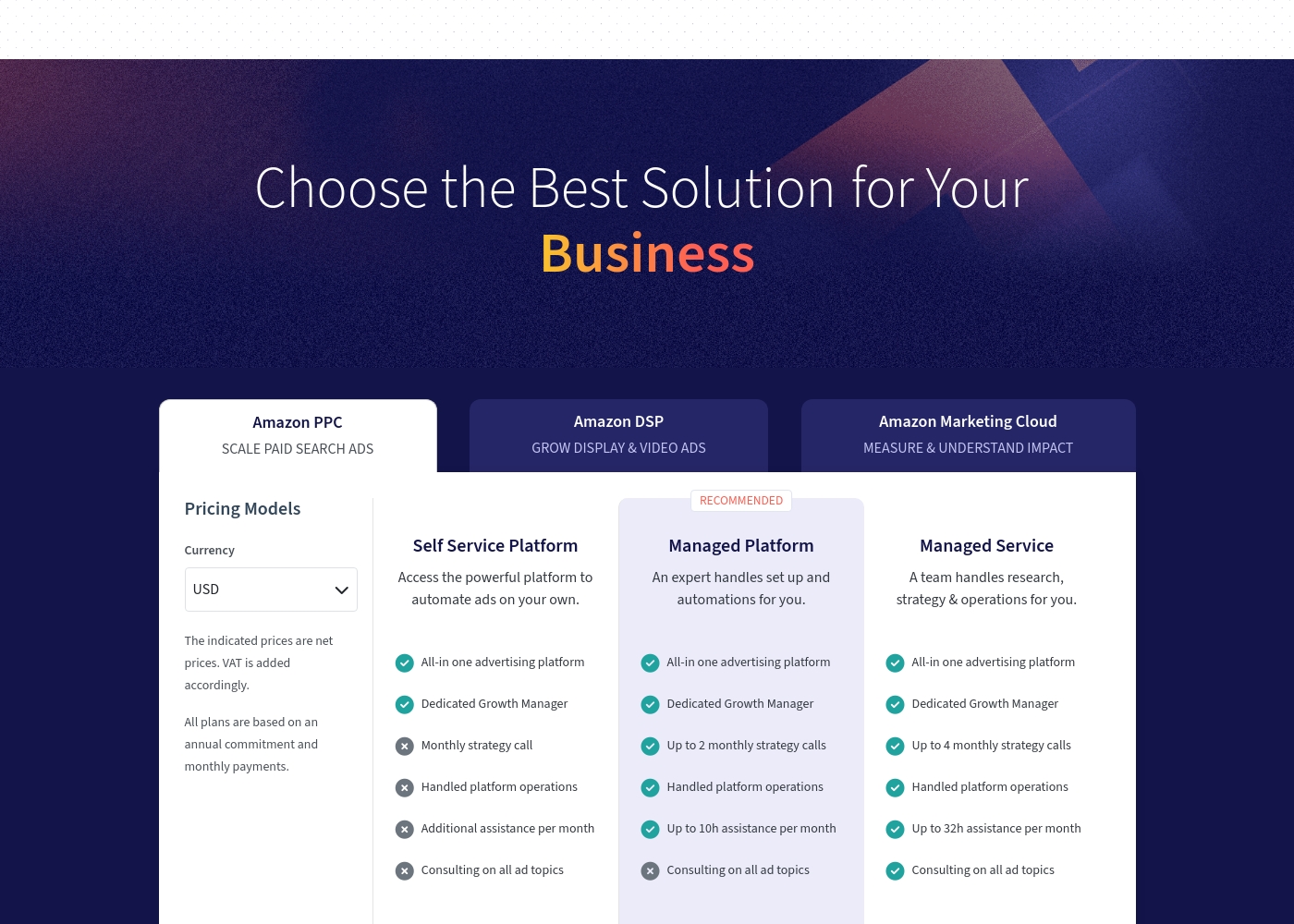
BidX pricing: BidX costs between 495 € and 4.995 € per month plus a percentage of connected ad spend. All plans require an annual commitment with monthly payments and target Amazon PPC, DSP, and AMC management for brands and agencies alike.
New customers can also start with a three-month proof of concept period to test features before a full commitment. Additional solutions like AMC reports start at 295 € per month, and keyword tracking is free for the first 100 terms before tiered fees apply for larger volumes.
No free trial is explicitly stated, but complimentary audits and onboarding are available to help users get started effectively. All indicated prices are net costs and do not include VAT, which is added accordingly based on your location and business status.
Take a look at the specific features and the secure guarantee offered below.
Volza Subscription
Best For: Exporters and importers needing verified global trade leads. Refund Policy: 100% money-back guarantee Other Features: Verified contact details for decision makers, 203 country coverage, dash-to-use dashboards, 24/7 fanatical support.
This subscription is designed for trade professionals who need consistent, legal-grade accuracy for market research. It's a great fit if you're looking to outmaneuver competitors by finding hidden suppliers or buyers in underrepresented regions.
- Access to 203 countries
- Over 3 billion shipment records
- Verified contact details (Phone, Email, LinkedIn)
- Ready-to-use dashboards
- 24/7 dedicated support
Pricing Head-to-Head
User Reviews
We couldn't access the live review content from Trustpilot or Capterra due to access restrictions. Without the specific user snippets, we cannot synthesize a balanced summary of recurring themes like accuracy, ease of use, or support responsiveness. Our assessment is therefore based solely on the provided website content and pricing details.
We could not access any substantive user reviews from Trustpilot or Capterra for this analysis. The provided snippets indicate that both platforms were protected by security verification pages or returned errors, preventing the retrieval of specific user feedback, ratings, or recurring themes like accuracy, ease of use, support, or pricing. Therefore, a balanced summary combining external sentiment cannot be formulated from the given inputs.
Our Verdict
It's a tie. BidX and Volza are built for completely different jobs. BidX's superpower is Amazon ad automation. It creates campaigns 12x faster. Users see a 36% ROAS lift in 6 weeks. It saves 14+ hours per week on manual tasks. Volza's superpower is global trade data. It covers 203 countries with 3 billion records. You get verified contact details for decision-makers. It offers a 100% money-back guarantee. The deciding factor is your business. If you sell on Amazon, BidX is your growth engine. If you trade internationally, Volza is your data detective. Choose BidX if you manage Amazon ads and want to scale faster with AI. Choose Volza if you need to find buyers or suppliers worldwide with confidence.
Frequently Asked Questions
Is BidX or Volza better for Amazon sellers?
BidX is built specifically for Amazon PPC and DSP advertising. It automates campaigns and improves ROAS. Volza is not for Amazon ads; it's for global trade data. Choose BidX if you sell on Amazon.
Which tool has better pricing transparency?
Neither tool is fully transparent. BidX starts at €495/month but requires a quote. Volza's prices aren't listed publicly. BidX gives a clearer range. Volza offers a free trial to explore first.
Can I use Volza for Amazon product research?
Volza focuses on global trade data like import and export shipments. It's not designed for Amazon product research. BidX is for Amazon ad management. For Amazon-specific tools, BidX is more relevant.
Does BidX offer a free trial like Volza?
No, BidX doesn't have a free trial. New customers can start with a three-month proof-of-concept period. Volza offers a free trial to explore its database. Volza is less risky to try.
Which platform is easier to use for beginners?
BidX automates complex ad work, which might help beginners. But it requires an Amazon account and ad spend. Volza's search and dashboards are straightforward for trade data. Ease depends on your skill set.
Are there hidden costs with BidX or Volza?
BidX has extra fees for AMC reports (€295/month) and keyword tracking. Volza has a no double-charge policy but unclear subscription costs. Always check the fine print with both tools.
Ready to Choose?
Both tools have their strengths. Choose based on your specific needs.