BidX vs DataHawk
BidX and DataHawk both help Amazon sellers, but they tackle different problems. BidX focuses on automating ads to save time and boost sales. DataHawk aims to unify all your ecommerce data into one smart dashboard.
Best for: Amazon brands and agencies managing PPC, DSP, and AMC campaigns, Businesses looking to automate ad management and save 14+ hours per week
Best for: Brands and agencies selling on multiple marketplaces like Amazon and Walmart, Businesses tired of manual spreadsheets and needing a unified data dashboard
Powerful Amazon PPC automation for scaling brands.
BidX is a robust, AI-driven platform that delivers significant time savings and performance gains for Amazon advertisers. We found its full-funnel automation and proven results compelling. Overall, it's a strong choice for brands ready to invest in scaling their Amazon PPC efficiently, though the annual commitment is a key consideration.
Pros
- Dramatic time savings, creating campaigns up to 12x faster.
- Proven performance metrics: 36% ROAS lift and 43% sales growth.
- Full-funnel management covering search, display, and video ads.
- Flexible usage: self-service or managed service options.
Cons
- Pricing is opaque, requiring direct contact for quotes.
- Requires an annual contract with monthly payments.
- No free trial is explicitly offered, only a proof-of-concept period.
- Base costs start high (from €495/month) plus a spend percentage.
Powerful Analytics, But Opaque Pricing
We see DataHawk as a strong contender for businesses needing a unified, AI-powered view of their ecommerce data. The platform promises to simplify complex analytics. Overall, it appears capable, but the custom pricing model and lack of public reviews are key considerations for potential buyers.
Pros
- Unifies data from multiple marketplaces into one dashboard.
- Includes AI-guided insights to uncover performance opportunities.
- Designed for ease of use, reducing manual data work.
- Scalable platform with features like daily alerts.
Cons
- Pricing is entirely custom and not publicly disclosed.
- Requires booking a demo for any cost information.
- No standard or transparent monthly/annual rates listed.
- Limited public user reviews make independent validation difficult.
AboutBidX
BidX is a marketplace growth platform built for brands and agencies selling on Amazon. ✨ It provides full-funnel advertising software to manage everything from search ads to display and video campaigns. The platform uses AI and automation to handle the complex work, so you can focus on strategy. It's designed for sellers and marketers who want better results with less manual effort.
AboutDataHawk
DataHawk is a unified analytics platform for ecommerce. 🎯 It combines data from different sources into one place. The system uses artificial intelligence to help you understand your performance better. It’s designed for ecommerce businesses that want clearer, smarter insights.
Highlights
Feature Comparison
Features Overview
We highlight the main differences and pick a winner for each feature.
Automation & AI
BidX uses AI to automate Amazon ads, saving up to 14 hours a week. DataHawk uses AI to analyze ecommerce data and surface insights.
BidX automates campaign creation, bidding, and keyword management. Users report creating campaigns 12x faster than Seller Central. DataHawk uses AI to uncover patterns in your sales and performance data. It provides guided insights within dashboards. BidX's AI is focused on execution and efficiency. DataHawk's AI is focused on analysis and understanding. If you need to save time on ad tasks, BidX's automation is a clear winner.
Data Unification
BidX is centered on Amazon advertising data. DataHawk unifies data from multiple marketplaces into one dashboard.
BidX focuses on deep Amazon advertising metrics. It integrates with Amazon Marketing Cloud for detailed insights. DataHawk pulls data from Amazon, Walmart, and other marketplaces. It creates a single source of truth for performance. If you sell on multiple marketplaces, DataHawk gives you a broader view. BidX gives you deeper control over Amazon ads. A brand selling only on Amazon might prefer BidX's depth.
Reporting & Analytics
BidX provides specialized advertising reports like AMC and Share of Voice. DataHawk offers executive-ready dashboards and daily alerts.
BidX offers AMC reports starting at €295/month and keyword tracking. These are advanced, ad-specific analytics. DataHawk provides unified dashboards with daily performance alerts. It's designed for strategic overview, not just ads. BidX's reporting is deep for Amazon ad optimization. DataHawk's reporting is broad for overall business health. An agency managing ad performance would lean towards BidX's specialized reports.
User Interface
BidX's interface is built for managing complex ad campaigns. DataHawk's interface is designed to simplify analytics for non-technical users.
BidX is a marketplace growth platform. Its interface handles full-funnel ad management for PPC, DSP, and AMC. DataHawk aims to make analytics straightforward. It transforms complex data into clean, executive-ready dashboards. BidX's UI may have a steeper learning curve for ad novices. DataHawk's UI is built for accessibility. If you're not a data expert, DataHawk's simplified approach may be easier to navigate.
Customer Support
BidX offers phone and email support with specific hours. DataHawk's support details are less transparent, requiring a demo.
BidX support is available Mon-Fri, 10am-5pm via phone or email at hello@bidx.io. Onboarding is complimentary. DataHawk mentions support tiers but doesn't specify channels or response times publicly. You must discuss this in a demo. BidX provides more upfront information about its support channels. DataHawk's support details are opaque. For predictable support, BidX's listed hours are more reliable.
Pricing Model
Both tools use custom pricing. BidX starts at €495/month plus ad spend percentage. DataHawk is fully custom.
BidX pricing starts from €495/month with an annual commitment. Additional fees apply for AMC reports and keyword tracking. DataHawk pricing is entirely custom. Annual plans are based on analytics depth and marketplace connectivity needs. Both require a demo or quote. BidX at least gives a starting range. DataHawk is more opaque. For budgeting, BidX's starting point is slightly more transparent.
Integration Ecosystem
BidX integrates deeply with Amazon's advertising and selling APIs. DataHawk connects to Amazon, Walmart, and other marketplaces.
BidX natively supports Amazon PPC, DSP, and AMC via official APIs. It mentions external traffic channels but no specific third-party integrations. DataHawk connects to Amazon and Walmart, with support for other marketplaces. Full list available on request. BidX is a specialist for the Amazon ad ecosystem. DataHawk is a generalist for multi-marketplace data. If your business is Amazon-only, BidX's depth is better. If you sell on Walmart too, DataHawk wins.
Learning Curve
BidX may require learning Amazon ad concepts. DataHawk is designed for ease of use, even for non-technical users.
BidX handles complex ad automation. It includes complimentary onboarding to learn the platform. DataHawk simplifies analytics. It's built to make powerful analytics straightforward for all users. BidX's curve involves understanding ad management. DataHawk's curve is minimal for data viewing. For a non-technical user, DataHawk's learning curve is likely gentler.
Collaboration & Reporting
BidX offers multi-account management for agencies. DataHawk allows separate dashboards for multiple clients.
BidX supports agency use with white-label versions and multi-account management. It's built for brands and agencies. DataHawk lets you create separate dashboards for each client. This simplifies reporting for agencies. Both tools support agency needs. BidX is more focused on ad management collaboration. DataHawk is more focused on data reporting collaboration. An agency managing client ads would benefit from BidX's multi-account features.
Performance & Speed
BidX claims 12x faster campaign creation. DataHawk emphasizes daily alerts and streamlined workflows.
BidX's automation creates campaigns 12x faster than Seller Central. This saves significant time on manual tasks. DataHawk provides daily performance alerts. It helps you react quickly to changes in your business. BidX's speed advantage is in ad operations. DataHawk's advantage is in proactive monitoring. For ad creation speed, BidX is unmatched. For data monitoring, DataHawk is strong.
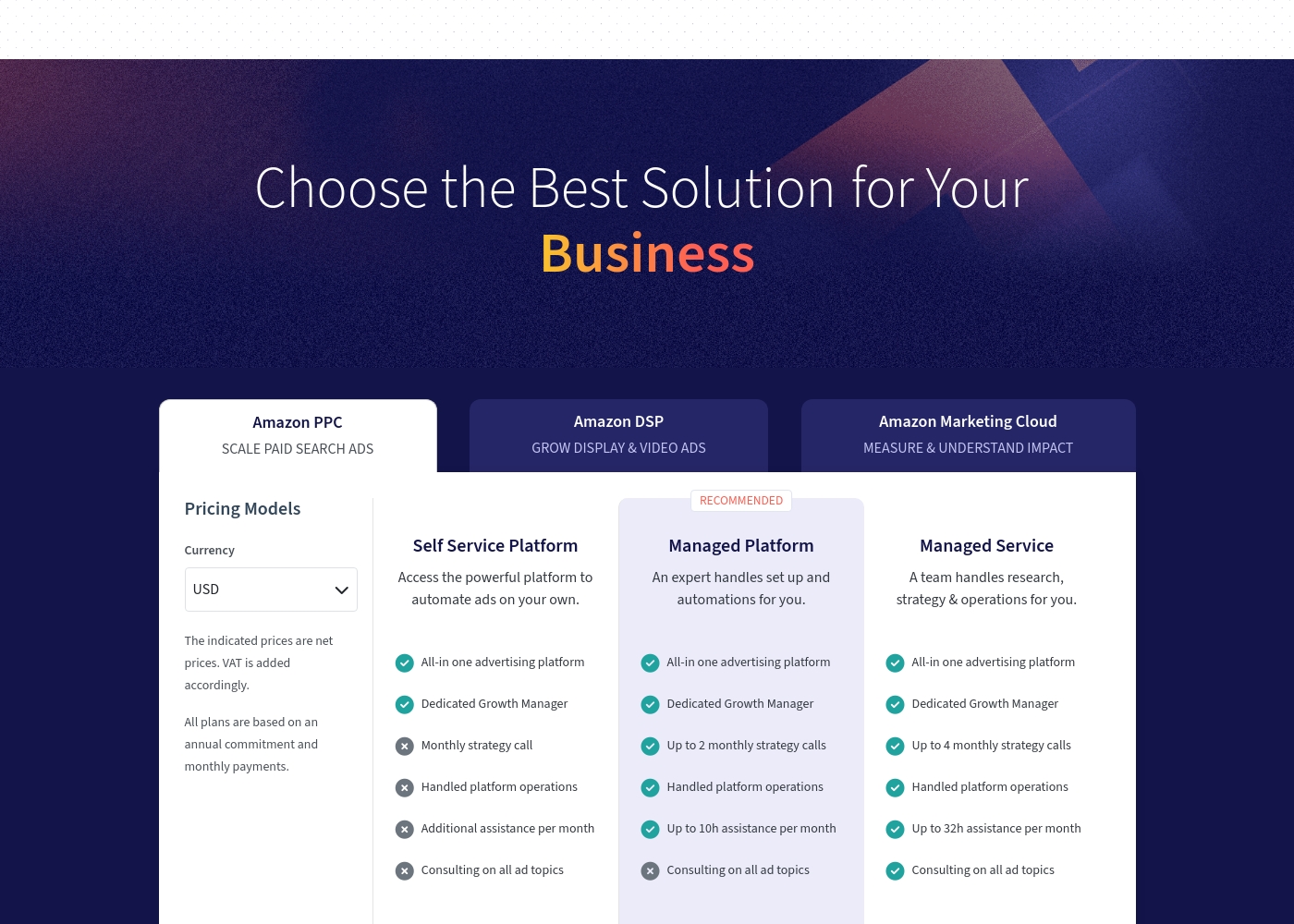
BidX pricing: BidX costs between 495 € and 4.995 € per month plus a percentage of connected ad spend. All plans require an annual commitment with monthly payments and target Amazon PPC, DSP, and AMC management for brands and agencies alike.
New customers can also start with a three-month proof of concept period to test features before a full commitment. Additional solutions like AMC reports start at 295 € per month, and keyword tracking is free for the first 100 terms before tiered fees apply for larger volumes.
No free trial is explicitly stated, but complimentary audits and onboarding are available to help users get started effectively. All indicated prices are net costs and do not include VAT, which is added accordingly based on your location and business status.
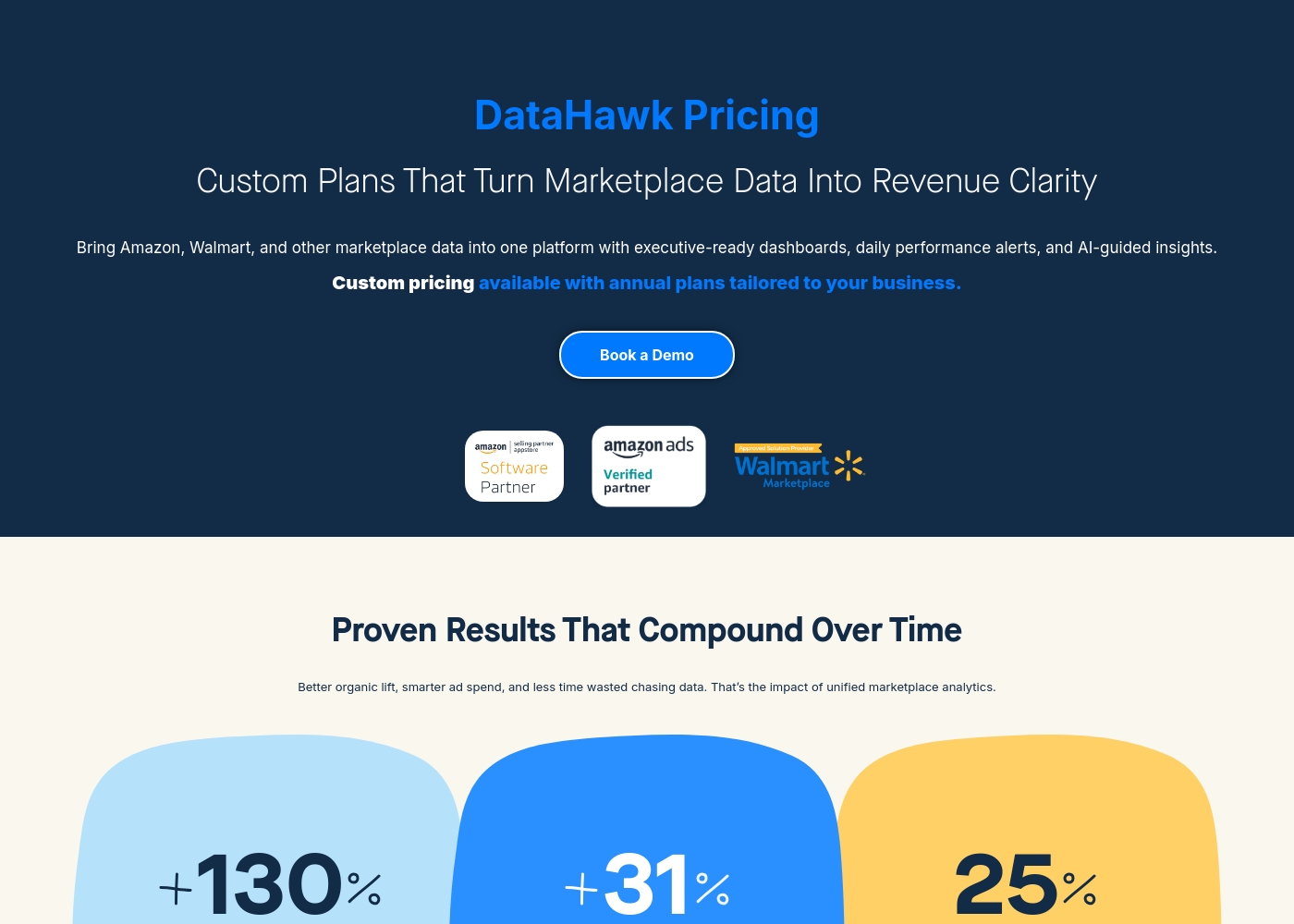
DataHawk pricing: DataHawk offers custom pricing models tailored specifically to your business needs and marketplace scale. Instead of flat fees, they provide annual plans based on the depth of analytics and connectivity required for your eCommerce operations Explorer dashboards and AI insights included everywhere. 🚀
Custom
Websites Supported: Amazon, Walmart, and other marketplaces Best For: Brands and agencies needing unified marketplace analytics and automated reporting Other Features: Executive-ready dashboards, Daily performance alerts, AI-guided insights, Amazon Ads partner verification, Walmart Marketplace integration
This plan is perfect for growing businesses that have outgrown manual spreadsheets. It brings multiple marketplace data sources into one clean view so you can focus on strategy rather than data cleaning. You get professional-grade tools regardless of your technical background.
Pricing Head-to-Head
User Reviews
We couldn't access the live review content from Trustpilot or Capterra due to access restrictions. Without the specific user snippets, we cannot synthesize a balanced summary of recurring themes like accuracy, ease of use, or support responsiveness. Our assessment is therefore based solely on the provided website content and pricing details.
We found that user sentiment on Trustpilot and Capterra is currently inaccessible due to technical blocks (CAPTERRA returns a 403 error, and Trustpilot requires browser verification). This means we cannot synthesize specific recurring themes like accuracy, ease of use, support, pricing, or onboarding from live reviews at this time. We advise checking the review platforms directly for the latest user feedback.
Our Verdict
BidX and DataHawk solve different problems for Amazon sellers. BidX is your ad automation powerhouse. DataHawk is your data unification expert. BidX's superpower is saving you massive time on Amazon ads. It automates PPC, DSP, and AMC campaigns. Users report saving over 14 hours each week and seeing a 36% ROAS lift. DataHawk's superpower is making sense of your ecommerce data. It unifies sales and performance from Amazon and Walmart into one dashboard. It uses AI to help you find insights you'd miss manually. The deciding factor is your main pain point. If managing Amazon ads feels like a chore, BidX is your answer. If you're drowning in scattered data, DataHawk will clear the water. For most Amazon-focused sellers, BidX is the stronger tool for growing sales. If you sell on multiple marketplaces and need a single analytics view, DataHawk is the better fit.
Frequently Asked Questions
Which is better for small teams: BidX or DataHawk?
BidX offers self-service plans for smaller teams starting at €495/month. DataHawk requires custom pricing based on your needs. For a small team focused on Amazon ads, BidX might be more accessible. DataHawk is better if you need cross-marketplace analytics and have the budget for a custom plan.
Does BidX have unified data dashboards like DataHawk?
BidX focuses on Amazon advertising data and integrates with Amazon Marketing Cloud. DataHawk is specifically built to unify data from multiple marketplaces into one dashboard. For a single, broad view across channels, DataHawk is the better choice.
Is DataHawk worth the extra cost over BidX?
It depends on your needs. Both have custom pricing. BidX starts around €495/month for ad management. DataHawk's cost is tailored to your analytics depth. If you need multi-marketplace data unification, DataHawk's value is clear. If you only manage Amazon ads, BidX is likely more cost-effective.
Can I migrate from BidX to DataHawk easily?
The provided data doesn't specify a migration process. BidX offers onboarding and restructuring services. DataHawk's onboarding details are discussed during a demo. You should ask both vendors about migration support during the sales process.
Which tool saves more time: BidX or DataHawk?
BidX saves time on ad automation, reporting up to 14 hours per week saved. DataHawk saves time on data gathering and reporting by unifying sources. The time savings depend on your main task. For ad creation, BidX wins. For data analysis, DataHawk wins.
Do both tools offer free trials?
No, neither tool explicitly offers a free trial. BidX offers a three-month proof-of-concept period for new customers. DataHawk requires booking a demo to discuss options. You'll need to engage with their sales teams to get started.
Ready to Choose?
Both tools have their strengths. Choose based on your specific needs.