Autoblogging.ai vs SEOmatic
Autoblogging.ai is the quick blogger, while SEOmatic is the professional scaling engine. Both use AI to scale content, but their methods are wildly different. Autoblogging.ai focuses on posting speed and WordPress integration. SEOmatic excels at scaling unique pages from structured data, promising 100x content velocity.
Best for: Solopreneurs testing AI content generation without upfront cost., Marketers who rely solely on WordPress for publishing and scheduling.
Best for: Marketing agencies managing thousands of client pages (Agency plan)., SaaS companies implementing data-driven programmatic SEO strategies.
Quick results, highly inconsistent reliability.
We observed that Autoblogging.ai delivers impressive content generation speed, which appeals strongly to users needing rapid scaling for their SEO efforts. However, the external feedback highlights chronic issues related to platform reliability, inconsistent output quality, and unprofessional leadership. Overall, we cannot confidently recommend this tool due to its severe customer service and consistency problems.
Pros
- Fast article generation for unprecedented scaling efficiency.
- Output can be highly readable and well-formatted.
- Specialized content modes potentially boost traffic and rankings.
- Interface is generally straightforward and easy to use.
Cons
- Quality of generated content is often inconsistent or 'hit or miss'.
- Significant reliability concerns regarding credit fulfillment and account access.
- Credits expire monthly, increasing cost pressures for lower usage.
- Customer support is widely reported as non-responsive or poor.
AI power for content scale.
We find SEOmatic offers a powerful, no-code solution for creating thousands of unique, ranking pages rapidly, promising significant cost savings over manual methods. The structured pricing clearly aligns scaling costs with necessary AI writing capacity and publishing volume. Overall, this is a premium choice for agencies and enterprises focused on aggressive programmatic content growth.
Pros
- Generates content 100x faster than traditional manual writing.
- Achieves significant cost savings, potentially $50+ per page.
- Guarantees content uniqueness through variables and AI integration.
- Supports automated publishing directly to any major CMS.
Cons
- External user feedback specifically on the AI tool functionality is very limited.
- Must choose annual billing to secure the lowest pricing tiers.
- There is no permanently free plan or explicit money-back guarantee noted.
AboutAutoblogging.ai
Autoblogging uses advanced software to create articles without manually typing them. This process, known as automatic or automated blogging, has evolved significantly.
Autoblogging.ai is a leading name in this space. It transforms the concept of an auto blog writer into a sophisticated reality.
This platform utilizes cutting-edge AI algorithms to generate genuinely unique and relevant articles. It offers a seamless and powerful content solution for SEO Professionals, Brands, and Marketers.
AboutSEOmatic
SEOmatic is the premier content automation platform designed for large-scale SEO content. It's built specifically for agencies, SaaS companies, and e-commerce brands seeking rapid growth. This tool transforms simple templates and uploaded data into powerful pages that rank on Google and popular LLMs. Essentially, it serves as a robust content engine, replacing cumbersome spreadsheets and multiple manual tools. It truly is the simple way to scale SEO pages. 💡
Highlights
Feature Comparison
Features Overview
We highlight the main differences and pick a winner for each feature.
Content Scale & Velocity
SEOmatic is built for massive scale (10K+ pages); Autoblogging.ai handles steady, manageable publishing speed.
Autoblogging.ai helps maintain a steady publishing rhythm. It prioritizes fast article creation for SEO professionals and marketers. It focuses on singular, continuous blog posts. SEOmatic provides 100x speed compared to manual creation. Users can manage 100-page campaigns in about six hours total. This is true bulk creation. Choose Autoblogging.ai for a quality blog cadence. Choose SEOmatic for extreme, large-volume programmatic creation. SEOmatic’s velocity is designed for agencies scaling fast. For businesses needing thousands of location pages, SEOmatic is the clear, specialized winner.
Data Integration
SEOmatic is data-driven; Autoblogging.ai operates purely on AI generation alone.
Autoblogging.ai generates content from scratch quickly based on prompts. It does not mention connecting to external data for content sourcing. You rely entirely on its AI model. SEOmatic allows uploading CSV data or connecting external sources dynamically. This ensures data-driven content stays fresh and accurate. Content changes as your data fields change. If your content needs to reflect changing metrics or databases, SEOmatic is the only choice. Autoblogging.ai works best for static, evergreen blog articles. The dynamic integration ability is crucial for programmatic SEO, SEOmatic's specialty.
Content Uniqueness
SEOmatic guarantees uniqueness through variables; Autoblogging.ai aims for relevant, unique article output.
Autoblogging.ai content aims to be unique and relevant. However, user reviews suggest output quality can be hit or miss sometimes. It relies completely on the AI model. SEOmatic guarantees uniqueness using variables, spin syntax, and AI integration. This technical framework prevents Google penalties from duplicate content at scale. SEOmatic has a technical safety net to ensure massive scaling without duplication worries. Autoblogging.ai focuses on readability for smaller volumes. Agencies publishing thousands of pages should rely on SEOmatic's systematic uniqueness guarantee.
CMS & Workflow
Autoblogging.ai is tailored for WordPress; SEOmatic targets any CMS with robust management features.
Autoblogging.ai features direct integration with WordPress for easy posting. Users can schedule posts directly from the tool. This is great for dedicated WordPress bloggers. SEOmatic promises publishing to Any CMS and handles indexing automatically. It offers both drip publishing and rapid bulk actions. Autoblogging.ai locks you into WordPress synergy for posting. SEOmatic is CMS-agnostic and manages advanced publishing logistics. SEOmatic includes automated internal linking, streamlining the often-tedious SEO management process.
Pricing & Entry Cost
Autoblogging.ai offers a free tier; SEOmatic is paid, offering transparent tiers up to 300K words.
Autoblogging.ai offers flexible pricing plans, including a free plan and usage-based billing. It’s an accessible starting point. SEOmatic is tiered, starting at $41/month if billed annually. Plans scale based precisely on AI word count and page publication limits. Autoblogging.ai is easier to start with low or zero cost investment. SEOmatic requires more commitment but is fully transparent on capacity limits. If you only need a few articles a month, Autoblogging.ai is likely the better budget option.
Team Collaboration
SEOmatic explicitly includes seats for teams; Autoblogging.ai provides no concrete collaboration details.
Autoblogging.ai implies team use via flexible pricing but seats are not detailed. It seems geared towards individual users or small operations. SEOmatic includes collaboration as a core feature on its paid plans. Premium includes 3 seats, and Agency includes 5 collaboration seats. SEOmatic is clearly designed to support multiple users running large, concurrent campaigns. This makes project management easier. For larger marketing teams or agencies, SEOmatic provides necessary multi-user access controls.
Support Quality
SEOmatic has tiered support and strong sentiment; Autoblogging.ai has mixed reviews regarding support response.
Autoblogging.ai reviews cite reports of poor customer support and reliability issues like bugs. Support response times are inconsistent for users. SEOmatic offers Normal Support on Basic and Premium Support on higher plans. User sentiment praises their service commitment. SEOmatic has structured its support offering for scalability and client success. Autoblogging.ai's users report frustration. Reliable support is important when running mission-critical, large-scale campaigns like those on SEOmatic.
User Experience (UX)
SEOmatic is simple and code-free; Autoblogging.ai has reports of clunky UX and convoluted sign-up processes.
Autoblogging.ai has user reviews mentioning a clunky UX and convoluted sign-up/login flow. This can hinder fast adoption. SEOmatic is user-friendly and requires absolutely no coding skills. It promises setting up a bulk engine in minutes. SEOmatic removes technical hurdles for programmatic content creation. Autoblogging.ai’s focus seems centered only on the output, not the process flow. If seamless setup is critical, SEOmatic's simple interface is a big advantage over Autoblogging.ai.
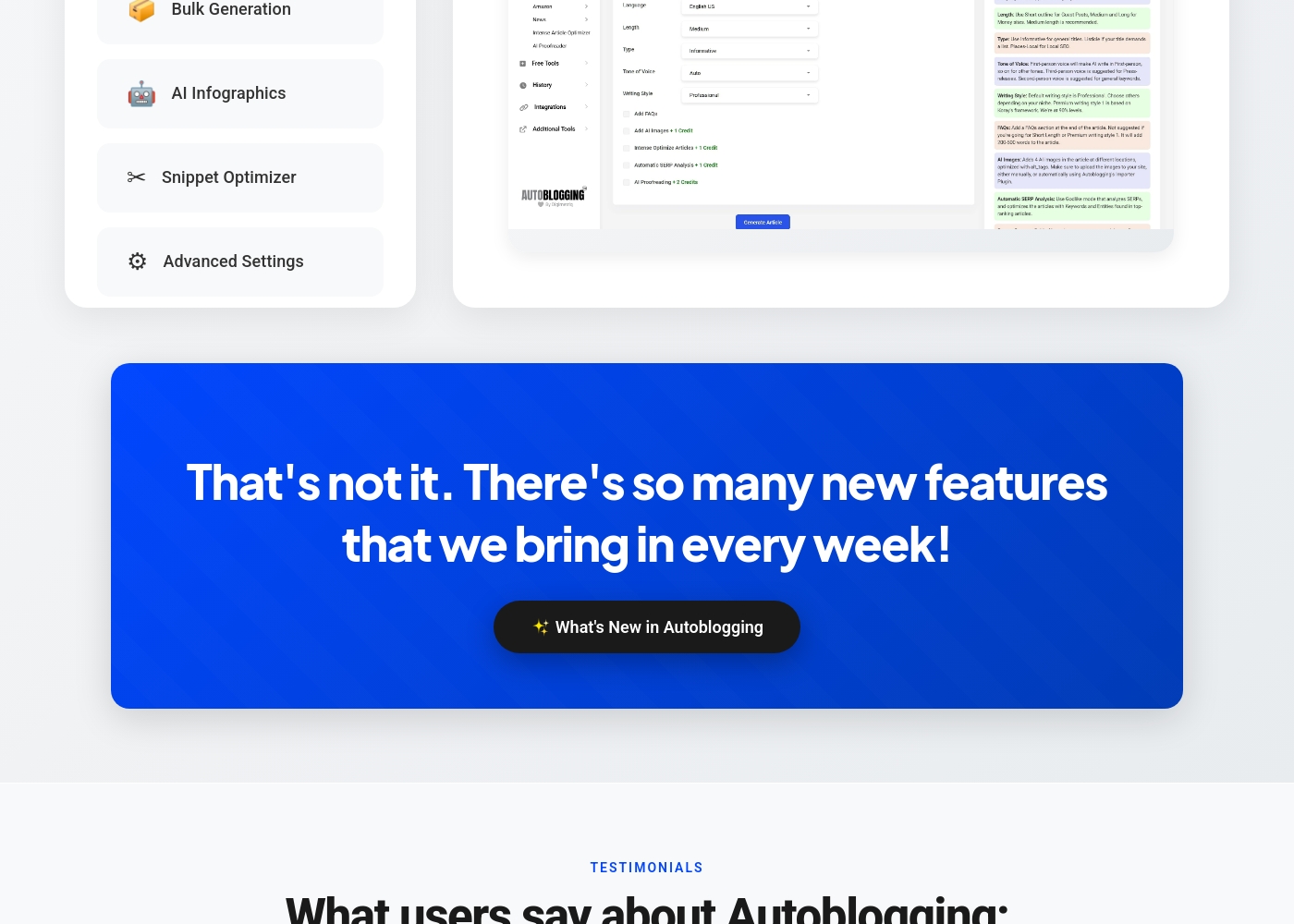
The platform advertises "flexible pricing plans" for generating high-quality SEO articles.
Usage-Based Credit System
Best For: Users who rely heavily on specific advanced features like SERP analysis or proofreading. Other Features:
- Add AI Images costs 1 Credit
- Snippet Optimize Articles requires 1 Credit
- Automatic SERP Analysis needs 1 Credit
- AI Proofreading utilizes 2 Credits
Autoblogging.ai appears to utilize a credit-based model for accessing premium functions. Standard article generation details are not available. However, advanced tools like image generation, snippet optimization, or detailed SERP analysis require credits to execute. This structure suggests that your total cost will fluctuate based on how frequently you use these powerful features for content creation.
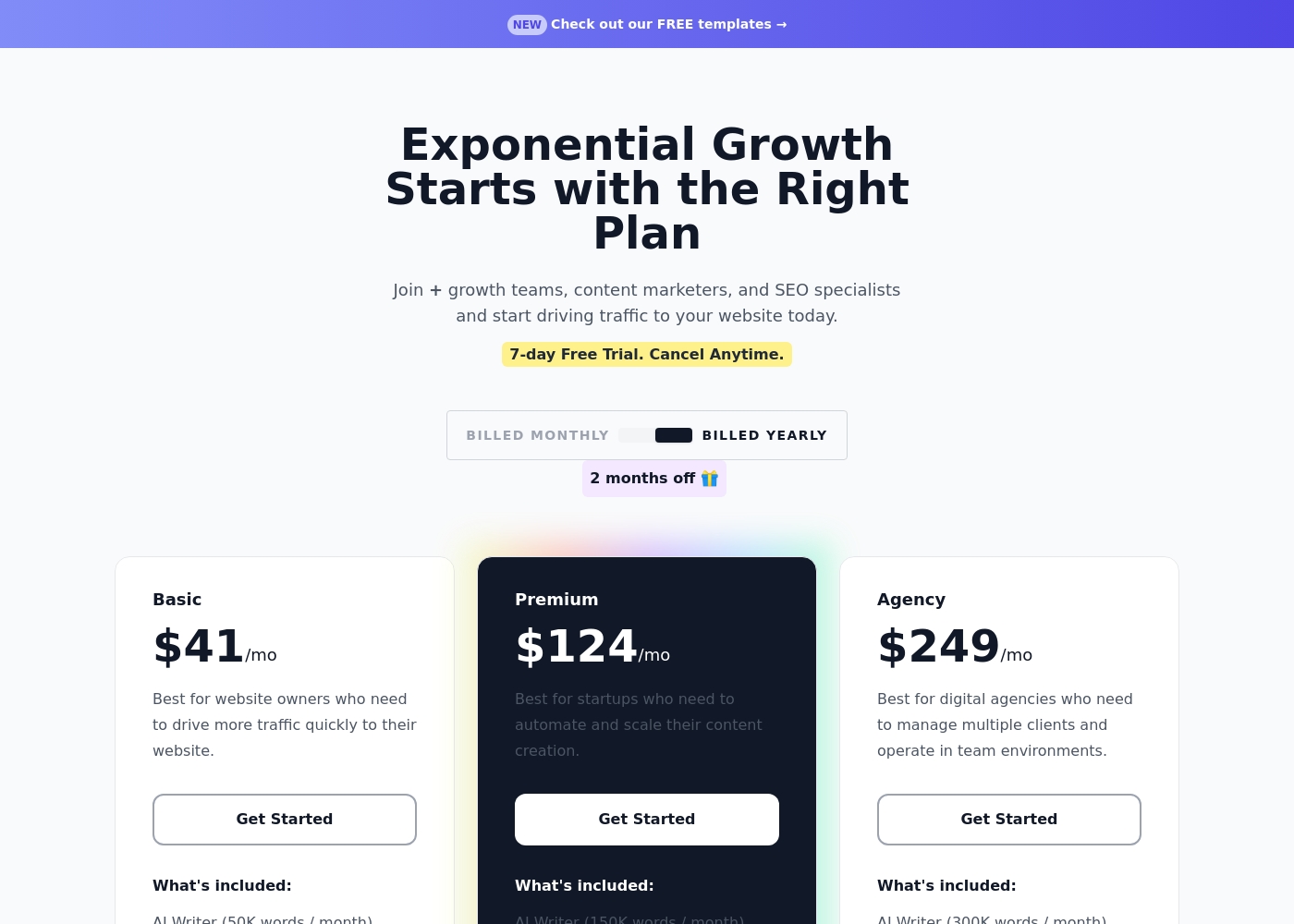
SEOmatic costs between $41 and $249 per month (when billed annually) with 3 professional plans: Basic at $41/mo, Premium at $124/mo, and Agency at $249/mo.
Here’s a closer look at the features included in each plan to help you find the right fit for your scaling goals.
Basic
Price: $41/mo (Billed annually, saving 2 months) Best For: Website owners who need to drive more traffic quickly to their website. Other Features:
- AI Writer (50K words / month)
- Publish up to 500 pages / month
- Normal Support
- Advanced Analytics
- AI Writer (50K words / month)
- Unlimited Projects
- Publish to Any CMS
- Advanced Analytics
- Normal Support
- AI Writer (150K words / month)
- Unlimited Projects
- Publish to Any CMS
- Advanced Analytics
- Premium Support
- AI Writer (300K words / month)
- Unlimited Projects
- Publish to Any CMS
- Advanced Analytics
- Premium Support
Pricing Notes
- Autoblogging.ai offers a free plan, providing a zero-cost entry point for marketers.
- SEOmatic requires annual billing to secure the lowest rate of $41/month, saving two months' fees.
- SEOmatic pricing scales predictably based on AI words (50K up to 300K) and published pages (500 up to 10K).
- Autoblogging.ai's exact pricing tiers and usage limits beyond the free tier are not transparently stated in public data.
Pricing Head-to-Head
User Reviews
The external feedback for Autoblogging.ai is highly polarized, resulting in a poor 2.6 TrustScore. Users praise the service's speed, ease of use, and ability to generate highly readable content, with some reporting significant positive SEO results using specialized features like 'Godlike Mode.' However, the overwhelming sentiment focuses on fundamental operational issues.
Recurring complaints highlight major reliability problems with disappearing or unfulfilled credits and sudden account blocks for users, particularly those on free or trial plans. Customer support is criticized as slow, non-responsive, or virtually non-existent when users seek refunds or issue resolution.
This app is excellent! It combines feature flexibility with consistent results. The output is highly readable, and the automated formatting saves us a huge amount of time. It streamlines the whole production process.
User feedback for SEOmatic is currently limited to just four Trustpilot reviews (3.9/5), which appear to focus heavily on the services provided by "The SEO Matic" agency rather than the programmatic software itself. Reviewers consistently praise the team's competence, commitment, and the tangible results achieved through general SEO, SMM, and website development efforts. Customers report seeing substantial growth, with one noting an immediate increase in online web orders and another stating their business has "grown 2-folds." Users feel that the staff maintains a commitment "above and beyond." These positive testimonials emphasize the ability of the service provider to help clients reach specific goals, such as sales targets for book marketing and maintaining market presence. While there is no specific feedback yet on the AI writing accuracy or platform ease-of-use, the overall sentiment toward the quality of service delivered and positive business outcomes is very strong 💪.
This is my second time working with them, and their services are amazing as always. Their professionals are extremely competent. They helped me achieve my sales target with effective book marketing.
Our Verdict
The decision between Autoblogging.ai and SEOmatic boils down to your core objective: consistent blogging or massive programmatic scale. Autoblogging.ai is the right choice for continuous, standard article production. If you need quick, readable content integrated into WordPress, Autoblogging.ai delivers that perfectly. Autoblogging.ai's superpower is its accessibility and focus on immediate speed for traditional article marketing. It offers a free tier, making it easy to test AI writing quickly. It’s designed to keep your blog active and maintain a steady publishing rhythm with minimal manual effort. SEOmatic is built for extreme velocity and specialized programmatic content. It can publish up to 10,000 unique, data-driven pages 100x faster than manual work. SEOmatic guarantees uniqueness and handles complex SEO logistics like dynamic content refresh and automated internal linking. Look at your target volume: Are you publishing 30 high-quality articles, or 3,000 unique pages? If you rely on structured data for content, SEOmatic is the clear, specialized enterprise choice. If you are a solo marketer or small brand focusing only on quick WordPress publishing, Autoblogging.ai is more budget-friendly. Final verdict: Use Autoblogging.ai for entry-level speed and flexible costs. Choose SEOmatic if you are an agency or SaaS dedicated to aggressive, data-driven programmatic growth and need guaranteed uniqueness at scale.
Frequently Asked Questions
Which is better for agencies: Autoblogging.ai or SEOmatic?
SEOmatic is significantly better for agencies managing scale. It offers an Agency plan with 5 collaboration seats and can handle up to 10,000 unique pages monthly. Autoblogging.ai lacks the necessary team features and high-volume programmatic capacity.
Does Autoblogging.ai handle programmatic SEO like SEOmatic?
No, Autoblogging.ai is designed for traditional article generation and scheduling. SEOmatic is built specifically for programmatic SEO. It integrates structured data to create bulk unique pages using templates.
Which tool offers a permanently free option?
Autoblogging.ai provides a designated free plan available for instant entry. SEOmatic offers a 7-day risk-free trial but requires a paid subscription thereafter. Autoblogging.ai is cheaper to start.
How do Autoblogging.ai and SEOmatic handle publishing to a CMS?
Autoblogging.ai integrates directly with WordPress for easy posting and scheduling. SEOmatic provides advanced publishing that connects to practically Any CMS. SEOmatic also manages SEO logistics like indexing.
Is content uniqueness guaranteed in SEOmatic or Autoblogging.ai?
SEOmatic guarantees uniqueness using advanced variables and spin syntax, preventing duplication at scale. Autoblogging.ai aims for relevant, unique output but offers no such technical guarantee for large volumes.
Which tool is better for integrating external data sources?
SEOmatic is built specifically to integrate external data, allowing content to be created and dynamically refreshed when data changes. Autoblogging.ai does not offer external data integration.
Ready to Choose?
Both tools have their strengths. Choose based on your specific needs.