AfterShip Shipping vs ShipStation
AfterShip Shipping and ShipStation are essential for e-commerce fulfillment, but they serve different priorities. AfterShip Shipping leverages deep APIs for specialized automation and vast global carrier access. ShipStation provides rock-solid reliability, broader marketplace integrations, and high-volume batch printing. Picking wisely depends on whether you are engineer-led or operations-led.
Best for: Teams needing powerful, dedicated APIs for custom rate calculations, Businesses focused solely on obtaining the widest carrier reach (129) through one core integration
Best for: Multi-channel e-commerce sellers managing orders from 4+ selling platforms, Warehouse operations needing to batch print 500+ labels rapidly
Robust multi-carrier portal, unreliable support.
We recognize AfterShip Shipping offers robust multi-carrier integration, enabling strong fulfillment automation and effective rate shopping across 132 services. However, we found reliable execution is undermined by severely inconsistent support response times and recurring critical billing errors reported by multiple users. Overall, we recommend caution due to significant operational risks posed by the lack of reliable customer service and data accuracy.
Pros
- Access to over 132 carriers through a single, quick integration.
- Powerful rate shopping compares rates across services in real-time.
- Platform supports a high rate of fulfillment automation (up to 80%).
- The application is generally easy for users to navigate and understand.
Cons
- Customer support is inconsistent and can take a month or more for simple replies.
- Frequent issues reported regarding inaccurate or inconsistent tracking and delivery status.
- Users report being charged after cancelling accounts or having difficulty unsubscribing.
- Support agents often fail to read contextual history within existing threads.
Powerful Shipping Automation, Weak Customer Support.
We find ShipStation offers powerful automation and deep carrier discounts, streamlining logistics for handling high volumes efficiently. Overall, while the technical capacity and feature set are strong, prospective users must be aware that the platform is regularly criticized for slow, unhelpful customer support and opaque billing practices.
Pros
- Seamless integration with unlimited selling channels (Starter plan and up).
- Access industry-leading carrier discounts (up to 90% off FedEx rates).
- Automates repetitive tasks, allowing users to batch print up to 500 labels.
- Robust automation rules like rate shopping simplify workflow significantly.
Cons
- Customer support is consistently reported as slow, outsourced, and ineffective.
- Users report critical failures with the two-factor authentication (MFA) login process.
- Concerns regarding unexpected fees, pricing opacity, and sharp subscription increases.
- Filing claims or securing refunds for lost packages or billing adjustments is often difficult.
AboutAfterShip Shipping
AfterShip Shipping is a multi-carrier shipping management platform designed to simplify eCommerce fulfillment operations. It's built for brands expanding globally who need agile carrier integrations without draining IT resources.
This single portal unites access to over 132 carriers via one integration. You can easily plug it into your current tech stack for effective label printing and management.
By connecting your own carrier accounts, you start shipping in minutes, not hours, while enjoying your existing negotiated rates. It truly streamlines core needs and helps shorten fulfillment lead times.
AboutShipStation
ShipStation is a centralized logistics solution designed for businesses looking to streamline and scale their operations. It connects to over 400 existing integrations, linking your stores and providing access to more than 180 carrier partners. This single sign-on platform helps simplify your entire order fulfillment process. ShipStation actively manages everything from importing orders to tracking shipments. It is built to grow with you, supporting operations scaling to as many as 15,000 orders a day. ✅
Highlights
Feature Comparison
Features Overview
We highlight the main differences and pick a winner for each feature.
Carrier Reach & Access
AfterShip Shipping offers a single integration for 129 global carriers. ShipStation connects to 400+ integrations, offering more ecosystem depth.
AfterShip Shipping focuses on simplifying carrier management with 129 global carriers via one unified integration. This is excellent for rapid global carrier deployment without complex manual work. ShipStation works with 400+ integrations, covering major global carriers widely. ShipStation ensures you access the best rates instantly from these established relationships. AfterShip Shipping maximizes technical flexibility in carrier linkage. ShipStation offers broader, more established channel and carrier connectivity. Both platforms offer substantial USPS discounts worth up to 90%.
High-Volume Automation
AfterShip Shipping automates decision-making processes up to 80%. ShipStation handles label printing 15x faster with batch printing up to 500.
AfterShip Shipping allows robust rules-based automation for up to 80% of fulfillment tasks. The system automatically selects shippers and pre-fills details based on custom rules. This minimizes manual decision-making significantly. ShipStation optimizes the speed of actual label generation and deployment. You can batch print up to 500 labels in one batch, increasing throughput fifteenfold. AfterShip Shipping concentrates on automating complex logistics decision trees. ShipStation optimizes the execution and speed of printing hundreds of simple labels. If your logistics rules are complex, AfterShip Shipping is ideal. If you run a high-volume warehouse needing sheer speed, ShipStation excels.
Integration Ecosystem
ShipStation offers 400+ integrations centralizing every sales channel. AfterShip Shipping focuses on core shipping, supporting around 70 apps.
ShipStation dominates marketplace connectivity with 400+ available integrations and 180+ partners. This lets you manage orders from multiple stores seamlessly using one login. If you sell on many marketplaces, ShipStation centralizes everything easily. AfterShip Shipping confirms extensive eCommerce support for major platforms. Its 70+ supported apps primarily focus on providing essential shipping functions. For multi-channel sellers who use niche marketplaces, ShipStation provides far more options. ShipStation's broader ecosystem ensures cleaner order data flow from diverse sources.
Developer Tools (API)
AfterShip Shipping offers specialized, dedicated APIs for custom rate requests and validation. ShipStation mentions API access but with fewer technical specifics.
AfterShip Shipping's Pro plan specifically includes powerful APIs for engineers. Dedicated tools include APIs for labels, rates, carrier accounts, webhooks, and address validation. This allows for deeply embedding custom shipping logic. ShipStation confirms that API pricing and access are available. However, ShipStation is generally geared toward visual user interfaces rather than custom engineering requirements. AfterShip Shipping is superior if you need to integrate real-time rate display into your checkout flow. Its validation tools help reduce shipping errors automatically.
Customer Support Quality
ShipStation support is inconsistent but generally functional. AfterShip Shipping faces severe user complaints regarding responsiveness and trust.
ShipStation offers tiered support, including chat, email, and phone support on appropriate plans. Reviews suggest support quality can vary and may require patience. AfterShip Shipping faces severe complaints about extremely slow and unhelpful support agents. Users report difficulties disputing unauthorized charges and canceling subscriptions. AfterShip Shipping requires paying for expensive additional support tiers for guaranteed response times. Given the critical user reports, ShipStation offers a much safer, more reliable overall support experience.
Branding & Customer Experience
ShipStation provides comprehensive post-purchase branding options. AfterShip Shipping focuses solely on fulfillment efficiency and label creation.
ShipStation offers extensive branding for the critical post-purchase journey. You can customize emails, packing slips, tracking pages, and the returns portal. This ensures a consistent brand experience for your buyers. AfterShip Shipping's features primarily focus on label generation and workflow automation speed. It does not advertise branded tracking pages or comprehensive returns management publicly. If customer perception and brand continuity are vital, ShipStation gives you significant control. ShipStation makes the delivery communication chain feel integrated with your brand identity.
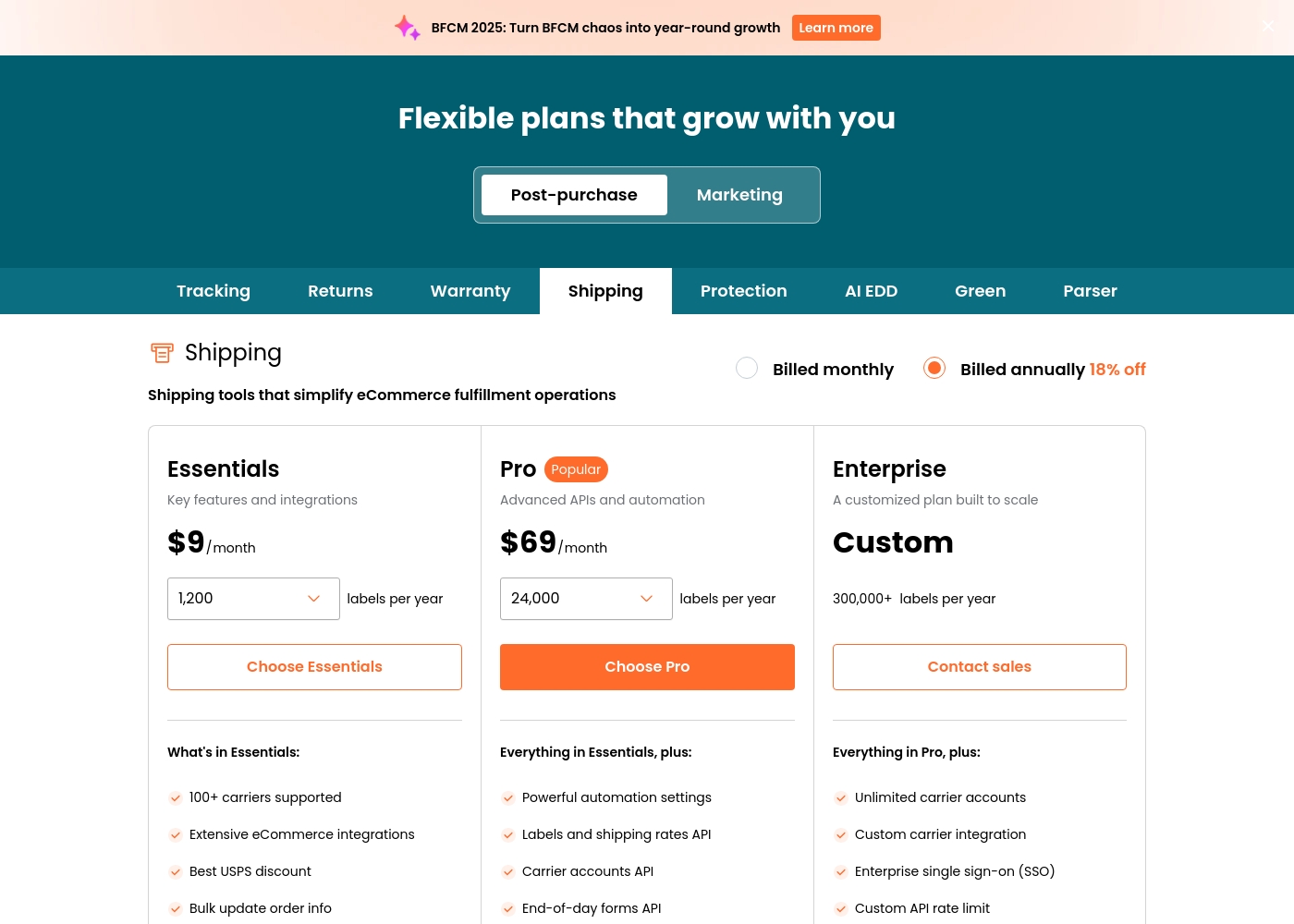
AfterShip Shipping costs between $0 and $69 per month with four primary plans: Free (basic features), Essentials at $9/month, Pro at $69/month, and Enterprise (Custom pricing).
Below you can review the specific limits and features for monthly billing. Remember that choosing annual billing can save you 18% on your subscription price.
Free
Price: $0 Best For: Businesses just starting out Other Features: You get all basic features and 10 free shipping labels to start.
- All basic features
- 10 free shipping labels
- 100+ carriers supported
- Extensive eCommerce integrations
- Best USPS discount
- Bulk update order info
- Bulk create shipping labels
- Everything in Essentials
- Powerful automation settings
- Labels and shipping rates API
- Carrier accounts API
- End-of-day forms API
- Everything in Pro
- Unlimited carrier accounts
- Custom carrier integration
- Enterprise single sign-on (SSO)
- Custom API rate limit
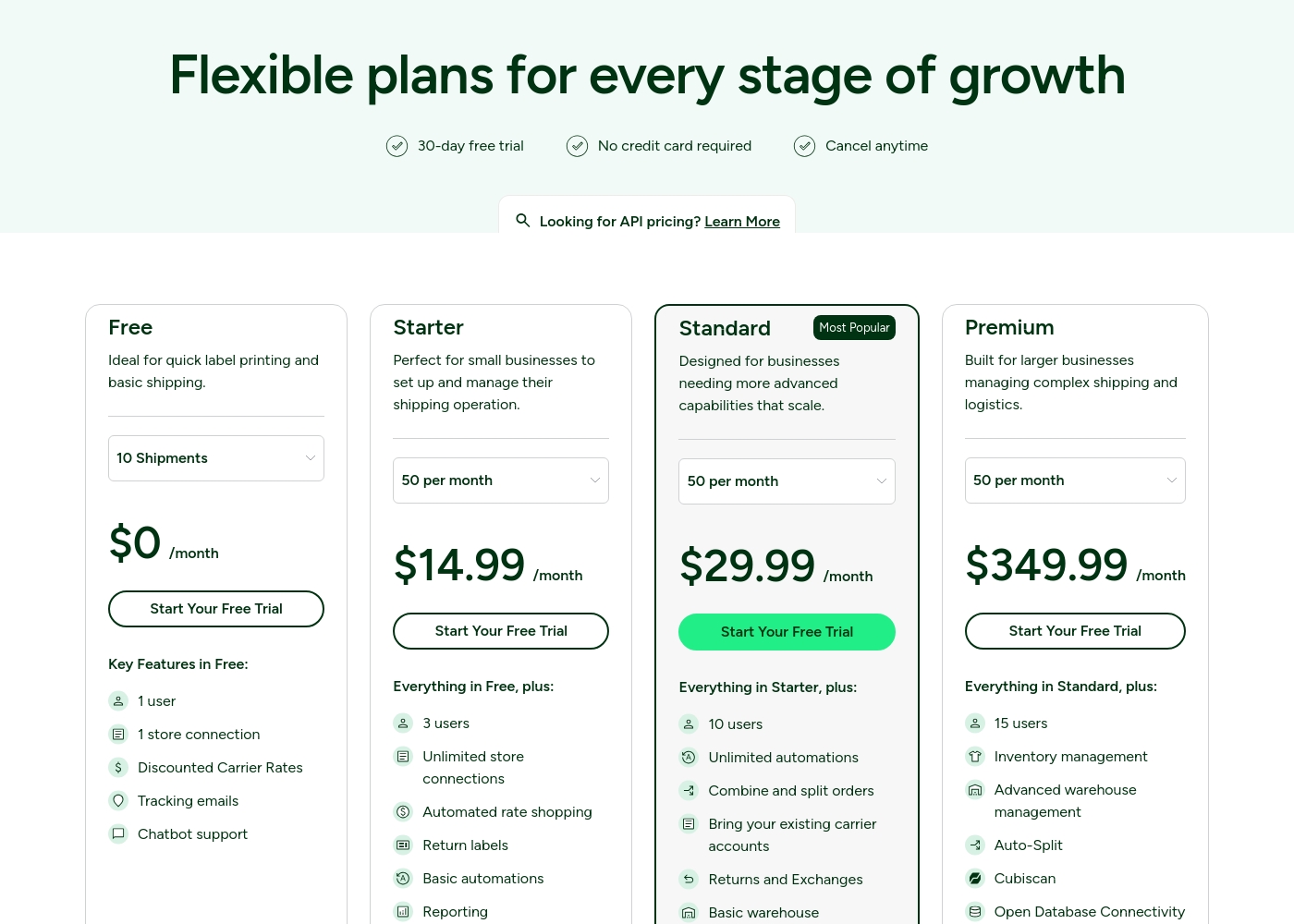
ShipStation costs between $0 and $349.99 per month with four plans: Free at $0/month, Starter at $14.99/month, Standard at $29.99/month, and Premium at $349.99/month.
Here's a look at the features included with each plan tier.
Free
Price: $0 per month Websites Supported: 1 Best For: Quick label printing and basic shipping. Refund Policy: Not applicable Other Features:
- 1 user
- Discounted Carrier Rates
- Tracking emails automatically sent
- Chatbot support included
- 1 user
- 1 store connection
- Discounted Carrier Rates
- Tracking emails
- Chatbot support
- 3 users
- Unlimited store connections
- Automated rate shopping
- Return labels
- Basic automations
- 10 users
- Unlimited automations
- Combine and split orders
- Bring your existing carrier accounts
- Returns and Exchanges
- 15 users
- Inventory management
- Advanced warehouse management
- Auto-Split
- Cubiscan
Pricing Notes
- AfterShip Shipping plans are usage-based, scaling strictly on annual label volume up to 24,000 for $69/mo (Pro).
- ShipStation offers a superior 30-day free trial compared to the 7 days offered by AfterShip Shipping.
- ShipStation’s much wider pricing range indicates it accommodates vastly higher order volumes than AfterShip Shipping’s standard tiers.
- AfterShip Shipping offers an 18% discount for paying annually, making its service potentially cheaper for commitment.
- Be cautious with AfterShip Shipping; user reviews mention recurring issues with unauthorized charges and difficult subscription cancellations.
Pricing Head-to-Head
User Reviews
AfterShip Shipping reviews reveal highly mixed feedback, reflected in its lower overall TrustScore. While the core product offers strong features like label printing and easy navigation, recurring user frustrations center on critical operational failures.
The most common complaint involves intensely slow and unhelpful customer support 👎. Many users report support tickets taking weeks or even a month for a simple reply, often finding agents unresponsive or copying irrelevant, canned text.
Debashish was super helpful! He answered all my questions quickly and even got on a Google Meet to walk me through the steps. This was truly excellent customer service.
ShipStation receives mixed yet clearly polarized feedback. Many users praise the platform for its efficiency, noting the seamless integration with various selling channels and the significant time saved when printing labels and managing high shipment volumes.
Customers frequently highlight the convenience of features, such as creating return labels and accessing competitive, discounted shipping rates. Positive experiences often mention excellent onboarding sessions led by helpful, specific representatives.
This was one of the best business decisions this year! Implementing ShipStation and shipping directly from our home office has been a total game-changer. It is an easy, seamless solution that saves us so much time.
Our Verdict
The decision between AfterShip Shipping and ShipStation hinges on platform stability versus specialized technical control. ShipStation is the established, reliable fulfillment workhorse for multi-channel sales. AfterShip Shipping offers incredible potential but is drastically hampered by user reports of poor support and flawed execution. Startups need a dependable foundation, making ShipStation the default choice for most growing businesses. AfterShip Shipping's superpower is its deep technical control and carrier flexibility. The Pro plan gives you powerful, dedicated APIs built for advanced tasks like U.S. address validation. This makes AfterShip Shipping perfect if your engineering team wants to embed ultra-specific shipping logic. It’s also unmatched if you need rapid access to 129 global carriers easily. ShipStation’s strength lies in its expansive ecosystem breadth and operational reliability for growing businesses. With 400+ integrations, ShipStation centralizes all your selling channels under one login easily. ShipStation efficiently handles high volume, letting you batch print up to 500 labels much faster than manual methods. The critical deciding factor is customer trust and ongoing reliability. While ShipStation can have typical software glitches, AfterShip Shipping users report critical issues regarding tracking accuracy and unresponsive support. If you manage high-stakes shipments, ShipStation provides a significantly safer fulfillment foundation. Choose ShipStation for reliable multi-channel volume, and stick to AfterShip Shipping only for highly custom API projects.
Frequently Asked Questions
Which software offers better technical tools: AfterShip Shipping or ShipStation?
AfterShip Shipping offers superior dedicated API access, particularly for advanced users. Its Pro plan includes specific APIs for rates, webhooks, and U.S. address validation. ShipStation offers general API access, but AfterShip Shipping is designed for deeper custom integration.
Which is better for multi-channel selling: AfterShip Shipping or ShipStation?
ShipStation is the clear winner for multi-channel selling and handling multiple storefronts. ShipStation integrates seamlessly with 400+ partners and marketplaces. AfterShip Shipping focuses more on core carrier connectivity rather than channel breadth, supporting about 70 apps.
Does AfterShip Shipping have a mobile app like ShipStation?
ShipStation confirms it offers a mobile app for on-the-go management and access. AfterShip Shipping’s documentation does not explicitly mention a dedicated mobile application for users. If you need mobile management visibility, choose ShipStation.
Is ShipStation worth the higher potential cost compared to AfterShip Shipping?
Yes, ShipStation offers better stability, superior customer support reputation, and broader integrations for the cost. While AfterShip Shipping is cheaper at the $69 Pro tier, its poor reliability reviews suggest ShipStation offers better value and less hassle.
How do the free trials of AfterShip Shipping and ShipStation compare?
ShipStation offers a more substantial 30-day free trial that requires no credit card on file. AfterShip Shipping only provides a 7-day free trial period for potential customers to test its features fully.
Which platform offers better post-purchase customer branding?
ShipStation is the winner here, offering extensive tools for customer communications. ShipStation allows you to brand tracking pages, emails, and the returns portal. AfterShip Shipping focuses mostly on the logistics backend with less emphasis on customer-facing branding.
Ready to Choose?
Both tools have their strengths. Choose based on your specific needs.