AfterShip Shipping vs ShipEngine
AfterShip Shipping and ShipEngine both simplify complex multi-carrier logistics management. AfterShip Shipping focuses on USPS discounts and merchant-friendly fulfillment automation. ShipEngine targets developers with a high-performance, extremely flexible shipping API. This is a choice between a SaaS platform and a pure API utility.
Best for: E-commerce companies prioritizing USPS shipping savings up to 90%, Businesses needing automated fulfillment rules using a merchant web interface
Best for: Developers needing a robust integration for 200+ global carriers, Logistics providers seeking maximum speed and flexibility via high-performance API
Robust multi-carrier portal, unreliable support.
We recognize AfterShip Shipping offers robust multi-carrier integration, enabling strong fulfillment automation and effective rate shopping across 132 services. However, we found reliable execution is undermined by severely inconsistent support response times and recurring critical billing errors reported by multiple users. Overall, we recommend caution due to significant operational risks posed by the lack of reliable customer service and data accuracy.
Pros
- Access to over 132 carriers through a single, quick integration.
- Powerful rate shopping compares rates across services in real-time.
- Platform supports a high rate of fulfillment automation (up to 80%).
- The application is generally easy for users to navigate and understand.
Cons
- Customer support is inconsistent and can take a month or more for simple replies.
- Frequent issues reported regarding inaccurate or inconsistent tracking and delivery status.
- Users report being charged after cancelling accounts or having difficulty unsubscribing.
- Support agents often fail to read contextual history within existing threads.
Pros
Cons
AboutAfterShip Shipping
AfterShip Shipping is a multi-carrier shipping management platform designed to simplify eCommerce fulfillment operations. It's built for brands expanding globally who need agile carrier integrations without draining IT resources.
This single portal unites access to over 132 carriers via one integration. You can easily plug it into your current tech stack for effective label printing and management.
By connecting your own carrier accounts, you start shipping in minutes, not hours, while enjoying your existing negotiated rates. It truly streamlines core needs and helps shorten fulfillment lead times.
AboutShipEngine
At its core, ShipEngine is a modern, reliable shipping API. Think of it as the central brain that connects all your shipping tasks. It’s built for developers and the merchants they support. You can plug it into your existing systems—like a marketplace, warehouse management tool, or a custom app—and get everything shipping in minutes. 💡 It’s designed to be the engine that powers your entire logistics operation.
Highlights
Feature Comparison
Features Overview
We highlight the main differences and pick a winner for each feature.
Carrier Network Access
ShipEngine connects to significantly more global carriers. AfterShip Shipping offers comprehensive access but a smaller network.
AfterShip Shipping provides access to 129 global carriers via a single unified integration. This is robust enough for most standard e-commerce operations. AfterShip Shipping focuses highly on simplifying your complex carrier management. ShipEngine offers integration with over 200 global carriers through its single API integration. This wider reach is crucial for advanced global logistics or niche markets. ShipEngine is clearly better for maximum carrier flexibility worldwide. ShipEngine's wider network ensures specialized shipping needs are almost always covered. For businesses with highly complex or multi-regional supply chains, ShipEngine is the clear choice. The trade-off is AfterShip Shipping’s focus on automation versus ShipEngine’s raw connectivity. If your business expands rapidly into new international zones, the 200+ carriers via ShipEngine provide peace of mind. AfterShip Shipping's network is strong but ultimately less expansive than ShipEngine's.
Discounts and Savings
AfterShip Shipping advertises much higher, specific postage savings. ShipEngine offers general discounted rates in its plans.
AfterShip Shipping boasts powerful USPS discounts, potentially saving users up to 90%. This massive saving makes AfterShip Shipping extremely attractive for U.S.-centric shippers. The Essentials plan is also only $9 per month to access these discounts. ShipEngine provides discounted carrier rates, even on its free plan access. You can leverage ShipEngine's rates immediately upon connecting the API. However, ShipEngine does not publicly specify savings percentages like AfterShip Shipping. AfterShip Shipping provides a clear pathway to cost reduction for small businesses. Their $9 tier allows users to start leveraging the USPS partnership quickly. ShipEngine's paid tier starts at $75, making initial savings harder to achieve. For companies heavily reliant on U.S. domestic shipping, the 90% USPS discount from AfterShip Shipping is a massive competitive advantage. ShipEngine focuses more on API flexibility than guaranteed discount levels.
Developer Experience
ShipEngine is fundamentally designed for developers with API tools. AfterShip Shipping offers APIs but lacks the dedicated developer environment.
AfterShip Shipping offers powerful APIs (Labels, Rates, Validation) starting at the Pro plan ($69/month). These APIs enable deep automation and integration into your tech stack. AfterShip Shipping APIs focus on high-volume fulfillment logic. ShipEngine is built API-first and offers a free 30-day sandbox environment. Developers can test endpoints risk-free before committing to a paid plan. ShipEngine provides SDKs and a tool called Elements for rapid custom integration. ShipEngine makes embedding customizable shipping features into third-party systems simple and fast. This is crucial for integrating with complex WMS or ERP systems. AfterShip Shipping requires more traditional API integration work. The dedicated sandbox and Elements tool give ShipEngine a significant edge for technical teams. If you are coding a solution, ShipEngine provides better resources for rapid deployment.
Address Validation
ShipEngine provides global address validation for any location. AfterShip Shipping's address validation is limited to the U.S.
AfterShip Shipping offers an Address Validation API, but the data states it is limited to U.S. addresses. This limitation simplifies implementation but restricts international accuracy. Accurate validation still reduces failed deliveries within the U.S. ShipEngine provides Address Validation for any address globally from its Advanced plan onward. This broad coverage is essential for international e-commerce sellers. ShipEngine also includes calculating taxes and duties for international shipments. This difference is critical if you ship outside of North America regularly. AfterShip Shipping may lead to more address discrepancies for global orders. ShipEngine provides complete data verification wherever your customers live. ShipEngine ensures better delivery accuracy by correcting addresses on a global scale. AfterShip Shipping is perfectly adequate if your entire fulfillment pipeline is strictly domestic U.S. only.
Fulfillment Automation
AfterShip Shipping claims much higher fulfillment automation percentages. Both use rules for efficient label creation.
AfterShip Shipping provides a specialized Order Management Portal for centralization and automation. Some AfterShip Shipping users automate up to 80% of their fulfillment workflow using rules. Automation helps select shipping options based on product type and destination. ShipEngine automates creating shipping labels and customs documents based on consolidated order data. It offers powerful API calls to embed automation into your custom system. ShipEngine focuses on the speed of the API request. AfterShip Shipping's automation is highly tailored toward the merchant's daily workflow. It allows smaller teams to handle much greater label volume efficiently. ShipEngine focuses on providing the API tools rather than a high-level fulfillment portal. If your primary goal is reducing manual clicks inside a web interface, AfterShip Shipping provides the higher reported automation results. ShipEngine requires more coding to achieve integrated automation.
Pricing Structure
AfterShip Shipping uses clear volume tiers for its fixed pricing. ShipEngine relies heavily on usage and overage fees.
AfterShip Shipping uses predictable, tiered pricing based on annual label volume. The Pro plan, for instance, offers 24,000 labels yearly for a fixed fee. AfterShip Shipping offers an 18% discount for annual commitments. ShipEngine's pricing starts at $75 for 1,000 labels per month in the Advanced tier. If you exceed this, additional labels cost $0.075 each, introducing variable costs. Key API calls also have their own usage caps and overage fees. AfterShip Shipping provides clearer budgetary control for businesses that can estimate volume reliably. The fixed price reduces the risk of unexpected high monthly bills. ShipEngine's structure benefits those who may have highly variable usage months. If budget predictability is essential, AfterShip Shipping's fixed-tier approach is preferable. ShipEngine requires careful monitoring of label and API usage limits to avoid surprise charges.
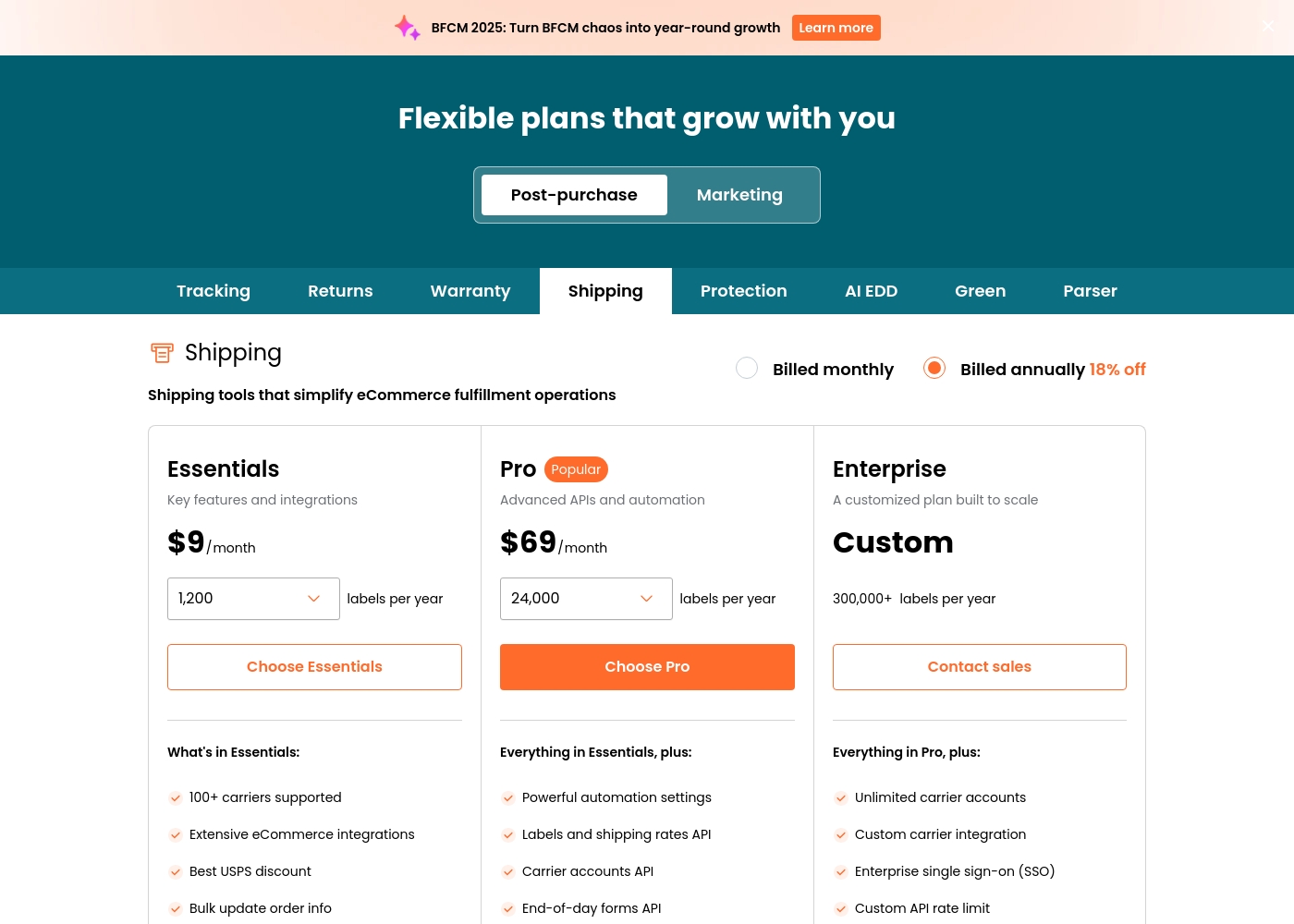
AfterShip Shipping costs between $0 and $69 per month with four primary plans: Free (basic features), Essentials at $9/month, Pro at $69/month, and Enterprise (Custom pricing).
Below you can review the specific limits and features for monthly billing. Remember that choosing annual billing can save you 18% on your subscription price.
Free
Price: $0 Best For: Businesses just starting out Other Features: You get all basic features and 10 free shipping labels to start.
- All basic features
- 10 free shipping labels
- 100+ carriers supported
- Extensive eCommerce integrations
- Best USPS discount
- Bulk update order info
- Bulk create shipping labels
- Everything in Essentials
- Powerful automation settings
- Labels and shipping rates API
- Carrier accounts API
- End-of-day forms API
- Everything in Pro
- Unlimited carrier accounts
- Custom carrier integration
- Enterprise single sign-on (SSO)
- Custom API rate limit
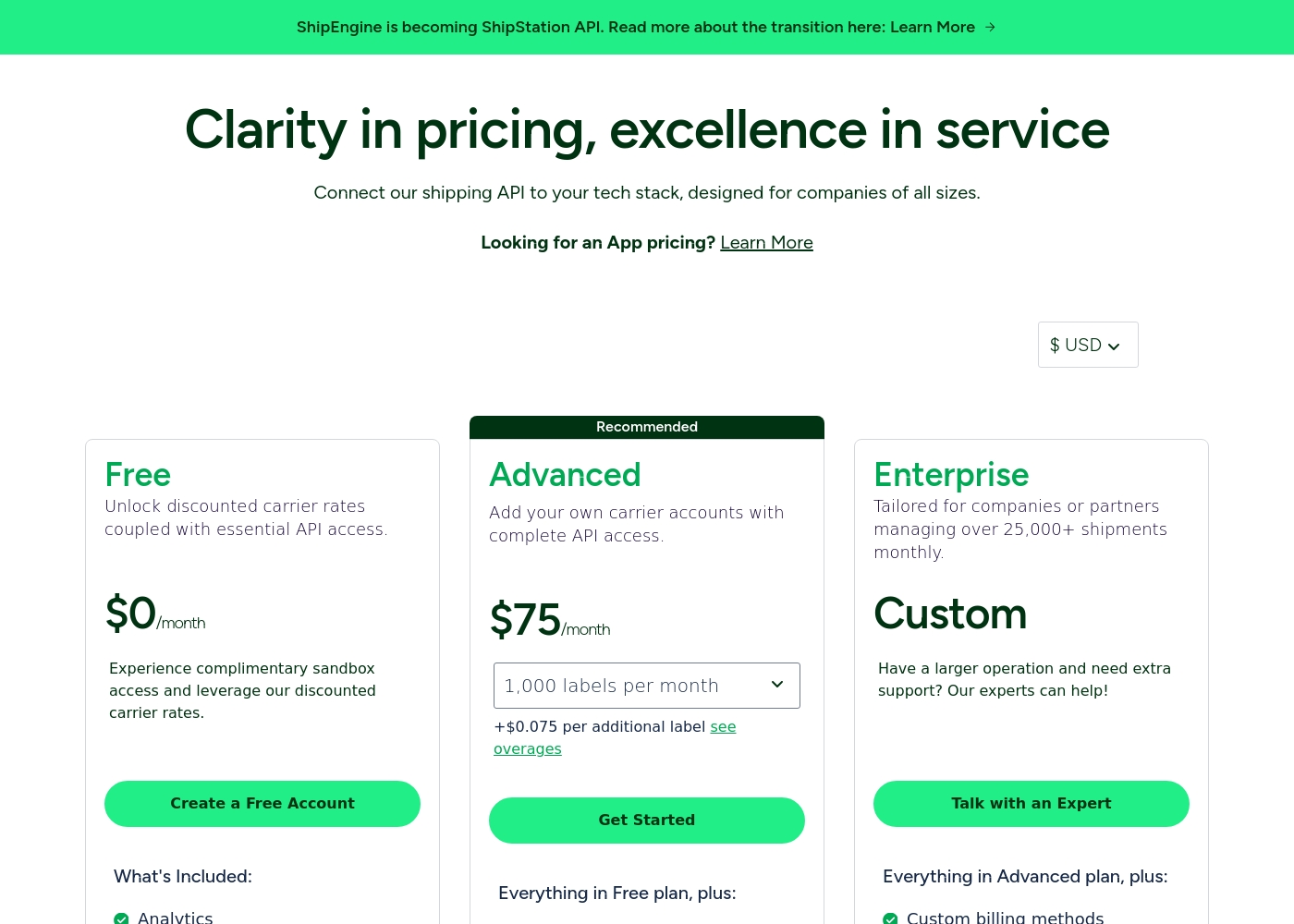
ShipEngine pricing: ShipEngine offers a transparent pricing structure starting with a free tier and scaling to usage-based paid plans starting at $75/month. You can choose to stick with ShipEngine's carrier rates for free or bring your own accounts with an Advanced plan.
house. Note: ShipEngine is transitioning to ShipStation API.
Individual plan names and features are detailed below. Tracking and address validation API calls may incur additional costs based on volume.
Pricing Notes
- AfterShip Shipping offers a much lower entry point at $9/month for the Essentials plan.
- ShipEngine's Advanced plan starts higher at $75 per month for 1,000 labels, plus overage fees.
- AfterShip Shipping provides a remarkable benefit by offering up to 90% savings via their USPS partnership.
- ShipEngine has usage overage fees if you exceed label or specific API call limits, increasing complexity.
- Annual billing saves 18% on the subscription costs for AfterShip Shipping paid plans.
- ShipEngine offers a subscription-free Free plan to access discounted carrier rates.
Pricing Head-to-Head
User Reviews
AfterShip Shipping reviews reveal highly mixed feedback, reflected in its lower overall TrustScore. While the core product offers strong features like label printing and easy navigation, recurring user frustrations center on critical operational failures.
The most common complaint involves intensely slow and unhelpful customer support 👎. Many users report support tickets taking weeks or even a month for a simple reply, often finding agents unresponsive or copying irrelevant, canned text.
Debashish was super helpful! He answered all my questions quickly and even got on a Google Meet to walk me through the steps. This was truly excellent customer service.
Our Verdict
Choosing between AfterShip Shipping and ShipEngine means deciding between merchant convenience and developer control. ShipEngine consistently wins for technical performance and global reach. AfterShip Shipping is the easier, cost-effective choice for small, US-focused shippers. AfterShip Shipping's superpower is making logistics easier and cheaper for the average merchant. It provides unmatched USPS discounts, saving businesses up to 90% on eligible postage. AfterShip Shipping users can also automate routine fulfillment tasks up to 80% using defined business rules. Its lowest paid plan is only $9/month. ShipEngine is the dedicated, high-performance API solution, built for extensive customization. Its massive 200+ carrier network is significantly larger than AfterShip Shipping’s 129 carriers. ShipEngine supports developers with a free sandbox and powerful rapid integration tools like Elements. Your deciding factor depends on who is using the tool. Choose AfterShip Shipping if you need affordable entry and high automation via a simple web portal. Choose ShipEngine if you are a developer building a sophisticated, custom logistics platform or integrating with core enterprise systems. ShipEngine is superior for global scalability. Ultimately, ShipEngine offers better overall capabilities for enterprise-grade volume and flexibility, especially for international shipping. However, AfterShip Shipping is the recommended cost-saving solution for small businesses who mostly ship domestically and value interface simplicity.
Frequently Asked Questions
Which software is better for high-volume, enterprise shipping?
ShipEngine is generally better suited for high-volume enterprise users. Its platform is designed for over 25,000 monthly shipments with higher API limits. AfterShip Shipping's Enterprise tier handles 300,000+ labels annually, but ShipEngine is built for deeper technical integration.
Does AfterShip Shipping or ShipEngine have a larger selection of carriers?
ShipEngine offers a significantly larger network with access to over 200 global carriers. AfterShip Shipping provides access to 129 global carriers. ShipEngine offers greater geographical reach for highly specialized logistics needs worldwide.
Which tool offers the best shipping discounts?
AfterShip Shipping advertises highly specific USPS savings, up to 90% on eligible shipments. ShipEngine offers discounted carrier rates, but the maximum savings percentage is not specified. AfterShip Shipping is better for specific USPS cost reduction.
Can I use my existing carrier contracts with AfterShip Shipping and ShipEngine?
Yes, both AfterShip Shipping and ShipEngine allow you to connect your existing carrier accounts. This feature is unlocked only once you upgrade to a paid plan on both platforms. ShipEngine requires the Advanced plan ($75/month) to connect your custom rates.
Which platform provides global address validation features?
ShipEngine is the winner here, offering address validation for any address globally. AfterShip Shipping's validation is specifically limited to U.S. addresses only. This makes ShipEngine essential for international e-commerce compliance.
Is ShipEngine too technical for a small business owner?
ShipEngine is highly developer-focused and designed for API integration into complex systems. AfterShip Shipping is likely an easier, more accessible choice for small businesses. AfterShip Shipping provides a clearer fulfillment management web interface.
Ready to Choose?
Both tools have their strengths. Choose based on your specific needs.