AfterShip Returns vs Seel
AfterShip Returns and Seel both handle returns, but they tackle different problems. AfterShip Returns focuses on turning refunds into revenue via exchanges. Seel builds an entire AI-powered post-purchase support layer to cut your ticket volume.
Best for: E-commerce businesses with 100+ monthly returns, Operations teams needing to automate complex, conditional return policies
Best for: Merchants drowning in 'Where Is My Order?' support tickets, Teams wanting to automate common post-purchase inquiries 24/7
Advanced Automation, Risky Service Reliability
We find AfterShip Returns to be feature-rich, offering advanced tools for automation, fraud prevention, and revenue recovery through exchanges. The advertised benefits are substantial, including reported cuts in processing time. Overall, the significant gap between the product's advanced potential and the deeply concerning reports of poor reliability, support, and billing practices necessitates caution.
Pros
- Maximizes revenue retention using incentivized exchanges and store credit.
- Configurable policy rules handle complex, conditional return workflows.
- Built-in fraud detection protects against policy abuse and repeat offenders.
- Supports printerless returns using QR codes and broad global drop-off sites.
Cons
- Severe lack of customer support responsiveness and efficacy is a common complaint.
- Frequent user reports detailing inaccurate or delayed tracking information.
- Recurring issues with unauthorized billing and difficulty canceling subscriptions.
- Overage fees of $0.50–$1.00 per return can quickly increase monthly costs.
Excellent post-purchase automation for e-commerce.
Seel effectively automates the post-purchase chaos, handling returns, tracking, and support with impressive AI. Overall, we find it's a robust, secure solution that delivers on its promise to reduce merchant workload and improve the customer experience, though it requires a custom consultation for pricing.
Pros
- Significantly reduces WISMO tickets with automated tracking updates.
- Provides 24/7 AI-powered live support for common shopper queries.
- Offers a branded, configurable resolution portal for returns/refunds.
- Integrates smoothly with platforms like Shopify.
Cons
- Pricing is not public; requires a custom demo and consultation.
- No free trial or free plan is explicitly offered.
- Initial onboarding and setup may require merchant effort.
- Services like 'One-click resale' are still in beta.
AboutAfterShip Returns
AfterShip Returns is comprehensive management software designed to automate your entire returns and exchanges process. It moves returns from being a headache to a genuine new opportunity. This solution helps retailers turn unhappy returns into revenue retention through tools like incentivized exchanges and store credits. You get complete policy control and simplified global reverse logistics. The platform reduces complexity and eliminates many manual tasks, freeing up your team's time. ✅
AboutSeel
Seel is a post-purchase infrastructure platform for online merchants. It provides the tools to manage the entire customer experience after the "Buy" button is clicked. Think of it as a centralized system for handling returns, refunds, and support queries, powered by AI and trained on millions of interactions. ✅
Highlights
Feature Comparison
Features Overview
We highlight the main differences and pick a winner for each feature.
Core Value Proposition
AfterShip Returns optimizes the returns process. Seel builds a comprehensive post-purchase safety net.
AfterShip Returns is laser-focused on automating the returns workflow to retain revenue. It helps you convert refunds into exchanges or store credit. The platform offers deep policy automation and fraud detection for returns. Seel takes a broader view. It provides a unified system for returns, delivery tracking, and AI-powered customer support. Its goal is to eliminate the post-purchase chaos and reduce your support team's workload. The key difference is scope. AfterShip Returns solves a specific, costly problem (returns). Seel aims to own the entire post-purchase customer experience. Choose AfterShip Returns if your primary pain is return costs and process. Choose Seel if you're overwhelmed by a high volume of delivery and support inquiries.
Automation & AI
Seel's AI handles live support. AfterShip's automation manages complex return rules.
AfterShip Returns offers sophisticated rule-based automation. You can create conditional workflows for return eligibility, routing, and processing. This is great for enforcing complex, specific policies automatically. Seel leverages AI differently. Its 'Agentic Workforce' provides 24/7 live AI chat to shoppers. This AI is trained on your policies to handle real-time questions like address changes, not just return status. AfterShip's strength is operational automation behind the scenes. Seel's strength is customer-facing, conversational automation. For heavy policy enforcement, AfterShip Returns is more configurable. For deflecting support tickets, Seel's AI is more direct.
Revenue vs. Support
AfterShip Turns returns into retained sales. Seel Reduces support costs and boosts confidence.
AfterShip Returns is built for revenue recovery. It incentivizes exchanges and offers a 'Shop Now' feature. This directly tackles the revenue loss from refunds and can lead to reported 50% revenue retention. Seel focuses on operational savings and conversion. By automating tracking and support, it slashes WISMO tickets. Its Worry-Free Purchase program can increase conversion rates by giving shoppers confidence. AfterShip's value is in protecting your top line. Seel's value is in improving your bottom line through efficiency and increased sales. If returns are eating your margins, use AfterShip. If support costs and lost sales from anxiety are the issue, use Seel.
Logistics & Tracking
AfterShip Manages label generation. Seel Focuses on proactive delivery updates.
AfterShip Returns excels in reverse logistics. It auto-generates labels for 62+ carriers and offers 300,000+ printless drop-off locations. This streamlines the physical return process for customers and your team. Seel shines in proactive communication. Its global delivery tracking sends real-time updates directly to shoppers. This single feature is designed to eliminate 'Where Is My Order?' inquiries. AfterShip simplifies the action of returning an item. Seel simplifies the waiting and communication around any shipment. For complex return shipping logistics, AfterShip is more robust. For pre-return delivery confidence and updates, Seel is superior.
Ease of Use
Seel is praised for smooth integration. AfterShip's setup is fast but support is lacking.
AfterShip Returns advertises a ~30-minute setup. However, user reviews frequently cite poor support and issues when problems arise, making troubleshooting difficult. Seel is consistently noted for smooth integration, especially with Shopify. The branded resolution portal is straightforward to configure, and support is described as responsive. The experience when things go right favors both. The experience when you need help heavily favors Seel. For straightforward setup and reliable support during configuration, Seel has the edge based on user sentiment.
Pricing Transparency
AfterShip has clear published plans. Seel requires a custom demo.
AfterShip Returns lists clear, usage-based plans starting at $11/month. You know exactly what you'll pay for a given return volume, including overage fees. Seel's pricing is not public. You must book a demo for a custom quote. The model is likely usage-based or integrated into a shopper fee. This makes direct cost comparison impossible upfront. AfterShip offers predictability. Seel offers tailored pricing but requires a sales process. If you need to budget precisely before a sales call, AfterShip Returns is more transparent.
Customer Support Quality
Seel users report responsive help. AfterShip users report severe delays and issues.
AfterShip Returns' reviews are filled with complaints about support. Users report month-long response times, template answers, and unhelpful agents. This is a major red flag. Seel's reviews praise its support team. Users mention responsive and helpful configuration assistance. The overall sentiment is that the team is easy to work with. This is one of the most critical differences in the real-world experience of using these tools. Reliable support when you need it is invaluable. Seel appears to deliver this, while AfterShip Returns currently does not.
Security & Compliance
Both are compliant. Seel has insurance licensing for added trust.
AfterShip Returns holds ISO 27001 certification and complies with GDPR. This meets standard enterprise security requirements for data management. Seel offers SOC 2 Type II, GDPR, and CCPA compliance. It also holds a National Association of Insurance Commissioners license in all 50 US states. This insurance licensing adds a layer of regulated trust. Both meet essential security standards. Seel's NAIC license is unique for a post-purchase platform and may matter for specific business models. For most businesses, both are secure. If operating in regulated sectors, Seel's licensing could be a deciding factor.
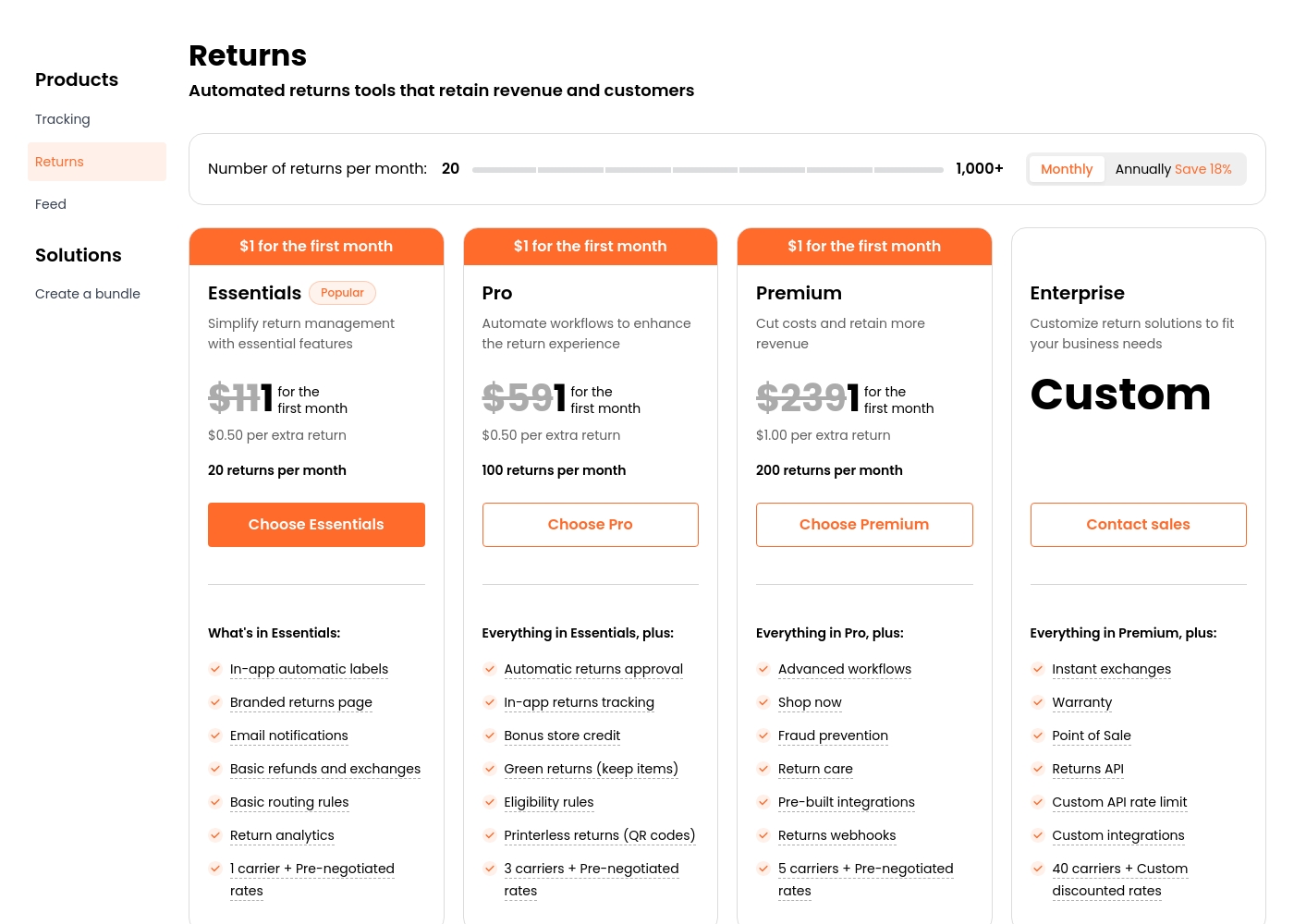
AfterShip Returns costs between $11 and Custom per month with three standard plans: Essentials at $11, Pro at $59, and Premium at $239. There is also an Enterprise tier for larger, customized needs.
These plans utilize a flexible model based on the number of returns processed monthly.
Essentials (Popular)
Price: $11 per month Best For: Simplify return management with essential features Other Features:
- In-app automatic labels
- Branded returns page
- Basic refunds and exchanges
- Return analytics
- 1 carrier + Pre-negotiated rates
- In-app automatic labels
- Branded returns page
- Email notifications
- Basic refunds and exchanges
- Basic routing rules
- Automatic returns approval
- In-app returns tracking
- Bonus store credit
- Green returns (keep items)
- Eligibility rules
- Advanced workflows
- Shop now
- Fraud prevention
- Return care
- Pre-built integrations
- Instant exchanges
- Warranty
- Point of Sale
- Returns API
- Custom API rate limit
Here's a look at the services Seel offers to help manage your post-purchase experience.
Worry-Free Purchase®
Best For: Online retailers wanting to offer comprehensive refunds and returns for any reason. Other Features: - Automatic return/refund processing, - Resolution portal for shoppers, - One-click resale (beta) functionality, - Configurable resolution requirements.
This service is perfect if you want to give your shoppers total confidence during checkout. It lets customers return items for reasons ranging from product issues to simple second thoughts. 🛍️
- Comprehensive refunds and returns for any reason
- Configurable resolution rules
- One-click resale listing (beta)
- Integration with Shopify gift cards
- 24/7 live AI support chat
- Automated delivery tracking
- Real-time resolution status for shoppers
- Custom AI training on brand policies
Pricing Notes
- AfterShip Returns offers transparent, published pricing. The $1 first-month deal is a strong incentive to test.
- Seel's pricing is opaque and requires a sales consultation. No free trial is explicitly advertised.
- AfterShip's overage fees ($0.50-$1.00 per extra return) can add up if your volume fluctuates.
- Seel's cost may be integrated into a shopper fee or usage model, which could shift the cost burden.
Pricing Head-to-Head
User Reviews
Trustpilot reviews indicate that while AfterShip promises advanced software capabilities, the user experience is dramatically impacted by reliability and operational issues. The core problem highlighted by customers is inconsistent tracking accuracy 🤯.
Many users report that delivery status updates are severely delayed, showing packages still "on the way" days after they were physically delivered, fundamentally undermining the reliability of the system. Compounding this, customer support is widely criticized.
Support is frustratingly slow. Agents frequently use template responses and don't seem to read the prior history in the thread, making complex issues hard to resolve quickly.
We found user sentiment for Seel on Trustpilot to be overwhelmingly positive, with many praising the platform's impact on their operations. A recurring theme is the significant reduction in 'Where Is My Order?' (WISMO) tickets and post-purchase support workload, thanks to the reliable tracking and AI chat.
Users frequently highlight the ease of use for both merchants and shoppers, noting that integration is straightforward and the branded resolution portal feels seamless. Several reviews mention the accuracy and helpfulness of the customer support when issues arise.
Seel has been a game-changer for our support team. The automated tracking updates cut our WISMO tickets by a huge margin. It's easy to set up and the branded portal looks great.
Our Verdict
For most e-commerce businesses, Seel is the safer and more comprehensive choice. It tackles the broader chaos of post-purchase operations, not just returns. Its positive user reviews are a major green flag. AfterShip Returns' superpower is deep returns automation. It excels at turning refunds into revenue and enforcing complex policies. It's a specialist tool for high-volume return processing. Seel's superpower is building a full post-purchase safety net. Its AI chat and proactive tracking eliminate a massive chunk of support tickets. It improves the customer experience from checkout to delivery. The deciding factor is your core problem. If returns are your only major pain, explore AfterShip Returns—but be cautious of its support. If you're fighting a war on multiple fronts with support tickets, choose Seel. For a reliable partner to handle the entire post-purchase journey, pick Seel. For a dedicated tool to optimize just the returns engine, AfterShip Returns is technically more specialized, but proceed with eyes open.
Frequently Asked Questions
Which is better for small teams: AfterShip Returns or Seel?
Seel may be better for small teams. Its AI support can extend your capacity without hiring. AfterShip Returns helps automate return processing, but poor support could burden a small team if issues arise.
Does AfterShip Returns reduce 'Where Is My Order?' tickets like Seel?
No. AfterShip Returns focuses on automating the returns process. Seel's core feature is proactive delivery tracking and AI chat specifically designed to eliminate WISMO tickets.
Is Seel worth the extra cost over AfterShip Returns?
Seel's pricing is custom, so 'extra cost' isn't clear. Its value is in reducing support workload and boosting confidence. AfterShip's cost is transparent. Compare based on your operational pain points.
Which platform has better customer support?
Seel has significantly better-reported customer support. Reviews praise its responsiveness. AfterShip Returns' reviews frequently complain of unresponsive, template-based support that delays resolutions.
Can AfterShip Returns handle complex, conditional return policies?
Yes. AfterShip Returns offers advanced, configurable rules based on return reasons, time windows, and eligibility. This is one of its key strengths for enforcing specific business policies.
Does Seel offer a free trial?
No. Seel does not advertise a free trial. You must book a demo for a consultation. AfterShip Returns offers a heavily discounted first month ($1) for testing.
Ready to Choose?
Both tools have their strengths. Choose based on your specific needs.