AfterShip Email vs Cakemail
AfterShip Email is hyper-focused on e-commerce, offering powerful AI and revenue recovery tools. Cakemail targets developers and integrated systems via robust APIs and low-cost access. This comparison pits specialist merchant marketing against technical flexibility and affordability.
Best for: E-commerce businesses specifically using Shopify or WooCommerce, Teams prioritizing revenue recovery automation from abandoned carts
Best for: Developers or agencies needing robust Email APIs for deep product integration, Startups seeking a permanent Free plan and highly affordable paid tiers
Feature-rich, but buyer beware of support.
The platform offers impressive specialized eCommerce automation features and supports robust AI-powered segmentation. However, we identified significant, widespread user complaints regarding poor operational reliability and extremely slow, unhelpful customer support organizationally. Overall, the powerful feature set is clearly offset by notable business practice and service risks.
Pros
- Specialized tools built for eCommerce (abandoned carts, unique coupon codes).
- Robust AI features available for predictive demographics and customer segmentation.
- Clear, flexible pricing tiers that include a helpful free plan.
- Intuitive drag-and-drop editor simplifies creating personalized email campaigns.
Cons
- Widespread user reports of extremely unresponsive and ineffective customer support.
- System reliability issues cited, particularly concerning data accuracy (tracking service).
- Recurring user complaints about unauthorized charges and difficulties canceling subscriptions.
Specialized Email API for Product Integration.
We assessed Cakemail based on its defined market position: an email platform designed for deep product integration, offering embedded solutions and robust APIs. The pricing is accessible, featuring a permanent Free tier and low costs for smaller lists. Overall, this is a highly specialized tool best suited for developers or companies needing to bake email functionality directly into their existing software products.
Pros
- Permanent Free plan is available for continuous use and testing.
- Specific focus on embedded email capabilities and Email API access.
- Strong integration support via Zapier connections.
- Premium plan offers unlimited users and unlimited audiences.
Cons
- Pricing scales strictly based on total contact count.
- Monthly send limits are relatively conservative for paid tiers (e.g., 7,500 sends).
- Specialized focus on API/embedded use may limit appeal for general marketing needs.
- Lack of external user reviews makes reliability and support assessment difficult.
AboutAfterShip Email
AfterShip Email is an agile email automation tool built specifically for eCommerce needs. It helps you design and execute targeted campaigns that boost sales and improve customer engagement. This software works well with major platforms like Shopify, WooCommerce, and Klaviyo, ensuring you can leverage existing data easily. 💡
The platform provides well-designed templates for various scenarios, allowing you to create relevant content without excessive complications. By integrating seamlessly with other AfterShip systems, you can achieve full visibility and engagement throughout the customer lifecycle.
AboutCakemail
Cakemail is described fundamentally as an Email Marketing Platform. It is designed for businesses looking to enhance their existing offerings. This includes integrating options like embedded email, automation, or resale products directly into their services. It supports scaling companies by providing robust capabilities such as Email APIs and dedicated Professional Services. 💡
Highlights
Feature Comparison
Features Overview
We highlight the main differences and pick a winner for each feature.
E-commerce Optimization
AfterShip Email provides built-in tools for retail conversion; Cakemail is generalized.
AfterShip Email is purpose-built for Shopify and WooCommerce merchant needs. It offers Unique Coupon Codes to maximize tracking and prevent fraud. This specialized feature can lead to major revenue jumps (48% reported increase). Cakemail focuses on core email marketing and product integration via APIs. It doesn't natively advertise specialized upsell or coupon code features. You would need custom implementation through its API. AfterShip Email gives merchants immediate access to high-impact conversion tools. Cakemail requires more technical effort to achieve similar results. If your main goal is optimizing online revenue streams, AfterShip Email is the default choice.
Integration & API Access
Cakemail offers robust, core Email APIs; AfterShip Email gates complex APIs behind Enterprise plans.
Cakemail’s core strength is integration, offering robust Email APIs and Zapier connectivity. This allows developers to embed email functionality directly into their applications. Cakemail is designed to power up your product. AfterShip Email connects quickly to Shopify and standard eCommerce tools. Its full range of advanced APIs is restricted only to the expensive Enterprise plan. This is the clear differentiator: developers needing deep, flexible integration should choose Cakemail. Standard merchants should stick with AfterShip Email. Cakemail makes complex automation and data sync simpler using its developer-first approach.
AI and Targeting
AfterShip Email uses advanced AI features, but Cakemail relies solely on standard segmentation.
AfterShip Email provides AI-powered Predicted Demographics for better segmentation. It uses smart algorithms for in-email product recommendations. This drives personalization based on forecasted customer features. Cakemail achieves smarter targeting through robust audience management capabilities. It lacks specific AI-driven features like demographic prediction. Its targeting relies on data fed via Zapier integrations. If predictive intelligence is a must, AfterShip Email is the only option here. Cakemail provides flexible segmentation but without the deep learning layer. Use AfterShip Email to leverage predictive customer insights without managing complex data pipelines yourself.
Pricing Structure
Cakemail is much cheaper for small lists; AfterShip Email offers more features but requires a higher investment.
Cakemail’s Premium plan costs only $14/month for 500 contacts, including unlimited users. This provides excellent value for small, collaborative teams. Cakemail pricing scales strictly with list size. AfterShip Email starts at $9/month, but advanced features quickly push the price to $99-$149/month. You must pay an additional $10-$12 per user per month. Cakemail is better for budget-conscious companies that need basic power. AfterShip Email delivers specialized ROI-driving features at a higher price point. The high cost of adding team members drastically increases the cost of AfterShip Email for growing firms.
Team & User Access
Cakemail fully supports large teams with unlimited users; AfterShip Email charges expensive per-seat fees.
Cakemail is a huge win for collaboration, offering unlimited users on its Premium plan. Even the affordable Growth plan supports five user accounts. You pay only for your contacts. AfterShip Email requires purchasing Team Member access separately for $10-12 monthly per seat. This can add significant, hidden costs quickly. For growing teams who need many logins, Cakemail is budget-friendly and hassle-free. AfterShip Email penalizes scaling team size. A team of ten using AfterShip Email would pay an additional minimum of $100 monthly just for access.
Customer Support Quality
AfterShip Email has concerning, documented negative support reports; Cakemail feedback is currently missing.
Widespread user reports cite AfterShip Email's support as difficult, unresponsive, and ineffective. Agents often provide copy-pasted responses. AfterShip Email offers a paid Silver Support plan with guaranteed 10-minute response times via chat. You must pay extra for reliable help. Cakemail includes 'Premium Support' in its top plan but provides no specific promises or response SLAs. External user sentiment is currently unknown. Users choosing AfterShip Email expose themselves to a higher risk of poor service quality unless they pay for the Silver support tier.
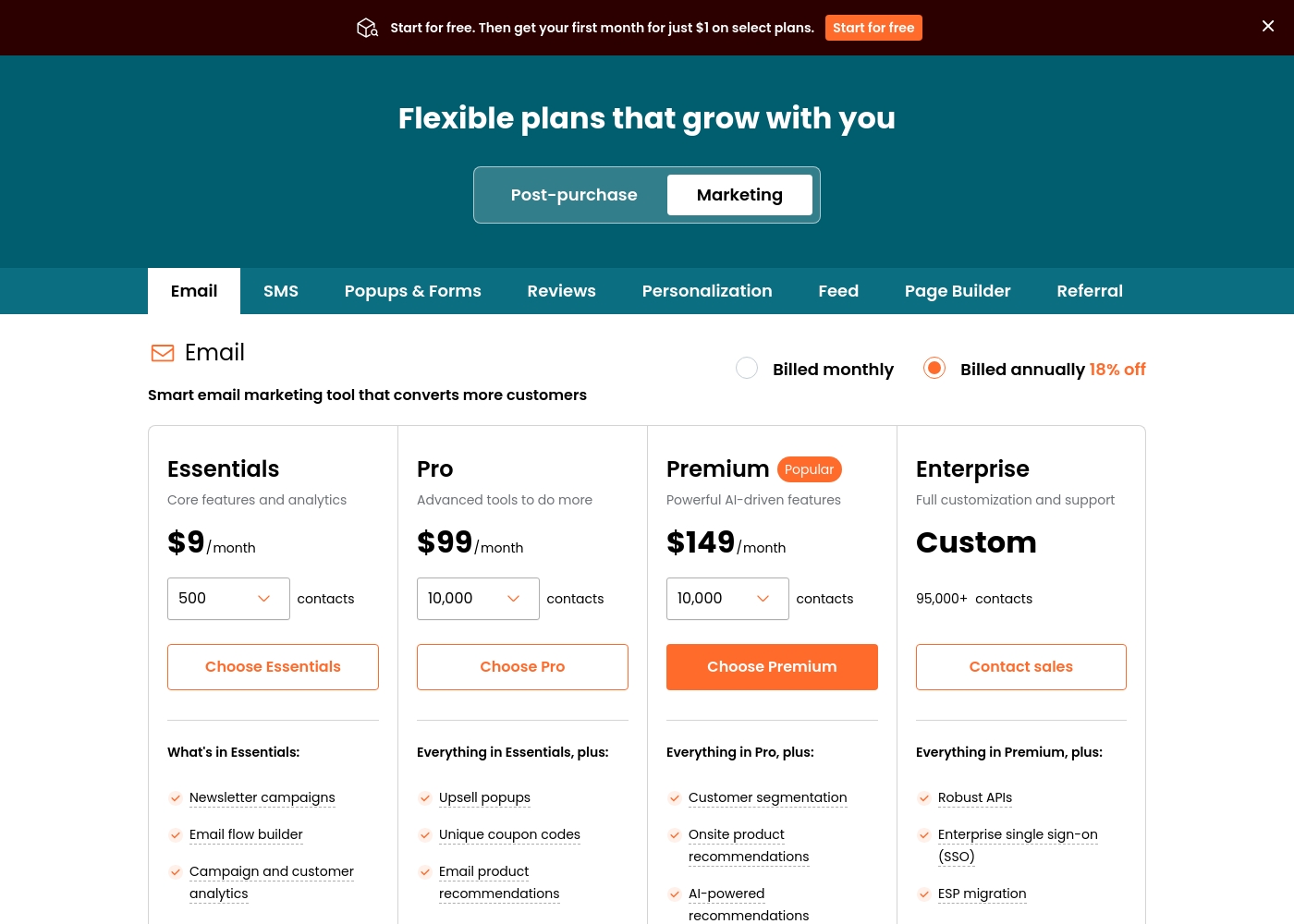
AfterShip Email costs between $9 and Custom per month with 4 main paid plans: Essentials at $9/month, Pro at $99/month, Premium at $149/month, and Enterprise at Custom pricing.
These flexible plans are designed to accommodate your growing business needs, with pricing based on your number of contacts. If you choose to be billed annually instead of monthly, you save 18%.
Essentials
Price: $9/month Best For: Core features and analytics Other Features:
- Newsletter campaigns
- Email flow builder
- Campaign and customer analytics
- Remove AfterShip branding
- Includes all basic features
- Newsletter campaigns
- Email flow builder
- Campaign and customer analytics
- eCommerce and ESP integrations
- Remove AfterShip branding
- Everything in Essentials, plus:
- Upsell popups
- Unique coupon codes
- Email product recommendations
- Countdown timers
- Everything in Pro, plus:
- Customer segmentation
- Onsite product recommendations
- AI-powered recommendations
- Advanced automated email flows
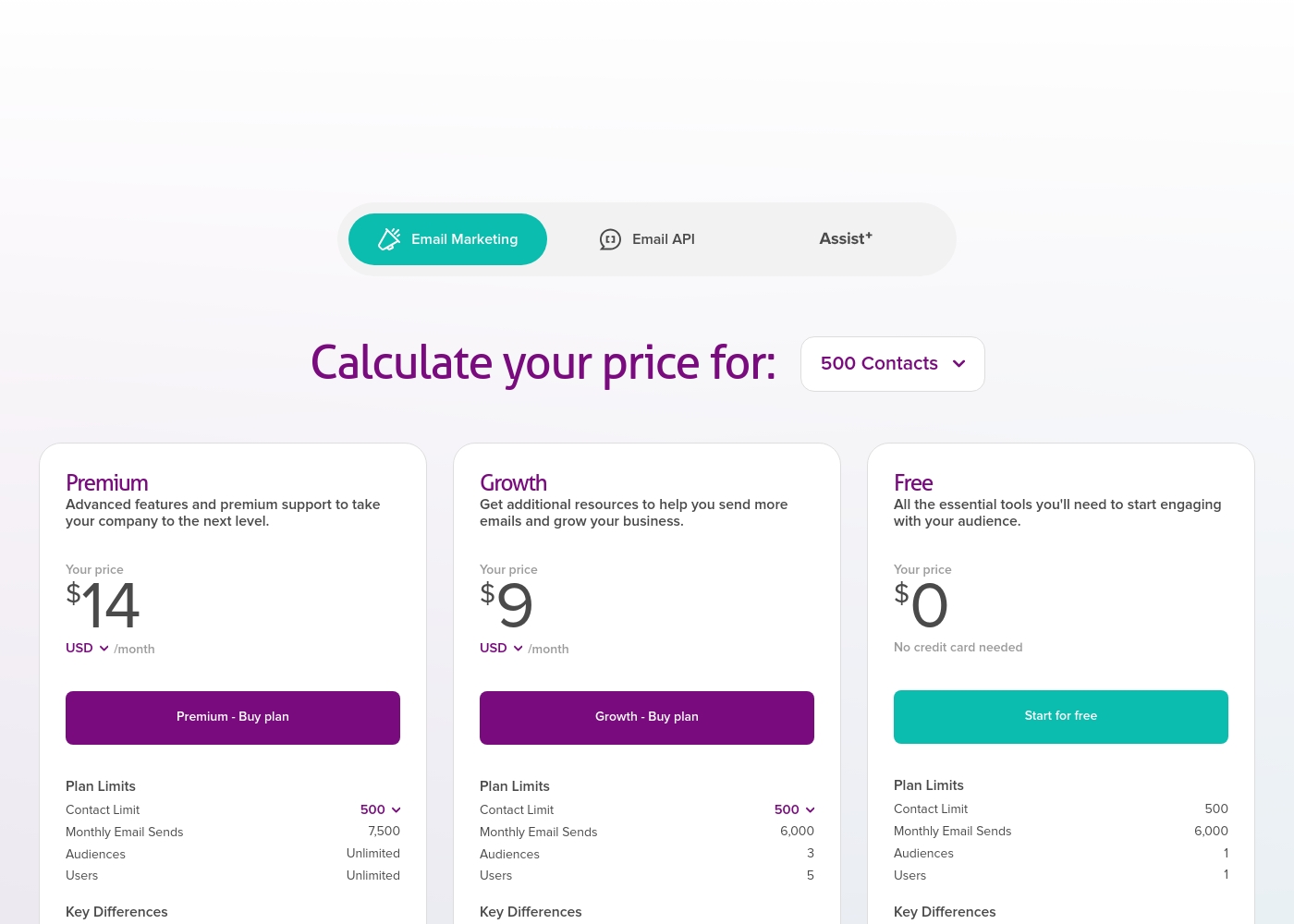
Cakemail costs between $0 and $14 per month for up to 500 contacts with three plans: Free at $0, Growth at $9, and Premium at $14.
The prices shown below are specifically for accounts managing up to 500 contacts. Prices will increase if you need higher contact limits or greater sending volumes.
Free
Price: $0 /month Best For: New businesses or teams just starting out with email marketing Other Features:
- No credit card required to sign up
- Allows 1 user and 1 audience
- 6,000 monthly email sends
- Advanced features and premium support
- Unlimited Audiences
- Unlimited Users
- Additional resources to grow your business
- 3 Audiences
- 5 Users
- Essential tools to start engaging with your audience
- 1 Audience
- 1 User
- No credit card needed
Pricing Notes
- AfterShip Email charges an extra $10-$12 per team member, significantly raising costs for large teams.
- Cakemail’s highest plan available for 500 contacts is $14/month and includes unlimited users.
- AfterShip Email users can save 18% by choosing annual billing over monthly subscriptions.
- Cakemail has conservative maximum monthly send limits (7,500 on Premium plan).
- Before upgrading AfterShip Email, be aware of widespread reports criticizing their billing and cancellation practices.
Pricing Head-to-Head
User Reviews
The external feedback available mostly targets AfterShip’s core logistics and tracking product, not the dedicated Email marketing tool. However, the consistent negative sentiment raises significant concerns about the company's overall operational reliability and customer support structure.
Users frequently cite major issues with tracking accuracy, noting packages are often shown as "still on the way" even after delivery, or that logs are contradictory. More alarmingly, the review volume heavily criticizes the customer service experience.
This is some of the worst business support I’ve received. Agents refuse to read the context in the thread and just copy-paste answers that don't address the core question. Getting a simple reply often takes over a month to process.
We currently do not have specific user feedback snippets available for Cakemail from Trustpilot or Capterra to establish recurring themes regarding user experience. Based solely on the product description, Cakemail positions itself as a platform focused on embedded email solutions for products and services, featuring robust Email APIs and Zapier integrations.
Their pricing structure is usage-based, scaling with contacts, offering a permanent Free plan alongside Growth ($9/month) and Premium ($14/month) tiers (for 500 contacts). While the tool aims to offer smarter targeting and professional services, we cannot provide concrete details on user satisfaction regarding ease of use, support responsiveness, or system reliability.
Our Verdict
Choosing between AfterShip Email and Cakemail depends entirely on your primary goal. Are you a high-growth e-commerce brand, or a developer specializing in integration? The difference is stark. AfterShip Email is the clear winner for online merchants and sellers. Its superpower is specialized conversion, offering unique coupon codes and AI recommendations. Features like the 4.2% abandoned cart recapture rate prove its immediate ROI for eCommerce. Cakemail shines for technical users and highly collaborative teams. Its superpower is technical flexibility and affordability for small lists. Cakemail provides robust Email APIs and grants unlimited user access, saving massive licensing fees. Its focus is embedded email solutions. Pricing is the deciding factor for small operations. Cakemail is vastly cheaper for full functionality and large teams. AfterShip Email delivers highly specialized features, but at a premium price and with known support risks. If you sell products online, trust AfterShip Email's specialized automation. If you build products or need affordable API access for custom integration, Cakemail is your powerful, cost-effective ally.
Frequently Asked Questions
Which tool is better for a standard e-commerce store: AfterShip Email or Cakemail?
AfterShip Email is purpose-built for e-commerce, offering native Shopify and WooCommerce integrations. It includes unique features like abandoned cart recovery and unique coupon codes. Cakemail is better for developers who want to embed email into their own apps.
Why is Cakemail's Premium plan so much cheaper than AfterShip Email's?
Cakemail’s overall cost is much lower for small contact lists (e.g., $14 for 500 contacts). AfterShip Email invests heavily in specialized AI and recovery features. It prices these advanced features higher and charges separately for team access.
Does AfterShip Email or Cakemail offer better support for a large team?
Cakemail is better for large teams because its top plan includes unlimited users. AfterShip Email charges an extra $10-$12 per team member monthly. This per-seat fee adds significant, unexpected cost to AfterShip Email.
Can I integrate Cakemail with Shopify easily for basic marketing automation?
You can connect Cakemail using Zapier or its Email APIs to sync data. AfterShip Email simplifies this with native, one-click integrations for Shopify and WooCommerce. AfterShip Email offers a smoother setup for merchants.
Does Cakemail offer specialized features like Unique Coupon Codes?
No, Unique Coupon Codes are specific to AfterShip Email, designed for e-commerce revenue growth. Cakemail is more oriented toward generalized marketing automation flows. AfterShip Email uses these codes to reduce fraud and boost sales.
Which tool offers a better approach to scalability?
They scale differently. AfterShip Email offers dedicated Enterprise features like SSO and account managers for huge retailers. Cakemail offers high-volume limits via Custom Plus plans and supports scaling through resale partnerships.
Ready to Choose?
Both tools have their strengths. Choose based on your specific needs.