Google Cloud vs MongoDB
Choosing between Google Cloud and MongoDB can be tough. One is a massive cloud infrastructure provider, while the other is a specialized data platform. Here's how to decide which one fits your project.
强大的基础设施,伴随着有风险的账单和支持体验。
我们承认 Google Cloud 提供了领先的基础设施,为企业工作负载提供了强大的 AI 集成和显著的扩展能力。然而,大量关于客户支持难以获得和令人困惑、不透明的账单的报告令人深感担忧。总而言之,对于那些优先考虑响应式帮助或细致成本控制的用户来说,我们认为该平台存在高风险。
优点
- 可使用 Gemini 和 Vertex AI 等顶级生成式 AI 工具。
- 支持开源、多云和混合开发战略。
- 新用户注册后可获得 300 美元的免费积分。
- 通过承诺使用折扣,有潜力节省高达 57%。
缺点
- 客户服务支持通常难以获得且隐藏。
- 用户报告尽管有积分,但账单不透明且出现意外收费。
- 技术支持订阅费用极高(每月高达 12,500 美元)。
- 按需付费服务缺乏硬性支出限制是一个常见痛点。
Powerful, flexible platform for modern data.
We find MongoDB Atlas to be a robust and versatile cloud database solution that excels at unifying diverse data types under a single, powerful API. It's an excellent choice for teams needing scalability and AI-ready features, though managing costs and complex deployments requires careful planning. Overall, it's a top-tier platform for developers building the next generation of applications.
优点
- Excellent flexibility with its document model.
- Powerful, unified platform for databases, search, and streaming.
- Strong scalability and high availability guarantees.
- Native vector search integration for AI applications.
缺点
- Costs can escalate quickly with high usage and dedicated resources.
- Advanced features and configurations can have a steep learning curve.
- Support responsiveness can be inconsistent for some users.
关于Google Cloud
Google Cloud 是一个全面的云平台,提供 150 多种产品和功能。它帮助企业现代化现有基础设施或从头开始构建完全由 AI 驱动的应用程序。该服务专为准备进行数字化增长和转型的开发人员、企业领导者和初创公司设计。
新客户可以试用 Google Cloud,免费使用 20 多种产品。此外,您注册后还将获得 300 美元的免费积分以帮助您探索。💡
关于MongoDB
💡 MongoDB Atlas is a comprehensive cloud data platform built for modern applications. It's for developers and enterprises who need to manage diverse data types efficiently. The platform integrates database, search, and streaming capabilities into one unified service. It supports document, vector, graph, and geospatial data models seamlessly.
亮点
功能比较
功能概览
我们强调主要差异并为每个功能选择获胜者。
Core Purpose
Google Cloud is a vast cloud infrastructure platform. MongoDB is a specialized data platform.
Google Cloud offers over 150 products. You can run everything from VMs to AI models. It's like renting a supercomputer. MongoDB Atlas focuses on your data layer. It manages your database, search, and streams. It's like having a dedicated, expert DBA. The difference is scope vs. specialization. Google Cloud provides the entire toolbox. MongoDB excels at one critical tool. For a startup building a full app, Google Cloud provides the foundation. For a team optimizing a data-heavy feature, MongoDB is targeted.
AI & Data Analytics
Google Cloud has massive AI/ML and analytics suites. MongoDB has native vector search for AI apps.
Google Cloud's Vertex AI and BigQuery are industry leaders. You can build models with 200+ foundation models. BigQuery runs petabyte-scale analytics. MongoDB's strength is unifying data and vectors. You can store operational data and embeddings together. This simplifies building AI features like semantic search. Google Cloud offers a broader, more complex AI platform. MongoDB makes specific AI workflows simpler. One is a comprehensive lab, the other a focused workbench. Choose Google Cloud for custom model training. Choose MongoDB for integrating AI into your existing app's data flow.
Database Flexibility
Google Cloud offers multiple managed databases. MongoDB offers one highly flexible document database.
Google Cloud provides Cloud SQL, Spanner, Firestore, and more. You pick the right tool for each job. This can mean managing multiple systems. MongoDB uses a single document model for all data. The same API handles operational, graph, and geospatial data. This reduces context switching. Google Cloud gives you specialized databases. MongoDB gives you one versatile database. It's the difference between a Swiss Army knife and a full workshop. For apps with diverse data types in one service, MongoDB is seamless. For needing different database engines, Google Cloud has options.
Real-time Processing
Google Cloud uses multiple services for streams. MongoDB has integrated stream processing.
Google Cloud handles streams with Dataflow, Pub/Sub, and others. It's powerful but requires configuring separate services. This adds architectural complexity. MongoDB Atlas Stream Processing is built in. You use the same query language for streams and batches. This creates a unified developer experience. Google Cloud offers more scalable, global streaming. MongoDB offers simplicity and integration. One is built for massive scale, the other for developer velocity. For processing Kafka streams alongside your app data, MongoDB is simpler. For global, high-throughput event processing, Google Cloud has dedicated tools.
Ease of Getting Started
Both have generous free tiers. Google Cloud has a steeper initial learning curve.
Google Cloud gives $300 in credits and 20+ free products. However, its console can feel slow and complex. New users report difficulty with simple tasks. MongoDB offers a free-forever tier with 512 MB. The Atlas interface is focused and generally intuitive. Many developers find its document model natural. Google Cloud's scale means more to learn upfront. MongoDB's focus makes its core product more approachable. One is a sprawling city, the other a well-organized campus. Your choice depends on your role. A cloud architect might embrace Google Cloud's scope. An app developer might prefer MongoDB's streamlined data focus.
Cost Management
Google Cloud offers committed discounts but billing can be unclear. MongoDB costs scale with resource usage.
Google Cloud's pricing is usage-based with potential for 57% savings. Users complain about non-transparent billing and unexpected charges. Support for cost limits is a pain point. MongoDB's costs scale with storage and compute hours. Users note costs can escalate quickly with high usage. Monitoring your usage is crucial in both cases. Google Cloud has more discount levers but more billing complexity. MongoDB's model is simpler but can surprise you. Both require vigilant monitoring. For predictable, committed workloads, Google Cloud's discounts help. For variable workloads, MongoDB's pay-as-you-go is straightforward.
Customer Support
Google Cloud support is expensive and hard to reach. MongoDB support is included in paid tiers.
Google Cloud's technical support can cost up to $12,500/month. Free users report support is hidden and nearly impossible to contact. This is a major frustration. MongoDB's Dedicated tiers include enhanced support. Users report mixed experiences but availability is better. SLAs are tied to your pricing tier. Google Cloud's paid support is enterprise-grade but costly. MongoDB's included support is more accessible for mid-market. The difference in accessibility is stark. If you're a large enterprise, Google Cloud's support might be justified. For smaller teams, MongoDB's included support is a significant advantage.
Vendor Lock-in Risk
Google Cloud promotes multicloud. MongoDB is an open-source based platform.
Google Cloud actively supports hybrid and multicloud strategies. They offer tools to manage apps across clouds. This reduces lock-in to their specific infrastructure. MongoDB's core is open source. You can run it on-premise or other clouds. Atlas is a managed service on AWS, Azure, and GCP. Google Cloud sells infrastructure flexibility. MongoDB sells data portability. Both address lock-in from different angles. If you fear infrastructure lock-in, Google Cloud's stance is reassuring. If you fear data lock-in, MongoDB's open-source core is a plus.
Google Cloud 的成本差异很大,因为它采用基于使用量的计费模式,为新客户提供 300 美元的免费积分以及 20 多种免费产品的访问权限。
您在这里找不到固定的月度套餐,而是三种利用平台计算资源的灵活方式。
按需付费(标准定价)
价格:未明确说明(基于使用量) 支持的网站:未明确说明 最适合:需要灵活扩展的各种规模的组织 退款政策:未明确说明 其他特点:
- 您只为您使用的服务付费。
- 无预先费用或终止费用。
- 通过承诺使用折扣节省高达 57%。
- 包含免费 24/7 账单支持。
- 只为您使用的服务付费
- 无预先费用或终止费用
- 通过承诺使用折扣节省高达 57%
- 免费 24/7 账单支持
- 300 美元免费积分
- 免费使用 20 多种产品
- 运行、测试和部署工作负载
- 高达 35 万美元的云积分
- 定制支持和解决方案
- 为创新型公司提供扩展支持
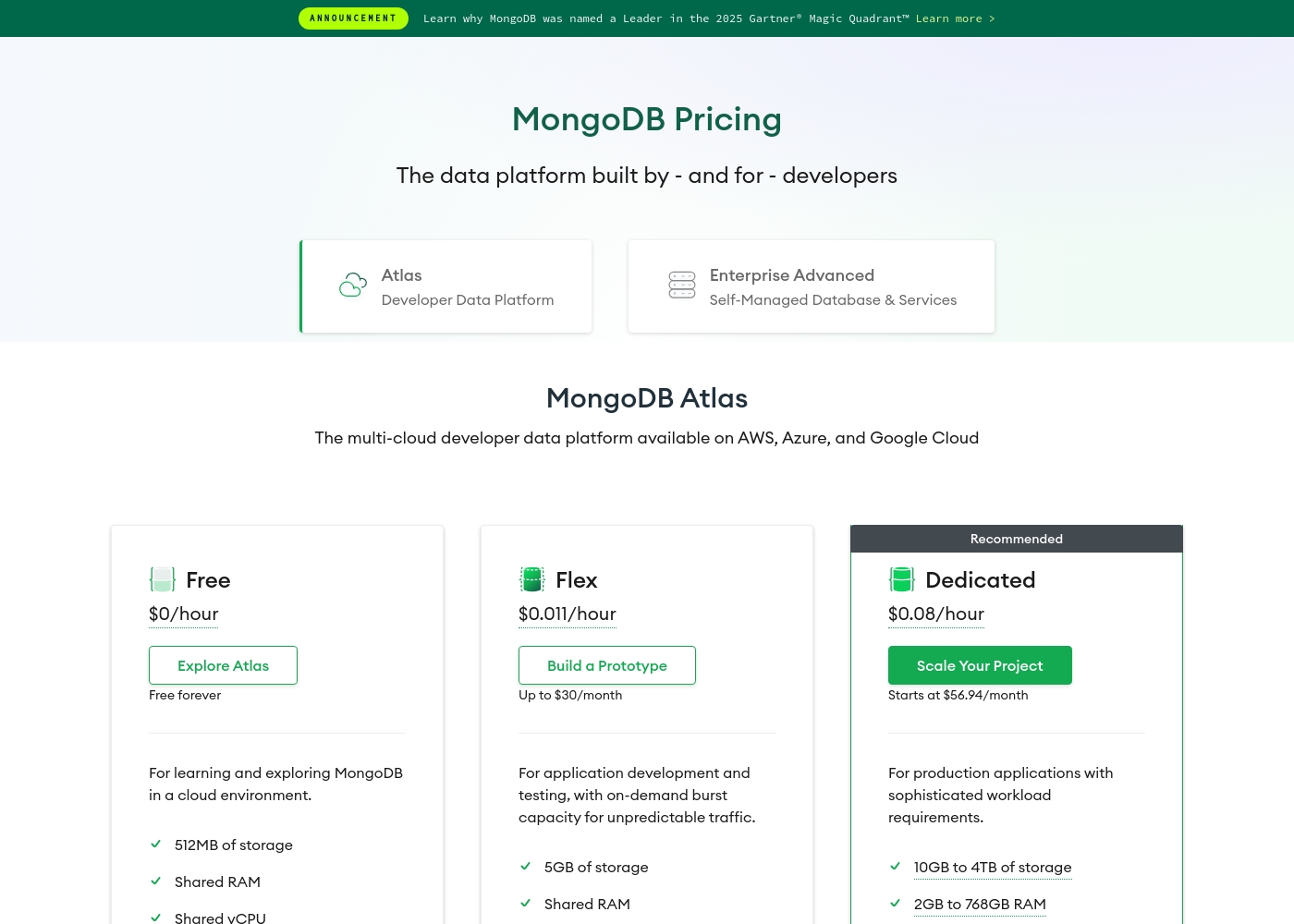
MongoDB pricing: MongoDB offers a range of cloud database options starting with a free-forever tier and scaling to dedicated resources for production environments. Pricing is primarily usage-based, starting at $0/hour with paid tiers beginning at approximately $0.011/hour and $0.08/hour for advanced workloads.
Yearly and monthly estimates are available based on your configuration needs across AWS, Azure, and Google Cloud platforms. Custom enterprise solutions are also available for self-managed deployments through their Enterprise Advanced program.
Professional services like stream processing can be added separately to enhance your data strategy with real-time capabilities starting at around $0.06/hour per instance level SP2 or higher depending on your needs. Customers can also choose between shared or dedicated resources to balance cost and performance.
Pricing Notes
- Google Cloud offers $300 in free credits for new customers, while MongoDB has a free-forever tier.
- Google Cloud's technical support is extremely expensive, costing up to $12,500 per month.
- MongoDB's costs scale with cluster resources (storage, RAM, vCPUs), which can escalate quickly.
- Both platforms use usage-based pricing, making it hard to predict costs without careful monitoring.
- Google Cloud provides committed use discounts up to 57% for predictable workloads.
Pricing Head-to-Head
用户评论
外部情绪,主要通过 Trustpilot 捕捉到,总体非常负面,评分为 1.5 星。最常被引用的问题围绕着账单不透明和完全失灵的客户支持⚠️。用户报告了意外的费用,即使他们拥有大量的免费积分,这些费用有时高达数百美元。许多人认为这种缺乏透明度是针对新用户的“故意陷阱”。此外,寻求帮助几乎是不可能的;用户形容支持系统被刻意隐藏且无法到达,让他们陷入令人沮丧的无休止的循环。那些需要技术帮助的人面临着极其高昂的费用,专业技术支持每月花费高达数千美元。
除了成本管理,用户还批评了易用性的缺乏。用户抱怨控制台“慢得无法使用”,而获取 API 密钥等简单任务的过程需要过多的点击。用户还难以完成重要的账户管理功能,例如删除持续产生费用的激活项目或更新账单信息。这强烈表明,尽管该平台技术强大,但其周边的用户体验、管理和财务控制存在严重缺陷。
我的账户产生了 327 欧元的 API 费用,尽管我有 264 欧元的免费积分可用,但这些积分没有被使用。支持完全隐藏且无法联系到,这看起来像一个故意的陷阱。该平台的定价结构极其不透明。
Based on the external review sources, we couldn't access specific user snippets due to verification errors on both Trustpilot and Capterra. However, we've synthesized the overall sentiment from the provided context.
Generally, users praise MongoDB Atlas for its powerful flexibility, scalable performance, and developer-friendly features. Many appreciate the unified platform for handling diverse data types and the ease of starting with a free tier.
MongoDB's flexibility is a game-changer for our agile team. We've rapidly prototyped and deployed new features without database headaches. The scalability gives us peace of mind.
我们的判断
This isn't a simple apples-to-apples comparison. Google Cloud is the full cloud platform. MongoDB is the specialized data platform. Google Cloud's superpower is its sheer scale. It offers everything from world-class AI with Vertex AI to massive analytics with BigQuery. It's your partner for the entire infrastructure stack. MongoDB's superpower is data unification. It seamlessly blends operational data, vector search, and streaming into one system. This simplifies building complex, data-rich applications dramatically. The deciding factor is your core need. If you need a comprehensive cloud foundation, Google Cloud is the answer. If your biggest challenge is managing and querying diverse application data, MongoDB is your tool. For a startup building from scratch, Google Cloud provides the full toolkit. For a team trying to make their app's data layer smarter and faster, MongoDB delivers targeted power.
常见问题
Which is better for small teams: Google Cloud or MongoDB?
MongoDB often wins for small teams focused on their app's database. Its free-forever tier and focused interface are easier to start with. Google Cloud's $300 credit is generous, but its platform can feel overwhelming.
Does Google Cloud have a database like MongoDB?
Yes, Google Cloud offers Firestore and Cloud Datastore as document databases. They serve similar use cases to MongoDB. However, MongoDB's core platform is built entirely around this document model and its associated features.
Is MongoDB worth the extra cost over Google Cloud?
It's not about extra cost, but about value for your specific need. MongoDB's cost is for a specialized data platform. Google Cloud's costs are for a broad infrastructure suite. If you only need a powerful database, MongoDB's pricing can be more predictable.
Can I use Google Cloud and MongoDB together?
Yes, absolutely. You can run MongoDB Atlas as a managed service on Google Cloud infrastructure. This is a common pattern, combining Google's infrastructure with MongoDB's specialized database.
Which is easier to learn for a developer?
Many developers find MongoDB's document model and query API more intuitive initially. Google Cloud requires learning a vast array of services and concepts. The learning curves serve different goals: app development vs. infrastructure management.
Which platform is better for AI applications?
It depends on the AI task. For training custom models at scale, Google Cloud's Vertex AI is more powerful. For adding semantic search or AI features to an app using your existing data, MongoDB's native vector search is simpler.
准备好选择了?
这两个工具都有各自的优点。根据您的具体需求进行选择。