DataHawk vs Splunk
DataHawk and Splunk both tackle data chaos, but for totally different worlds. DataHawk unifies your ecommerce metrics, while Splunk analyzes machine data for security and IT. Your choice depends on whether you sell products online or manage a complex tech stack.
Best for: Ecommerce brands selling on Amazon and Walmart, Marketing agencies managing multiple online stores
Best for: Enterprise security teams, IT operations and DevOps engineers
Powerful Analytics, But Opaque Pricing
We see DataHawk as a strong contender for businesses needing a unified, AI-powered view of their ecommerce data. The platform promises to simplify complex analytics. Overall, it appears capable, but the custom pricing model and lack of public reviews are key considerations for potential buyers.
优点
- Unifies data from multiple marketplaces into one dashboard.
- Includes AI-guided insights to uncover performance opportunities.
- Designed for ease of use, reducing manual data work.
- Scalable platform with features like daily alerts.
缺点
- Pricing is entirely custom and not publicly disclosed.
- Requires booking a demo for any cost information.
- No standard or transparent monthly/annual rates listed.
- Limited public user reviews make independent validation difficult.
Powerful but complex data platform.
We find Splunk offers a robust, unified platform for security and observability with extensive integrations and scalability. However, its pricing structure is opaque and usage-based, which can make cost planning challenging. Overall, it's a strong choice for enterprises needing deep data analysis, but smaller teams may find it complex and expensive.
优点
- Unified platform for security and observability.
- Over 2,000 integrations with various data sources.
- AI and automation for threat response.
- Handles massive data volumes at scale.
缺点
- Opaque pricing requires consultation with sales.
- Can be complex to set up and learn.
- Usage-based models may lead to unpredictable costs.
- External review access was blocked, limiting user sentiment data.
关于DataHawk
DataHawk is a unified analytics platform for ecommerce. 🎯 It combines data from different sources into one place. The system uses artificial intelligence to help you understand your performance better. It’s designed for ecommerce businesses that want clearer, smarter insights.
关于Splunk
Splunk is a unified platform for security and observability. It's designed for teams that need to search, analyze, and act on data from any source. Whether you're a security analyst hunting threats or an engineer troubleshooting app performance, it brings everything together in one place. ✨
亮点
功能比较
功能概览
我们强调主要差异并为每个功能选择获胜者。
Core Purpose
DataHawk is built for ecommerce, while Splunk is a general-purpose data platform for IT and security.
DataHawk focuses exclusively on unifying sales, ad, and inventory data from marketplaces like Amazon and Walmart. It's designed to replace spreadsheets for ecommerce brands. Splunk is a unified platform for searching, analyzing, and acting on any machine data. It's trusted by enterprises for security threat detection, IT troubleshooting, and infrastructure monitoring. The key difference is specialization. DataHawk solves a specific business problem (ecommerce analytics), while Splunk solves a broad technical challenge (data analysis at scale).
Data Integration
Splunk connects to thousands of sources; DataHawk connects to major marketplaces.
DataHawk integrates with Amazon and Walmart marketplaces. This allows brands to pull their core performance data into one dashboard automatically. Splunk boasts over 2,000 integrations. It can ingest logs, metrics, and traces from virtually any source, including databases, cloud services, and business applications. Splunk's integration ecosystem is vastly larger, but DataHawk's connections are highly specialized and pre-built for its specific use case.
AI Capabilities
Both use AI, but for different purposes: performance insights vs. threat response.
DataHawk's AI provides guided insights within its dashboards. It helps uncover performance opportunities and explains trends in your ecommerce data. Splunk's AI powers high-fidelity alerts and automated workflows. It helps security teams detect threats and investigate incidents with greater precision. The AI is a core feature for both, but its application is entirely different based on the platform's goal.
User Experience
DataHawk is designed for simplicity; Splunk is noted for its complexity.
DataHawk is built to make analytics straightforward for non-technical users. It transforms complex data into clear, executive-ready dashboards. Splunk is a powerful tool that can be complex to set up and learn. Reviews note its steep learning curve, especially for users without a technical background. For a marketing manager, DataHawk is likely easier. For a security analyst, Splunk's complexity is necessary for its power.
Reporting & Dashboards
Both offer powerful dashboards, but with different data and audiences.
DataHawk provides executive-ready dashboards focused on key ecommerce metrics like sales, ad spend, and buy box percentage. Splunk offers customizable dashboards and reports for analyzing massive volumes of machine data across security and IT operations. You choose the dashboard based on your data. DataHawk's is for business performance; Splunk's is for technical health.
Scalability
Splunk is built for massive scale; DataHawk scales with your business size.
DataHawk states its platform is scalable, with limits tailored to your business size as part of a custom plan. Splunk is designed for the world's largest enterprises. It handles massive data volumes and scales across global networks and AI infrastructure. Splunk is proven at a larger scale, but DataHawk's scalability is sufficient for its target market.
Pricing Transparency
Both have opaque pricing, requiring a sales conversation for a quote.
DataHawk uses custom annual plans with no public pricing. You must book a demo to get a quote based on your analytics needs. Splunk also offers custom pricing, with models based on data volume or activity. You need to contact their sales team for specifics. Neither tool makes pricing easy. Both require a commitment to get started.
Trial Availability
Splunk offers a free trial; DataHawk does not state one is available.
DataHawk's FAQ says you should book a demo, and trial availability is not explicitly stated on their site. Splunk explicitly states it offers a free trial to explore the user interface and features before buying. If you want to test drive before you commit, Splunk gives you that option.
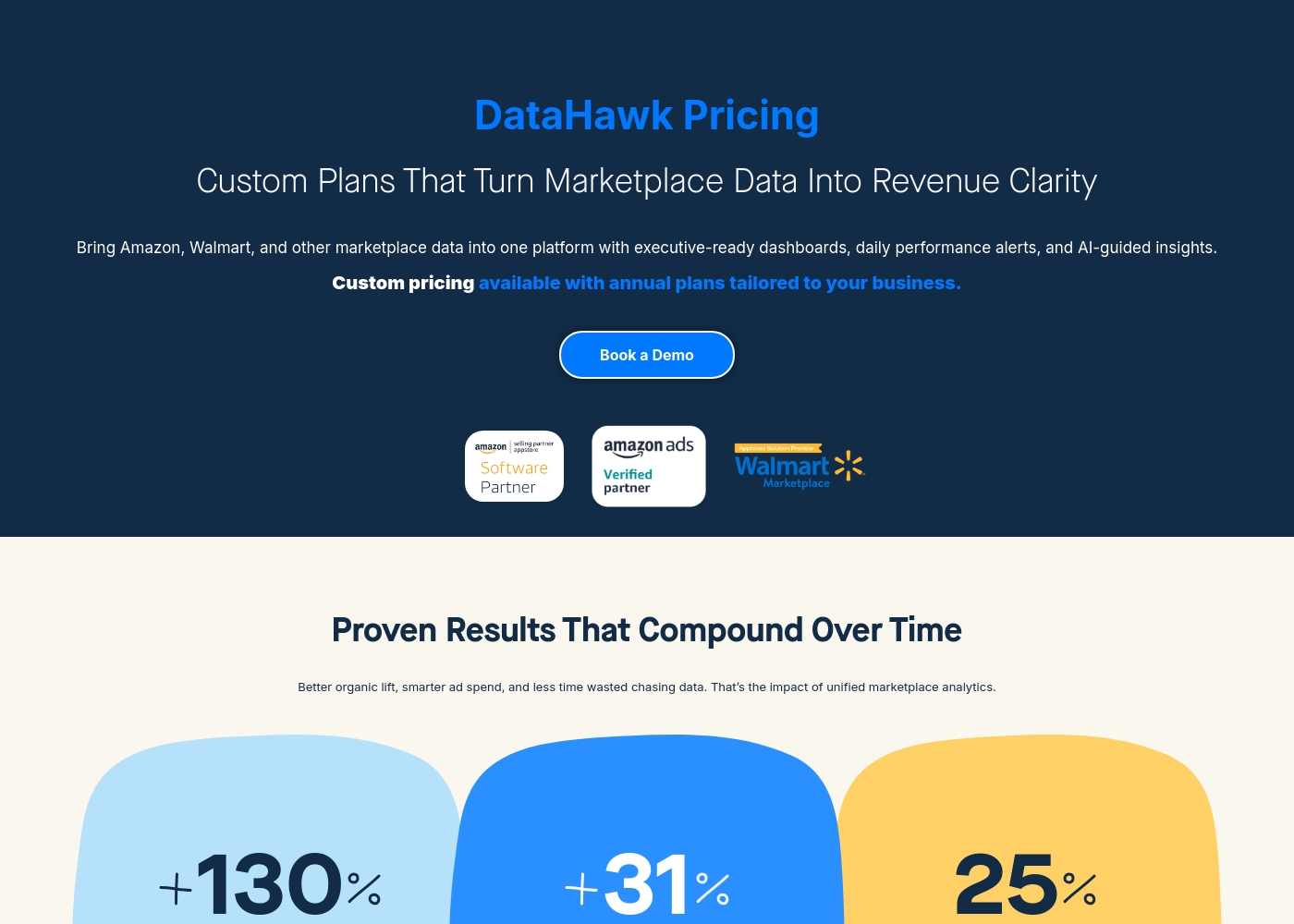
DataHawk pricing: DataHawk offers custom pricing models tailored specifically to your business needs and marketplace scale. Instead of flat fees, they provide annual plans based on the depth of analytics and connectivity required for your eCommerce operations Explorer dashboards and AI insights included everywhere. 🚀
Custom
Websites Supported: Amazon, Walmart, and other marketplaces Best For: Brands and agencies needing unified marketplace analytics and automated reporting Other Features: Executive-ready dashboards, Daily performance alerts, AI-guided insights, Amazon Ads partner verification, Walmart Marketplace integration
This plan is perfect for growing businesses that have outgrown manual spreadsheets. It brings multiple marketplace data sources into one clean view so you can focus on strategy rather than data cleaning. You get professional-grade tools regardless of your technical background.
Take a look at the different ways you can manage your data costs below.
Ingest Pricing
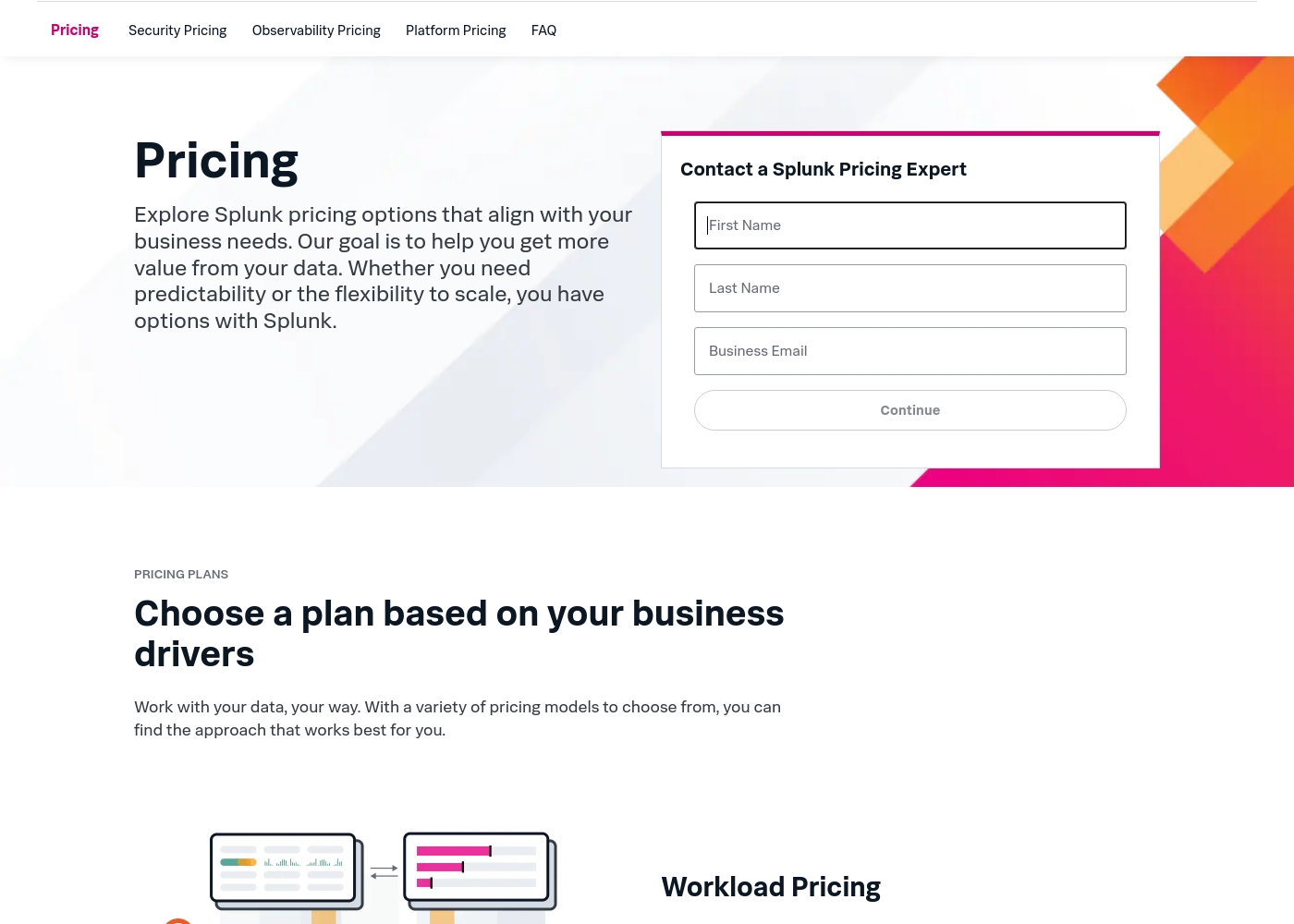
Best For: Teams needing predictable costs for high-volume data ingestion Other Features: Simple predictable approach, Economical search scaling, Broad data ingestion
This plan is a great fit if you want a straightforward bill based on the amount of data you bring into the platform. It makes it easy to run extra searches without worrying about hidden fees. It's built for consistency and long-term planning.
- Search and analyze machine data
- Expanded use cases on ingested data
- Standard data ingestion
- Metric time series (MTS)
- Traces analyzed per minute
- Sessions monitoring
- Uptime requests
Pricing Notes
- DataHawk pricing is entirely custom and not publicly disclosed. You must book a demo for any cost information.
- Splunk uses usage-based models, which can lead to unpredictable costs if your data volume or activity spikes.
- Splunk offers a free trial, which DataHawk does not explicitly state is available.
- Both tools require sales consultations for quotes, making direct cost comparison impossible without contact.
Pricing Head-to-Head
用户评论
We found that user sentiment on Trustpilot and Capterra is currently inaccessible due to technical blocks (CAPTERRA returns a 403 error, and Trustpilot requires browser verification). This means we cannot synthesize specific recurring themes like accuracy, ease of use, support, pricing, or onboarding from live reviews at this time. We advise checking the review platforms directly for the latest user feedback.
Based on the provided external sources, we couldn't retrieve detailed user reviews for Splunk due to access restrictions. Trustpilot and Capterra both returned verification or security pages, preventing us from gathering specific sentiment on accuracy, ease of use, support, or pricing.
This means our review is based solely on the official product information and pricing details provided. We recommend checking these review sites directly for the latest user feedback before making a decision.
我们的判断
DataHawk and Splunk aren't really competitors—they're tools for completely different jobs. DataHawk is your go-to for ecommerce. Splunk is your go-to for security and IT operations. The choice is crystal clear based on what problem you're trying to solve. DataHawk's superpower is unifying marketplace data. It pulls your Amazon and Walmart sales, ads, and inventory into one clean dashboard. No more spreadsheet chaos. It even uses AI to spot performance opportunities you might miss. Splunk's superpower is making sense of any data at any scale. It ingests logs and metrics from thousands of sources. It helps security teams hunt threats and engineers troubleshoot complex systems. It's built for massive enterprise environments. So, the deciding factor is your data source and goal. If you're an ecommerce brand drowning in marketplace data, DataHawk is the simple, focused solution. If you're an IT team managing a complex tech stack, Splunk is the powerful, comprehensive platform. Final verdict: Choose DataHawk if you sell products online and need clearer ecommerce insights. Choose Splunk if you're responsible for security, infrastructure, or application performance across a complex environment. There's no overlap here.
常见问题
Which is better for small teams: DataHawk or Splunk?
DataHawk is likely better for a small ecommerce team. Splunk is typically used by larger organizations with significant data needs and more complex infrastructure to monitor.
Can Splunk do ecommerce analytics like DataHawk?
No, Splunk is not designed for that. Splunk analyzes machine data for security and IT. DataHawk is specialized for Amazon and Walmart marketplace performance metrics.
Is Splunk worth the extra cost over DataHawk?
They solve different problems, so it's not an apples-to-apples comparison. Splunk's cost is for enterprise-scale security and observability. DataHawk's cost is for ecommerce analytics.
Which has a better free trial?
Splunk explicitly offers a free trial. DataHawk does not clearly state a trial is available; you need to book a demo to explore options.
Which is easier to learn?
DataHawk is designed for ease of use for business users. Splunk is noted as having a steeper learning curve and complexity, especially for those without a technical background.
Which has more integrations?
Splunk has far more integrations, over 2,000 from various sources. DataHawk's integrations are focused specifically on marketplaces like Amazon and Walmart.
准备好选择了?
这两个工具都有各自的优点。根据您的具体需求进行选择。