Databox vs Typewise
Databox and Typewise are both AI-powered tools, but they solve completely different problems. Databox turns business data into clear insights in seconds. Typewise automates customer support and sales conversations across your entire tech stack.
Best for: Marketing teams needing campaign insights, Agencies creating client performance reports
Best for: Customer support teams automating ticket resolution, Sales teams orchestrating quote and renewal workflows
Smart AI analytics for growing teams.
We found Databox is a capable BI platform that connects to many data sources and uses AI to explain performance. Overall, it's a strong choice for teams needing fast, actionable insights from their data, especially with its unlimited user model.
优点
- AI-powered Genie provides instant, plain-English answers to data questions.
- Connects to 130+ data sources, creating a single source of truth.
- Unlimited users and dashboards on all paid plans, removing seat-based costs.
- Offers a free plan and a 14-day trial for paid tiers.
缺点
- Pricing starts at $159/month for paid plans, which may be high for small budgets.
- Advanced features like white-labeling are available as paid add-ons.
- Limited external review data was accessible for a full sentiment check.
- The platform's depth might require an onboarding period for full adoption.
关于Databox
Databox is a business intelligence and analytics platform built for teams that need clear, trusted answers fast. It connects directly to over 130 tools you already use, like CRMs and marketing platforms, and turns that data into shared metrics, dashboards, and AI-powered insights. Whether you're a marketing lead, a business analyst, or an agency owner, it's designed to help you understand performance without the technical headaches.
关于Typewise
亮点
功能比较
功能概览
我们强调主要差异并为每个功能选择获胜者。
AI Capabilities
Databox uses AI to explain your business data. Typewise uses AI to automate customer conversations.
Databox's AI, called Genie, is an analyst. You ask it questions in plain English, like "Why did sales drop last week?" It pulls data from connected tools and gives you a clear answer with context. Typewise's AI is an orchestrator. It connects channels and systems, then uses agents to handle tasks. It can draft replies, process refunds, or look up order status automatically. The key difference is direction. Databox looks inward at your performance data. Typewise looks outward at customer interactions across your tech stack. For a marketing team, Databox's AI is a game-changer. For a support team drowning in tickets, Typewise's AI is the solution.
User Interface & Setup
Databox focuses on dashboards anyone can use. Typewise focuses on connecting complex systems quickly.
Databox is built for self-service. You start with a template, connect a data source, and have a live dashboard in minutes. Non-technical users can build their own views. Typewise is built for orchestration. The goal is to connect your entire stack—CRM, ERP, knowledge base—in about 15 minutes for a first agent. It's more about system integration than individual dashboards. Databox's UI is about visualizing what you already know. Typewise's UI is about setting rules for AI to act on what your systems know. One is a window into your data. The other is a control panel for automating workflows.
Integrations
Both connect to many tools, but for different reasons. Databox pulls data; Typewise takes action.
Databox connects to 130+ sources like Google Analytics, Salesforce, and HubSpot. It pulls data in to create a single source of truth for reporting. Typewise connects to 200+ platforms like Zendesk, Salesforce, and ERPs. It reads and writes data, allowing AI agents to take actions like updating records or processing requests. The integration philosophies are different. Databox integrates for insight. Typewise integrates for execution. If you need to see all your marketing data in one place, Databox wins. If you need AI to act across multiple business systems, Typewise wins.
Automation
Typewise is built for end-to-end automation. Databox automates reporting and alerts.
Databox automates insight delivery. It can send scheduled reports, create performance alerts, and forecast trends. It automates the *reporting* of what's happening. Typewise automates the work itself. It can resolve support tickets, generate quotes, and orchestrate multi-step processes. It automates the *tasks* based on what's happening. The scale of automation is different. Databox automates information flow. Typewise automates business workflows. Typewise is the clear winner if you want to remove manual work from customer-facing processes. Databox is better for automating performance monitoring.
Pricing & Value
Databox has predictable tiers. Typewise's cost scales directly with the outcomes you automate.
Databox starts with a free plan, then paid tiers from $159/month. All paid plans include unlimited users, so you're not penalized for team growth. Extra data sources cost $7/month each. Typewise starts at $1 per successful resolution. You only pay when the AI finishes a task. This can be great for ROI but might get expensive for very high-volume teams. Databox's value is in unlimited access to insights. Typewise's value is in paying only for automated results. Choose Databox for fixed, scalable cost. Choose Typewise if you want costs tied directly to performance.
Customer Support
Databox offers standard support. Typewise's model is built around AI-driven support.
Databox provides chat support and a help center on all plans. The Premium plan gets priority support. Details on response time guarantees aren't specified. Typewise's entire platform is designed to enhance customer support. Their own support is noted as responsive in reviews, but detailed SLAs aren't public. The difference is meta. Databox helps you monitor support KPIs. Typewise helps you perform support tasks. If you need help with your analytics tool, Databox is your support. If you need help automating your support team's work, Typewise is the answer.
Mobile Experience
Databox has a dedicated mobile app for monitoring. Typewise's mobile capabilities are less defined.
Databox explicitly mentions an executive dashboard in its mobile app. You can get AI insights and monitor key metrics from your phone. Typewise's feature sections focus on omnichannel customer communication (email, chat, WhatsApp) but don't highlight a dedicated mobile app for internal users. Databox is clearly built for on-the-go monitoring. Typewise's mobile story is more about meeting customers where they are. For an executive who needs performance updates while traveling, Databox is the choice.
Learning Curve
Databox aims for simplicity from the start. Typewise may require deeper setup for complex workflows.
Databox is designed for self-service. The goal is for anyone to connect data and build dashboards without training. The AI analyst requires only natural language. Typewise notes a potential steep learning curve in reviews. Setting up multi-agent workflows and hybrid intelligence rules takes planning and understanding. One tool lowers the barrier to data exploration. The other empowers complex automation but requires investment to configure properly. Databox gets you to value faster for simple reporting. Typewise delivers greater value for well-configured, complex processes.
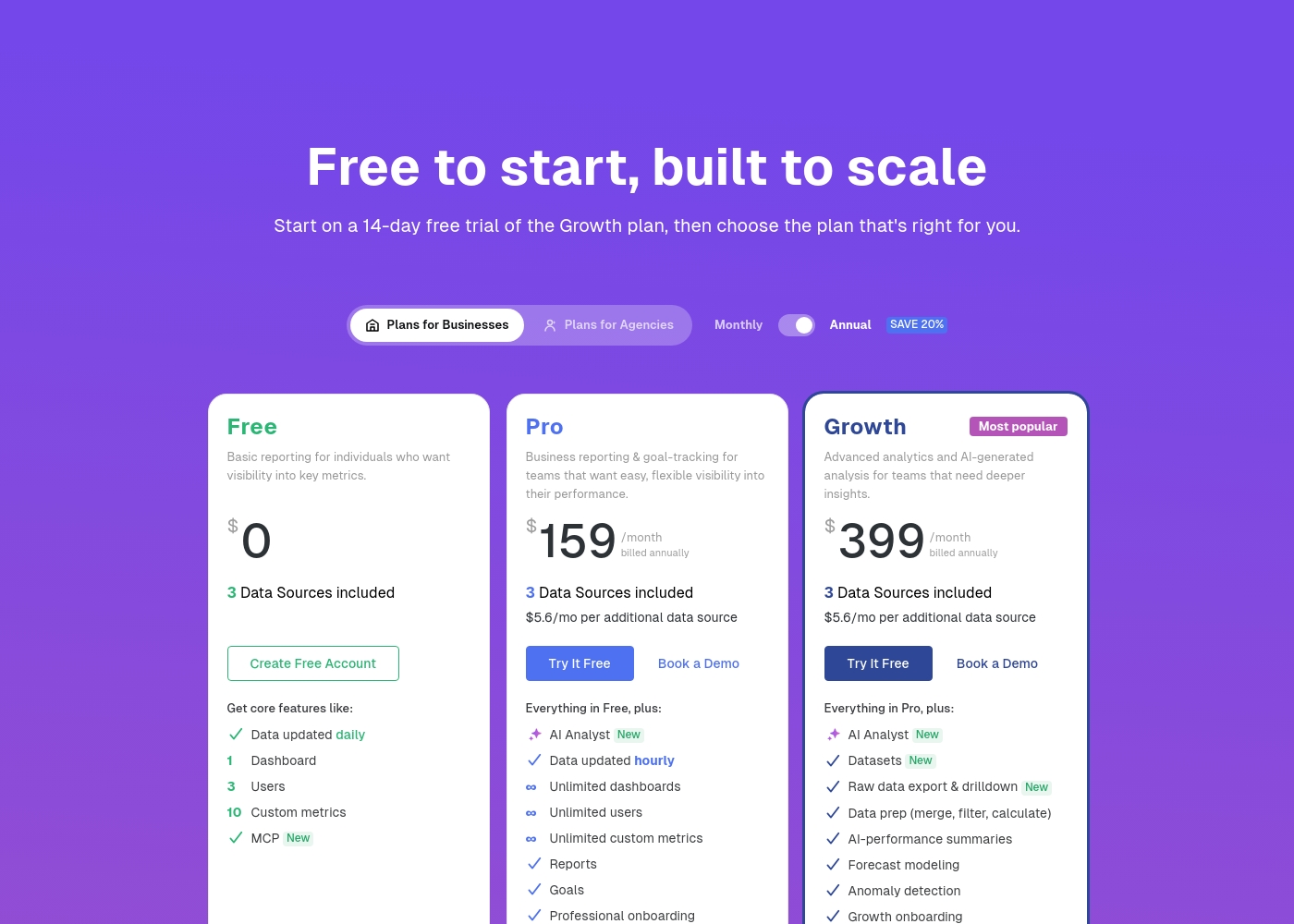
Databox pricing: Databox offers a forever-free plan and three paid tiers starting at $159/month when billed annually. Pricing is based on data features and bundled data sources, with a 20% discount on yearly subscriptions.
All paid plans include unlimited users and dashboards, but extra data sources are billed based on a per-source monthly fee. A 14-day free trial is available for all new users to explore the full-featured platform before committing to a paid plan.
Professional, Growth, and Premium tiers ensure high scalability for teams of any size by removing seat-based pricing and offering advanced analytics, AI-powered reports, and business intelligence features regardless of team complexity or user count. For even more power, you can also add on specialized services like OKRs and white-labeling to truly customize your dashboard experience for your organization or clients' needs and brand standards through their flexible dashboard portal.
Pricing Notes
- Databox's paid plans start at $159/month but include unlimited users and dashboards.
- Typewise's pricing is purely outcome-based, aligning cost directly with automated resolutions.
- Databox charges $7/month for each additional data source beyond the plan limit.
- Typewise's costs can scale with volume, which may be a consideration for very high-traffic teams.
Pricing Head-to-Head
用户评论
We found external review snippets were blocked by security checks on both Trustpilot and Capterra, preventing us from gathering specific user feedback from these sources. Therefore, our assessment is based solely on the provided website content and pricing information, which highlights key features like AI-powered analytics, extensive integrations, and unlimited users on paid plans.
我们的判断
This isn't a head-to-head battle. Databox and Typewise are built for completely different jobs. Choosing between them is about the problem you need to solve right now. Databox's superpower is instant clarity. It connects to your marketing, sales, and other tools. Then, its AI analyst explains what the numbers mean in plain English. You get answers, not just charts. Typewise's superpower is intelligent action. It sits on top of your entire software stack. It uses AI agents to handle customer conversations and workflows, from email replies to processing refunds. The deciding factor is your goal. Pick Databox if you need to understand *why* your business metrics are changing. Pick Typewise if you need AI to *do* the work based on what's happening in your systems. For a marketing lead asking "Which campaign worked best?" choose Databox. For a support manager saying "Resolve these tickets automatically," choose Typewise. Know your core problem, and the choice becomes clear.
常见问题
Which is better for small teams: Databox or Typewise?
Databox has a free plan and includes unlimited users on paid tiers, making it great for budget-conscious small teams. Typewise's pay-per-resolution model might have lower initial costs but can scale with your ticket volume.
Does Databox have workflow automation like Typewise?
Not in the same way. Databox automates reporting, alerts, and data visualization. Typewise automates customer support and sales workflows across multiple systems, like updating a CRM or processing an order.
Is Typewise worth the extra cost over Databox?
It's not an 'extra cost'—it's a different pricing model for a different product. If you need to automate customer service tasks that save agent time, Typewise's per-resolution fee can provide clear ROI. Databox's value is in unlimited data access for insights.
Can I use both Databox and Typewise together?
Yes, they can be complementary. You could use Typewise to automate support workflows and then connect those systems to Databox. Databox could then track the performance and impact of the automation Typewise is running.
Which tool is easier to set up and learn?
Databox is generally easier for immediate use. You can connect a data source and have a dashboard in minutes. Typewise offers a fast initial launch but may require more configuration for complex, multi-step automation rules.
Do both tools integrate with Salesforce?
Yes. Databox connects to Salesforce to pull data for analytics and dashboards. Typewise integrates deeply with Salesforce, allowing AI agents to read and write data, enabling automated actions within the CRM.
准备好选择了?
这两个工具都有各自的优点。根据您的具体需求进行选择。