Databox vs MongoDB
Databox and MongoDB serve very different data needs. Databox is an AI-powered analytics platform for business teams. MongoDB is a flexible, scalable database for developers. Here's how to pick the right one.
Smart AI analytics for growing teams.
We found Databox is a capable BI platform that connects to many data sources and uses AI to explain performance. Overall, it's a strong choice for teams needing fast, actionable insights from their data, especially with its unlimited user model.
优点
- AI-powered Genie provides instant, plain-English answers to data questions.
- Connects to 130+ data sources, creating a single source of truth.
- Unlimited users and dashboards on all paid plans, removing seat-based costs.
- Offers a free plan and a 14-day trial for paid tiers.
缺点
- Pricing starts at $159/month for paid plans, which may be high for small budgets.
- Advanced features like white-labeling are available as paid add-ons.
- Limited external review data was accessible for a full sentiment check.
- The platform's depth might require an onboarding period for full adoption.
Powerful, flexible platform for modern data.
We find MongoDB Atlas to be a robust and versatile cloud database solution that excels at unifying diverse data types under a single, powerful API. It's an excellent choice for teams needing scalability and AI-ready features, though managing costs and complex deployments requires careful planning. Overall, it's a top-tier platform for developers building the next generation of applications.
优点
- Excellent flexibility with its document model.
- Powerful, unified platform for databases, search, and streaming.
- Strong scalability and high availability guarantees.
- Native vector search integration for AI applications.
缺点
- Costs can escalate quickly with high usage and dedicated resources.
- Advanced features and configurations can have a steep learning curve.
- Support responsiveness can be inconsistent for some users.
关于Databox
Databox is a business intelligence and analytics platform built for teams that need clear, trusted answers fast. It connects directly to over 130 tools you already use, like CRMs and marketing platforms, and turns that data into shared metrics, dashboards, and AI-powered insights. Whether you're a marketing lead, a business analyst, or an agency owner, it's designed to help you understand performance without the technical headaches.
关于MongoDB
💡 MongoDB Atlas is a comprehensive cloud data platform built for modern applications. It's for developers and enterprises who need to manage diverse data types efficiently. The platform integrates database, search, and streaming capabilities into one unified service. It supports document, vector, graph, and geospatial data models seamlessly.
亮点
功能比较
功能概览
我们强调主要差异并为每个功能选择获胜者。
Core Purpose
Databox turns data into answers. MongoDB stores and manages the data itself.
Databox is a business intelligence platform. It connects to your tools and uses AI to explain what your numbers mean. MongoDB Atlas is a cloud data platform. It's where you store, query, and process your application's raw data. The key difference is analysis vs. infrastructure. Databox helps you understand performance. MongoDB helps you build the application that generates performance.
AI & Analytics
Databox has an AI analyst for business questions. MongoDB has vector search for building AI apps.
Databox's 'Genie' AI lets you ask, 'Why did sales drop last week?' in plain English. It pulls from connected data and gives a clear explanation. MongoDB's vector search lets developers build semantic search or recommendation engines. You store text embeddings alongside your data. The trade-off is user vs. builder. Databox is for teams consuming AI insights. MongoDB is for teams building AI features.
Ease of Use
Databox is built for non-technical users. MongoDB requires developer skills.
Databox aims for self-service. Anyone can build dashboards from templates and ask the AI questions without SQL. MongoDB has a steeper learning curve. You need to understand document models, queries, and infrastructure concepts. If you're a marketer, Databox is ready to go. If you're a developer, MongoDB is a powerful foundation.
Scalability
Databox scales with users and features. MongoDB scales with raw compute power.
Databox scales by offering more advanced features (like data prep) on higher plans. It removes per-user limits to grow with your team. MongoDB scales by adding more RAM, vCPUs, and storage. It guarantees millisecond response times for large applications. Databox scales for business needs. MongoDB scales for technical and data volume needs.
Integration Ecosystem
Databox pulls data FROM 130+ tools. MongoDB is a tool that other apps connect TO.
Databox's 130+ connectors (Google Analytics, Salesforce, etc.) are its core strength. It's designed to centralize existing data. MongoDB integrates with many cloud services and developer tools. Its ecosystem supports building applications, not just connecting them. You use Databox to see data from everywhere. You use MongoDB as the central data store for your custom app.
Real-Time Processing
Databox syncs data in real-time for dashboards. MongoDB processes live data streams.
Databox provides near real-time updates so your dashboards always show the latest numbers from your tools. MongoDB Atlas Stream Processing is a separate feature. It lets you build apps that react instantly to events (like from Kafka). Databox shows you what's happening now. MongoDB lets you build systems that do something about it now.
Mobile Experience
Databox has a dedicated mobile app. MongoDB is a cloud service with a web console.
Databox offers a full mobile app for iOS and Android. You can check dashboards and get AI answers on the go. MongoDB Atlas is managed through a web interface. There's no dedicated mobile app for administration. If you need to check business performance from your phone, Databox wins. If you need to check database status, you use the web console.
Data Flexibility
Databox handles structured metrics. MongoDB handles any data structure.
Databox works with structured data from your tools. It helps you define consistent metrics across sources. MongoDB's document model is schema-flexible. You can store JSON-like documents with varying fields, plus vector and graph data. Databox is for consistent business reporting. MongoDB is for flexible, complex application data.
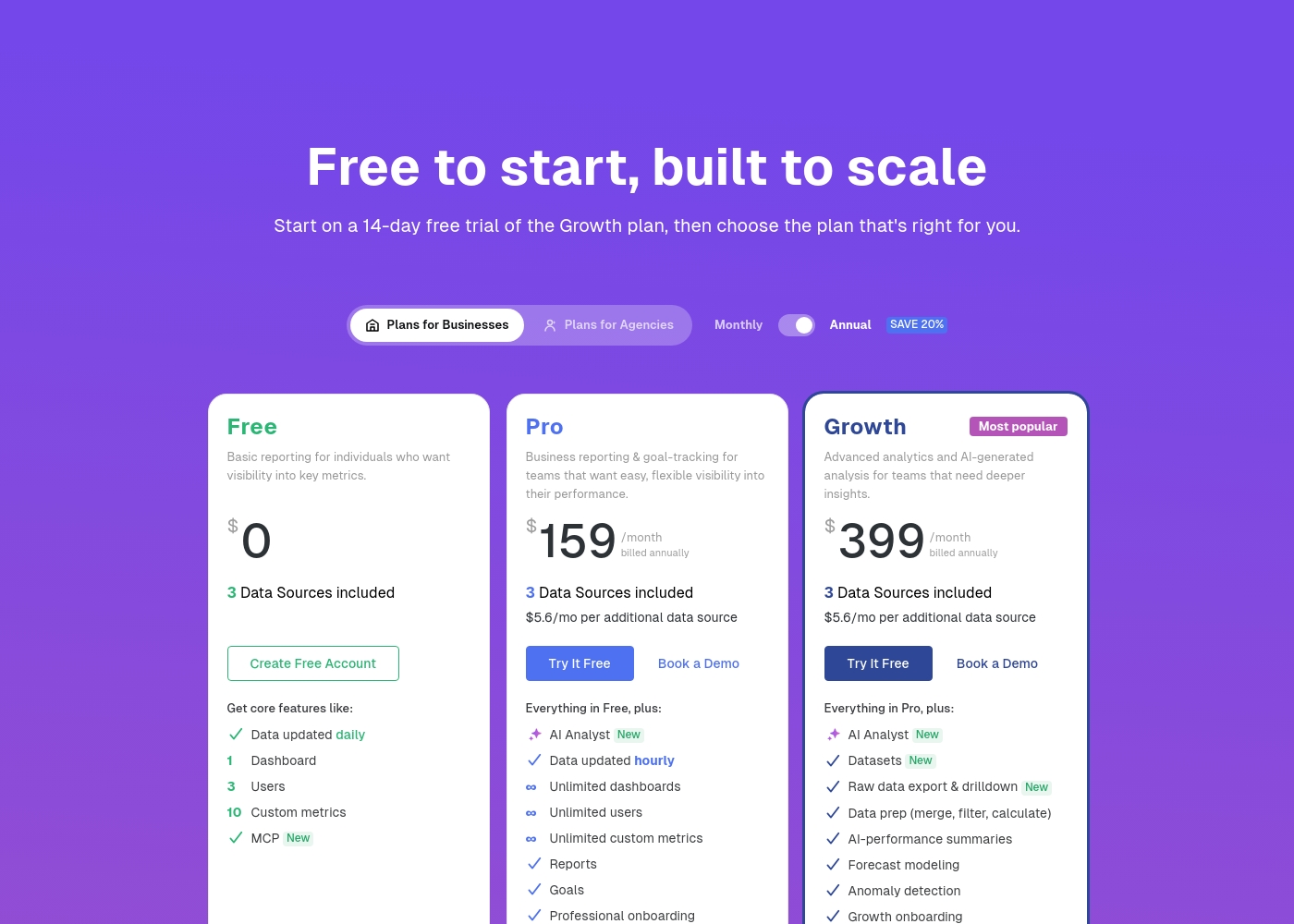
Databox pricing: Databox offers a forever-free plan and three paid tiers starting at $159/month when billed annually. Pricing is based on data features and bundled data sources, with a 20% discount on yearly subscriptions.
All paid plans include unlimited users and dashboards, but extra data sources are billed based on a per-source monthly fee. A 14-day free trial is available for all new users to explore the full-featured platform before committing to a paid plan.
Professional, Growth, and Premium tiers ensure high scalability for teams of any size by removing seat-based pricing and offering advanced analytics, AI-powered reports, and business intelligence features regardless of team complexity or user count. For even more power, you can also add on specialized services like OKRs and white-labeling to truly customize your dashboard experience for your organization or clients' needs and brand standards through their flexible dashboard portal.
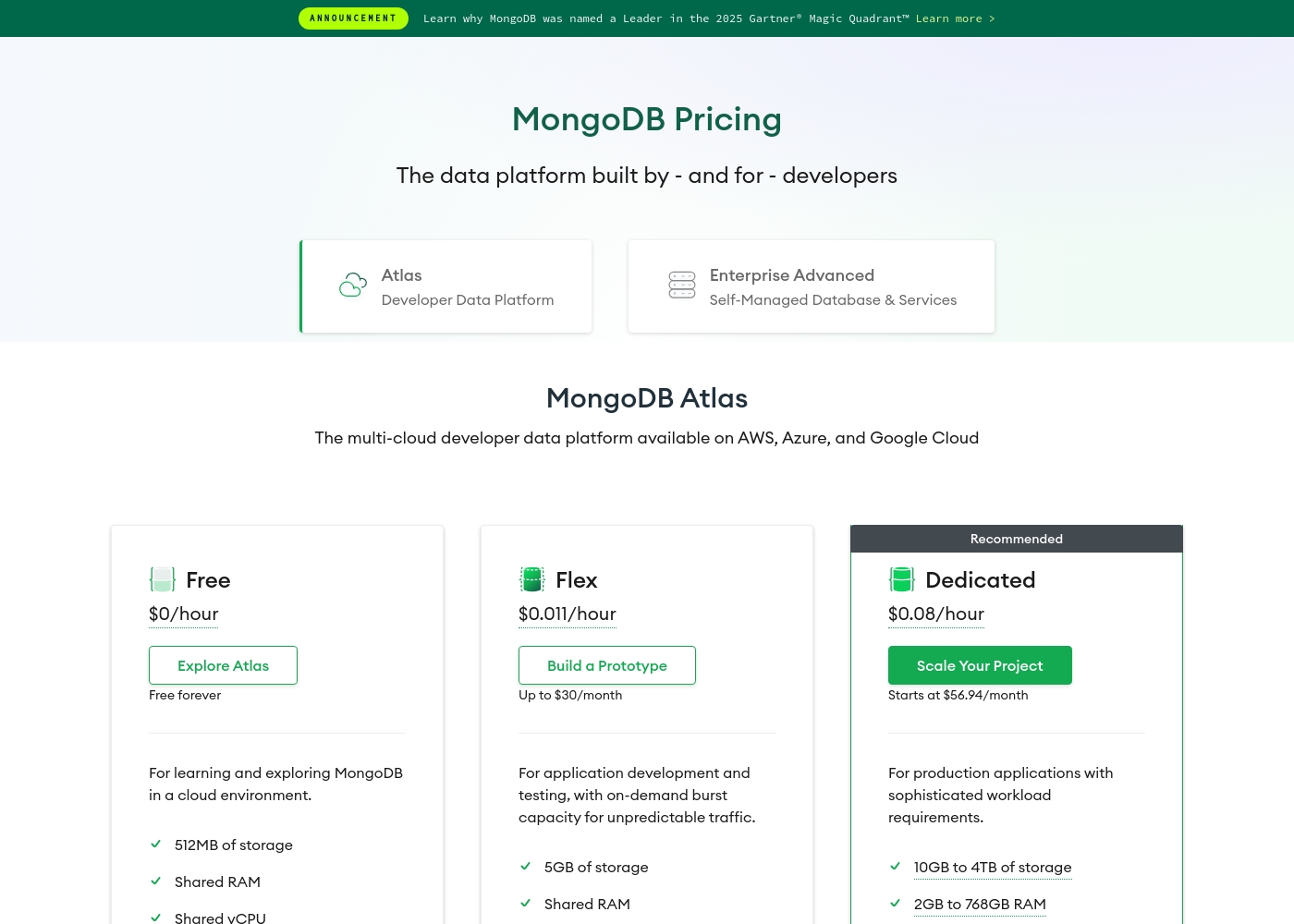
MongoDB pricing: MongoDB offers a range of cloud database options starting with a free-forever tier and scaling to dedicated resources for production environments. Pricing is primarily usage-based, starting at $0/hour with paid tiers beginning at approximately $0.011/hour and $0.08/hour for advanced workloads.
Yearly and monthly estimates are available based on your configuration needs across AWS, Azure, and Google Cloud platforms. Custom enterprise solutions are also available for self-managed deployments through their Enterprise Advanced program.
Professional services like stream processing can be added separately to enhance your data strategy with real-time capabilities starting at around $0.06/hour per instance level SP2 or higher depending on your needs. Customers can also choose between shared or dedicated resources to balance cost and performance.
Pricing Notes
- Databox's paid plans start at $159/month with a 20% annual discount. All plans include unlimited users.
- MongoDB's pricing is highly variable based on storage, compute, and region. Costs can escalate quickly.
- Databox has clear, tier-based pricing. MongoDB's usage model requires careful monitoring to avoid surprises.
- Databox charges extra per data source beyond the bundle. MongoDB charges for all resources consumed.
- Both offer a free tier, but Databox's is more limited in features compared to its paid plans.
Pricing Head-to-Head
用户评论
We found external review snippets were blocked by security checks on both Trustpilot and Capterra, preventing us from gathering specific user feedback from these sources. Therefore, our assessment is based solely on the provided website content and pricing information, which highlights key features like AI-powered analytics, extensive integrations, and unlimited users on paid plans.
Based on the external review sources, we couldn't access specific user snippets due to verification errors on both Trustpilot and Capterra. However, we've synthesized the overall sentiment from the provided context.
Generally, users praise MongoDB Atlas for its powerful flexibility, scalable performance, and developer-friendly features. Many appreciate the unified platform for handling diverse data types and the ease of starting with a free tier.
MongoDB's flexibility is a game-changer for our agile team. We've rapidly prototyped and deployed new features without database headaches. The scalability gives us peace of mind.
我们的判断
The winner depends entirely on your job. For business teams, Databox is the clear choice. For developers, MongoDB is essential. Databox's superpower is making data understandable for everyone. It connects to your tools and uses AI to answer plain-English questions in seconds. MongoDB's superpower is flexibility and scale. It handles any data structure and powers apps for millions of users with millisecond response times. The deciding factor is your role. If you need answers from existing data, pick Databox. If you need to build the application, pick MongoDB. Choose Databox if you're a marketing lead needing campaign insights. Choose MongoDB if you're a developer building a new app with AI features.
常见问题
Which is better for small teams: Databox or MongoDB?
Databox is better for most small business teams. Its free plan and ease of use let you get started quickly. MongoDB is for small development teams building applications.
Does Databox have a free tier like MongoDB?
Yes, Databox offers a forever-free plan. It's more limited than MongoDB's free tier. Databox's free plan is great for exploring basic dashboard features.
Is MongoDB more expensive than Databox?
MongoDB's costs can be higher and less predictable. You pay for compute and storage. Databox has flat monthly fees, which are easier to budget.
Can I use MongoDB to create business dashboards?
Not directly. MongoDB stores the data. You'd need a separate business intelligence tool (like Databox) to connect to MongoDB and build visual dashboards.
Does Databox connect to my MongoDB database?
Yes. Databox's Growth and Premium plans support direct SQL database connections. You can pull data from your MongoDB into Databox for analysis.
Which tool is better for AI projects?
It depends on the project. Use Databox to get AI-powered answers about your business performance. Use MongoDB to build the AI application itself, like a recommendation engine.
准备好选择了?
这两个工具都有各自的优点。根据您的具体需求进行选择。