Coast vs Divvy
Coast and Divvy both promise to kill your expense reports, but they're built for very different teams. Coast is a focused tool for fleet-heavy businesses needing tight fuel controls. Divvy is a broader, free expense platform—but with major reliability concerns.
Smart fuel card, real control.
We found Coast to be a strong, unified solution for fleet-based businesses tired of juggling separate fuel and expense cards. It delivers powerful controls and real-time tracking that can genuinely cut down on admin and prevent fraud. Overall, it's a compelling choice for teams ready to consolidate their spending into one efficient platform.
优点
- All-in-one card for fuel, field, and office expenses simplifies tracking.
- Strong custom controls and telematics integrations help prevent fuel fraud.
- Real-time spending visibility and alerts for immediate oversight.
- Competitive fuel rebates and discounts at 30,000+ stations.
缺点
- $4 monthly fee per active user can become significant for large teams.
- 2.5% fee on foreign transactions limits international use.
- Customer support responsiveness is inconsistent according to some users.
- Requires integrations with telematics/accounting software for maximum value.
功能很棒,但支持问题严重。
我们发现 BILL Spend & Expense 提供了一个强大的免费费用管理平台,具有实时控制和会计集成等出色功能。然而,有关糟糕的客户支持、巨大的支付延迟和意外账户关闭的外部可靠性报告是一个我们反复从用户那里看到的重大担忧。总而言之,在运营可靠性和客户服务响应能力方面没有取得实质性改进之前,我们无法为基本业务运营推荐此平台。
优点
- 费用管理软件完全免费提供。
- 提供实时开支可见性和可定制的预算控制。
- 用户可以轻松发行无限数量的虚拟卡和实体卡。
- 与主流会计系统(QuickBooks、NetSuite)的无缝集成功能。
缺点
- 客户支持和响应能力极差或几乎不存在。
- 关于延迟付款和故意持有资金(ACH 需要超过 4 个工作日)的报告频繁出现。
- 设置和入职流程困难且令人困惑。
- 可靠性问题反复出现;账户突然被阻止或关闭,通常没有解释。
关于Coast
Coast is an all-in-one fuel card, corporate card, and expense management platform built for businesses with fleets. It's designed to replace multiple card programs and manual processes, giving companies like landscaping, construction, and field service teams a single tool to control and track all their spending. The platform provides powerful fraud prevention, integrates with existing telematics and accounting software, and aims to help businesses save significantly on fuel and admin time.
关于Divvy
BILL Spend & Expense(前身为 Divvy)是一个多合一的开支管理平台,专为现代企业打造。✅ 它将免费的世界一流软件与 BILL Divvy Card 访问权限相结合。这种独特的组合有助于中小型企业实现更大程度的控制。
它通过强调控制、简洁和节省来专注于改革开支和费用管理。最终目标是完全消除手动费用报告。
亮点
功能比较
功能概览
我们强调主要差异并为每个功能选择获胜者。
Pricing & Value
Coast charges $4 per active user. Divvy is free, but tied to its credit product.
Coast has a simple, usage-based model. You pay $4 each month for every user who makes a transaction. Inactive users cost nothing. This gives you predictable costs based on actual activity. Divvy offers its expense management software completely free. There are no hidden fees or contracts for the software itself. Access is tied to using the BILL Divvy Card for your corporate credit. The key difference is the direct vs. indirect cost. With Coast, you pay a clear fee for the platform. With Divvy, you pay nothing for software, but you're locked into their credit product.
Fleet & Fuel Controls
Coast is built for fleets with GPS-based fuel controls. Divvy is a general-purpose card.
Coast's superpower is its deep fleet focus. It integrates with telematics like Samsara to block a transaction if the vehicle isn't at a gas pump. You can set rules per driver, vehicle, and time of day. Divvy provides general customizable spend controls and policies. You can set budgets and categories. However, it lacks the specialized, GPS-based transaction blocking for fuel that Coast offers. For a landscaping or construction company, Coast's controls are transformative. Divvy's controls are solid for general office spend but not for preventing fuel fraud in the field.
Ease of Setup
Coast has a fast online application. Divvy's onboarding is frequently called confusing.
Coast emphasizes a quick start. Their online application can be approved in minutes. The goal is to get you spending with minimal hassle, and card shipping is free. Divvy's setup is a common pain point in reviews. Users report a confusing onboarding process that requires watching multiple videos to understand basic configuration. It creates friction from day one. If you need your team carded and controlled this week, Coast is the faster path. Divvy's process may delay your rollout significantly.
Customer Support
Coast offers US-based support aiming to solve issues on the first call. Divvy's support is a major complaint.
Coast provides responsive, 100% US-based customer support. Their stated goal is to resolve your issue on the first call. Some users report inconsistent responsiveness, but it's a clear focus. Divvy's support is a critical failure point in user reviews. Customers describe hours on hold, non-responsive staff, and a lack of visibility across support cases. It's a top frustration. When your card is blocked or there's a transaction dispute, support quality matters. Coast gives you a direct line to US agents. Divvy's support structure appears to be a significant operational weakness.
Payment Reliability
Coast uses standard billing cycles. Divvy is criticized for holding funds and delaying payments.
Coast operates with a standard monthly billing cycle. You pay your bill in full each month, with clear late fee policies. The system is straightforward for accounting. Divvy receives severe criticism for payment delays. Users report funds being held for 4+ business days for ACH payments, seeming intentionally slow. This disrupts cash flow for vendors and payroll. For predictable cash flow management, Coast is more reliable. Divvy's payment processing issues are a major operational risk highlighted in numerous reviews.
Rewards & Savings
Coast offers direct fuel rebates. Divvy has a flexible rewards program for general spend.
Coast's rewards are tailored for fleets. You earn 3–9¢ per gallon at 30,000+ partnered stations. There's also 1% cash back on non-fuel purchases. Savings are direct and fuel-focused. Divvy's rewards are broader. You can earn points for cash back, statement credit, travel perks, or gift cards. It's designed for general business spending, not specific fuel discounts. For a business buying 5,000 gallons a month, Coast's per-gallon rebate is a concrete, predictable savings. Divvy's rewards value depends on your general spending mix.
Accounting Sync
Both integrate with major platforms like QuickBooks and NetSuite.
Coast integrates with QuickBooks, NetSuite, and Sage Intacct. Transactions sync automatically with receipts attached. This cuts down manual entry for your bookkeeper. Divvy also offers seamless integration with the same major systems. The goal is to move your books from weeks to days by automating data flow from card transactions. In this category, it's a tie. Both platforms recognize the need to automate expense coding and integrate with core accounting software. Neither has a clear advantage here.
User Reviews & Trust
Coast has solid 4.1-star ratings. Divvy has a poor 2.3-star average.
Coast holds a 4.1 out of 5 rating. Users praise the easy setup and real-time visibility. They highlight the fuel rebates and having one card for all expenses. Criticisms focus on support speed and the $4 fee adding up. Divvy has a concerning 2.3 out of 5 rating. Feedback is overwhelmingly negative about customer support, payment delays, and account reliability. Users report sudden account closures and unexpected issues. The trust gap is massive. Coast's reviews indicate a functional product with some support quirks. Divvy's reviews suggest serious operational and support failures that undermine its great features.
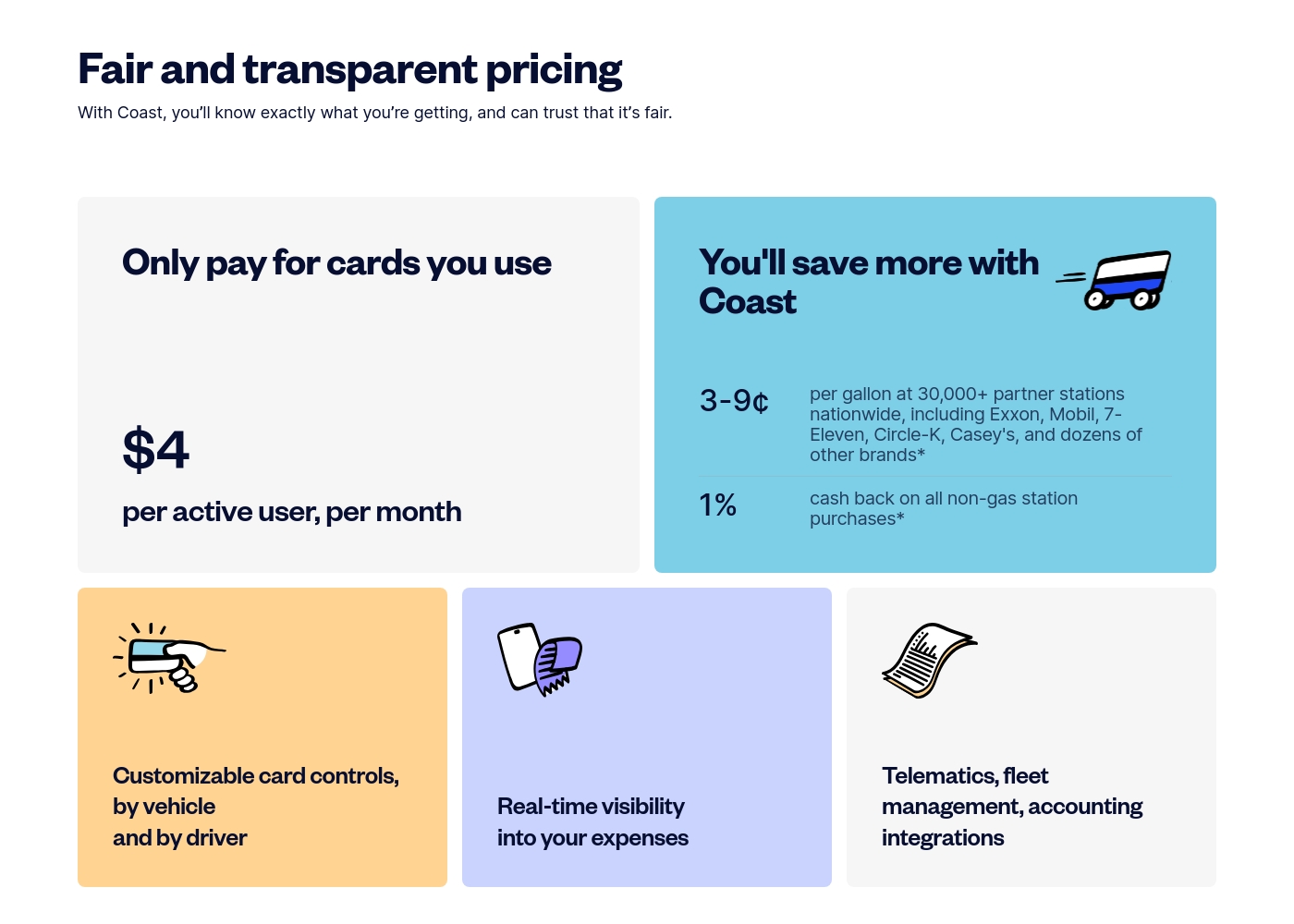
Coast costs $4 per active user per month with 1 plan: Coast Fleet & Fuel Card at $4 per active user per month.
Take a look at how our simple, usage-based model works for your team.
Coast Fleet & Fuel Card
Price: $4 per active user per month Websites Supported: Not explicitly stated Best For: Growing fleets needing fuel and expense management Refund Policy: Not explicitly stated Other Features: 3–9¢ fuel rebates per gallon, 1% cashback on non-gas purchases, customizable card controls, Visa acceptance everywhere, real-time expense visibility
- 3–9¢ per gallon rebates at 30,000+ partners
- 1% cash back on all non-gas station purchases
- Customizable card controls by vehicle and driver
- Real-time visibility into expenses
- Accounting and telematics integrations
Divvy (BILL Spend & Expense) 每月费用为免费,提供一项主要产品:开支与费用软件,免费。
强大的软件平台免费提供,让您可以专注于高效管理您的企业财务。以下是单一、全面的软件产品细分。
开支与费用软件
价格:免费 支持的网站:未明确说明 最适合:寻求强大、集成式开支管理和企业信用的企业。 退款政策:未明确说明 其他功能:
- 无隐藏费用或合同。
- 无限的实体卡和虚拟卡。
- 为所有用户提供备受好评的、功能齐全的移动应用程序。
- 支持报销和费用跟踪。
- 与 QuickBooks、NetSuite 和 Sage Intacct 集成。
- 免费软件,并可访问 BILL Divvy Card
- 无隐藏费用或合同
- 您需要的实体卡和虚拟卡数量不限
- 备受好评且功能齐全的移动应用程序
- 实时可见性和对开支的可定制控制
Pricing Notes
- Coast's $4 fee applies only to users who make at least one transaction per month.
- Divvy's software is free, but it's bundled with access to the BILL Divvy Card corporate credit product.
- Coast has a 2.5% fee on international transactions.
- Users report Divvy may have unexpected fees or charges after signing up for the 'free' service.
- Both lack a traditional free trial or money-back guarantee.
Pricing Head-to-Head
用户评论
We couldn't access detailed reviews from Capterra due to a security block. From Trustpilot, users praise Coast's easy setup and the real-time visibility it provides over fleet spending.
Many highlight the fuel rebates and the simplicity of having one card for all expenses. However, some note that customer support can be slow to resolve issues and that the $4 per user monthly fee adds up for larger teams.
Signing up was incredibly fast. The card gives me real-time notifications for every purchase, which is perfect for managing my crew's spending. The fuel rebates are a nice bonus that adds up.
免费的集成式控制开支软件核心产品很有吸引力,但外部可靠性报告却显示了对服务执行情况的极其负面的看法。用户报告称在客户支持方面存在严重问题,经常提到工作人员响应不及时、难以联系且缺乏跨案件的可见性。这种关键的运营失败导致了有关可靠性的巨大挫败感,尤其是在支付处理方面。反复出现的主题包括资金被持有或延迟,ACH/电子支付通常需要四个或更多工作日才能结清。虽然数字卡的便利性有时被提及,但困难和令人困惑的入职流程,加上突然账户被阻止或关闭的报告,严重侵蚀了用户的信任。公司的运营标准和支持结构必须大幅改进,才能与强大的功能集保持一致。👎
这是我有史以来最糟糕的客户服务体验。我本周花了六个多小时在线等待,与知识不全的人交谈,他们对其他支持电话没有可见性。
我们的判断
This isn't a close call. Coast is the clear winner for most businesses, especially those with vehicles. Divvy's free price tag is tempting, but its operational failures are a deal-breaker. Coast's superpower is its laser focus on fleet control. It integrates with telematics to physically block fuel fraud before it happens. That's a level of protection Divvy simply doesn't offer. Divvy's superpower is its free, feature-rich software. It does a lot for zero subscription cost. However, reports of held funds and terrible support mean your 'free' tool could cost you in vendor relationships and headaches. The deciding factor is reliability. If you need a tool you can trust to work smoothly and get support when things go wrong, Coast is the safer bet. Divvy is a high-risk, high-reward proposition. Choose Coast if your team has vehicles and you need iron-clad fuel controls and reliable operations. Choose Divvy only if you have zero budget, minimal support needs, and can tolerate significant payment and support friction. For everyone else, Coast is the smarter, more dependable choice.
常见问题
Which is better for small teams: Coast or Divvy?
For a small team with vehicles, Coast is better. Its controls prevent costly fuel fraud. Divvy is free, but its support and payment issues can cripple a small operation.
Does Coast have general corporate cards like Divvy?
Yes. While Coast is optimized for fleets, its Visa card works everywhere for job supplies and office expenses. You can set controls per category.
Is Divvy worth the extra cost over Coast?
Divvy's software is free, so there's no direct extra cost. The real question is whether you'll pay in time and stress due to its reported support and payment problems.
Can I migrate from Coast to Divvy easily?
Migration ease isn't specified. You would need to close your Coast account and apply for the BILL Divvy Card. Your accounting integrations may need reconfiguration.
Which has better customer support?
Coast has a decisive advantage. It offers US-based support focused on first-call resolution. Divvy's support is a top user complaint, with reports of long holds and unhelpful staff.
Do both tools integrate with QuickBooks?
Yes, both Coast and Divvy integrate with QuickBooks, NetSuite, and Sage Intacct. They both aim to automate expense coding to save accounting time.
准备好选择了?
这两个工具都有各自的优点。根据您的具体需求进行选择。