Calilio vs Typewise
Calilio and Typewise are both AI-powered tools, but for totally different jobs. Calilio is a cloud phone system for calls and global numbers. Typewise is an AI automation platform for customer support workflows. Here's how to pick the right one.
Best for: Small to mid-sized businesses needing a unified phone system, Teams with global customer bases needing virtual numbers
Best for: Customer support teams automating complex ticket resolution, Sales teams needing AI to handle routine inquiries
Solid global VoIP, but check reviews.
We found Calilio to be a feature-rich cloud phone system with strong global reach and AI tools. However, we lack independent user reviews to fully assess its real-world performance, support, and value. Overall, it promises a lot for distributed teams but requires careful validation against user feedback.
优点
- Virtual numbers from over 100 countries for a global presence.
- Unified platform for calls, texts, voicemails, and AI insights.
- Potential for significant cost savings versus traditional phone systems.
- Smart features like IVR, call routing, and real-time transcription.
缺点
- Independent user reviews (like on Trustpilot/Capterra) could not be accessed for this assessment.
- Long-term reliability and customer support effectiveness are unverified without external data.
- The platform's true ease of use for non-technical teams is unclear.
- Pricing specifics and potential hidden costs beyond the starting rate are not detailed.
关于Calilio
✨ Calilio is a modern, cloud-based phone system designed to simplify business communication. It's built for businesses of all sizes—from individual users to large call centers—who need to manage calls, messages, and customer interactions efficiently. You can use it on your existing computer or smartphone.
关于Typewise
功能比较
功能概览
我们强调主要差异并为每个功能选择获胜者。
Core Purpose
Calilio is a cloud phone system. Typewise is an AI automation platform.
Calilio's core is managing calls, voicemails, and texts in a unified callbox. It's built for business communication. Typewise sits on top of your tech stack. It automates complex workflows for support, sales, and commerce. Calilio focuses on telephony: routing calls, queuing, and dialing. Typewise focuses on orchestration: connecting CRM, ERP, and knowledge bases. The difference is communication vs. automation. For example, Calilio helps a real estate agent manage leads via phone. Typewise helps a support team automatically resolve billing tickets. They solve different problems entirely.
AI Capabilities
Calilio uses AI for call insights. Typewise uses AI to automate entire workflows.
Calilio's AI suite provides real-time call transcription, sentiment analysis, and reason extraction. It turns conversations into data. Typewise's AI is an 'orchestration layer.' It coordinates multiple agents across your tools using natural language. Calilio's AI is about understanding a call after it happens. Typewise's AI is about handling a task from start to finish. It can read your CRM, check order status, and process a refund. The key trade-off: Calilio gives you insights. Typewise gives you automated outcomes. Calilio helps you learn from calls. Typewise helps you eliminate the need for many calls.
Integration Ecosystem
Typewise connects deeply to 200+ tools. Calilio's integrations are more limited.
Typewise boasts over 200 deep, out-of-the-box integrations. This includes Salesforce, Zendesk, and various ERPs. It also supports webhooks and REST APIs for custom connections. Calilio mentions CRM integration, like Pipedrive, on its Premium and Enterprise plans. The Standard plan doesn't include it. The full list isn't detailed, so you may need to check documentation. For teams with a complex tech stack, Typewise is clearly better. If you just need a phone system that works with a few tools, Calilio might be enough. Typewise's MCP-native architecture supports over 6,000 connectors.
User Interface & Ease of Use
Calilio is simple to set up. Typewise has a steeper learning curve.
Calilio offers a simple 3-step onboarding: create account, verify email, set up workspace. Users praise its straightforward setup. It's designed to be easy for non-technical teams. Typewise has a potential steep learning curve. External feedback notes this. You need to define workflows, connect tools, and train the AI. But once tuned, it's powerful. Calilio is about getting a phone system running fast. Typewise is about building sophisticated automations. Calilio is simpler. Typewise is more complex but more capable.
Pricing Model
Calilio uses per-user bundles. Typewise pays per successful resolution.
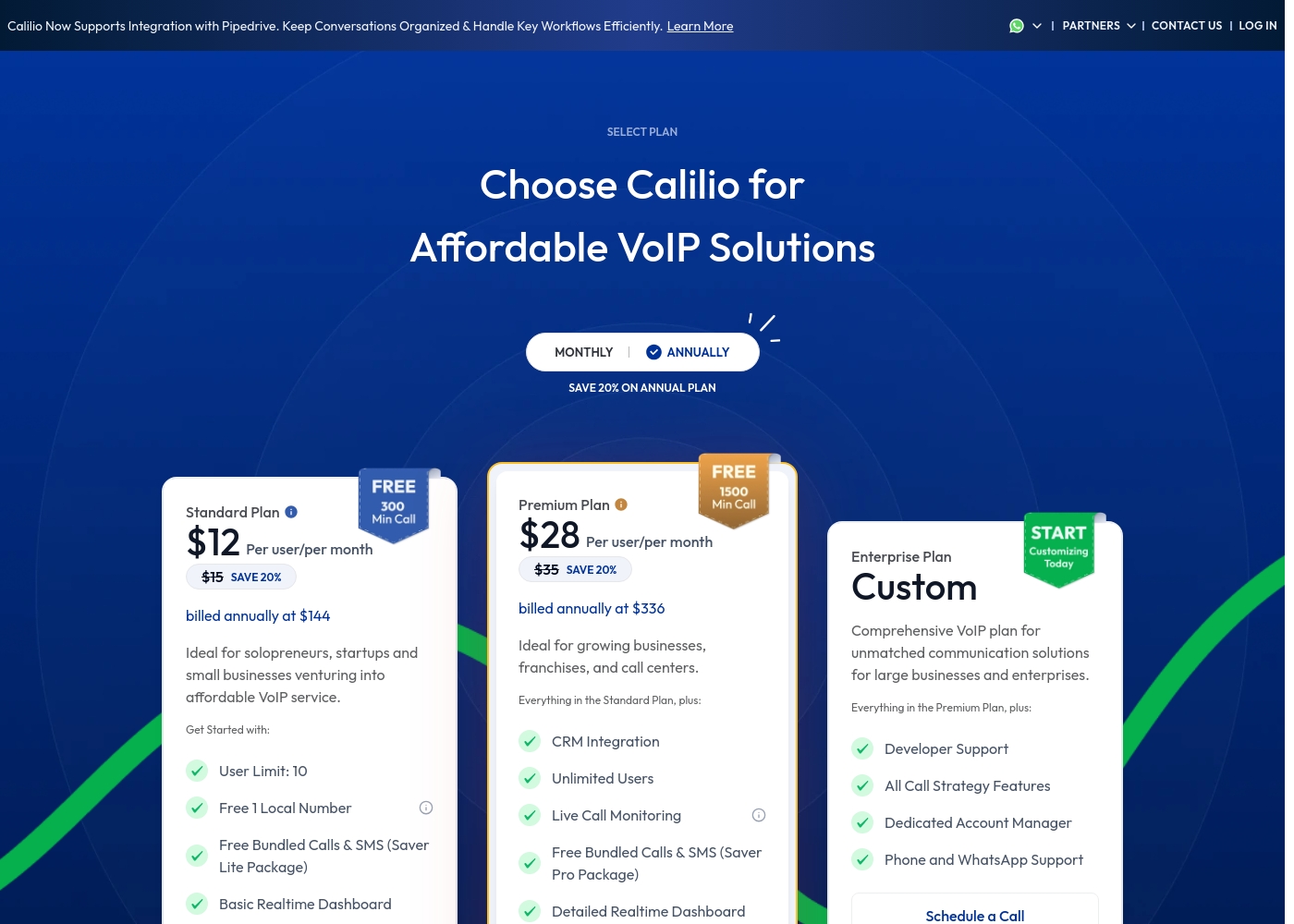
Calilio's pricing starts at $12/user/month billed annually. It's based on user counts and bundled communication minutes. Additional usage is pay-per-minute from a wallet. It has free and paid tiers. Typewise's pricing is success-based, starting at $1 per resolution. You only pay when the AI successfully resolves an issue. No hidden fees. The cost scales with your ticket volume. Calilio's model is predictable per employee. Typewise's model is variable per outcome. For a stable team, Calilio might be easier to budget. For variable support volume, Typewise aligns cost with value.
Global Reach & Localization
Calilio offers numbers in 100+ countries. Typewise supports any language in/out.
Calilio provides virtual numbers from over 100 countries. You can get local, toll-free, or mobile numbers to build a global presence. It's ideal for international business communication. Typewise works in 'Any Language in/out.' It focuses on language support for AI interactions, not phone numbers. Regional data residency options are mentioned. Calilio is for establishing a local presence with phone numbers. Typewise is for handling conversations in any language. If you need a UK phone number, choose Calilio. If you need to support 10 languages in chat, choose Typewise.
Customer Support & SLAs
Calilio offers 24/7 support. Typewise support is responsive but details are unclear.
Calilio offers 24/7 support. Users praise this in testimonials. The Enterprise plan includes dedicated account management and phone/WhatsApp support. Typewise's external reviews mention generally responsive support. However, the official site doesn't specify detailed support hours, response time SLAs, or tiered plans. Calilio is more transparent about support levels. Typewise's support quality is less documented. If 24/7 support is critical, Calilio is a safer bet. Typewise may be fine for business hours.
Security & Compliance
Both emphasize security. Typewise details enterprise features more.
Calilio mentions security features like call encryption for law offices and secure data handling. For detailed documentation, you should contact support. Typewise emphasizes enterprise-grade security and governance. It features audit logs, access controls, policy-based permissions, and data residency options for compliance. Typewise provides more specifics on governance features. Calilio's security details are less detailed. For highly regulated industries, Typewise's audit trails and controls are a clear advantage.
Mobile Experience
Calilio works on smartphones. Typewise doesn't emphasize mobile.
Calilio is cloud-based and runs on your existing computer or smartphone. No expensive hardware needed. This supports remote teams well. Typewise's description focuses on workflow automation across tech stacks. It doesn't mention a dedicated mobile app or experience. It's more of a back-end AI platform. Calilio is designed for on-the-go communication. Typewise is designed for back-office automation. If your team needs a mobile phone app, Calilio is the choice. Typewise is for desk-based support agents.
Performance & Reliability
Typewise may have reliability issues with complex tasks. Calilio's reliability is unverified.
Calilio's long-term reliability and support effectiveness are unverified without external data. We couldn't access independent reviews. Typewise's cons note occasional reliability issues with complex tasks. Some users report this. But it's designed for rapid deployment and safe launches. Neither tool has a perfect track record here. Typewise's issues are with complexity. Calilio's reliability is unknown. For simple, critical phone calls, Calilio might be safer. For complex AI workflows, Typewise's hybrid model adds a safety layer.
Scalability & Team Size
Both can scale, but for different things.
Calilio offers plans for all sizes, from solopreneurs to large call centers. The Standard plan has a user limit of 10. Premium and Enterprise offer unlimited users. Typewise is designed to scale across channels and teams. It's for customer-facing departments. Pricing scales with resolutions, not users. This is good for variable team sizes. Calilio scales by adding more users and call capacity. Typewise scales by handling more automated resolutions. If you're a growing call center, Calilio fits. If you're automating support, Typewise scales with your ticket volume.
Calilio pricing: Calilio offers flexible subscription plans starting at $12 per user monthly when billed annually. Pricing is based on user counts and bundled communication minutes, with options for monthly or yearly billing.
Pricing Head-to-Head
用户评论
We could not retrieve detailed review content from Trustpilot or Capterra due to access restrictions, so we're basing this assessment solely on Calilio's provided information. Without external user feedback, we cannot synthesize a balanced sentiment summary on themes like accuracy, support, or pricing value. We recommend checking these review platforms directly for current user experiences. ⚠️
Setting up Calilio was straightforward for our team. The AI transcription feature has been a game-changer for our sales calls, helping us review conversations quickly.
我们的判断
Calilio and Typewise are for completely different needs. Calilio is your cloud phone system. Typewise is your AI workflow engine. Calilio's superpower is global communication. It gives you virtual numbers from 100+ countries. It unifies calls, voicemails, and transcripts in one place. Its AI provides real-time call insights. Typewise's superpower is intelligent automation. It connects to 200+ tools like Salesforce and Zendesk. You can create workflows with natural language. Its Hybrid Intelligence balances AI and human control. The deciding factor is your problem. If you need to manage calls and build a global phone presence, choose Calilio. If you want to automate complex support and sales tasks across your entire tech stack, choose Typewise. Final verdict: Calilio for unified business communication. Typewise for AI-powered workflow automation. Calilio is simpler for phone needs. Typewise is more powerful for complex, integrated processes.
常见问题
Which is better for small teams: Calilio or Typewise?
Calilio might be better for small teams needing a simple phone system with global numbers. Typewise is more complex, designed for teams automating support workflows. Calilio has a Standard plan for up to 10 users.
Does Calilio have AI automation like Typewise?
No, Calilio's AI is focused on call insights like transcription and sentiment analysis. Typewise's AI is for automating entire workflows across tools. Calilio understands calls; Typewise handles tasks end-to-end.
Is Typewise worth the extra cost over Calilio?
It depends on your needs. Typewise's success-based pricing ($1/resolution) aligns cost with results. Calilio's per-user pricing is more predictable. Typewise is for automating support; Calilio is for managing phone calls.
Can I integrate Calilio with Salesforce like Typewise?
Calilio mentions CRM integration (like Pipedrive) on Premium/Enterprise plans. Typewise offers 200+ deep integrations, including Salesforce. Typewise's integration ecosystem is significantly broader.
How fast can I get started with each tool?
Calilio has a simple 3-step onboarding. Typewise claims its first AI agent can be live in about 15 minutes. Typewise is faster for launching AI workflows; Calilio is simpler for basic phone setup.
Which tool is better for international business?
Calilio excels with virtual numbers from 100+ countries for a global presence. Typewise supports any language for AI interactions but doesn't provide phone numbers. Calilio is for building local phone identities.
准备好选择了?
这两个工具都有各自的优点。根据您的具体需求进行选择。