BILL vs Navan
BILL and Navan are both popular platforms, but they solve very different problems. BILL focuses on automating your back-office financial operations like accounts payable. Navan, on the other hand, is built specifically to streamline corporate travel booking and expense reporting. Choosing between them depends on your biggest operational headache.
强大的自动化,具有挑战性的用户体验。
我们认识到 BILL 提供了强大的财务运营功能,旨在显著自动化应付账款/应收账款和支出管理流程。然而,大量的用户反馈记录了支付可靠性和访问功能客户支持渠道方面的严重缺陷。总体而言,由于在解决操作问题时不断出现关键问题和困难,我们建议谨慎行事,尽管其效率提升潜力是明确的。
优点
- 快速实现核心应付账款和发票流程的自动化。
- 用户报告显著节省时间,平均每月超过 12 小时。
- 提供与主流会计软件的自动双向同步。
- 在更高级别的套餐中提供应付账款、应收账款和采购的集中管理。
缺点
- 客户支持一直被认为是基本不存在或无法联系。
- 支付经常出现多日延迟(ACH/电子支付),有时归因于资金被冻结。
- 困难且令人困惑的设置过程需要大量的时间和精力。
- 有报告称账户在没有事先警告或明确说明的情况下被关闭或信贷被撤销。
A solid travel hub, with some expense hiccups.
We find Navan is a capable all-in-one platform for corporate travel and expenses, especially for small to mid-sized companies. Overall, its strong booking interface and helpful support are weighed down by inconsistent expense processing and a lack of public pricing clarity.
优点
- Free plan available for companies up to 300 employees.
- Unified platform for both travel booking and expense reporting.
- Generally praised for a straightforward and easy-to-use interface.
- Customer support is noted as responsive and helpful in resolving issues.
缺点
- Expense reimbursements can be slow or contain processing errors.
- Enterprise pricing requires contacting sales; no transparent public rates.
- Initial setup and platform rollout may be complex for some organizations.
- May not be ideal for teams needing niche, deep accounting integrations without confirmation.
关于BILL
BILL 是明确的财务运营平台,旨在为您的企业带来简化和自动化。它在一个平台上管理从应付账款 (AP) 和应收账款 (AR) 到支出和费用管理的所有内容。
您将获得一个汇总的现金流任务列表和一个安全的登录入口。BILL 提供与您首选会计软件的无缝自动同步,确保您自信地自动化整个技术栈。它专为数千家企业和 6,000 多家会计师事务所而构建。💡
关于Navan
Navan is a comprehensive platform for managing business travel and expenses. It’s designed for companies of all sizes, from small businesses to large enterprises. The platform serves various industries, including technology, healthcare, and retail. 💡 It aims to be a single solution for booking trips and handling the related costs.
亮点
功能比较
功能概览
我们强调主要差异并为每个功能选择获胜者。
Core Focus
BILL automates your core financial back-office. Navan is built for corporate travel and expense management.
BILL is a financial operations platform. It handles accounts payable, accounts receivable, and spend management. You can automate bill payments, send invoices, and track expenses with a Divvy card. Navan is a travel and expense platform. Employees book flights and hotels directly in Navan. Those bookings then automatically connect to expense reports for easier processing. The key difference is BILL runs your financial engine. Navan runs your travel program. They don't directly compete. Choose BILL if your main pain is manual bill processing. Choose Navan if your main pain is booking travel and tracking receipts.
Pricing & Value
BILL charges per user. Navan offers a free plan for smaller companies.
BILL has no free option. Pricing starts at $45 per user per month for the Essentials plan. The popular Corporate plan costs $89 per user per month. You pay for every person who needs access. Navan Business is completely free for companies with up to 300 employees. It includes core travel features. Larger companies get custom pricing for the Enterprise plan. BILL's value is in financial automation ROI. Users report saving 12+ hours monthly. Navan's value is cost savings on travel and time saved on expense reports. If budget is a primary concern and you have fewer than 300 people, Navan's free tier is a major advantage. BILL requires a paid investment from day one.
Customer Support
Users report significant challenges reaching BILL's support. Navan's support gets consistently positive reviews.
BILL includes standard live chat and phone support with all paid plans. However, user reviews on Trustpilot are filled with complaints. Customers describe support as "impossible to contact" and "useless chat bots." Navan offers 24/7 support with its free plan. Enterprise customers get a dedicated Account Executive and Customer Success Manager. Reviews frequently praise the support team as "responsive" and "helpful." The difference is stark. BILL's support is a major pain point for users. Navan's support is highlighted as a strength. This could be a deciding factor. If you need reliable help when issues arise, Navan appears to be the safer choice.
Ease of Use & Onboarding
Both platforms promise simplicity. Reviews suggest BILL's setup is difficult, while Navan's is generally easier but can be complex for enterprises.
BILL's marketing emphasizes saving time. However, user reviews consistently mention a "difficult and confusing setup process." Many report it requires extensive time and effort to get started. Navan is often praised for its "straightforward and easy-to-use interface" for travelers. The booking process is intuitive. Some enterprise reviews note that initial onboarding can be complex. For a small team, Navan likely offers a quicker, smoother start. For BILL, be prepared for a significant implementation investment. The day-to-day use matters most. Navan gets high marks for its booking experience. BILL's interface is functional but not its praised feature.
Reporting & Analytics
BILL provides financial reporting for AP/AR. Navan offers customizable travel and expense reports.
BILL focuses on financial reporting. You can track cash flow, AP/AR aging, and spend by category. It syncs data with your accounting software for consolidated views. Navan provides customizable reports specifically for travel spend. You can analyze booking patterns, policy compliance, and expense trends. Its data is tied to HRIS integrations. Both provide valuable insights, but for different domains. BILL's reporting helps you manage your company's money. Navan's reporting helps you manage your travel program. The winner depends on what you need to analyze. Financial health or travel policy effectiveness?
Integration Ecosystem
BILL excels with accounting software sync. Navan focuses on HRIS and travel ecosystem integrations.
BILL's standout feature is automatic 2-way sync with leading accounting software. This ensures your books are always current. It's a key selling point for finance teams. Navan offers over 30 pre-built HRIS integrations. This connects your travel platform to employee data and payroll systems. Deeper accounting integration requires sales consultation. BILL is the winner for direct accounting software connectivity. Navan wins for connecting to your HR and payroll stack. Your existing software stack will determine which integrations are more critical to your workflow.
Mobile Experience
Both offer mobile apps. BILL's app manages bills and approvals. Navan's app is for booking and on-the-go expenses.
BILL has a mobile app that allows you to review and approve bills from anywhere. You can manage cash flow tasks on your phone. It extends core AP/AR functions to mobile. Navan's mobile app lets employees book and change travel plans while traveling. They can also submit and manage expenses from their phone. The focus is on the traveler's experience. Both provide necessary mobile functionality. BILL's app is for the finance approver. Navan's app is for the traveling employee. Neither mobile experience is described as a standout feature, but both meet essential needs for their respective users.
Scalability
BILL scales with user count and plan tier. Navan scales from free to custom enterprise plans.
BILL scales by adding more users and moving to higher-tier plans like Corporate or Enterprise. Enterprise offers custom pricing, enhanced security, and multi-location accounting. Navan scales from its free Business plan for up to 300 employees to a fully customized Enterprise plan. Enterprise adds a dedicated success manager and global coverage. Both tools are built to grow with a company. The scaling path is different. BILL scales with financial complexity and user count. Navan scales with employee count and geographic complexity. For a large, global company with complex travel needs, Navan Enterprise is a clear path. For a large company with complex AP/AR needs, BILL Enterprise is the solution.
BILL 的应付账款和应收账款有四个不同的级别,每用户每月价格在 45 美元到 89 美元之间:Essentials 45 美元/用户/月,Team 55 美元/用户/月,Corporate 89 美元/用户/月。
我们仔细看看每个套餐为您的财务运营平台提供了什么。
Essentials
价格:45 美元/用户/月 支持的网站:未明确说明 最适合:快速自动化核心应付账款和发票处理 退款政策:未明确说明 其他功能:
- 应付账款时间减少 50%。
- 有效自动化发票流程。
- 提高收款速度 2 倍。
- 应付账款时间减少 50%
- 自动化发票处理
- 收款速度提高 2 倍
- 获得更细粒度的控制
- 与主流会计软件自动双向同步
- 额外的定制功能
- 在一个地方自信地管理应付账款、应收账款和采购
- 解锁增强的安全功能
- 高级支持
- 多地点会计能力
- 更多
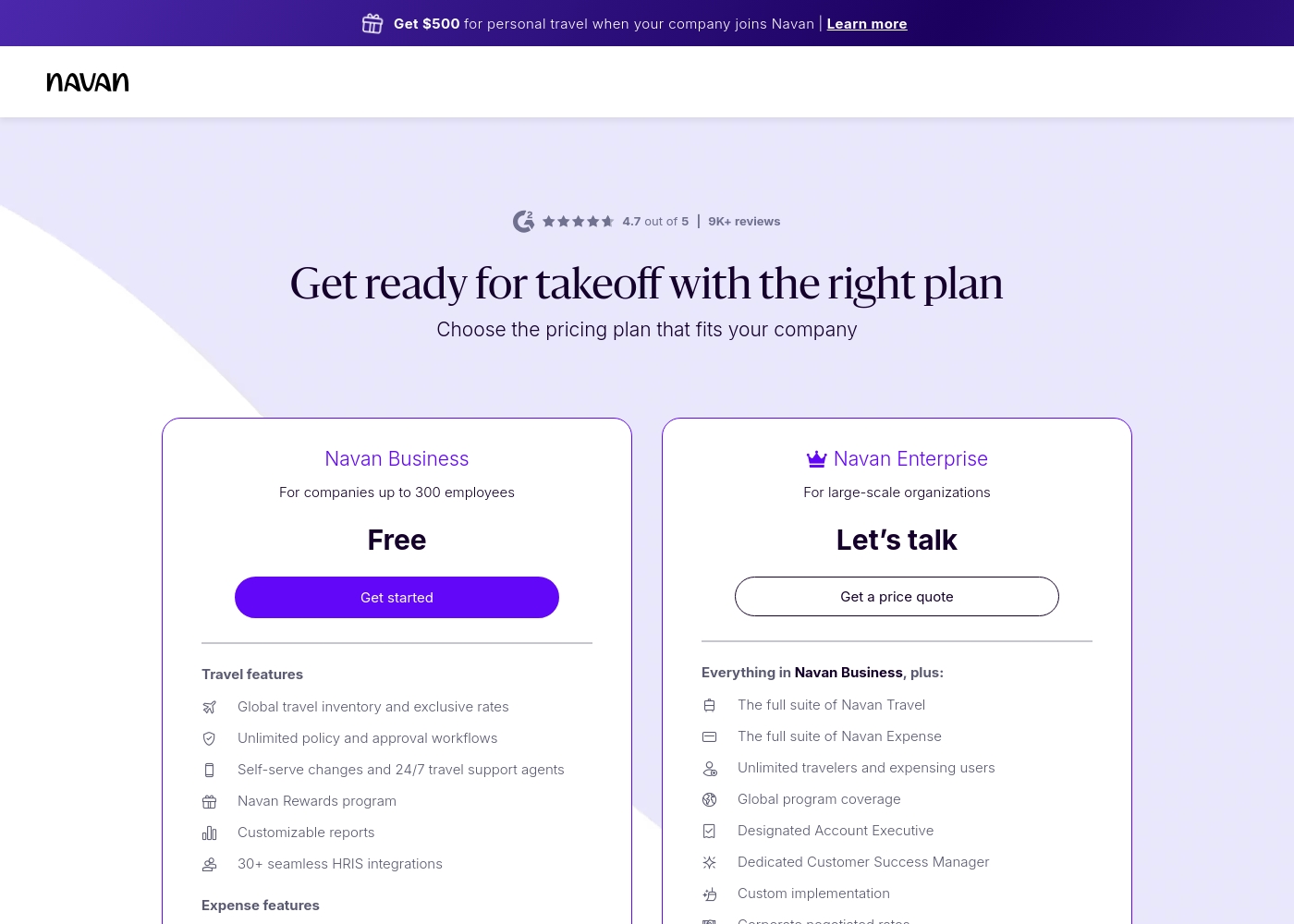
Navan costs between $0 and a custom quote with 2 plans: Navan Business at Free and Navan Enterprise at a custom price.
Here is a breakdown of the available plans and their core features for your team.
Navan Business
Price: Free Websites Supported: Not explicitly stated Best For: Companies up to 300 employees Refund Policy: Not explicitly stated Other Features: Global travel inventory, unlimited policy workflows, 24/7 support, Navan Rewards, 30+ HRIS integrations
- Global travel inventory and exclusive rates
- Unlimited policy and approval workflows
- Self-serve changes and 24/7 support
- Navan Rewards program
- Customizable reports
- Full suite of Navan Travel & Expense
- Unlimited travelers and expensing users
- Global program coverage
- Designated Account Executive
- Dedicated Customer Success Manager
Pricing Notes
- BILL has no free plan or free trial. All users must subscribe to a paid plan starting at $45/user/month.
- Navan offers a robust free plan (Navan Business) for companies with up to 300 employees, which includes core travel features.
- BILL's pricing is transparent but scales linearly with team size. A team of 10 on the Corporate plan costs $890/month.
- Navan's Enterprise pricing is opaque and requires contacting sales, which can be a barrier for buyers wanting quick cost estimates.
Pricing Head-to-Head
用户评论
BILL 在 Trustpilot 上的评价明显偏低(5 分中有 2.5 分),这与其自身对效率的有力承诺相矛盾。最普遍的抱怨是客服支持基本不存在。用户报告花费数小时处理缓慢、无济于事的聊天机器人,通常无法解决基本的访问或支付问题。可靠性是一个主要关注点,尤其是在支付方面;用户经常提到 ACH/电子支付存在重大延迟(3-4 个工作日),并声称该公司为了赚取利息而故意扣留资金。这直接影响了宣传的速度。此外,许多评论者提到设置和入职过程很困难,认为过程耗时且令人困惑。虽然一些用户赞赏数字卡的便利性或总体上对自动化概念的认可 ✨,但重复出现的主题都指向严重的操作故障。关于在取消后出现未授权的经常性计费、意外费用以及账户在没有明确解释的情况下被任意关闭的报告,也助长了用户的不信任感和不诚实的观感。
我几乎不可能在这个平台上获得任何支持。我花了数周时间才重新获得账户访问权限。您被困在无用的聊天支持中,他们三次告诉我他们已经解决了问题,但实际上并没有。
Trustpilot reviews for Navan paint a mixed picture. 👍 Many users praise the platform's ease of use, highlighting how simple it is to book travel and manage expenses.
The responsive customer support is frequently noted as a major plus, helping resolve issues quickly. 👎 However, a recurring theme involves delays in expense reimbursements and occasional errors in processing payments.
Booking travel has never been easier. The platform is intuitive, and I love earning rewards for my business trips. It's a huge time-saver.
我们的判断
Let's cut to the chase. BILL and Navan aren't really competitors. They solve entirely different business problems. BILL's superpower is financial automation. It's built to crush manual accounts payable, automate invoicing, and sync with your accounting software. Users report saving 12+ hours a month on AP tasks alone. Navan's superpower is simplifying corporate travel. It unifies booking flights and hotels with submitting expense reports. Employees love the easy interface, and finance teams get better policy compliance. The deciding factor is your biggest operational headache. If your team dreads processing stacks of paper bills, BILL is your answer. If your team's travel bookings and expense reports are a mess, Navan is built for you. Choose BILL if you need to automate AP/AR and have a budget for per-user software. Choose Navan if you want to streamline travel and expenses, especially if your team is under 300 people (it's free!). They're both strong tools—just for very different jobs.
常见问题
Which is better for small teams: BILL or Navan?
Navan is often better for small teams focused on travel, as its Business plan is free for up to 300 employees. BILL is better for small teams drowning in manual bill payments, but it requires a paid subscription starting at $45 per user per month.
Does BILL handle travel booking like Navan?
No, BILL is not a travel booking platform. Its core focus is automating accounts payable, accounts receivable, and spend management. For corporate travel booking and itinerary management, you would need a specialized tool like Navan.
Is Navan worth it if we don't travel often?
Probably not. Navan's value comes from consolidating frequent travel and expense management. If your company has minimal travel, a simpler expense tool or even your accounting software might be sufficient. Its free plan is only worthwhile if you'll use the travel booking features.
How does the pricing compare for a 50-person team?
For a 50-person team, BILL would cost at least $2,250/month on the Essentials plan. Navan would be completely free under its Business plan (for up to 300 employees). The cost difference is substantial if travel is your main need.
Which integrates better with QuickBooks?
BILL is designed for this. It offers automatic 2-way sync with leading accounting software like QuickBooks. Navan's integration with accounting systems is less direct; you would need to confirm specific compatibility with their sales team.
Can I use BILL and Navan together?
Yes, many companies use both. You could use Navan to book travel and manage those expenses, then use BILL to automate the payment of the resulting vendor invoices and other operational bills. They serve complementary functions.
准备好选择了?
这两个工具都有各自的优点。根据您的具体需求进行选择。