Assembly vs Drip
Assembly and Drip serve completely different masters. Assembly builds a modern home for your client relationships. Drip turns browsers into buyers with automated emails. Your choice depends on whether you manage clients or sell products.
Solid all-in-one client portal
Overall, we find Assembly to be a strong, user-friendly platform for professional firms aiming to centralize client management and present a polished brand. It delivers on its core promise of a modern portal but may require consideration for specific integration needs or advanced customization.
优点
- Intuitive, modern interface that is easy for clients and staff to navigate.
- Comprehensive all-in-one platform replacing scattered emails, files, and invoices.
- Strong branding and white-labeling options, especially on higher-tier plans.
- Includes key features like invoicing, messaging, and eSignatures without add-ons.
缺点
- Pricing escalates significantly for team seats and advanced features like HIPAA.
- Some users report navigation friction or layout issues when accessing specific features under time pressure.
- Integration options may require setup work if your specific software isn't listed.
- Not ideal for very simple or infrequent client interactions due to pricing structure.

Powerful for e-commerce, but check the support.
We find Drip to be a highly capable email automation platform built specifically for B2C e-commerce. Its visual builder and smart segmentation are standout features for creating personalized customer journeys. Overall, it's a strong choice for online brands, provided your team can manage the learning curve and verify support levels.
优点
- Excellent visual workflow builder for automation
- Deep e-commerce integrations (Shopify, WooCommerce)
- Powerful, behavior-based segmentation tools
- Free migration for large lists (17,500+)
缺点
- Pricing can become expensive as contacts scale
- Some users report slow or inconsistent customer support
- Requires integration with compatible platforms
- Advanced features may have a learning curve
关于Assembly
💡 Assembly is a client portal and back-office platform for professional service firms. It's built for businesses in accounting, law, marketing, real estate, and tech. The goal is to replace clutter with a single, client-friendly hub.
关于Drip
Drip is an email marketing automation platform built for B2C companies that sell online. Whether you're an e-commerce brand, a course creator, or a travel provider, it gives you the tools to move beyond generic newsletters. It's designed to be a powerful yet simple engine for driving revenue through personalization. 💡
亮点
功能比较
功能概览
我们强调主要差异并为每个功能选择获胜者。
Primary Focus
Assembly is a client relationship hub. Drip is an email revenue engine.
Assembly is built for professional service firms. It centralizes client communication, files, invoicing, and contracts in one branded portal. Drip is built for B2C e-commerce brands. It focuses on automating personalized email campaigns to drive sales and customer loyalty. The key difference is client management vs. customer marketing. Assembly manages ongoing service relationships. Drip automates the buyer journey.
User Interface
Assembly's portal is modern and client-facing. Drip's builder is powerful but can have a learning curve.
Assembly offers a clean, intuitive interface for both your team and your clients. Users praise its modern look and easy navigation. Drip's visual email builder is powerful but some users report a learning curve for advanced features. The dashboard focuses on campaign performance. Assembly prioritizes simplicity for client interactions. Drip prioritizes depth for marketing automation.
Automation
Drip's automation is its core superpower. Assembly offers basic task automation.
Drip excels with unlimited automated workflows. You can build sequences for cart abandonment, welcome series, and behavior-based triggers. Assembly offers automation tasks capped by plan (e.g., 1K/mo on Professional). These are for internal workflow steps, not customer marketing. Drip's automation drives revenue directly. Assembly's automation streamlines client processes.
Integrations
Drip connects deeply with e-commerce platforms. Assembly connects via Zapier and API.
Drip offers 50+ direct integrations with platforms like Shopify, BigCommerce, and WooCommerce. It's built to plug into your sales stack. Assembly connects via Zapier, Make, and API on higher plans. It focuses on integrating with your existing tools without a deep native ecosystem. Drip has more native e-commerce integrations. Assembly relies on broader integration platforms.
Security & Compliance
Assembly offers enterprise-grade compliance for regulated industries. Drip focuses on email compliance.
Assembly provides SOC2 and HIPAA compliance with a BAA on Advanced plans. It includes audit logs and access permissions for sensitive data. Drip ensures GDPR and CAN-SPAM compliance for email marketing. It helps with deliverability but doesn't offer healthcare-level data security. Assembly is built for industries with strict data rules. Drip is built for marketing compliance.
Reporting & Analytics
Drip provides detailed campaign and revenue analytics. Assembly offers basic client metrics.
Drip gives you deep insights into email performance, conversion rates, and revenue attribution. You can see what's driving sales. Assembly provides visibility into client interactions and activity within the portal. It's more about relationship management than marketing metrics. Drip's analytics are for optimizing marketing spend. Assembly's analytics are for managing client work.
Customer Support
Assembly's support scales with your plan. Drip's support has mixed reviews.
Assembly offers tiered support, from standard to a dedicated success manager on Enterprise. Higher plans get priority email and call support. Drip offers email support for all paid plans and live chat for $99+/month. Some users report slow or inconsistent responses. Assembly's support structure is clearer. Drip's support satisfaction is variable.
Scalability
Assembly scales with team size and client limits. Drip scales with contact list size.
Assembly's plans scale by adding team seats and removing client caps. Enterprise offers custom limits for large firms. Drip scales purely based on your contact list and email volume. Prices rise as your audience grows, but you get unlimited sends. Both scale, but for different reasons. Assembly scales with your team. Drip scales with your audience.
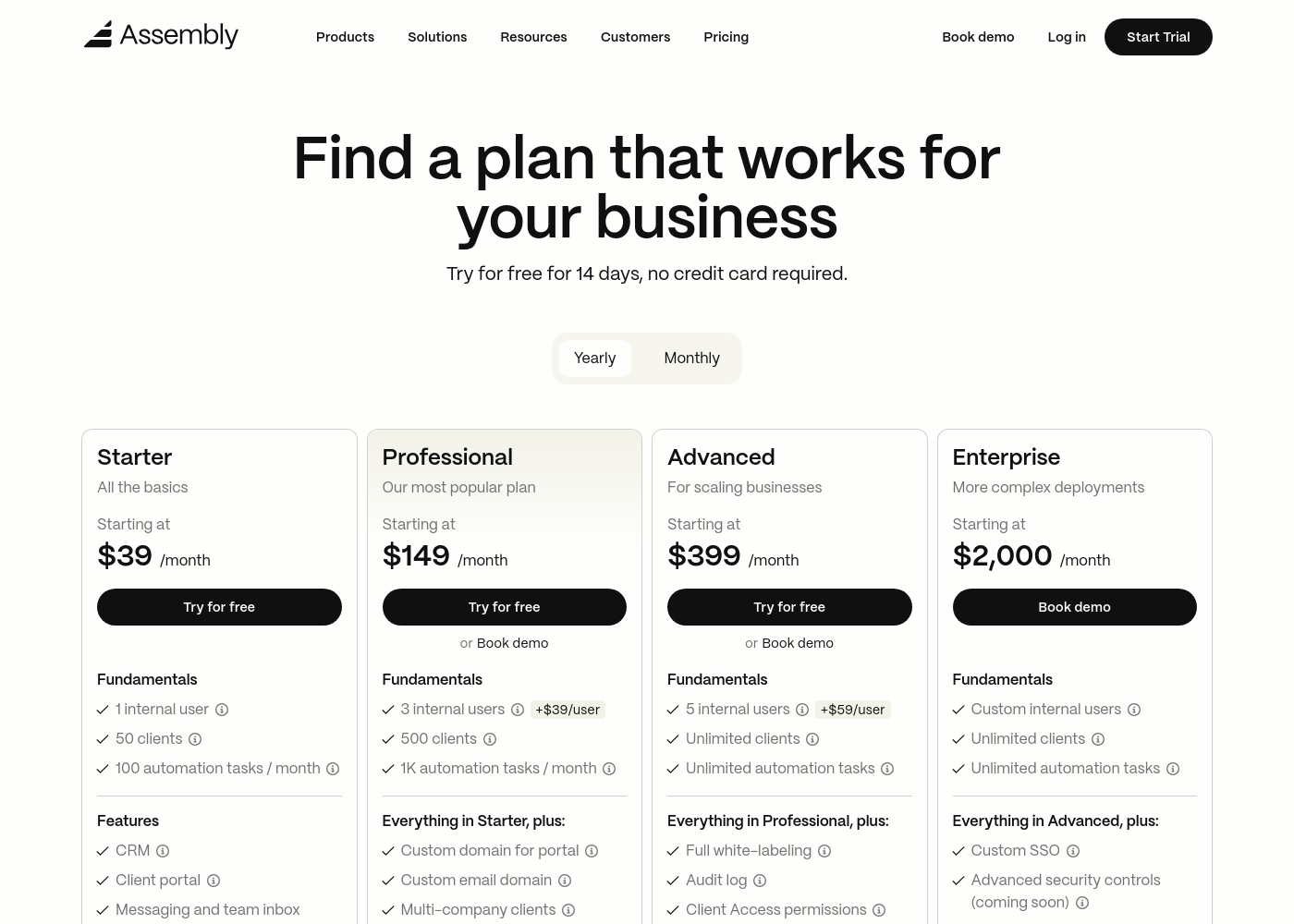
Assembly costs between $39 and $2,000 per month with 4 plans: Starter at $39, Professional at $149, Advanced at $399, and Enterprise at $2,000.
Take a look at the feature breakdown for each tier below.
Starter
Price: $39 / month Websites Supported: Not explicitly stated Best For: Solo entrepreneurs and small service providers Refund Policy: 30-day satisfaction guarantee Other Features: CRM, white-labeled client portal, messaging, invoicing, and task management.
- CRM
- Client portal
- Messaging & inbox
- Invoices & pay links
- Proposals & contracts
- Custom domain
- API & Zapier/Make
- Multi-company clients
- Low payment fees
- Full white-labeling
- Audit log
- HIPAA compliance
- Client access permissions
- Custom SSO
- Sandbox workspace
- Dedicated success manager
- Technical advisor
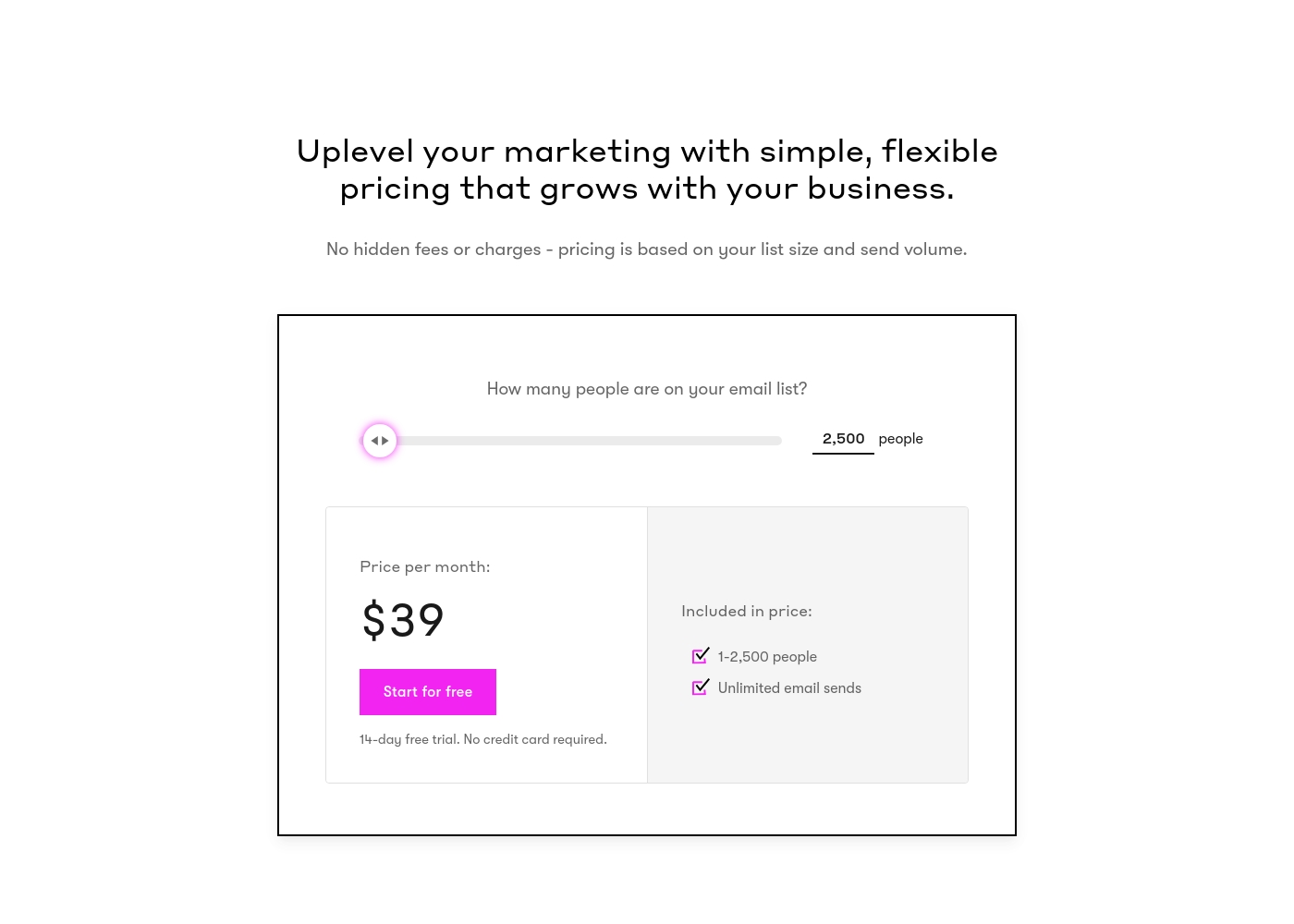
Drip pricing: Drip offers a flexible, usage-based subscription starting at $39/month for up to 2,500 people. Pricing scales based on your email list size and includes a 14-day free trial with no credit card required to start browsing its powerful automation tools tool and visual builder.
Your monthly cost increases as your audience grows, but you always get features like unlimited email sends and onsite campaigns. This ensures you only pay for what you actually use while accessing expert support and pre-built marketing playbooks right from the start.
You can cancel your subscription at any time within your billing settings if your business needs change. This model is specifically designed for e-commerce brands looking for deep segmentation and personalized customer journeys without enterprise-level complexity or hidden fees.
Pricing Notes
- Assembly's Starter plan ($39/mo) includes 1 user and 50 clients. Adding users costs $39-59 each.
- Drip's pricing starts at $39/mo for up to 2,500 contacts. Costs increase with your list size.
- Assembly has a 30-day satisfaction guarantee after purchase. Drip's trial becomes inactive after 14 days if you don't upgrade.
- Assembly's Advanced plan ($399/mo) unlocks unlimited clients and HIPAA compliance.
- Drip offers free migration and onboarding for lists over 17,500 contacts.
Pricing Head-to-Head
用户评论
From our research on Trustpilot and Capterra, users consistently praise Assembly for its modern, intuitive interface and the ease with which it centralizes client communication. The platform is frequently described as a clean, all-in-one hub that simplifies operations.
However, some users on Capterra note occasional friction in navigation under time pressure and desire more robust customization. Support responsiveness and the value of included features like invoicing and portals are highlighted as major positives, while pricing for higher tiers is seen as a consideration for scaling firms.
Assembly's interface is quick to navigate and simple to operate. It has been great for keeping our client recognition tasks organized in one place without a steep learning curve.
We found a mixed bag of user sentiment from Trustpilot, as the Capterra link was inaccessible. Reviews praise Drip's powerful automation and segmentation for driving revenue, with many noting its ease of use for e-commerce.
💡 On the downside, several users report frustration with customer support responsiveness and occasional platform glitches. Pricing is frequently cited as a concern, with some feeling the cost can escalate quickly as contacts grow.
Drip's automation tools are top-notch. We set up abandoned cart sequences that really boosted our recovery rate. The visual builder makes it easy to see the customer journey.
我们的判断
Assembly and Drip are built for completely different jobs. This isn't a head-to-head battle. Assembly's superpower is creating a single, branded home for your client relationships. It replaces scattered emails with a modern portal for communication, files, and payments. Drip's superpower is turning browsers into buyers through automated email sequences. Its visual builder and smart segmentation drive e-commerce revenue. The deciding factor is your business model. If you sell services and manage client relationships, Assembly is your hub. If you sell products and need automated marketing, Drip is your engine. Choose Assembly if you're a service firm wanting a professional client portal. Choose Drip if you're an e-commerce brand ready to automate email marketing. They solve different problems excellently.
常见问题
Can I use Assembly and Drip together?
Yes, you could. Use Assembly to manage client relationships and invoicing. Use Drip for automated marketing emails to your customers. They serve different purposes and can complement each other.
Which is better for a small online store?
Drip is better for an online store. It's designed specifically for e-commerce with deep Shopify integration and cart abandonment workflows. Assembly is built for service firms.
Does Assembly have email marketing like Drip?
No, Assembly doesn't have email marketing automation. It includes secure messaging within the client portal. For automated email campaigns, you'd need a tool like Drip.
Is Drip more affordable than Assembly?
It depends on your needs. Drip starts at $39/mo for 2,500 contacts. Assembly starts at $39/mo but adds $39 per team user. For a solo user, they're comparable. For a team, Assembly costs more.
Which tool offers better customer support?
Assembly offers clearer, tiered support with dedicated managers on higher plans. Drip's support has mixed reviews, with some users reporting slow response times.
Can I migrate from Assembly to Drip?
They serve different purposes, so migration isn't typical. You'd likely use both tools side-by-side for different functions, not replace one with the other.
准备好选择了?
这两个工具都有各自的优点。根据您的具体需求进行选择。