MongoDB vs Vultr
MongoDB and Vultr are not direct competitors, but comparing them clarifies a key choice. Do you need a smart database or raw computing power? That's the heart of the decision.
Powerful, flexible platform for modern data.
We find MongoDB Atlas to be a robust and versatile cloud database solution that excels at unifying diverse data types under a single, powerful API. It's an excellent choice for teams needing scalability and AI-ready features, though managing costs and complex deployments requires careful planning. Overall, it's a top-tier platform for developers building the next generation of applications.
Ưu điểm
- Excellent flexibility with its document model.
- Powerful, unified platform for databases, search, and streaming.
- Strong scalability and high availability guarantees.
- Native vector search integration for AI applications.
Nhược điểm
- Costs can escalate quickly with high usage and dedicated resources.
- Advanced features and configurations can have a steep learning curve.
- Support responsiveness can be inconsistent for some users.
Công nghệ tiên tiến, Hỗ trợ gặp nhiều vấn đề nghiêm trọng.
Chúng tôi nhận thấy Vultr cung cấp các tài nguyên hiệu suất cao, thông số kỹ thuật cao được tối ưu hóa cho khối lượng công việc AI và HPC, cung cấp quyền truy cập ngay lập tức vào cơ sở hạ tầng toàn cầu tiên tiến nhất. Tuy nhiên, phản hồi của người dùng rõ ràng cho thấy sự bất ổn nghiêm trọng về hỗ trợ hoạt động, quy trình xác minh và độ tin cậy của mạng. Nhìn chung, Vultr là một nhà cung cấp rủi ro cao, nơi công nghệ đẳng cấp thế giới bị lu mờ nghiêm trọng bởi những thất bại phổ biến trong dịch vụ khách hàng và quản lý tài khoản.
Ưu điểm
- Tiếp cận phần cứng AI và HPC tiên tiến (NVIDIA HGX B200, AMD Instinct).
- Phạm vi hoạt động toàn cầu với 32 địa điểm trung tâm dữ liệu đám mây.
- Thanh toán linh hoạt theo giờ và theo tháng dựa trên mức sử dụng, bắt đầu từ 2,50 USD/tháng.
- Có sẵn các dịch vụ được quản lý như Kubernetes Engine và cơ sở dữ liệu.
Nhược điểm
- Dịch vụ hỗ trợ khách hàng nhìn chung chậm, không hữu ích, chỉ qua hệ thống phiếu và không phản hồi.
- Tạm dừng tài khoản tùy tiện và chấm dứt dịch vụ xảy ra thường xuyên (ví dụ: do CPU đột biến).
- Các bước xác minh bắt buộc không hợp lý, xâm phạm quyền riêng tư (yêu cầu ảnh ID, thẻ tín dụng).
- Gặp khó khăn trong việc lấy lại tiền hoàn lại, đặc biệt đối với các khoản tiền gửi bằng tiền điện tử.
VềMongoDB
💡 MongoDB Atlas is a comprehensive cloud data platform built for modern applications. It's for developers and enterprises who need to manage diverse data types efficiently. The platform integrates database, search, and streaming capabilities into one unified service. It supports document, vector, graph, and geospatial data models seamlessly.
VềVultr
Vultr cung cấp một nền tảng điện toán đám mây toàn diện mạnh mẽ. Nó cung cấp các dịch vụ từ máy ảo có thể cấu hình đến máy chủ chuyên dụng được tăng tốc cao 💡. Nền tảng này lý tưởng cho các nhà phát triển và doanh nghiệp tập trung vào điện toán hiệu năng cao và triển khai mô hình AI phức tạp. Bạn có thể khởi động các cấu hình chung hoặc tối ưu hóa trong vòng chưa đầy 60 giây.
Điểm nổi bật
So sánh tính năng
Tổng quan về tính năng
Chúng tôi làm nổi bật những khác biệt chính và chọn người chiến thắng cho từng tính năng.
Core Function
MongoDB is a specialized data platform. Vultr is a general-purpose computing foundation.
MongoDB Atlas is a managed cloud database. It's a complete platform for storing, searching, and processing data. You get a document database with built-in vector search and analytics. Vultr provides raw cloud compute. You rent virtual machines or bare-metal servers. You must install, configure, and manage your own database and software stack on top. The key difference is control vs. convenience. Vultr gives you infrastructure to build on. MongoDB gives you a finished, intelligent data system. Choose MongoDB if data management is your core problem. Choose Vultr if you need flexible computing power for any purpose.
AI & ML Capabilities
MongoDB integrates AI features into your data. Vultr provides the powerful hardware to train models.
MongoDB Atlas has native vector search. You can build semantic search and AI apps directly on your operational data. It also offers stream processing for real-time AI pipelines. Vultr's strength is GPU infrastructure. You can deploy clusters with NVIDIA HGX B200 and AMD Instinct GPUs. These are for training massive AI models at scale. MongoDB makes AI features easier to build. Vultr provides the brute-force computing needed for the most demanding AI research. A startup building a recommendation engine might choose MongoDB. A research lab training a language model would choose Vultr.
Pricing Structure
MongoDB's cost is tied to data storage and usage. Vultr's cost is tied to virtual machine size and runtime.
MongoDB Atlas pricing is based on resources your cluster uses. Costs start at $0 for the free tier. Paid plans begin around $0.011/hour for shared resources. Vultr's pricing is per virtual machine instance. Plans start at $2.50/month for a tiny 0.5 GB server. High-end GPU plans require 36-month prepaid contracts. Both are usage-based, but the units differ. MongoDB charges for a managed service. Vultr charges for raw compute hours. Monitoring is crucial for both. MongoDB costs can spike with data growth. Vultr costs increase with larger VM selections.
Ease of Use
MongoDB simplifies database management. Vultr simplifies server deployment.
MongoDB Atlas handles backups, patches, and scaling for you. Its dashboard lets you configure clusters in minutes. It removes traditional database administration headaches. Vultr lets you deploy a server in under 60 seconds. But you are responsible for the entire software stack. You must secure, update, and manage the OS and applications. MongoDB has a gentler learning curve for data tasks. Vultr requires broader systems administration skills. Choose MongoDB to focus on your application code. Choose Vultr if you need deep control over your server environment.
Scalability
MongoDB scales your data layer automatically. Vultr lets you manually resize your compute power.
MongoDB Atlas can automatically scale storage and RAM. It handles sharding across servers as your data grows. Performance stays consistent at scale. With Vultr, you choose a VM plan with fixed resources. To scale, you must resize to a larger plan (often requiring a reboot) or add more servers yourself. MongoDB's scaling is more hands-off and data-focused. Vultr's scaling is more manual but offers predictable cost control. A viral app with unpredictable traffic might prefer MongoDB's autoscaling. A predictable production workload might prefer Vultr's fixed-size VMs.
Customer Support
Both have significant issues, but user reports on Vultr are far more negative.
MongoDB support is noted as sometimes inconsistent. Dedicated tiers include enhanced support options. The quality can vary. Vultr support is frequently described as slow, unresponsive, and ticket-based. Many users report being unable to get help during critical failures. MongoDB's support has room for improvement. Vultr's support is a major pain point for many users. For mission-critical apps, MongoDB's inconsistent support may be a concern. For Vultr, support failures can halt your entire operation.
Reliability & Uptime
MongoDB guarantees high availability. Vultr has reported network and instance stability issues.
MongoDB Atlas guarantees 99.99% availability for dedicated clusters. It's built for mission-critical applications requiring constant uptime. Vultr users report network instability and catastrophic server failures. Account suspensions over CPU usage have caused outages for customers. MongoDB provides strong uptime guarantees for your data. Vultr's infrastructure reliability is questioned by a significant portion of its user base. If uptime is non-negotiable, MongoDB's SLAs are a clear advantage. Choosing Vultr carries higher operational risk.
Global Infrastructure
MongoDB leverages major cloud providers. Vultr operates its own global data center network.
MongoDB Atlas runs on AWS, Azure, and Google Cloud. You can deploy in any of their global regions. It piggybacks on their massive infrastructure. Vultr owns and operates 32 data centers worldwide. This gives you direct control over location without a cloud provider layer. MongoDB offers more geographic options through partners. Vultr offers more direct control over its owned facilities. Choose MongoDB for cloud integration. Choose Vultr if you prefer a dedicated, non-hyperscaler provider.
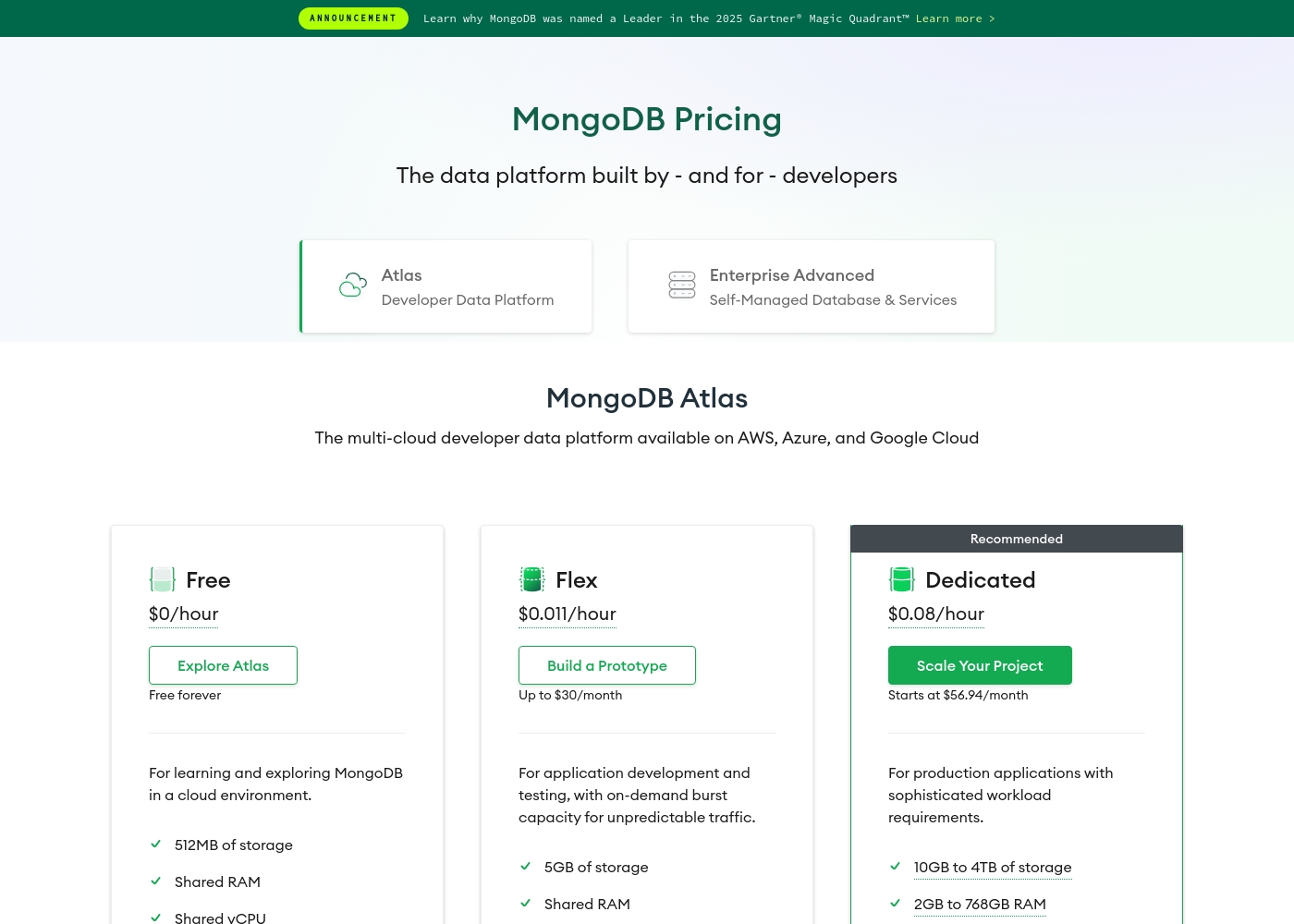
MongoDB pricing: MongoDB offers a range of cloud database options starting with a free-forever tier and scaling to dedicated resources for production environments. Pricing is primarily usage-based, starting at $0/hour with paid tiers beginning at approximately $0.011/hour and $0.08/hour for advanced workloads.
Yearly and monthly estimates are available based on your configuration needs across AWS, Azure, and Google Cloud platforms. Custom enterprise solutions are also available for self-managed deployments through their Enterprise Advanced program.
Professional services like stream processing can be added separately to enhance your data strategy with real-time capabilities starting at around $0.06/hour per instance level SP2 or higher depending on your needs. Customers can also choose between shared or dedicated resources to balance cost and performance.
Giá Vultr dao động từ 2,50 USD đến 80,00 USD mỗi tháng cho Cloud Compute Regular Performance, bao gồm tám gói, bắt đầu bằng cấu hình 1 vCPU / 0.5 GB với giá 2,50 USD/tháng.
Vultr cung cấp các dịch vụ Cloud Compute dựa trên máy ảo sử dụng vCPU dùng chung. Những máy này rất phù hợp cho các tác vụ hàng ngày như chạy các trang web lưu lượng truy cập thấp, cơ sở dữ liệu đơn giản hoặc môi trường phát triển nhỏ. Chúng tôi đã nêu chi tiết một vài tùy chọn có sẵn dưới đây.
1 vCPU / 0.5 GB (Chỉ với IPv6)
- 1 vCPU
- 0.5 GB Bộ nhớ/RAM
- 10 GB Lưu trữ
- 0.50 TB Băng thông
- 1 vCPU
- 1.0 GB Bộ nhớ/RAM
- 25 GB Lưu trữ
- 1.00 TB Băng thông
- 6 vCPU
- 16 GB Bộ nhớ/RAM
- 320 GB Lưu trữ
- 5.00 TB Băng thông
Pricing Notes
- MongoDB's free tier includes 512MB of storage, perfect for prototyping.
- Vultr has no free tier, but its lowest VM plan is only $2.50/month.
- MongoDB costs can grow quickly with data storage and high-performance clusters.
- Vultr costs are predictable per VM, but high-end GPU plans require 36-month prepayment.
- Enabling Vultr backups adds a 20% fee; DDoS protection adds $10/month.
Pricing Head-to-Head
Đánh giá của người dùng
Based on the external review sources, we couldn't access specific user snippets due to verification errors on both Trustpilot and Capterra. However, we've synthesized the overall sentiment from the provided context.
Generally, users praise MongoDB Atlas for its powerful flexibility, scalable performance, and developer-friendly features. Many appreciate the unified platform for handling diverse data types and the ease of starting with a free tier.
MongoDB's flexibility is a game-changer for our agile team. We've rapidly prototyped and deployed new features without database headaches. The scalability gives us peace of mind.
Vultr nhận được xếp hạng bên ngoài thấp, đặc biệt trên Trustpilot (2.1), nơi trải nghiệm của khách hàng bị phân cực đáng kể. Mặc dù một số người dùng thừa nhận giá cả cạnh tranh của Vultr và sức mạnh tổng thể của máy chủ, những thuộc tính tích cực này thường bị lu mờ bởi những thất bại hoạt động nghiêm trọng.
Khiếu nại phổ biến nhất xoay quanh dịch vụ hỗ trợ khách hàng tồi tệ, được mô tả là chậm chạp, không phản hồi và hoàn toàn qua hệ thống phiếu. Người dùng thường xuyên báo cáo việc tạm dừng tài khoản tùy tiện hoặc chấm dứt dịch vụ, thường được kích hoạt do vượt quá giới hạn sử dụng CPU chưa được công bố hoặc các khiếu nại DMCA vô căn cứ 😔.
Các đánh giá tiêu cực ở đây không phản ánh chín năm kinh nghiệm của tôi. Tôi đã là khách hàng được một thời gian dài chỉ lưu trữ một máy chủ web và thư điện tử. Các ưu đãi ban đầu luôn giữ mức giá trị tuyệt vời, và bộ phận hỗ trợ trước đây rất dễ tiếp cận.
Phán quyết của chúng tôi
The bottom line: MongoDB and Vultr solve completely different problems. You're not choosing between two similar tools; you're deciding if you need a smart database or raw computing power. MongoDB's superpower is being a unified data platform. It handles your database, search, vector AI, and real-time streams in one place. This eliminates complex data pipelines and lets you build features faster. Vultr's superpower is providing instant, cutting-edge computing hardware. You can deploy powerful GPU clusters for AI training in minutes. It's a blank canvas for any software you need to run. The deciding factor is your core challenge. If your problem is managing and querying complex application data, choose MongoDB. If your problem is needing affordable, powerful servers to run your own software, choose Vultr. For most application developers, MongoDB is the better fit. Choose Vultr only if you specifically need raw infrastructure control or extreme GPU compute for AI research.
Câu hỏi thường gặp
Can I use Vultr to host a MongoDB database?
Yes, absolutely. You can deploy a Vultr virtual machine and install MongoDB software on it yourself. However, you lose the managed features and ease-of-use of MongoDB Atlas.
Which is cheaper for a small project?
MongoDB's free tier is hard to beat for prototyping. For a live project, a tiny Vultr VM ($2.50/month) might be cheaper than a paid MongoDB cluster, but you'll spend more time on setup and management.
Does MongoDB require more technical knowledge than Vultr?
They require different skills. MongoDB Atlas simplifies database administration. Using a Vultr VM effectively requires broader systems and networking knowledge to secure and manage the server.
Which is better for AI projects?
It depends on the AI phase. For building AI features into an app, MongoDB's native vector search is ideal. For training large AI models from scratch, Vultr's GPU instances are necessary.
Is MongoDB more reliable than Vultr?
MongoDB Atlas provides strong uptime SLAs for its managed service. Vultr has more frequent user reports of network instability and account-related outages, making it less predictable.
Can I start with MongoDB Atlas and move to Vultr later?
You can export your data from MongoDB and set up a database on a Vultr server. This migration involves significant work, as you'd be moving from a managed service to a self-managed environment.
Sẵn sàng chọn?
Cả hai công cụ đều có điểm mạnh riêng. Chọn dựa trên nhu cầu cụ thể của bạn.