MongoDB vs Utho
MongoDB and Utho both aim to power your applications, but they serve very different needs. MongoDB is a mature, feature-rich data platform for AI and analytics. Utho is a budget-focused cloud server provider targeting cost-sensitive markets. This comparison helps you see which fits your project.
Powerful, flexible platform for modern data.
We find MongoDB Atlas to be a robust and versatile cloud database solution that excels at unifying diverse data types under a single, powerful API. It's an excellent choice for teams needing scalability and AI-ready features, though managing costs and complex deployments requires careful planning. Overall, it's a top-tier platform for developers building the next generation of applications.
Ưu điểm
- Excellent flexibility with its document model.
- Powerful, unified platform for databases, search, and streaming.
- Strong scalability and high availability guarantees.
- Native vector search integration for AI applications.
Nhược điểm
- Costs can escalate quickly with high usage and dedicated resources.
- Advanced features and configurations can have a steep learning curve.
- Support responsiveness can be inconsistent for some users.
Giá cả phải chăng, nhưng có rủi ro nghiêm trọng về độ ổn định.
Chúng tôi nhận thấy Utho trình bày một mô hình đám mây dựa trên mức sử dụng, giá cả phải chăng đầy tham vọng, được thiết kế để tiết kiệm chi phí đáng kể. Tuy nhiên, nhiều báo cáo của người dùng chỉ trích sự ổn định cơ bản của cơ sở hạ tầng, viện dẫn các lỗi quan trọng như hỏng hệ thống tệp và ngừng hoạt động không theo lịch trình. Nhìn chung, do rủi ro nghiêm trọng đối với sự ổn định và các vấn đề về tính toàn vẹn được người dùng báo cáo, chúng tôi không thể đề xuất Utho cho việc triển khai chuyên nghiệp hoặc sản xuất tại thời điểm này.
Ưu điểm
- Cấu trúc giá dựa trên mức sử dụng với giới hạn hàng tháng có thể dự đoán được.
- Quảng cáo giảm chi phí lên đến 60% so với các đối thủ cạnh tranh toàn cầu.
- Hứa hẹn hiệu suất cao, tuyên bố các hoạt động nhanh hơn 2 lần.
- Cung cấp các gói CPU Chia sẻ cốt lõi bắt đầu từ $17.48 mỗi tháng.
Nhược điểm
- Máy chủ được báo cáo là không đáng tin cậy một cách nghiêm trọng và không phù hợp cho việc sử dụng sản xuất.
- Người dùng báo cáo các lỗi nghiêm trọng như hỏng hệ thống tệp và lỗi VPS chỉ đọc.
- Xung đột thanh toán được báo cáo với tỷ lệ hàng giờ được quảng cáo (thanh toán hàng tháng ngay lập tức khi tạo).
- Các yêu cầu tiếp thị (truy cập GPU, thời gian dùng thử miễn phí) được báo cáo là sai hoặc gây hiểu lầm sau khi đăng ký.
VềMongoDB
💡 MongoDB Atlas is a comprehensive cloud data platform built for modern applications. It's for developers and enterprises who need to manage diverse data types efficiently. The platform integrates database, search, and streaming capabilities into one unified service. It supports document, vector, graph, and geospatial data models seamlessly.
VềUtho
Utho là nền tảng đám mây mạnh mẽ đầu tiên của Ấn Độ, được hơn 22.000 người dùng tin cậy và đang phát triển. Nó cung cấp một loạt đầy đủ các giải pháp máy chủ đám mây được thiết kế cho cả doanh nghiệp và nhà phát triển. Nền tảng này tập trung vào việc mang lại giá trị vô song và hiệu suất cao cho các hoạt động của bạn.
Họ mang đến trải nghiệm đám mây liền mạch được điều chỉnh hoàn toàn theo các yêu cầu cụ thể của bạn. Utho hoạt động thông qua quan hệ đối tác với các trung tâm dữ liệu hàng đầu, đảm bảo nhu cầu của bạn được ưu tiên trong cơ sở hạ tầng đáng tin cậy. 💡
Điểm nổi bật
So sánh tính năng
Tổng quan về tính năng
Chúng tôi làm nổi bật những khác biệt chính và chọn người chiến thắng cho từng tính năng.
Core Service & Focus
MongoDB is a specialized data platform. Utho is a general-purpose cloud server provider.
MongoDB Atlas is a comprehensive cloud data platform. It combines operational databases, vector search, and stream processing. It's built for developers needing a unified data layer for modern apps. Utho provides raw cloud infrastructure. You get virtual servers, storage, and managed services like Kubernetes. It's focused on being a cost-effective alternative to major cloud providers. The key difference is scope. MongoDB solves complex data challenges. Utho solves basic compute and hosting needs at a lower price.
AI & Advanced Analytics
MongoDB has native AI features. Utho does not.
MongoDB Atlas natively integrates vector search. You can build semantic search, recommendation engines, and AI applications. It also supports real-time analytics directly on operational data. Utho is an infrastructure provider. It doesn't offer built-in database analytics or AI-specific features. You would need to install and manage third-party tools on its servers. MongoDB is the clear winner for teams building intelligent, data-driven applications. Utho is just the hosting layer.
Pricing & Cost Control
Both offer usage-based pricing, but MongoDB's costs can scale high. Utho promotes deep discounts.
MongoDB pricing is usage-based, starting free. Costs can escalate quickly with high storage, RAM, and dedicated resources. You need to monitor usage carefully to avoid surprises. Utho advertises up to 60% cost reduction vs. big clouds. Plans start at $17.48/month. Billing is hourly but capped monthly at 672 hours. Utho's value proposition is pure cost savings. MongoDB's cost reflects its advanced platform capabilities. Your choice depends on if you need the data platform or just cheap servers.
Reliability & Production Readiness
MongoDB offers enterprise-grade SLAs. Utho has severe reported reliability issues.
MongoDB Atlas offers 99.995% uptime on dedicated tiers. It's trusted for mission-critical apps by thousands of companies. The managed service handles maintenance and scaling. User reviews for Utho are alarming. They report filesystem corruption, system freezes, and read-only VPS errors. Some call it critically unreliable for production. For any serious production workload, MongoDB is the safer choice. Utho's reported stability problems pose a significant risk.
Deployment & Management
MongoDB is a managed service. Utho offers more hands-on server control.
MongoDB Atlas is fully managed. It handles patching, backups, and scaling automatically. You focus on your application code, not database administration. With Utho, you get server instances. You manage the OS, software stack, and security. Deployment takes 30 seconds, but ongoing management is your responsibility. Choose MongoDB if you want to outsource infrastructure management. Choose Utho if you want low-level control and don't mind the ops work.
Target Audience
MongoDB targets developers and data teams. Utho targets cost-sensitive businesses in India.
MongoDB is ideal for developers building complex applications. It's perfect for teams needing scalability, AI features, and a unified data platform. Enterprises use it for critical systems. Utho explicitly targets startups, SMEs, and enterprises in India. Its main draw is significant cost savings. It's for those prioritizing price over advanced features. Your project's needs dictate the fit. Advanced data needs point to MongoDB. Tight budget points to Utho.
Scalability
Both claim easy scaling, but MongoDB's is proven at a larger scale.
MongoDB Atlas scales seamlessly. You can go from a free tier to a massive dedicated cluster with terabytes of data. It's designed for global-scale applications. Utho allows you to scale compute, storage, and network resources. You can deploy across global footprints with consistent pricing. Both offer scaling, but MongoDB's platform is battle-tested at a much larger scale for complex data workloads. Utho's scaling is for basic server resources.
Customer Support
MongoDB has tiered support. Utho promises 24/7 human help.
MongoDB offers documentation, community forums, and paid support plans. Response times and depth depend on your subscription tier. Utho advertises dedicated 24/7 human support via live chat, phone, and email. This is a key promise, especially for those without in-house IT. Utho's support promise is more accessible. However, support can't fix fundamental platform reliability issues, which are a major concern for Utho.
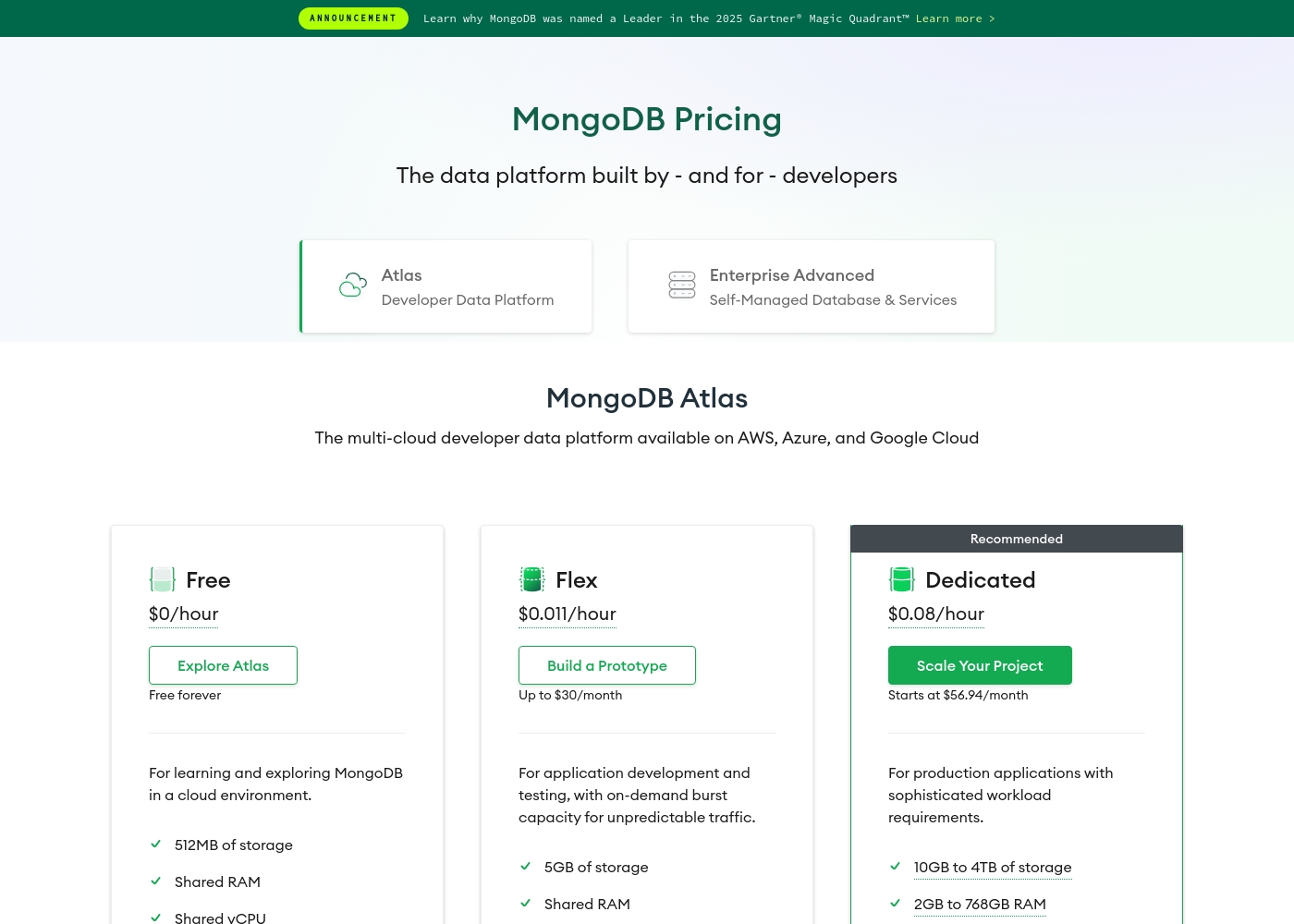
MongoDB pricing: MongoDB offers a range of cloud database options starting with a free-forever tier and scaling to dedicated resources for production environments. Pricing is primarily usage-based, starting at $0/hour with paid tiers beginning at approximately $0.011/hour and $0.08/hour for advanced workloads.
Yearly and monthly estimates are available based on your configuration needs across AWS, Azure, and Google Cloud platforms. Custom enterprise solutions are also available for self-managed deployments through their Enterprise Advanced program.
Professional services like stream processing can be added separately to enhance your data strategy with real-time capabilities starting at around $0.06/hour per instance level SP2 or higher depending on your needs. Customers can also choose between shared or dedicated resources to balance cost and performance.
Utho có giá từ $17.48 đến $87.62 mỗi tháng cho các gói CPU Chia sẻ, với bốn cấp độ: RAM 4 GB giá $17.48, RAM 8 GB giá $35.01, RAM 16 GB giá $53.72 và RAM 32 GB giá $87.62.
Utho cung cấp nhiều sản phẩm đám mây khác nhau; các mức giá dưới đây trình bày chi tiết các tùy chọn cấp độ CPU Chia sẻ cốt lõi.
Gói CPU Chia sẻ 4 GB RAM
Giá: $17.48 mỗi tháng ($0.02 mỗi giờ) Trang web được hỗ trợ: Không được nêu rõ Phù hợp nhất cho: Không được nêu rõ Chính sách hoàn tiền: Không được nêu rõ Các tính năng khác:
- 2 vCPU
- Đĩa SSD 80 GB
- 4 GB RAM
- 2 vCPU
- 80 GB SSD Disk
- Tính phí theo giờ ở mức $0.02
- 8 GB RAM
- 4 vCPU
- 160 GB SSD Disk
- Tính phí theo giờ ở mức $0.05
- 16 GB RAM
- 6 vCPU
- 320 GB SSD Disk
- Tính phí theo giờ ở mức $0.07
- 32 GB RAM
- 8 vCPU
- 480 GB SSD Disk
- Tính phí theo giờ ở mức $0.12
Pricing Notes
- MongoDB offers a generous 'free forever' tier for prototyping.
- Utho's trial is a 30-day money-back guarantee, not a usage-based free tier.
- MongoDB's costs can spike unpredictably with high resource consumption.
- Utho promotes cost savings of up to 60% compared to major cloud providers.
- Utho's hourly billing is capped at 672 hours per month, providing cost predictability.
- Both require careful monitoring, but for different reasons: MongoDB for usage, Utho for hidden limits.
Pricing Head-to-Head
Đánh giá của người dùng
Based on the external review sources, we couldn't access specific user snippets due to verification errors on both Trustpilot and Capterra. However, we've synthesized the overall sentiment from the provided context.
Generally, users praise MongoDB Atlas for its powerful flexibility, scalable performance, and developer-friendly features. Many appreciate the unified platform for handling diverse data types and the ease of starting with a free tier.
MongoDB's flexibility is a game-changer for our agile team. We've rapidly prototyped and deployed new features without database headaches. The scalability gives us peace of mind.
Người dùng nhất trí mô tả Utho là không đáng tin cậy và có khả năng gây hiểu lầm dựa trên phản hồi hạn chế nhưng quan trọng trên Trustpilot (4 bài đánh giá, điểm 2.6). Các vấn đề lặp đi lặp lại xoay quanh sự ổn định cốt lõi: các kỹ sư báo cáo các lỗi thảm khốc như hỏng hệ thống tệp, VPS tự động chuyển sang chế độ chỉ đọc và đóng băng hệ thống không theo lịch trình mà không có bất kỳ cảnh báo hoặc giám sát nào.
Một người dùng đã chuyển sang nhà cung cấp trước đó vào ban đêm để tránh ngừng hoạt động hoàn toàn, gọi Utho là chưa trưởng thành cho việc sử dụng sản xuất. Hơn nữa, khách hàng đã nêu lên những lo ngại nghiêm trọng về tính toàn vẹn của việc thanh toán và tính chính xác của tiếp thị.
Tôi đã chuyển sang với hy vọng giảm chi phí, nhưng Utho đã tạo ra các sự cố nghiêm trọng, rủi ro cao trong vòng vài ngày. VPS của tôi chuyển sang chế độ chỉ đọc mà không có cảnh báo, làm đóng băng hoàn toàn hệ thống. Cơ sở hạ tầng rẻ tiền này gần như đã khiến toàn bộ doanh nghiệp của tôi sụp đổ; hãy tránh xa Utho cho việc sử dụng sản xuất.
Phán quyết của chúng tôi
This isn't a close call. MongoDB and Utho serve fundamentally different needs, but one is clearly safer and more capable. MongoDB Atlas is a powerhouse for modern application development. Its superpower is unifying databases, AI vector search, and real-time streams on one platform. It's built for scale and complexity. Utho's superpower is its low price point. It promises cloud servers at a deep discount. Its focus is on raw compute, not advanced data services. The deciding factor is reliability and need. If you're building anything serious, MongoDB's proven platform is worth the cost. If you're on an extreme budget and can tolerate major risks, Utho is an option. For most developers and businesses, **MongoDB is the clear recommendation.** Choose Utho only if you need the cheapest possible server and have the stomach for the reported stability issues.
Câu hỏi thường gặp
Is MongoDB or Utho better for a new startup?
It depends entirely on your tech stack. Choose MongoDB Atlas if your startup needs a built-in database with AI features. Choose Utho only if you need the absolute cheapest virtual servers and can manage everything yourself.
Can I use Utho to host my MongoDB database?
Technically, yes. You could install MongoDB on a Utho server. However, you'd lose all of Atlas's managed benefits like backups, scaling, and security patches. It's much more work and risk.
Which is more expensive, MongoDB or Utho?
Utho has a lower starting price ($17.48/month) for a server. MongoDB starts free but costs can scale high for production data needs. For pure hosting cost, Utho is cheaper. For data platform value, MongoDB may be more cost-effective.
Is Utho reliable for production websites?
User reviews are very concerning. They report critical failures like filesystem corruption and system freezes. We cannot recommend Utho for production use based on these reports. MongoDB Atlas is designed for production workloads.
Does MongoDB have cloud servers like Utho?
No. MongoDB Atlas is a managed data platform, not an IaaS provider. You don't get a raw virtual server. You get a fully managed database service. Utho provides raw cloud servers (VMs).
Which one is easier for beginners?
For learning basic cloud servers, Utho might seem simpler. For learning modern application development, MongoDB Atlas's free tier and documentation are excellent. It depends on what you're trying to learn.
Sẵn sàng chọn?
Cả hai công cụ đều có điểm mạnh riêng. Chọn dựa trên nhu cầu cụ thể của bạn.