Microsoft Azure vs MongoDB
Microsoft Azure and MongoDB serve fundamentally different roles, which makes this comparison fascinating. Azure is a massive cloud platform for everything from AI to infrastructure. MongoDB is a specialized data platform for building modern apps with flexible data. It’s like comparing a full-service skyscraper to a masterfully designed workshop.
Các tính năng mạnh mẽ, trải nghiệm người dùng có vấn đề nghiêm trọng.
Microsoft Azure cung cấp cơ sở hạ tầng toàn cầu mạnh mẽ cho AI, HPC và di chuyển dữ liệu quy mô lớn. Tuy nhiên, phản hồi bên ngoài cho thấy các vấn đề nghiêm trọng về hỗ trợ khách hàng, tính minh bạch trong thanh toán và các giao thức độ tin cậy, đặc biệt liên quan đến lưu giữ dữ liệu. Nhìn chung, chúng tôi thấy tiềm năng công nghệ mang tính chuyển đổi, nhưng các vấn đề hoạt động và dịch vụ được báo cáo đòi hỏi phải thận trọng trước khi đầu tư lớn.
Ưu điểm
- Tăng tốc các giải pháp AI Tạo sinh quy mô lớn và khả năng triển khai.
- Phạm vi tiếp cận toàn cầu vô song trên nhiều khu vực trên toàn thế giới hơn bất kỳ nhà cung cấp nào khác.
- Cung cấp sự linh hoạt về cơ sở hạ tầng thông qua Azure Arc cho các môi trường lai.
- Hợp lý hóa việc di chuyển cho các cơ sở dữ liệu lớn hiện có như SQL Server và SAP.
Nhược điểm
- Hỗ trợ khách hàng được báo cáo rộng rãi là không phản hồi, chậm và cố ý khó truy cập.
- Cấu trúc thanh toán gây nhầm lẫn và thường dẫn đến các khoản phí ẩn bất ngờ hoặc lừa đảo.
- Dịch vụ không ổn định gây ra thời gian ngừng hoạt động và căng thẳng cao cho người dùng.
- Chính sách cho phép tự động xóa dữ liệu vĩnh viễn sau 90 ngày khi hóa đơn quá hạn.
Powerful, flexible platform for modern data.
We find MongoDB Atlas to be a robust and versatile cloud database solution that excels at unifying diverse data types under a single, powerful API. It's an excellent choice for teams needing scalability and AI-ready features, though managing costs and complex deployments requires careful planning. Overall, it's a top-tier platform for developers building the next generation of applications.
Ưu điểm
- Excellent flexibility with its document model.
- Powerful, unified platform for databases, search, and streaming.
- Strong scalability and high availability guarantees.
- Native vector search integration for AI applications.
Nhược điểm
- Costs can escalate quickly with high usage and dedicated resources.
- Advanced features and configurations can have a steep learning curve.
- Support responsiveness can be inconsistent for some users.
VềMicrosoft Azure
Azure là một nền tảng đám mây toàn diện được thiết kế cho sự đổi mới không giới hạn. Nó tạo điều kiện cho các giải pháp trên mọi thứ, từ phát triển ứng dụng đến chuyển đổi dữ liệu mạnh mẽ. Nền tảng này đặc biệt phục vụ các nhà phát triển, chuyên gia CNTT, nhà phân tích dữ liệu và lãnh đạo tổ chức. Azure cung cấp cơ sở hạ tầng toàn cầu cần thiết để vượt qua giới hạn của các trung tâm dữ liệu tại chỗ. Nó cung cấp nhiều khu vực trên toàn thế giới hơn bất kỳ nhà cung cấp nào khác. 💡
VềMongoDB
💡 MongoDB Atlas is a comprehensive cloud data platform built for modern applications. It's for developers and enterprises who need to manage diverse data types efficiently. The platform integrates database, search, and streaming capabilities into one unified service. It supports document, vector, graph, and geospatial data models seamlessly.
Điểm nổi bật
So sánh tính năng
Tổng quan về tính năng
Chúng tôi làm nổi bật những khác biệt chính và chọn người chiến thắng cho từng tính năng.
Core Purpose
Microsoft Azure is a vast cloud platform. MongoDB is a specialized data platform.
Microsoft Azure provides the entire building for cloud computing. It offers virtual machines, AI services, and global infrastructure. It's a platform for building, deploying, and scaling almost anything. MongoDB Atlas is the expertly designed furniture inside the apartment. It's a managed database service focused on flexible data models. It unifies operational data, search, and streaming into one system. The key difference is scope. Azure offers everything from raw servers to finished AI applications. MongoDB focuses on being the best possible data layer for your apps. Think of Azure as the cloud itself. Think of MongoDB as a specialized tool you run on that cloud.
AI & Data Intelligence
Microsoft Azure offers broad AI services. MongoDB provides native vector search.
Microsoft Azure delivers a comprehensive AI portfolio. Azure AI Foundry helps build and deploy generative AI solutions. It includes OpenAI models and machine learning lifecycle tools. MongoDB Atlas focuses on AI-ready data. It natively integrates vector search for semantic search and recommendations. You can store operational data and vector embeddings together. Azure's AI services are more numerous and varied. MongoDB's strength is tightly coupling AI search with your core database. For building a custom AI model, Azure is broader. For adding AI search to an existing app, MongoDB is simpler.
Database Flexibility
Microsoft Azure offers many database types. MongoDB offers one, powerful document model.
Microsoft Azure provides a managed database for every need. Options include relational (SQL Server, PostgreSQL) and NoSQL (Cosmos DB). You choose the right tool for each job. MongoDB specializes in a single, flexible document model. Data maps directly to application objects. A single query API handles lookups, analytics, and aggregations. Azure gives you more choices. MongoDB gives you more flexibility within its chosen model. For complex apps with varied data, Azure's variety helps. For apps needing rapid iteration, MongoDB's document model shines.
Scalability
Microsoft Azure scales globally. MongoDB scales vertically within clusters.
Microsoft Azure scales across a global network. It has more worldwide regions than any other cloud provider. You can deploy services close to users everywhere. MongoDB Atlas scales clusters vertically. You increase RAM, vCPUs, and storage as needed. It guarantees millisecond response times at scale. Azure's scale is about global reach and raw compute. MongoDB's scale is about handling more data and traffic efficiently. For a global app, Azure's regions are key. For a data-heavy app, MongoDB's cluster scaling is vital.
Real-Time Processing
Microsoft Azure has Stream Analytics. MongoDB has Atlas Stream Processing.
Microsoft Azure Stream Analytics processes high-volume data streams. It integrates with Azure services for real-time insights. It's part of a larger analytics ecosystem. MongoDB Atlas Stream Processing uses the familiar aggregation pipeline. It works with sources like Apache Kafka. It provides a unified developer experience for batch and streaming data. Azure's solution is more integrated into its cloud. MongoDB's solution feels more native to its database. For existing Azure users, Stream Analytics is a natural fit. For MongoDB users, Atlas Stream Processing avoids context switching.
Pricing Transparency
Microsoft Azure's pricing is complex and often criticized. MongoDB's pricing can also surprise.
Microsoft Azure uses consumption-based pricing. Costs depend on instance size, region, and commitment. Users report confusing bills and unexpected fees. MongoDB Atlas also uses consumption-based pricing. Costs scale with storage, RAM, and vCPUs. Users note costs can escalate quickly with high usage. Both models require careful monitoring. Azure's pricing is often cited as a major pain point. MongoDB's is complex but perhaps more predictable for database workloads. Neither platform is known for simple, predictable pricing.
Migration & Modernization
Microsoft Azure excels at legacy migration. MongoDB focuses on app modernization.
Microsoft Azure specializes in large-scale migrations. It can move SQL Server, SAP, and Oracle to the cloud. Often with few code changes. MongoDB helps modernize application data layers. You migrate from relational databases to a flexible document model. It simplifies building new apps. Azure's strength is moving old systems. MongoDB's is building new ones. For a legacy enterprise, Azure is the migration path. For a greenfield project, MongoDB speeds development.
User Reviews & Sentiment
Microsoft Azure reviews are overwhelmingly negative. MongoDB reviews are generally positive.
Microsoft Azure has a Trustpilot score of 1.5. Users criticize unresponsive support, confusing billing, and data deletion policies. The experience is widely panned. MongoDB has an average rating of 4.3. Users praise its flexibility, scalability, and developer features. Concerns exist about cost and learning curve. The gap in user sentiment is enormous. MongoDB is clearly more well-regarded by its users. For peace of mind, MongoDB's review profile is significantly better.
Security & Support
Microsoft Azure offers advanced security tools. Support quality is a major issue for both.
Microsoft Azure provides intelligent security analytics. Tools like Microsoft Sentinel and Defender for Cloud protect environments. However, customer support is reported as slow and hard to reach. MongoDB Atlas handles security essentials like encryption. Specific compliance details aren't listed. Support responsiveness can be inconsistent. Azure has more security features on paper. MongoDB's support issues seem less severe based on reviews. For advanced security, Azure has more tools. For reliable help, neither excels, but MongoDB fares better.
Microsoft Azure có giá từ $14.60/tháng đến $467.20/tháng với bốn danh mục phiên bản chính: General Purpose A-Series, Av2 Standard, Memory Intensive và Network Optimized.
Chúng tôi cung cấp ước tính giá hàng tháng dựa trên 730 giờ sử dụng. Chi phí bạn phải trả được xác định bởi các yếu tố như kích thước phiên bản, khu vực và liệu bạn chọn cam kết được đặt trước hay Trả theo mức sử dụng.
General Purpose (A-Series A0–A4)
Giá: $14.60/tháng (A0) đến $467.20/tháng (A4) Trang web được hỗ trợ: Không được nêu rõ Phù hợp nhất cho: Trang web, cơ sở dữ liệu nhỏ đến vừa và các ứng dụng thông thường khác Chính sách hoàn tiền: Không được nêu rõ Các tính năng khác:
- Các phiên bản dao động từ 1 đến 8 lõi
- Tùy chọn RAM từ 0,75 GB đến 14,00 GB
- Bộ nhớ tạm thời lên đến 2.040 GB
- 1 Core
- 0.75 GB RAM
- 20 GB Temporary Storage
- Best for everyday applications and testing
- 1 Core
- 2.00 GB RAM
- 10 GB Temporary Storage
- Similar CPU performance to A-Series
- Faster disk for low-traffic sites
- 8 Cores
- 56.00 GB RAM
- 2,040 GB Temporary Storage
- Ideal for large databases and high-throughput applications
- 16 Cores
- 224.00 GB RAM
- 2,000 GB Temporary Storage
- Designed for high performance computing (HPC)
- Uses Intel Xeon E5-2667 v3 processor
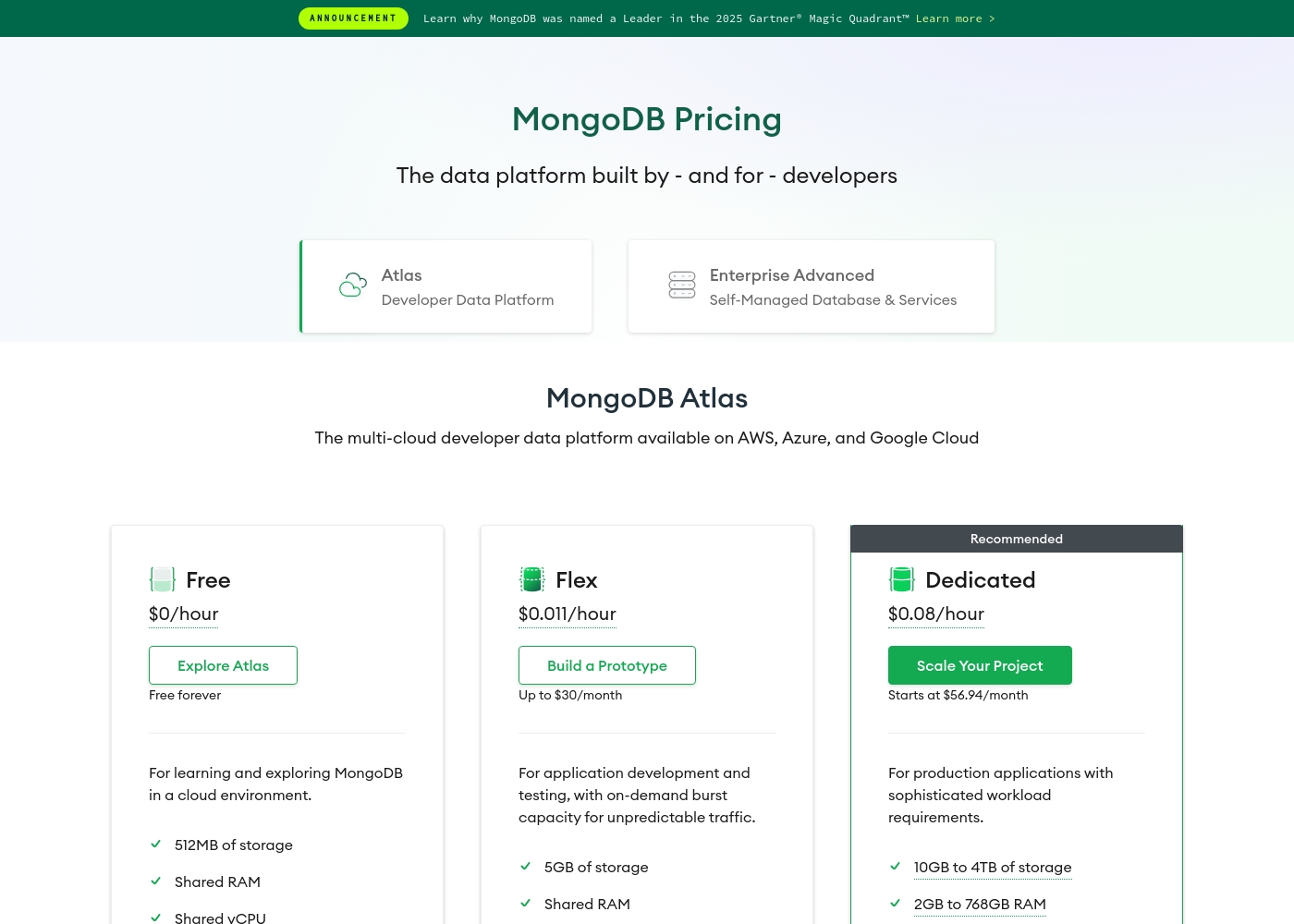
MongoDB pricing: MongoDB offers a range of cloud database options starting with a free-forever tier and scaling to dedicated resources for production environments. Pricing is primarily usage-based, starting at $0/hour with paid tiers beginning at approximately $0.011/hour and $0.08/hour for advanced workloads.
Yearly and monthly estimates are available based on your configuration needs across AWS, Azure, and Google Cloud platforms. Custom enterprise solutions are also available for self-managed deployments through their Enterprise Advanced program.
Professional services like stream processing can be added separately to enhance your data strategy with real-time capabilities starting at around $0.06/hour per instance level SP2 or higher depending on your needs. Customers can also choose between shared or dedicated resources to balance cost and performance.
Pricing Notes
- Microsoft Azure's pricing is instance-based and can be confusing. Users report unexpected fees and deceptive billing practices.
- MongoDB Atlas starts with a free forever tier. Paid tiers scale based on resources, which can become expensive at high usage.
- Both platforms use consumption-based models. You need to monitor usage carefully on either to avoid surprise bills.
- Azure offers a 30-day free trial with a $200 credit. MongoDB's free tier has no explicit trial period.
Pricing Head-to-Head
Đánh giá của người dùng
Phản hồi bên ngoài chỉ dựa trên Trustpilot cho thấy phần lớn là chỉ trích, dẫn đến Điểm tin cậy (TrustScore) rất thấp là 1,5. Nguồn gốc chính của sự thất vọng là hỗ trợ khách hàng, thường được người dùng mô tả là không phản hồi, khó tiếp cận và thiếu năng lực, đôi khi mất hàng tuần để giải quyết các phiếu hỗ trợ khẩn cấp.
Nhiều khách hàng báo cáo các phương thức thanh toán và định giá khó hiểu, bao gồm các khoản phí bất ngờ và việc tiếp tục tính phí ngay cả sau khi họ đã xóa hoàn toàn dịch vụ. Các vấn đề nghiêm trọng liên quan đến độ tin cậy và bảo mật dữ liệu cũng xuất hiện: nhiều người dùng lưu ý rằng dữ liệu tài khoản đã bị xóa tự động và vĩnh viễn do chính sách hóa đơn quá hạn 90 ngày, ngay cả khi họ gặp khó khăn trong việc thanh toán thông qua hệ thống.
Giá của Azure hoàn toàn gây hiểu lầm, khiến tôi phải chịu những khoản phí hoàn toàn bất ngờ. Tôi thực sự khuyên mọi người nên tránh nó. Chắc chắn nó sẽ lừa tiền của bạn cuối cùng.
Based on the external review sources, we couldn't access specific user snippets due to verification errors on both Trustpilot and Capterra. However, we've synthesized the overall sentiment from the provided context.
Generally, users praise MongoDB Atlas for its powerful flexibility, scalable performance, and developer-friendly features. Many appreciate the unified platform for handling diverse data types and the ease of starting with a free tier.
MongoDB's flexibility is a game-changer for our agile team. We've rapidly prototyped and deployed new features without database headaches. The scalability gives us peace of mind.
Phán quyết của chúng tôi
For most developers building modern applications, MongoDB is the clear winner. Microsoft Azure is a giant platform for everything, but it comes with serious user experience baggage. MongoDB focuses on doing one thing exceptionally well: providing a flexible, scalable data platform. Microsoft Azure's superpower is its sheer breadth. It can handle massive AI projects, legacy migrations, and global infrastructure. If you need a skyscraper-sized cloud for an enterprise, Azure has the tools. MongoDB's superpower is developer experience. Its document model speeds up development. The unified platform for data, search, and streaming simplifies your stack. The deciding factor is your primary need. If you need to move a giant SQL Server database to the cloud, choose Microsoft Azure. If you want to build a new app with AI features quickly, choose MongoDB. For greenfield projects and teams wanting to move fast, MongoDB is the smarter pick. Microsoft Azure is necessary for specific enterprise-scale cloud challenges, but be prepared for a rougher user journey.
Câu hỏi thường gặp
Which is better for small teams: Microsoft Azure or MongoDB?
MongoDB is often better for small teams. Its free tier and flexible model are great for prototyping. Microsoft Azure's complexity and pricing can be overwhelming for small budgets.
Is MongoDB worth the extra cost over Microsoft Azure?
It's not a direct cost comparison. Microsoft Azure is a cloud platform; MongoDB is a database service. MongoDB may be cheaper for database needs alone. Azure costs more but offers more services.
Can I migrate from Microsoft Azure to MongoDB easily?
They serve different purposes, so migration isn't typical. You might move a database workload from Azure SQL to MongoDB Atlas. The process uses migration tools, but it's not a platform switch.
Does Microsoft Azure have a free tier like MongoDB?
Microsoft Azure offers a 30-day free trial with a $200 credit. MongoDB has a free forever tier with 512MB storage. MongoDB's free offering is more permanent for small projects.
Which is better for AI applications?
Microsoft Azure has broader AI services, including Azure AI Foundry. MongoDB excels at integrating vector search for AI features. Choose Azure for building models, MongoDB for AI-powered apps.
How do their pricing models compare?
Both use consumption-based pricing. Microsoft Azure's costs depend on instance size and region. MongoDB's costs scale with storage and compute resources. Both require careful monitoring to avoid surprises.
Sẵn sàng chọn?
Cả hai công cụ đều có điểm mạnh riêng. Chọn dựa trên nhu cầu cụ thể của bạn.