Google Cloud vs MongoDB
Choosing between Google Cloud and MongoDB can be tough. One is a massive cloud infrastructure provider, while the other is a specialized data platform. Here's how to decide which one fits your project.
Cơ sở hạ tầng Mạnh mẽ, Thanh toán và Hỗ trợ Rủi ro.
Chúng tôi nhận thấy Google Cloud cung cấp cơ sở hạ tầng hàng đầu, mang đến sự tích hợp AI mạnh mẽ và khả năng mở rộng đáng kể cho các khối lượng công việc cấp doanh nghiệp. Tuy nhiên, số lượng lớn các báo cáo về dịch vụ hỗ trợ không thể truy cập và việc thanh toán khó hiểu, không minh bạch là điều đáng lo ngại sâu sắc. Nhìn chung, chúng tôi coi nền tảng này có rủi ro cao đối với những người dùng ưu tiên sự hỗ trợ nhanh nhạy hoặc kiểm soát chi phí chi tiết.
Ưu điểm
- Truy cập các công cụ AI tạo sinh hàng đầu như Gemini và Vertex AI.
- Hỗ trợ các chiến lược phát triển nguồn mở, đa đám mây và lai (hybrid).
- Người dùng mới nhận được 300 USD tín dụng miễn phí khi đăng ký.
- Cung cấp mức tiết kiệm tiềm năng lên đến 57% thông qua giảm giá sử dụng cam kết.
Nhược điểm
- Hỗ trợ dịch vụ khách hàng thường xuyên không thể truy cập và bị ẩn giấu.
- Người dùng báo cáo việc thanh toán không minh bạch và các khoản phí bất ngờ mặc dù có tín dụng.
- Chi phí cực kỳ cao cho các gói đăng ký hỗ trợ kỹ thuật (lên tới 12.500 USD/tháng).
- Thiếu giới hạn chi tiêu cố định cho các dịch vụ trả tiền theo mức sử dụng là một điểm yếu phổ biến.
Powerful, flexible platform for modern data.
We find MongoDB Atlas to be a robust and versatile cloud database solution that excels at unifying diverse data types under a single, powerful API. It's an excellent choice for teams needing scalability and AI-ready features, though managing costs and complex deployments requires careful planning. Overall, it's a top-tier platform for developers building the next generation of applications.
Ưu điểm
- Excellent flexibility with its document model.
- Powerful, unified platform for databases, search, and streaming.
- Strong scalability and high availability guarantees.
- Native vector search integration for AI applications.
Nhược điểm
- Costs can escalate quickly with high usage and dedicated resources.
- Advanced features and configurations can have a steep learning curve.
- Support responsiveness can be inconsistent for some users.
VềGoogle Cloud
Google Cloud là một nền tảng đám mây toàn diện cung cấp hơn 150 sản phẩm và khả năng. Nó giúp các doanh nghiệp hiện đại hóa cơ sở hạ tầng hiện có hoặc xây dựng hoàn toàn các ứng dụng mới được hỗ trợ bởi AI từ đầu. Dịch vụ này được thiết kế cho các nhà phát triển, lãnh đạo doanh nghiệp và các công ty khởi nghiệp sẵn sàng phát triển và chuyển đổi kỹ thuật số.
Khách hàng mới có thể dùng thử Google Cloud với việc sử dụng miễn phí hơn 20 sản phẩm. Hơn nữa, bạn sẽ nhận được 300 USD tín dụng miễn phí khi đăng ký để giúp bạn khám phá. 💡
VềMongoDB
💡 MongoDB Atlas is a comprehensive cloud data platform built for modern applications. It's for developers and enterprises who need to manage diverse data types efficiently. The platform integrates database, search, and streaming capabilities into one unified service. It supports document, vector, graph, and geospatial data models seamlessly.
Điểm nổi bật
So sánh tính năng
Tổng quan về tính năng
Chúng tôi làm nổi bật những khác biệt chính và chọn người chiến thắng cho từng tính năng.
Core Purpose
Google Cloud is a vast cloud infrastructure platform. MongoDB is a specialized data platform.
Google Cloud offers over 150 products. You can run everything from VMs to AI models. It's like renting a supercomputer. MongoDB Atlas focuses on your data layer. It manages your database, search, and streams. It's like having a dedicated, expert DBA. The difference is scope vs. specialization. Google Cloud provides the entire toolbox. MongoDB excels at one critical tool. For a startup building a full app, Google Cloud provides the foundation. For a team optimizing a data-heavy feature, MongoDB is targeted.
AI & Data Analytics
Google Cloud has massive AI/ML and analytics suites. MongoDB has native vector search for AI apps.
Google Cloud's Vertex AI and BigQuery are industry leaders. You can build models with 200+ foundation models. BigQuery runs petabyte-scale analytics. MongoDB's strength is unifying data and vectors. You can store operational data and embeddings together. This simplifies building AI features like semantic search. Google Cloud offers a broader, more complex AI platform. MongoDB makes specific AI workflows simpler. One is a comprehensive lab, the other a focused workbench. Choose Google Cloud for custom model training. Choose MongoDB for integrating AI into your existing app's data flow.
Database Flexibility
Google Cloud offers multiple managed databases. MongoDB offers one highly flexible document database.
Google Cloud provides Cloud SQL, Spanner, Firestore, and more. You pick the right tool for each job. This can mean managing multiple systems. MongoDB uses a single document model for all data. The same API handles operational, graph, and geospatial data. This reduces context switching. Google Cloud gives you specialized databases. MongoDB gives you one versatile database. It's the difference between a Swiss Army knife and a full workshop. For apps with diverse data types in one service, MongoDB is seamless. For needing different database engines, Google Cloud has options.
Real-time Processing
Google Cloud uses multiple services for streams. MongoDB has integrated stream processing.
Google Cloud handles streams with Dataflow, Pub/Sub, and others. It's powerful but requires configuring separate services. This adds architectural complexity. MongoDB Atlas Stream Processing is built in. You use the same query language for streams and batches. This creates a unified developer experience. Google Cloud offers more scalable, global streaming. MongoDB offers simplicity and integration. One is built for massive scale, the other for developer velocity. For processing Kafka streams alongside your app data, MongoDB is simpler. For global, high-throughput event processing, Google Cloud has dedicated tools.
Ease of Getting Started
Both have generous free tiers. Google Cloud has a steeper initial learning curve.
Google Cloud gives $300 in credits and 20+ free products. However, its console can feel slow and complex. New users report difficulty with simple tasks. MongoDB offers a free-forever tier with 512 MB. The Atlas interface is focused and generally intuitive. Many developers find its document model natural. Google Cloud's scale means more to learn upfront. MongoDB's focus makes its core product more approachable. One is a sprawling city, the other a well-organized campus. Your choice depends on your role. A cloud architect might embrace Google Cloud's scope. An app developer might prefer MongoDB's streamlined data focus.
Cost Management
Google Cloud offers committed discounts but billing can be unclear. MongoDB costs scale with resource usage.
Google Cloud's pricing is usage-based with potential for 57% savings. Users complain about non-transparent billing and unexpected charges. Support for cost limits is a pain point. MongoDB's costs scale with storage and compute hours. Users note costs can escalate quickly with high usage. Monitoring your usage is crucial in both cases. Google Cloud has more discount levers but more billing complexity. MongoDB's model is simpler but can surprise you. Both require vigilant monitoring. For predictable, committed workloads, Google Cloud's discounts help. For variable workloads, MongoDB's pay-as-you-go is straightforward.
Customer Support
Google Cloud support is expensive and hard to reach. MongoDB support is included in paid tiers.
Google Cloud's technical support can cost up to $12,500/month. Free users report support is hidden and nearly impossible to contact. This is a major frustration. MongoDB's Dedicated tiers include enhanced support. Users report mixed experiences but availability is better. SLAs are tied to your pricing tier. Google Cloud's paid support is enterprise-grade but costly. MongoDB's included support is more accessible for mid-market. The difference in accessibility is stark. If you're a large enterprise, Google Cloud's support might be justified. For smaller teams, MongoDB's included support is a significant advantage.
Vendor Lock-in Risk
Google Cloud promotes multicloud. MongoDB is an open-source based platform.
Google Cloud actively supports hybrid and multicloud strategies. They offer tools to manage apps across clouds. This reduces lock-in to their specific infrastructure. MongoDB's core is open source. You can run it on-premise or other clouds. Atlas is a managed service on AWS, Azure, and GCP. Google Cloud sells infrastructure flexibility. MongoDB sells data portability. Both address lock-in from different angles. If you fear infrastructure lock-in, Google Cloud's stance is reassuring. If you fear data lock-in, MongoDB's open-source core is a plus.
Chi phí Google Cloud thay đổi rộng rãi vì nó sử dụng cấu trúc thanh toán dựa trên mức sử dụng, cung cấp cho khách hàng mới 300 USD tín dụng miễn phí và quyền truy cập vào hơn 20 sản phẩm miễn phí.
Bạn sẽ không tìm thấy các gói cố định hàng tháng ở đây, mà thay vào đó là ba cách linh hoạt để sử dụng tài nguyên điện toán của nền tảng.
Trả tiền theo mức sử dụng (Định giá Tiêu chuẩn)
Giá: Không nêu rõ (Dựa trên mức sử dụng) Trang web được hỗ trợ: Không nêu rõ Phù hợp nhất với: Các tổ chức ở mọi quy mô cần mở rộng linh hoạt Chính sách hoàn tiền: Không nêu rõ Các tính năng khác:
- Bạn chỉ trả tiền cho các dịch vụ bạn sử dụng.
- Không có phí trả trước hoặc phí chấm dứt hợp đồng.
- Tiềm năng tiết kiệm tới 57% với các khoản giảm giá sử dụng cam kết.
- Bao gồm hỗ trợ thanh toán miễn phí 24/7.
- Chỉ trả tiền cho các dịch vụ bạn sử dụng
- Không có phí trả trước hoặc phí chấm dứt hợp đồng
- Tiết kiệm tới 57% với các khoản giảm giá sử dụng cam kết
- Hỗ trợ thanh toán miễn phí 24/7
- 300 USD tín dụng miễn phí
- Truy cập hơn 20 sản phẩm miễn phí
- Chạy, thử nghiệm và triển khai khối lượng công việc
- Tới 350.000 USD tín dụng Đám mây
- Hỗ trợ và giải pháp tùy chỉnh
- Hỗ trợ mở rộng quy mô cho các công ty đổi mới
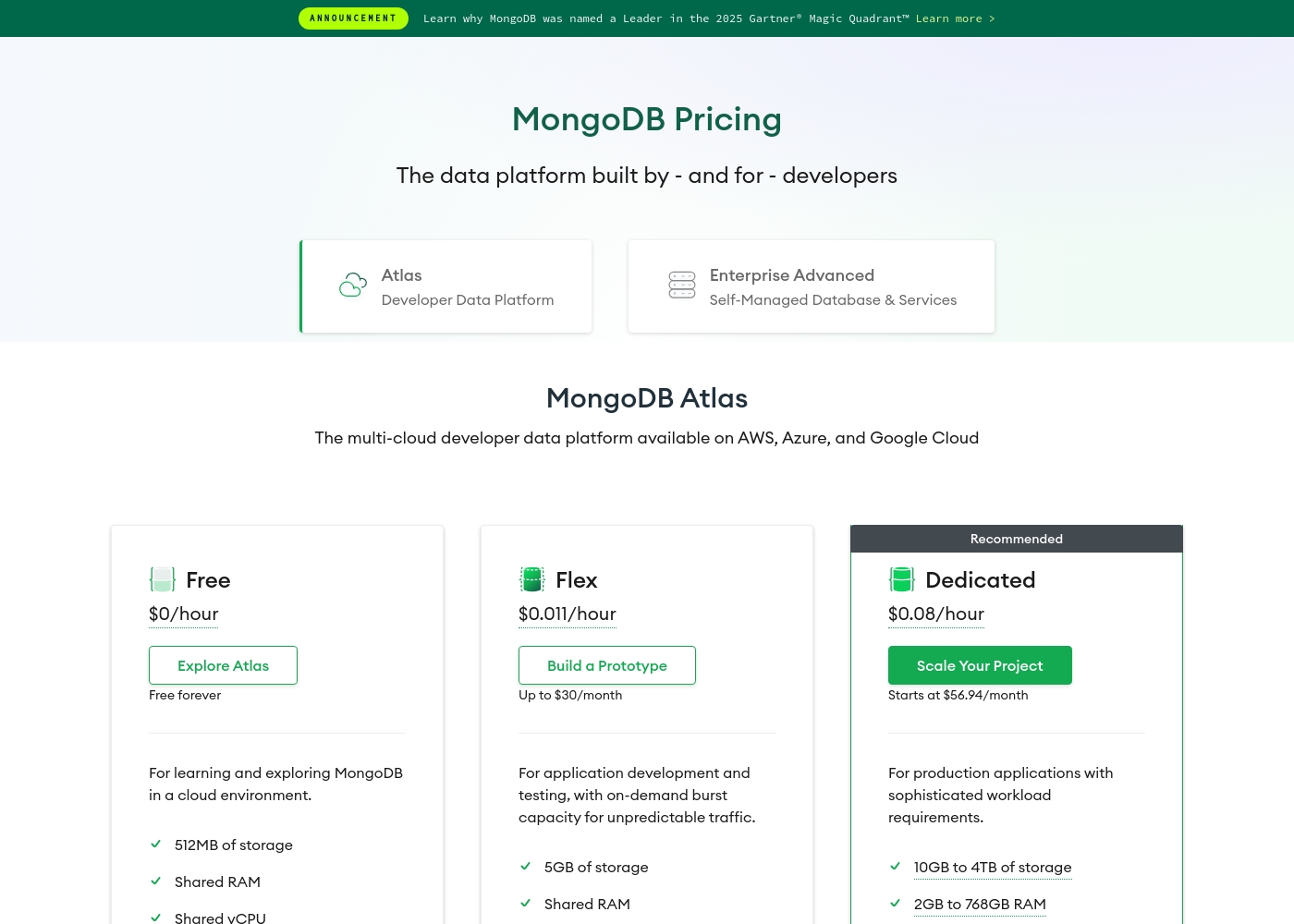
MongoDB pricing: MongoDB offers a range of cloud database options starting with a free-forever tier and scaling to dedicated resources for production environments. Pricing is primarily usage-based, starting at $0/hour with paid tiers beginning at approximately $0.011/hour and $0.08/hour for advanced workloads.
Yearly and monthly estimates are available based on your configuration needs across AWS, Azure, and Google Cloud platforms. Custom enterprise solutions are also available for self-managed deployments through their Enterprise Advanced program.
Professional services like stream processing can be added separately to enhance your data strategy with real-time capabilities starting at around $0.06/hour per instance level SP2 or higher depending on your needs. Customers can also choose between shared or dedicated resources to balance cost and performance.
Pricing Notes
- Google Cloud offers $300 in free credits for new customers, while MongoDB has a free-forever tier.
- Google Cloud's technical support is extremely expensive, costing up to $12,500 per month.
- MongoDB's costs scale with cluster resources (storage, RAM, vCPUs), which can escalate quickly.
- Both platforms use usage-based pricing, making it hard to predict costs without careful monitoring.
- Google Cloud provides committed use discounts up to 57% for predictable workloads.
Pricing Head-to-Head
Đánh giá của người dùng
Tâm lý bên ngoài, chủ yếu được ghi lại bởi Trustpilot, là cực kỳ tiêu cực, dẫn đến xếp hạng rất thấp là 1,5 sao. Các vấn đề thường gặp nhất xoay quanh thanh toán không minh bạch và dịch vụ hỗ trợ khách hàng hoàn toàn không hoạt động ⚠️. Người dùng báo cáo các khoản phí bất ngờ, đôi khi lên tới hàng trăm đô la, ngay cả khi họ có tín dụng miễn phí đáng kể. Nhiều người cảm thấy sự thiếu minh bạch này là một "cái bẫy cố ý" được thiết kế cho người dùng mới. Hơn nữa, việc nhận trợ giúp gần như là không thể; người dùng mô tả hỗ trợ là cố tình bị ẩn giấu và không thể tiếp cận, khiến họ bị mắc kẹt trong những vòng lặp gây thất vọng vô tận. Những người cần trợ giúp kỹ thuật phải đối mặt với các khoản phí cắt cổ, với hỗ trợ kỹ thuật chuyên biệt có chi phí hàng nghìn mỗi tháng.
Ngoài quản lý chi phí, người dùng chỉ trích khả năng sử dụng thấp. Các khiếu nại bao gồm console "chậm đến mức không thể sử dụng được" và quy trình cho các tác vụ đơn giản, như lấy khóa API, đòi hỏi số lần nhấp chuột quá mức. Người dùng cũng gặp khó khăn với các chức năng quản lý tài khoản quan trọng, chẳng hạn như xóa các dự án đang hoạt động tiếp tục phát sinh phí hoặc cập nhật thông tin thanh toán. Điều này cho thấy rõ ràng rằng mặc dù nền tảng này mạnh mẽ về mặt công nghệ, nhưng trải nghiệm người dùng, quản trị và kiểm soát tài chính xung quanh lại có nhiều thiếu sót nghiêm trọng.
Tài khoản của tôi phát sinh 327 EUR chi phí API, ngay cả khi tôi có sẵn 264 EUR tín dụng miễn phí mà không được sử dụng. Hỗ trợ hoàn toàn bị ẩn giấu và không thể liên lạc được, khiến nó trông giống như một cái bẫy cố ý. Nền tảng này có cấu trúc định giá cực kỳ không minh bạch.
Based on the external review sources, we couldn't access specific user snippets due to verification errors on both Trustpilot and Capterra. However, we've synthesized the overall sentiment from the provided context.
Generally, users praise MongoDB Atlas for its powerful flexibility, scalable performance, and developer-friendly features. Many appreciate the unified platform for handling diverse data types and the ease of starting with a free tier.
MongoDB's flexibility is a game-changer for our agile team. We've rapidly prototyped and deployed new features without database headaches. The scalability gives us peace of mind.
Phán quyết của chúng tôi
This isn't a simple apples-to-apples comparison. Google Cloud is the full cloud platform. MongoDB is the specialized data platform. Google Cloud's superpower is its sheer scale. It offers everything from world-class AI with Vertex AI to massive analytics with BigQuery. It's your partner for the entire infrastructure stack. MongoDB's superpower is data unification. It seamlessly blends operational data, vector search, and streaming into one system. This simplifies building complex, data-rich applications dramatically. The deciding factor is your core need. If you need a comprehensive cloud foundation, Google Cloud is the answer. If your biggest challenge is managing and querying diverse application data, MongoDB is your tool. For a startup building from scratch, Google Cloud provides the full toolkit. For a team trying to make their app's data layer smarter and faster, MongoDB delivers targeted power.
Câu hỏi thường gặp
Which is better for small teams: Google Cloud or MongoDB?
MongoDB often wins for small teams focused on their app's database. Its free-forever tier and focused interface are easier to start with. Google Cloud's $300 credit is generous, but its platform can feel overwhelming.
Does Google Cloud have a database like MongoDB?
Yes, Google Cloud offers Firestore and Cloud Datastore as document databases. They serve similar use cases to MongoDB. However, MongoDB's core platform is built entirely around this document model and its associated features.
Is MongoDB worth the extra cost over Google Cloud?
It's not about extra cost, but about value for your specific need. MongoDB's cost is for a specialized data platform. Google Cloud's costs are for a broad infrastructure suite. If you only need a powerful database, MongoDB's pricing can be more predictable.
Can I use Google Cloud and MongoDB together?
Yes, absolutely. You can run MongoDB Atlas as a managed service on Google Cloud infrastructure. This is a common pattern, combining Google's infrastructure with MongoDB's specialized database.
Which is easier to learn for a developer?
Many developers find MongoDB's document model and query API more intuitive initially. Google Cloud requires learning a vast array of services and concepts. The learning curves serve different goals: app development vs. infrastructure management.
Which platform is better for AI applications?
It depends on the AI task. For training custom models at scale, Google Cloud's Vertex AI is more powerful. For adding semantic search or AI features to an app using your existing data, MongoDB's native vector search is simpler.
Sẵn sàng chọn?
Cả hai công cụ đều có điểm mạnh riêng. Chọn dựa trên nhu cầu cụ thể của bạn.