DualEntry vs MongoDB
DualEntry and MongoDB solve very different problems. DualEntry is a focused AI ERP for finance teams. MongoDB is a flexible data platform for developers. Your choice depends entirely on whether you're closing books or building apps.
Best for: Finance teams managing 3+ business entities, Companies wanting to reduce month-end close from 20 days to 1
Best for: Application developers building modern, scalable apps, Teams needing to integrate AI/ML features with vector search
Powerful but unproven at scale
We find DualEntry to be a comprehensive, AI-driven ERP solution aimed at simplifying multi-entity financial operations. Overall, it promises significant efficiency gains like faster closes and unified reporting, but the lack of accessible external user reviews prevents us from validating core claims about reliability, support, and real-world performance.
Ưu điểm
- Claims to unify multi-entity financials into a single view
- Promises AI-powered automation for tedious tasks like transaction categorization
- Advertises a dramatic reduction in month-end close time
- Offers 13,000+ native integrations to connect with existing tools
Nhược điểm
- Pricing is not transparent and requires a custom quote
- No accessible external user reviews to validate claims of reliability or support
- Specific details on implementation complexity or training are not provided
- The platform's actual performance and stability are unverified from user feedback
Powerful, flexible platform for modern data.
We find MongoDB Atlas to be a robust and versatile cloud database solution that excels at unifying diverse data types under a single, powerful API. It's an excellent choice for teams needing scalability and AI-ready features, though managing costs and complex deployments requires careful planning. Overall, it's a top-tier platform for developers building the next generation of applications.
Ưu điểm
- Excellent flexibility with its document model.
- Powerful, unified platform for databases, search, and streaming.
- Strong scalability and high availability guarantees.
- Native vector search integration for AI applications.
Nhược điểm
- Costs can escalate quickly with high usage and dedicated resources.
- Advanced features and configurations can have a steep learning curve.
- Support responsiveness can be inconsistent for some users.
VềDualEntry
DualEntry is a modern, cloud-based ERP system built for finance teams, especially those handling multiple entities. 🧠 It's an all-in-one platform that consolidates your financial operations—from the general ledger and accounts payable to revenue recognition and reporting. It's designed for companies that have outgrown basic accounting software but need a more intuitive, integrated solution than traditional ERPs.
VềMongoDB
💡 MongoDB Atlas is a comprehensive cloud data platform built for modern applications. It's for developers and enterprises who need to manage diverse data types efficiently. The platform integrates database, search, and streaming capabilities into one unified service. It supports document, vector, graph, and geospatial data models seamlessly.
Điểm nổi bật
So sánh tính năng
Tổng quan về tính năng
Chúng tôi làm nổi bật những khác biệt chính và chọn người chiến thắng cho từng tính năng.
Core Purpose
DualEntry is for finance teams. MongoDB is for app developers. They're built for entirely different jobs.
DualEntry is an AI-powered ERP. It unifies financial operations like the general ledger, AP, and revenue recognition for multi-entity businesses. MongoDB Atlas is a cloud data platform. It manages operational data, vector embeddings, and real-time streams for application developers. The key difference is audience. DualEntry solves accounting chaos; MongoDB solves data architecture complexity.
Data Flexibility
MongoDB offers extreme flexibility. DualEntry provides structured financial data. One is for unstructured app data, the other for precise financial records.
MongoDB's document model lets you store flexible JSON-like data. It supports documents, vectors, graphs, and geospatial data in one system. DualEntry works with structured financial data. It uses a standard general ledger and entity-based accounting model for compliance. MongoDB wins for diverse data types. DualEntry is better for strict financial data integrity and reporting standards.
AI & Automation
DualEntry automates accounting tasks. MongoDB powers AI applications. Different goals: efficiency vs. innovation.
DualEntry uses AI for transaction categorization, bank-fee automation, and anomaly detection in financial data. MongoDB provides native vector search. This lets you build semantic search, recommendation engines, and generative AI apps directly. DualEntry's AI saves accountant time. MongoDB's AI lets developers build intelligent features into their products.
Scalability
MongoDB scales for massive data and traffic. DualEntry scales for business growth and more entities.
MongoDB Atlas guarantees millisecond response times at scale. It's built to serve millions of users and handle high-velocity data streams. DualEntry scales by adding more business entities and users. All plans include unlimited users and transactions. Choose MongoDB for app performance at scale. Choose DualEntry for growing your multi-entity financial operations.
Integration Ecosystem
DualEntry connects to 13,000+ financial tools. MongoDB integrates with 100+ developer technologies.
DualEntry offers over 13,000 native integrations. This includes banks, payroll systems, CRMs, and payment processors. MongoDB integrates with a broad developer stack. This includes cloud platforms, data tools, and programming languages. DualEntry's network is deeper for finance. MongoDB's is broader for application development.
Pricing & Value
DualEntry uses custom quotes. MongoDB offers transparent usage-based pricing. One targets enterprises, the other developers.
DualEntry provides custom quotes after a demo. All plans include unlimited users, which is great for large teams. MongoDB has a free tier and usage-based pricing. Costs can scale quickly with dedicated resources and high usage. DualEntry offers predictable costs for growing teams. MongoDB offers flexibility but requires careful cost monitoring.
Learning Curve
DualEntry aims for quick onboarding. MongoDB has a steeper learning curve for advanced features.
DualEntry promises live in 4-6 weeks. Data ingestion takes 24 hours, with hands-on implementation support. MongoDB is powerful but complex. Advanced features like stream processing and vector search have a steep learning curve. DualEntry is faster to start for finance users. MongoDB requires more technical expertise to leverage fully.
Security & Compliance
DualEntry focuses on financial compliance. MongoDB relies on cloud provider security. Critical difference for regulated industries.
DualEntry is SOC 2, PCI, CCPA, and SSL certified. It supports IFRS/GAAP compliance and uses AES-256 encryption. MongoDB Atlas security depends on your cloud provider (AWS, Azure, GCP). They handle encryption and access controls. DualEntry offers built-in financial compliance. MongoDB offers infrastructure security managed by cloud giants.
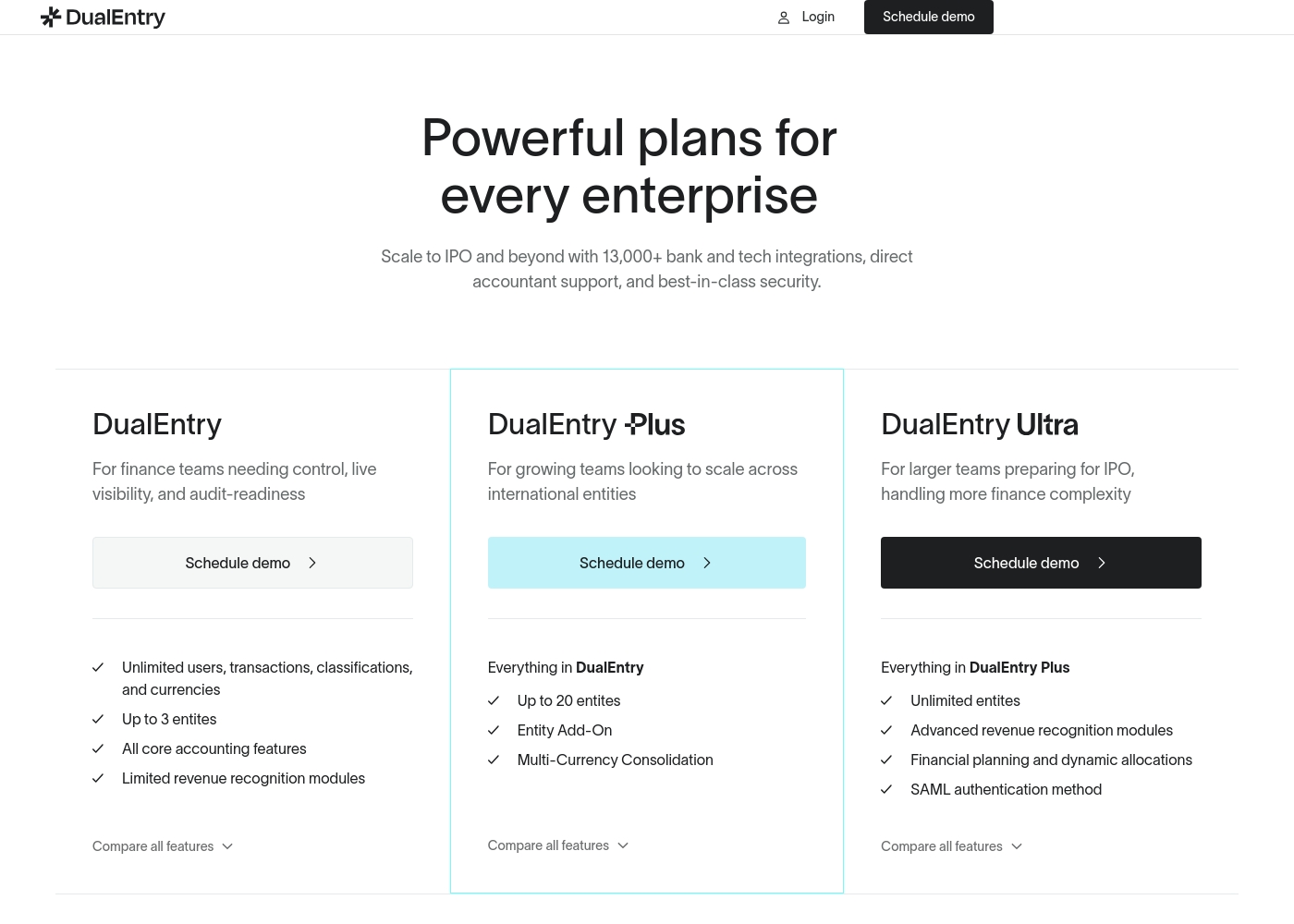
DualEntry pricing: DualEntry provides enterprise-grade accounting software with three distinct tiers designed to scale with your business. While specific rates are available via custom quotes, all plans include unlimited users and transactions to support growth without penalty fees or extra costs for implementation support and training sessions with an accountant team member and more for you and your business and more and more and more more more more more more more more more more more more more more more more more more more more more more more more more more more more more more more more more more more more and more more more more and more and more more more and more more more more more more more more and more more more and more more more more more more more more more more more more more more more more more more more more more more more more more more more more more more more more more more more more and more more more more and more and more more more and more more more more more more more more and more more more more more more more more more more more more more more more more more more more more and more more more and more more more more more more more more more more more more more more more more more more more more more more more more more more more more more more more more more more more more more and more more more more and more and more more more and more more more more more more more more and more more more more more more more more more more more more more more more more more more more more and more more more and more more more more more more more more more more more more more more more more more more more more more more more more more more more more more more more more more more more more more and more more more more and more and more more more and more more more more more more more more and more more more more more more more more more more more more more more more more more more more more and more more more and more more more more more more more more more mo
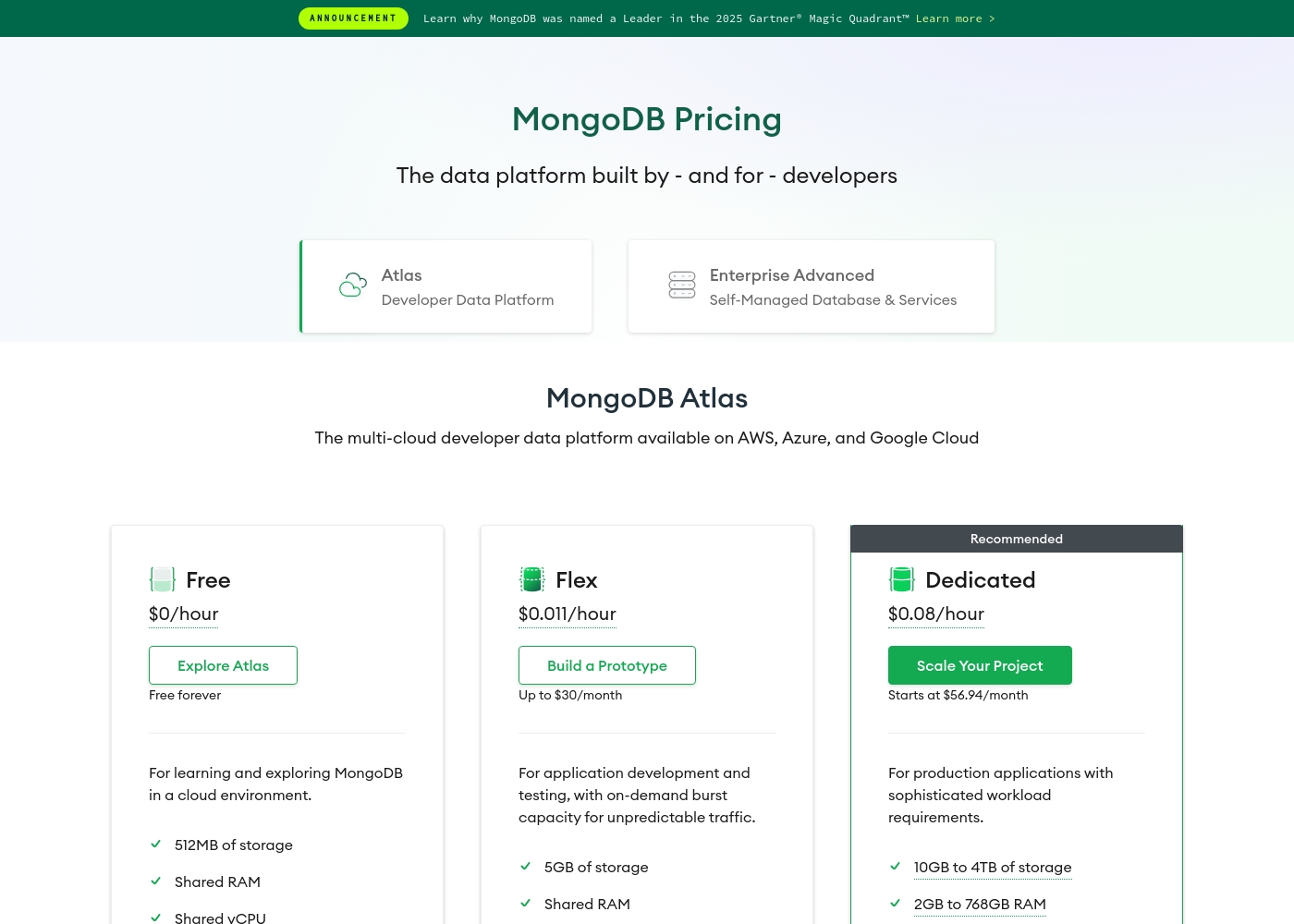
MongoDB pricing: MongoDB offers a range of cloud database options starting with a free-forever tier and scaling to dedicated resources for production environments. Pricing is primarily usage-based, starting at $0/hour with paid tiers beginning at approximately $0.011/hour and $0.08/hour for advanced workloads.
Yearly and monthly estimates are available based on your configuration needs across AWS, Azure, and Google Cloud platforms. Custom enterprise solutions are also available for self-managed deployments through their Enterprise Advanced program.
Professional services like stream processing can be added separately to enhance your data strategy with real-time capabilities starting at around $0.06/hour per instance level SP2 or higher depending on your needs. Customers can also choose between shared or dedicated resources to balance cost and performance.
Pricing Notes
- DualEntry pricing is not public; you must schedule a demo for a custom quote.
- All DualEntry plans include unlimited users and transactions, which is great for scaling teams.
- MongoDB Atlas has a free-forever tier with 512MB storage, perfect for prototyping.
- MongoDB's paid pricing is usage-based (e.g., $0.011/hour for Flex), so costs scale with your resource consumption.
Pricing Head-to-Head
Đánh giá của người dùng
We attempted to gather user feedback from Trustpilot and Capterra, but both sources were currently inaccessible due to security verification errors, preventing the collection of specific review snippets. This means we cannot synthesize external sentiment or identify recurring themes like accuracy, ease of use, or support responsiveness from user reviews. 🤔 Without these concrete data points, our final assessment relies solely on the provided product information from DualEntry's website.
Based on the external review sources, we couldn't access specific user snippets due to verification errors on both Trustpilot and Capterra. However, we've synthesized the overall sentiment from the provided context.
Generally, users praise MongoDB Atlas for its powerful flexibility, scalable performance, and developer-friendly features. Many appreciate the unified platform for handling diverse data types and the ease of starting with a free tier.
MongoDB's flexibility is a game-changer for our agile team. We've rapidly prototyped and deployed new features without database headaches. The scalability gives us peace of mind.
Phán quyết của chúng tôi
This isn't a fair fight—it's a choice between two different jobs. DualEntry is a specialized ERP for finance teams. MongoDB is a flexible data platform for developers. Your pick depends on whether you're closing books or building apps. DualEntry's superpower is simplifying multi-entity finance. It unifies all your entities into one view. Its AI automates tedious tasks like transaction categorization. Users report cutting month-end close from 20 days to just one. MongoDB's superpower is developer flexibility. It handles documents, vectors, and streams in one platform. You can build AI apps with native vector search. It scales to millions of users with millisecond response times. The deciding factor is your team's mission. If your priority is accurate, fast financial reporting, choose DualEntry. If your priority is building innovative, scalable applications, choose MongoDB. For finance teams drowning in spreadsheets, DualEntry is the clear winner. For developers building the next big app, MongoDB is the right foundation. Know your goal, and the choice becomes simple.
Câu hỏi thường gặp
Can I use MongoDB for accounting like DualEntry?
No, MongoDB is not an accounting system. It's a general-purpose database. You would need to build a custom accounting solution on top of it, which is complex. DualEntry is a complete, ready-to-use ERP for financial management.
Which is cheaper for a small startup: DualEntry or MongoDB?
MongoDB is likely cheaper to start. It has a free-forever tier with 512MB of storage. DualEntry has no free trial and requires a custom quote, making it harder to predict initial costs for a very small team.
Does DualEntry offer a free trial like MongoDB?
No, DualEntry does not offer a free trial. They focus on a hands-on, accountant-led implementation process. MongoDB offers a free-forever tier for learning and prototyping.
Which is better for real-time data: DualEntry or MongoDB?
It depends on the type of real-time data. MongoDB excels at processing high-velocity streams from sources like Kafka. DualEntry focuses on real-time financial reporting and continuous close for accounting data.
Can I migrate from DualEntry to MongoDB easily?
They serve different purposes, so migration isn't straightforward. Moving from DualEntry's financial ERP to MongoDB's database platform would require rebuilding your entire data architecture and business logic from scratch.
Which tool has better customer support?
DualEntry emphasizes dedicated accountant support via Slack and phone. MongoDB's support is more tiered and can vary in responsiveness. For personalized finance guidance, DualEntry's model is more hands-on.
Sẵn sàng chọn?
Cả hai công cụ đều có điểm mạnh riêng. Chọn dựa trên nhu cầu cụ thể của bạn.