Microsoft Azure vs MongoDB
Microsoft Azure and MongoDB serve fundamentally different roles, which makes this comparison fascinating. Azure is a massive cloud platform for everything from AI to infrastructure. MongoDB is a specialized data platform for building modern apps with flexible data. It’s like comparing a full-service skyscraper to a masterfully designed workshop.
Güçlü özellikler, derinlemesine sorunlu kullanıcı deneyimi.
Microsoft Azure, AI, YPK ve büyük ölçekli veri göçü için güçlü küresel altyapı sunmaktadır. Ancak harici geri bildirimler, veri saklama protokolleri ile ilgili ciddi sorunlar, müşteri desteği, faturalandırma şeffaflığı ve güvenilirlikle ilgili ciddi sorunları yansıtmaktadır. Genel olarak, ağır yatırım öncesinde dikkat gerektiren bildirilen operasyonel ve hizmet sorunları ile birlikte dönüştürücü teknolojik potansiyel görüyoruz.
Artılar
- Yüksek ölçekli Üretken Yapay Zeka çözümlerini ve dağıtım yeteneklerini hızlandırır.
- Diğer sağlayıcılardan daha fazla dünya çapındaki bölgeye yayılmış rakipsiz küresel erişim.
- Hibrit ortamlar için Azure Arc aracılığıyla altyapı esnekliği sunar.
- SQL Server ve SAP gibi kapsamlı eski veritabanlarının geçişini kolaylaştırır.
Eksiler
- Müşteri desteğinin yaygın olarak yanıtsız, yavaş ve erişilmesi amaçlı zor olduğu bildiriliyor.
- Faturalandırma yapısı kafa karıştırıcıdır ve genellikle beklenmedik veya yanıltıcı gizli ücretlerle sonuçlanır.
- Hizmet güvenilmezliği kesintilere ve yüksek kullanıcı stresine neden olur.
- Politika, bir faturanın vadesi geçmiş 90 gün sonra otomatik, kalıcı veri silinmesine izin verir.
Powerful, flexible platform for modern data.
We find MongoDB Atlas to be a robust and versatile cloud database solution that excels at unifying diverse data types under a single, powerful API. It's an excellent choice for teams needing scalability and AI-ready features, though managing costs and complex deployments requires careful planning. Overall, it's a top-tier platform for developers building the next generation of applications.
Artılar
- Excellent flexibility with its document model.
- Powerful, unified platform for databases, search, and streaming.
- Strong scalability and high availability guarantees.
- Native vector search integration for AI applications.
Eksiler
- Costs can escalate quickly with high usage and dedicated resources.
- Advanced features and configurations can have a steep learning curve.
- Support responsiveness can be inconsistent for some users.
HakkındaMicrosoft Azure
Azure, sınırsız yenilikçilik için tasarlanmış kapsamlı bir bulut platformudur. Uygulama geliştirmeden sağlam veri dönüşümüne kadar her alanda çözümleri kolaylaştırır. Platform, özellikle geliştiricilere, BT uzmanlarına, veri analistlerine ve kurumsal liderlere hizmet eder. Azure, şirket içi veri merkezlerinin sınırlarını aşmak için gereken küresel altyapıyı sağlar. Diğer sağlayıcılardan daha fazla dünya çapında bölge sunar. 💡
HakkındaMongoDB
💡 MongoDB Atlas is a comprehensive cloud data platform built for modern applications. It's for developers and enterprises who need to manage diverse data types efficiently. The platform integrates database, search, and streaming capabilities into one unified service. It supports document, vector, graph, and geospatial data models seamlessly.
Öne çıkanlar
Özellik karşılaştırması
Özelliklere Genel Bakış
Ana farkları vurguluyoruz ve her özellik için bir kazanan seçiyoruz.
Core Purpose
Microsoft Azure is a vast cloud platform. MongoDB is a specialized data platform.
Microsoft Azure provides the entire building for cloud computing. It offers virtual machines, AI services, and global infrastructure. It's a platform for building, deploying, and scaling almost anything. MongoDB Atlas is the expertly designed furniture inside the apartment. It's a managed database service focused on flexible data models. It unifies operational data, search, and streaming into one system. The key difference is scope. Azure offers everything from raw servers to finished AI applications. MongoDB focuses on being the best possible data layer for your apps. Think of Azure as the cloud itself. Think of MongoDB as a specialized tool you run on that cloud.
AI & Data Intelligence
Microsoft Azure offers broad AI services. MongoDB provides native vector search.
Microsoft Azure delivers a comprehensive AI portfolio. Azure AI Foundry helps build and deploy generative AI solutions. It includes OpenAI models and machine learning lifecycle tools. MongoDB Atlas focuses on AI-ready data. It natively integrates vector search for semantic search and recommendations. You can store operational data and vector embeddings together. Azure's AI services are more numerous and varied. MongoDB's strength is tightly coupling AI search with your core database. For building a custom AI model, Azure is broader. For adding AI search to an existing app, MongoDB is simpler.
Database Flexibility
Microsoft Azure offers many database types. MongoDB offers one, powerful document model.
Microsoft Azure provides a managed database for every need. Options include relational (SQL Server, PostgreSQL) and NoSQL (Cosmos DB). You choose the right tool for each job. MongoDB specializes in a single, flexible document model. Data maps directly to application objects. A single query API handles lookups, analytics, and aggregations. Azure gives you more choices. MongoDB gives you more flexibility within its chosen model. For complex apps with varied data, Azure's variety helps. For apps needing rapid iteration, MongoDB's document model shines.
Scalability
Microsoft Azure scales globally. MongoDB scales vertically within clusters.
Microsoft Azure scales across a global network. It has more worldwide regions than any other cloud provider. You can deploy services close to users everywhere. MongoDB Atlas scales clusters vertically. You increase RAM, vCPUs, and storage as needed. It guarantees millisecond response times at scale. Azure's scale is about global reach and raw compute. MongoDB's scale is about handling more data and traffic efficiently. For a global app, Azure's regions are key. For a data-heavy app, MongoDB's cluster scaling is vital.
Real-Time Processing
Microsoft Azure has Stream Analytics. MongoDB has Atlas Stream Processing.
Microsoft Azure Stream Analytics processes high-volume data streams. It integrates with Azure services for real-time insights. It's part of a larger analytics ecosystem. MongoDB Atlas Stream Processing uses the familiar aggregation pipeline. It works with sources like Apache Kafka. It provides a unified developer experience for batch and streaming data. Azure's solution is more integrated into its cloud. MongoDB's solution feels more native to its database. For existing Azure users, Stream Analytics is a natural fit. For MongoDB users, Atlas Stream Processing avoids context switching.
Pricing Transparency
Microsoft Azure's pricing is complex and often criticized. MongoDB's pricing can also surprise.
Microsoft Azure uses consumption-based pricing. Costs depend on instance size, region, and commitment. Users report confusing bills and unexpected fees. MongoDB Atlas also uses consumption-based pricing. Costs scale with storage, RAM, and vCPUs. Users note costs can escalate quickly with high usage. Both models require careful monitoring. Azure's pricing is often cited as a major pain point. MongoDB's is complex but perhaps more predictable for database workloads. Neither platform is known for simple, predictable pricing.
Migration & Modernization
Microsoft Azure excels at legacy migration. MongoDB focuses on app modernization.
Microsoft Azure specializes in large-scale migrations. It can move SQL Server, SAP, and Oracle to the cloud. Often with few code changes. MongoDB helps modernize application data layers. You migrate from relational databases to a flexible document model. It simplifies building new apps. Azure's strength is moving old systems. MongoDB's is building new ones. For a legacy enterprise, Azure is the migration path. For a greenfield project, MongoDB speeds development.
User Reviews & Sentiment
Microsoft Azure reviews are overwhelmingly negative. MongoDB reviews are generally positive.
Microsoft Azure has a Trustpilot score of 1.5. Users criticize unresponsive support, confusing billing, and data deletion policies. The experience is widely panned. MongoDB has an average rating of 4.3. Users praise its flexibility, scalability, and developer features. Concerns exist about cost and learning curve. The gap in user sentiment is enormous. MongoDB is clearly more well-regarded by its users. For peace of mind, MongoDB's review profile is significantly better.
Security & Support
Microsoft Azure offers advanced security tools. Support quality is a major issue for both.
Microsoft Azure provides intelligent security analytics. Tools like Microsoft Sentinel and Defender for Cloud protect environments. However, customer support is reported as slow and hard to reach. MongoDB Atlas handles security essentials like encryption. Specific compliance details aren't listed. Support responsiveness can be inconsistent. Azure has more security features on paper. MongoDB's support issues seem less severe based on reviews. For advanced security, Azure has more tools. For reliable help, neither excels, but MongoDB fares better.
Microsoft Azure'un maliyeti, dört ana örnek kategorisi olan Genel Amaçlı A-Serisi, Av2 Standart, Bellek Yoğun ve Ağ için Optimize Edilmiş olmak üzere aylık 14,60 ABD Doları ile 467,20 ABD Doları arasında değişmektedir.
730 saatlik kullanıma göre aylık fiyat tahminleri sunuyoruz. Ödeyeceğiniz maliyet, örnek boyutu, bölge ve yedekli taahhüt veya Kullanım başına öde seçeneği gibi faktörlere bağlıdır.
Genel Amaçlı (A-Serisi A0–A4)
Fiyat: Ayda 14,60 ABD Doları (A0) ile 467,20 ABD Doları (A4) arası Desteklenen Web Siteleri: Açıkça belirtilmemiş En İyisi: Web siteleri, küçük-orta ölçekli veritabanları ve diğer günlük uygulamalar için İade Politikası: Açıkça belirtilmemiş Diğer Özellikler:
- Örnekler 1 ila 8 çekirdek arasında değişir
- 0,75 GB ile 14,00 GB arasında RAM seçenekleri
- 2.040 GB'a kadar geçici depolama
- 1 Çekirdek
- 0,75 GB RAM
- 20 GB Geçici Depolama
- Günlük uygulamalar ve testler için en iyisi
- 1 Çekirdek
- 2,00 GB RAM
- 10 GB Geçici Depolama
- A-Serisi ile benzer CPU performansı
- Düşük trafikli siteler için daha hızlı disk
- 8 Çekirdek
- 56,00 GB RAM
- 2.040 GB Geçici Depolama
- Büyük veritabanları ve yüksek hacimli uygulamalar için ideal
- 16 Çekirdek
- 224,00 GB RAM
- 2.000 GB Geçici Depolama
- Yüksek performanslı hesaplama (YPK) için tasarlandı
- Intel Xeon E5-2667 v3 işlemci kullanır
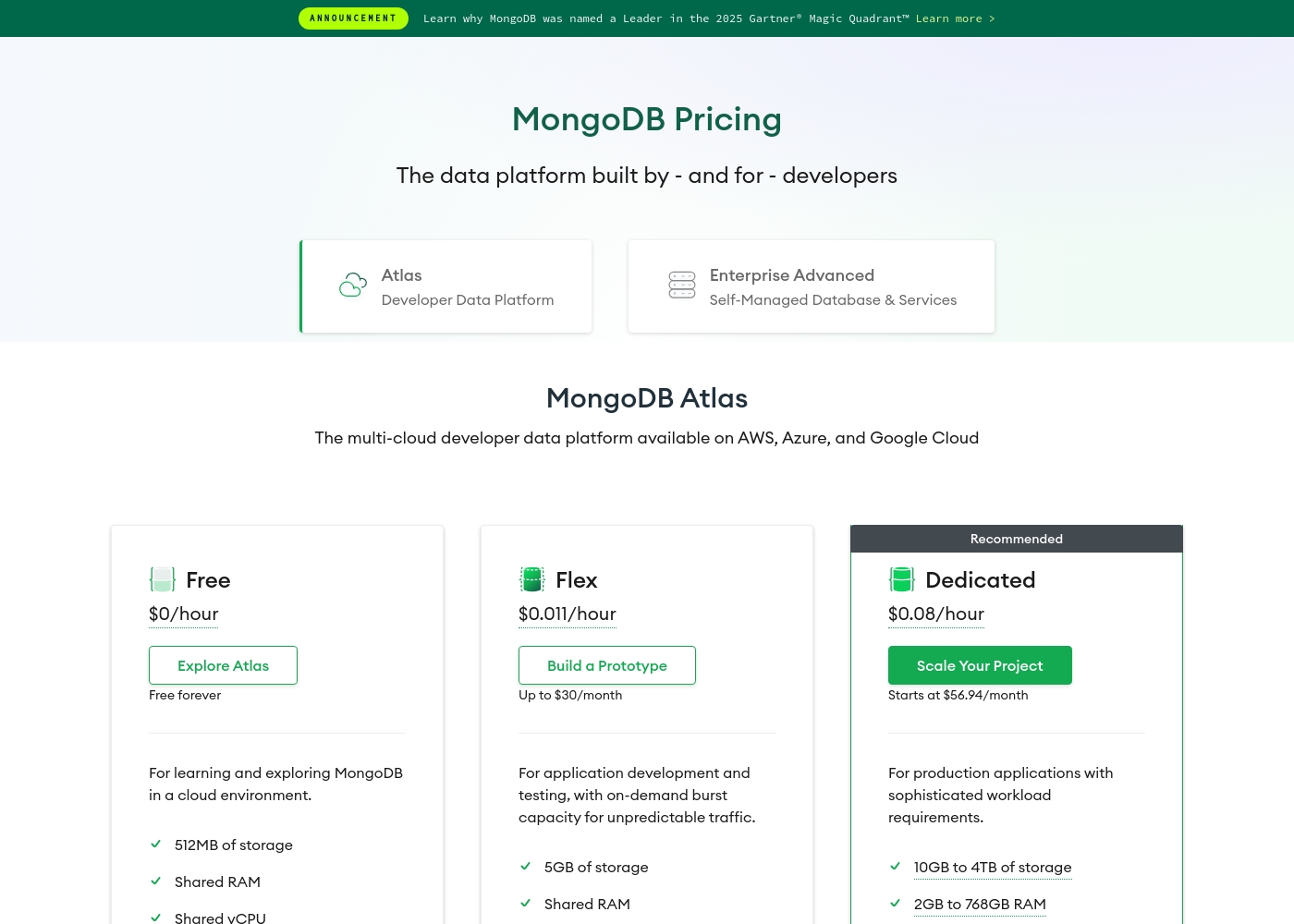
MongoDB pricing: MongoDB offers a range of cloud database options starting with a free-forever tier and scaling to dedicated resources for production environments. Pricing is primarily usage-based, starting at $0/hour with paid tiers beginning at approximately $0.011/hour and $0.08/hour for advanced workloads.
Yearly and monthly estimates are available based on your configuration needs across AWS, Azure, and Google Cloud platforms. Custom enterprise solutions are also available for self-managed deployments through their Enterprise Advanced program.
Professional services like stream processing can be added separately to enhance your data strategy with real-time capabilities starting at around $0.06/hour per instance level SP2 or higher depending on your needs. Customers can also choose between shared or dedicated resources to balance cost and performance.
Pricing Notes
- Microsoft Azure's pricing is instance-based and can be confusing. Users report unexpected fees and deceptive billing practices.
- MongoDB Atlas starts with a free forever tier. Paid tiers scale based on resources, which can become expensive at high usage.
- Both platforms use consumption-based models. You need to monitor usage carefully on either to avoid surprise bills.
- Azure offers a 30-day free trial with a $200 credit. MongoDB's free tier has no explicit trial period.
Pricing Head-to-Head
Kullanıcı yorumları
Yalnızca Trustpilot'tan alınan harici geri bildirimler ezici bir şekilde eleştirel olup, 1,5 gibi önemli ölçüde düşük bir TrustScore ile sonuçlanmaktadır. Hayal kırıklığının ana kaynağı, kullanıcıların acil biletleri ele almalarının haftalar sürmesi nedeniyle sıklıkla yanıtsız, ulaşılması zor ve yetersiz olarak tanımladığı müşteri hizmetleridir.
Birçok müşteri, hizmetleri tamamen sildikten sonra bile sürekli ücret alma ve beklenmedik ücretler dahil olmak üzere şeffaf olmayan fiyatlandırma ve faturalandırma uygulamaları bildirmektedir. Güvenilirlik ve veri güvenliği ile ilgili ciddi sorunlar da ortaya çıktı: Birden fazla kullanıcı, ödeme yapmakta zorlanmalarına rağmen, vadesi geçmiş 90 günlük fatura politikası nedeniyle şirket verilerinin otomatik ve kalıcı olarak silindiğini bildirdi.
Azure'un fiyatlandırması tamamen aldatıcı, beni tamamen beklenmedik ücretlerle vuruyor. Herkese bundan kaçınmasını şiddetle tavsiye ederim. Kesinlikle bir noktada sizi kandıracak.
Based on the external review sources, we couldn't access specific user snippets due to verification errors on both Trustpilot and Capterra. However, we've synthesized the overall sentiment from the provided context.
Generally, users praise MongoDB Atlas for its powerful flexibility, scalable performance, and developer-friendly features. Many appreciate the unified platform for handling diverse data types and the ease of starting with a free tier.
MongoDB's flexibility is a game-changer for our agile team. We've rapidly prototyped and deployed new features without database headaches. The scalability gives us peace of mind.
Bizim Kararımız
For most developers building modern applications, MongoDB is the clear winner. Microsoft Azure is a giant platform for everything, but it comes with serious user experience baggage. MongoDB focuses on doing one thing exceptionally well: providing a flexible, scalable data platform. Microsoft Azure's superpower is its sheer breadth. It can handle massive AI projects, legacy migrations, and global infrastructure. If you need a skyscraper-sized cloud for an enterprise, Azure has the tools. MongoDB's superpower is developer experience. Its document model speeds up development. The unified platform for data, search, and streaming simplifies your stack. The deciding factor is your primary need. If you need to move a giant SQL Server database to the cloud, choose Microsoft Azure. If you want to build a new app with AI features quickly, choose MongoDB. For greenfield projects and teams wanting to move fast, MongoDB is the smarter pick. Microsoft Azure is necessary for specific enterprise-scale cloud challenges, but be prepared for a rougher user journey.
Sıkça Sorulan Sorular
Which is better for small teams: Microsoft Azure or MongoDB?
MongoDB is often better for small teams. Its free tier and flexible model are great for prototyping. Microsoft Azure's complexity and pricing can be overwhelming for small budgets.
Is MongoDB worth the extra cost over Microsoft Azure?
It's not a direct cost comparison. Microsoft Azure is a cloud platform; MongoDB is a database service. MongoDB may be cheaper for database needs alone. Azure costs more but offers more services.
Can I migrate from Microsoft Azure to MongoDB easily?
They serve different purposes, so migration isn't typical. You might move a database workload from Azure SQL to MongoDB Atlas. The process uses migration tools, but it's not a platform switch.
Does Microsoft Azure have a free tier like MongoDB?
Microsoft Azure offers a 30-day free trial with a $200 credit. MongoDB has a free forever tier with 512MB storage. MongoDB's free offering is more permanent for small projects.
Which is better for AI applications?
Microsoft Azure has broader AI services, including Azure AI Foundry. MongoDB excels at integrating vector search for AI features. Choose Azure for building models, MongoDB for AI-powered apps.
How do their pricing models compare?
Both use consumption-based pricing. Microsoft Azure's costs depend on instance size and region. MongoDB's costs scale with storage and compute resources. Both require careful monitoring to avoid surprises.
Seçmeye hazır mısınız?
Her iki aracın da güçlü yönleri var. Özel ihtiyaçlarınıza göre seçin.