Druva vs Vanta
Druva and Vanta solve critical security problems, but from opposite ends. Druva protects your cloud data from threats like ransomware. Vanta automates your compliance with frameworks like SOC 2. One locks down your data, the other proves you're secure.
Solid cloud-native protection, but pricing is opaque.
We find Druva to be a robust, fully managed SaaS platform for cloud data security. It offers strong zero-trust and immutable backup features that simplify compliance and resilience. Overall, it's a capable solution for organizations focused on protecting AWS and Azure workloads, though the lack of public pricing requires direct engagement.
Artılar
- Fully managed SaaS platform simplifies operations and eliminates infrastructure overhead.
- Strong security posture with immutable backups and zero-trust architecture.
- Centralized management for multi-cloud environments (AWS, Azure).
- Designed for compliance, eDiscovery, and retention policy management.
Eksiler
- Pricing is not publicly disclosed, requiring contact with sales for quotes.
- Lack of a publicly mentioned free trial or money-back guarantee.
- External review platforms were inaccessible, limiting independent user feedback.
- Information on specific plan features and limits is not explicitly detailed.
Powerful compliance automation for growing teams.
We found Vanta excels at automating compliance workflows and reducing manual effort, which aligns with its promise to save time and accelerate deals. Its tiered pricing offers flexibility, but the lack of transparent costs and a free trial means committing to a demo before understanding the full investment.
Artılar
- Automates evidence collection and monitoring for frameworks like SOC 2.
- AI-powered questionnaire automation speeds up vendor assessments.
- Unified platform for compliance, risk management, and audit prep.
- Trust Center helps showcase security posture to customers.
Eksiler
- Pricing requires a custom quote, with no public tiers or free trial.
- Add-ons for key features like Third-Party Risk Management increase costs.
- Initial setup and policy onboarding may have a learning curve.
- Some users report integration challenges with specific tools.
HakkındaDruva
Druva is a cloud-native data security platform. ✨ It's designed for organizations needing to protect mission-critical applications and digital identities. The service is fully managed, meaning the infrastructure is handled for you. It's ideal for teams that want to secure data across AWS, Azure, and other cloud environments without managing extra tools.
HakkındaVanta
Vanta is an Agentic Trust Platform designed for startups, mid-market, and enterprise companies. It automates the entire process of getting and staying compliant with frameworks like SOC 2, ISO 27001, and HIPAA. The platform combines compliance, risk management, and audit preparation into one place. It's built for security leaders who want to scale their programs without adding headcount. 💡
Öne çıkanlar
Özellik karşılaştırması
Özelliklere Genel Bakış
Ana farkları vurguluyoruz ve her özellik için bir kazanan seçiyoruz.
Core Purpose & Focus
Druva is for data security. Vanta is for compliance automation.
Druva is a cloud-native platform focused on protecting your data from threats. It provides immutable backups and zero-trust security to keep your data safe and recoverable. Vanta automates the entire compliance process. It helps you get and stay compliant with frameworks like SOC 2, ISO 27001, and HIPAA by automating evidence collection. The key difference is proactive defense versus proof. Druva stops data loss, while Vanta proves you're secure to customers and auditors.
Security Architecture
Druva uses zero-trust and immutable backups. Vanta focuses on continuous monitoring.
Druva is built on a zero-trust model, verifying every access request. It creates immutable backups that cannot be altered, even by administrators, providing a clean recovery point. Vanta continuously monitors your security controls against compliance frameworks. It alerts you to gaps, allowing you to fix issues before they become problems. Druva's architecture prevents data tampering. Vanta's architecture ensures your security posture is always audit-ready.
Compliance Management
Druva simplifies governance. Vanta automates the entire compliance lifecycle.
Druva helps manage data retention and eDiscovery across clouds from one place. It streamlines governance policies but doesn't automate full compliance frameworks. Vanta is designed for compliance. It automates policy generation, evidence collection, and audit workflows for multiple frameworks. Its AI agent drafts policies and questionnaire responses. Vanta offers deep, automated compliance management. Druva provides tools to support compliance as part of broader data security.
Threat & Ransomware Protection
Druva specializes in ransomware recovery. Vanta is not a backup solution.
Druva's immutable backups are a core defense against ransomware. If an attack encrypts your data, you can recover from an unchangeable backup copy quickly. Vanta's continuous monitoring might help you spot a security gap that could lead to a ransomware attack, but it doesn't protect the data itself. For ransomware recovery, Druva is the clear choice. Vanta is for preventing the compliance fallout after an incident.
Vendor & Third-Party Risk
Vanta manages vendor risk. Druva does not focus on this area.
Druva focuses on securing your own cloud data and workloads. It doesn't have features for assessing or monitoring third-party vendor security. Vanta offers a Third-Party Risk Management module. It automates vendor discovery, security reviews, and continuous monitoring of your supply chain. If managing vendor risk is a priority, Vanta has a dedicated solution. Druva is not built for this use case.
AI & Automation Capabilities
Vanta leverages AI for compliance tasks. Druva focuses on automated data protection.
Druva's automation is in its fully managed platform and cloud-native scaling. It deploys and scales protection automatically. Vanta uses a Vanta Agent and AI to draft policies, answer questionnaires, and automate evidence collection. It saves teams hundreds of hours annually. Vanta has explicit, user-facing AI features for compliance work. Druva's automation is more about infrastructure and data management.
Ease of Getting Started
Druva deploys in minutes. Vanta requires policy onboarding.
Druva is a fully managed SaaS platform. You can deploy it in minutes and start protecting workloads immediately without complex setup. Vanta requires initial setup, including connecting tools and generating policies. Onboarding can take a couple of weeks and has a learning curve. For pure speed of deployment, Druva is faster. Vanta's setup is more involved but essential for its compliance engine.
Customer Support & Trust
Both have positive reviews. Vanta's Trust Center is a unique feature.
User reviews for both are rated 4.2 on external platforms. Druva's support details are part of enterprise agreements. Vanta offers support during audits. Vanta provides a Trust Center—a live portal to showcase your security posture to customers and partners. This builds direct trust. While both have good support reputations, Vanta's Trust Center offers a tangible way to prove compliance externally.
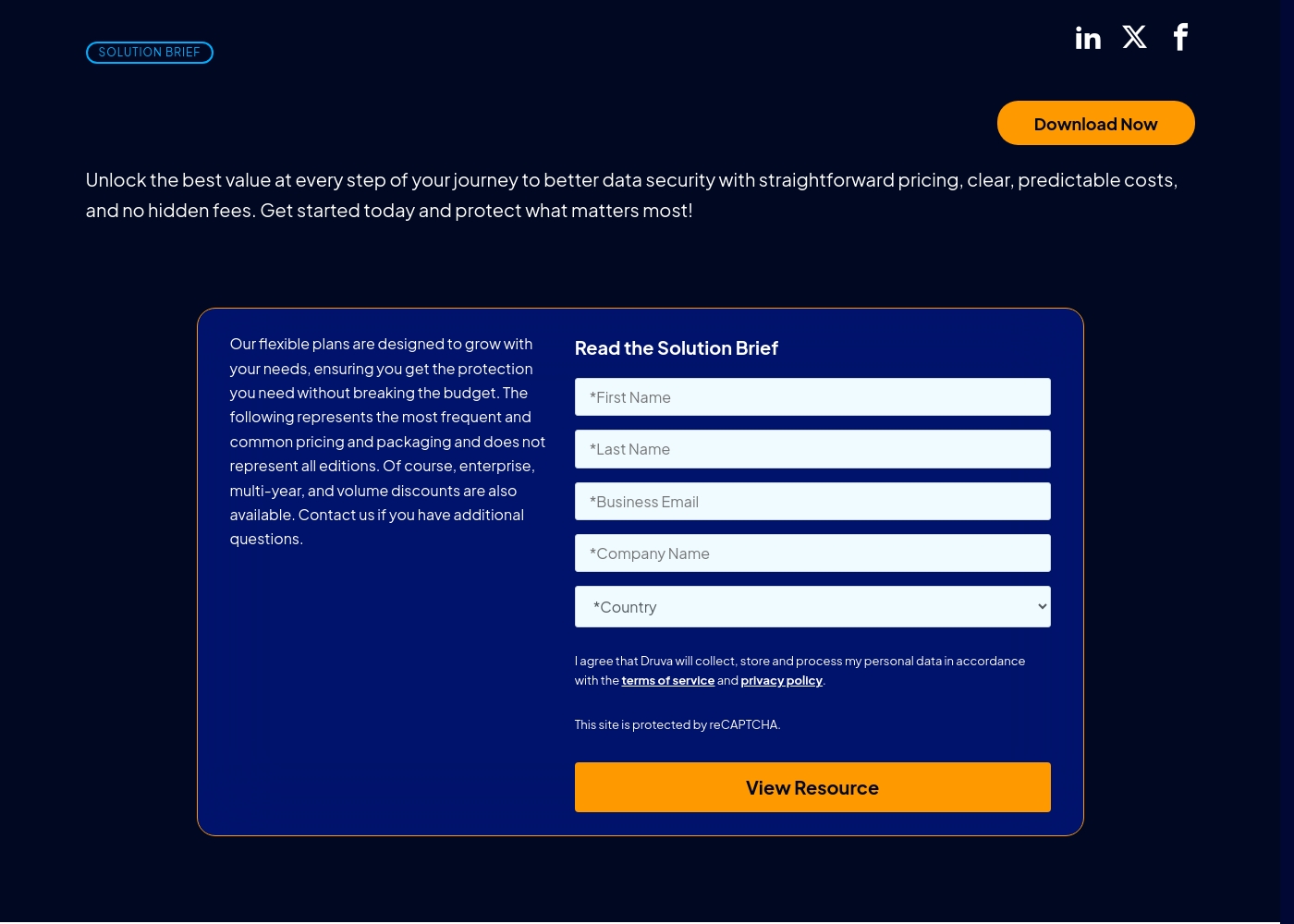
Druva costs are not explicitly stated as they prefer a tailored approach based on your specific data security and workload requirements.
Take a look at how Druva structures their offerings below.
Druva Plans
Price: Not explicitly stated Websites Supported: Not explicitly stated Best For: Organizations seeking cyber resilience for mission-critical apps and workloads. Refund Policy: Not explicitly stated Other Features: Immutable backups, zero-trust architecture, ransomware protection, centralized management, and microservices architecture.
- Immutable backups
- Zero-trust architecture
- Ransomware protection
- Centralized management menu
- Multi-cloud support (AWS, Azure)
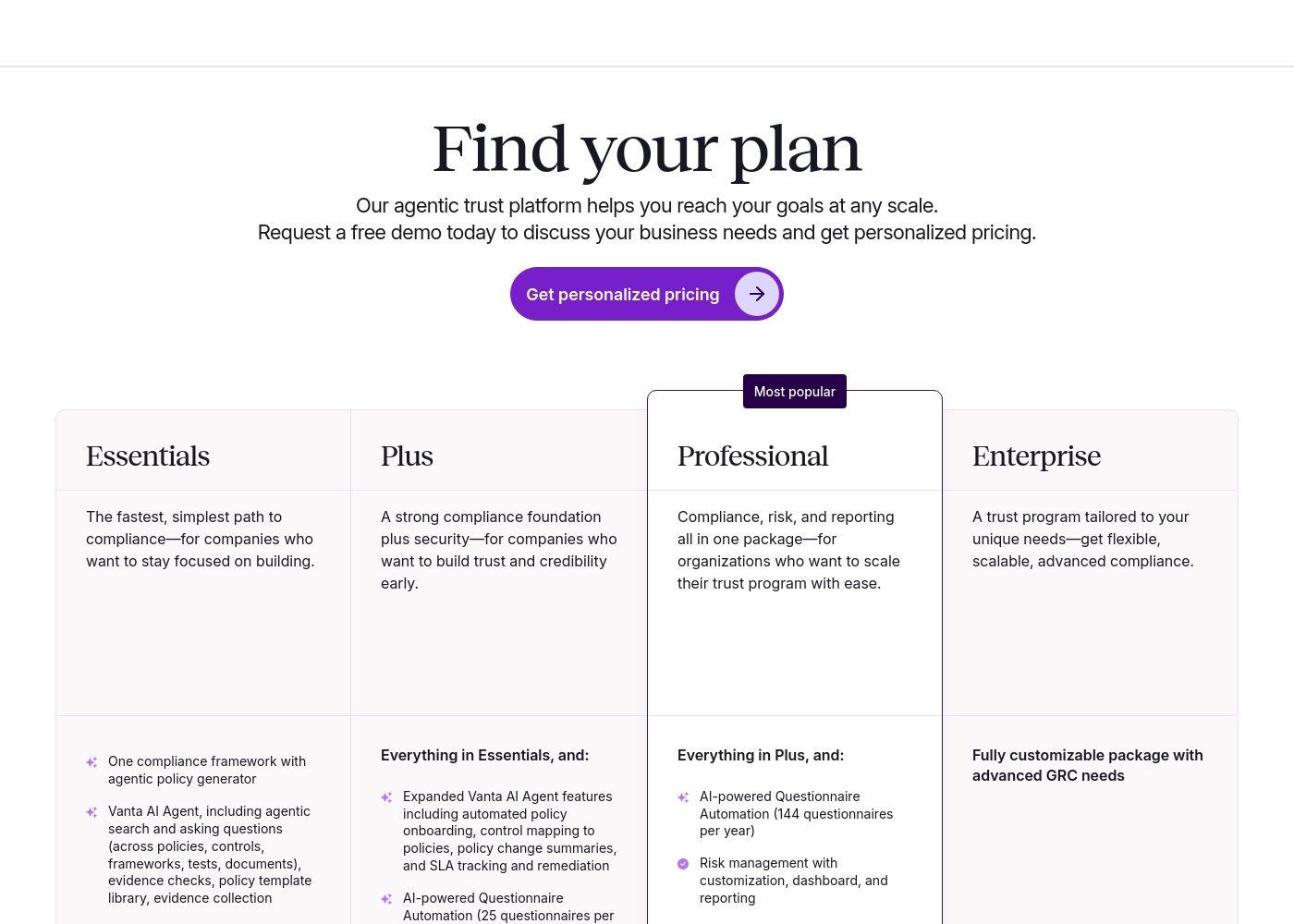
Vanta pricing is not explicitly stated but is provided via personalized quotes for four distinct plans: Essentials, Plus, Professional, and Enterprise.
Take a look at the details for each tier below to see which fits your company's current stage.
Essentials
Price: Not explicitly stated Websites Supported: Not explicitly stated Best For: Companies who want to stay focused on building while reaching compliance. Refund Policy: Not explicitly stated Other Features: One compliance framework, Vanta AI Agent, Automated evidence collection, Basic reporting and audit workflows, Auditor API access.
- One compliance framework with agentic policy generator
- Vanta AI Agent (search, evidence checks, policy templates)
- Automated evidence collection for audit readiness
- Basic reporting and audit workflows
- Auditor API and Trust Center access
- Automated policy onboarding
- Control mapping and SLA tracking
- AI-powered Questionnaire Automation (25 per year)
- Access Management
- AI-powered Questionnaire Automation (144 per year)
- Risk management with customization and reporting
- Advanced Trust Center
- Custom monitoring tests and automation
- Advanced reporting (six customizable reports)
- Fully customizable package
- Advanced GRC needs
- Workspaces and SCIM
- Advanced control management
Pricing Notes
- Neither Druva nor Vanta publicly lists pricing. Both require contacting sales for a custom quote.
- Druva's costs scale based on protection needs, with enterprise and multi-year discounts available.
- Vanta's pricing is based on business scale, number of compliance frameworks, and employee count across four tiers: Essentials, Plus, Professional, and Enterprise.
- Vanta offers specific feature limits per plan (e.g., 25 or 144 AI questionnaires per year). Druva's plan limits are not detailed.
- Both platforms have no public free trial or money-back guarantee mentioned.
Pricing Head-to-Head
Kullanıcı yorumları
External review sources for Druva are currently inaccessible for direct sentiment analysis. The Trustpilot and Capterra pages both returned security verification or forbidden errors, preventing us from gathering specific user feedback, ratings, or recurring themes. Consequently, our final assessment is based solely on the provided website content and pricing details, without corroborating external user sentiment. This limits our ability to provide a balanced, fact-based review of user experiences regarding accuracy, support, or value.
We couldn't access specific review snippets from Trustpilot or Capterra due to security blocks, but we know these platforms host user feedback on Vanta. Based on common themes in the compliance software space, users typically praise ease of use, automated evidence collection, and strong customer support that helps during audits.
However, recurring concerns often include custom pricing that can feel expensive for smaller teams, occasional integration hiccups with certain tools, and a learning curve during initial onboarding. The platform's reliability for continuous monitoring is frequently highlighted, though some note the AI questionnaire automation needs refinement.
Vanta automated our SOC 2 evidence collection, saving our team dozens of hours monthly. The platform is intuitive, and support was responsive when we had audit questions.
Bizim Kararımız
Druva and Vanta don't compete—they solve different, equally critical problems. One protects your data, the other proves you're secure. Druva's superpower is unbreakable data protection. It locks down your cloud data with immutable backups and zero-trust security, making you ransomware-resilient. If a breach happens, you recover clean. Vanta's superpower is compliance autopilot. It automates SOC 2 and ISO 27001, saving thousands of hours and helping you close deals up to 20% faster. It turns security from a blocker into a business enabler. The deciding factor is your immediate pain point. Is your biggest risk data loss or a stalled sales cycle? Are you trying to prevent a disaster or prove you've prevented one? Choose Druva if you need to secure mission-critical data across AWS and Azure. Choose Vanta if you need to automate compliance to scale your business. For many growing companies, the answer is eventually both.
Sıkça Sorulan Sorular
Which is better for small teams: Druva or Vanta?
It depends on the need. Choose Druva for simple, cloud-based data backup and security. Choose Vanta to automate compliance frameworks like SOC 2, which is often required for selling to larger clients.
Does Druva have compliance features like Vanta?
Druva helps with data governance and retention policies, which support compliance. However, it doesn't automate the full compliance lifecycle like Vanta. Vanta is the dedicated compliance automation platform.
Is Vanta worth the extra cost over Druva?
This isn't an apples-to-apples comparison. Vanta isn't 'extra cost'; it's a different tool for a different job. Vanta automates compliance to save time and close deals. Druva protects data from threats. The value depends on your priority.
Can I migrate from Druva to Vanta easily?
You wouldn't typically migrate between them, as they serve different purposes. You might use both: Druva for data protection and Vanta for compliance automation. They are complementary, not interchangeable.
Which one is easier to set up?
Druva is generally faster to deploy as it's a fully managed SaaS platform you can set up in minutes. Vanta requires more initial configuration for policies and integrations, which can take a few weeks.
Do they both offer free trials?
No. Neither Druva nor Vanta offers a public free trial. Both require contacting their sales teams for a demo and a custom quote.
Seçmeye hazır mısınız?
Her iki aracın da güçlü yönleri var. Özel ihtiyaçlarınıza göre seçin.