Drip vs Hive
Drip and Hive solve totally different problems. Drip is for sending automated marketing emails to sell products. Hive is for managing projects and collaborating with your team. Choosing between them is like choosing a marketing tool versus a project management tool.

Powerful for e-commerce, but check the support.
We find Drip to be a highly capable email automation platform built specifically for B2C e-commerce. Its visual builder and smart segmentation are standout features for creating personalized customer journeys. Overall, it's a strong choice for online brands, provided your team can manage the learning curve and verify support levels.
Artılar
- Excellent visual workflow builder for automation
- Deep e-commerce integrations (Shopify, WooCommerce)
- Powerful, behavior-based segmentation tools
- Free migration for large lists (17,500+)
Eksiler
- Pricing can become expensive as contacts scale
- Some users report slow or inconsistent customer support
- Requires integration with compatible platforms
- Advanced features may have a learning curve

Powerful hub for connected teams.
We found Hive excels at centralizing work across multiple tools into a single, AI-assisted workspace. Its flexible views and automation are strong assets, though the pricing structure and some user experiences around support warrant careful consideration. Overall, it's a robust choice for teams prioritizing integration and workflow efficiency.
Artılar
- Centralizes work from tools like Slack, Salesforce, and email into one unified workspace.
- Offers flexible project views including Kanban, Gantt, Calendar, and Table.
- Integrates Buzz AI for smart search, summaries, and turning conversations into tasks.
- Provides a free forever tier and a free trial with no credit card required.
Eksiler
- Some users report confusion or dissatisfaction with billing and subscription management.
- Advanced features and support are often reserved for higher-tier, more expensive plans.
- Requires upfront integration setup to realize its full value, which may not suit all teams.
- Pricing details for some modules or support levels are not fully transparent upfront.
HakkındaDrip
Drip is an email marketing automation platform built for B2C companies that sell online. Whether you're an e-commerce brand, a course creator, or a travel provider, it gives you the tools to move beyond generic newsletters. It's designed to be a powerful yet simple engine for driving revenue through personalization. 💡
HakkındaHive
Hive is a project management platform built for teams of all kinds. From agencies and marketing teams to non-profits and education groups, it’s designed to organize collaboration and automate workflows. It’s not just a task list; it’s a connected system where your work happens. 💡
Öne çıkanlar
Özellik karşılaştırması
Özelliklere Genel Bakış
Ana farkları vurguluyoruz ve her özellik için bir kazanan seçiyoruz.
Automation
Drip automates emails. Hive automates tasks. Their automation serves completely different purposes.
Drip's automation is built for marketing. You create workflows for cart abandonment, welcome series, and behavioral triggers. It uses customer data to send the right email at the right time. Hive's automation focuses on projects. You can set up automated actions, recurring tasks, and project templates. It's designed to save time on administrative work. Drip's automation directly drives revenue. Hive's automation improves team efficiency. The key difference is the goal: selling vs. organizing.
AI Features
Hive has a built-in AI assistant. Drip focuses on behavioral data instead.
Hive offers Buzz AI, which can search across connected apps, summarize meetings, and create action items from conversations. It's a smart assistant within your workspace. Drip doesn't have a general-purpose AI assistant. Its intelligence comes from behavioral segmentation and automated email triggers based on user actions. Hive's AI is about productivity and information synthesis. Drip's 'intelligence' is about marketing optimization. They solve different problems.
User Interface
Drip has a simple, focused email builder. Hive offers a complex, multi-view dashboard.
Drip's interface is built for email creation. It has a visual builder for designing messages and setting up workflows. It's straightforward for its specific purpose. Hive's interface is a full project workspace. You can switch between Kanban, Gantt, calendar, and table views. It's more complex but highly adaptable. For email marketing, Drip's UI is simpler. For managing diverse projects, Hive's UI is more powerful.
Integrations
Both connect to popular tools, but for different ecosystems.
Drip integrates deeply with e-commerce platforms like Shopify, BigCommerce, and WooCommerce. It's built to pull in store data for personalized emails. Hive integrates with a wide business stack including Slack, Salesforce, email, and Gong. It's built to centralize work from various apps. Drip's integrations serve marketing. Hive's integrations serve collaboration. Choose based on your software stack's primary need.
Reporting & Analytics
Hive offers more detailed project analytics. Drip focuses on email campaign metrics.
Drip's reporting shows email performance: open rates, clicks, revenue generated. It helps you measure what's working in your campaigns. Hive's reporting, especially on higher tiers, tracks project progress, team workload, and time spent. It gives managers a big-picture view of operations. Drip measures marketing ROI. Hive measures team productivity. They track fundamentally different things.
Customer Support
Drip offers quick email support. Hive's best support is for enterprise customers.
Drip promises email support for all paid users. They highlight fast response times (under 1.6 hours) and a 97.3% satisfaction score. Hive's support varies by plan. Enterprise plans get a dedicated Customer Success Manager. Other plans use a contact form. For general users, Drip's support access is more straightforward. Hive offers premium, dedicated support only at the highest price point.
Pricing Model
Drip charges based on your contact list size. Hive charges per user on your team.
Drip's cost scales with the number of people in your email list. You pay more as your audience grows, but there are no per-user fees. Hive's cost scales with your team size. You pay a monthly fee for each person who needs access, with different tiers for features. Drip's pricing suits growing marketing lists. Hive's pricing suits growing teams. Your choice depends on what you're scaling.
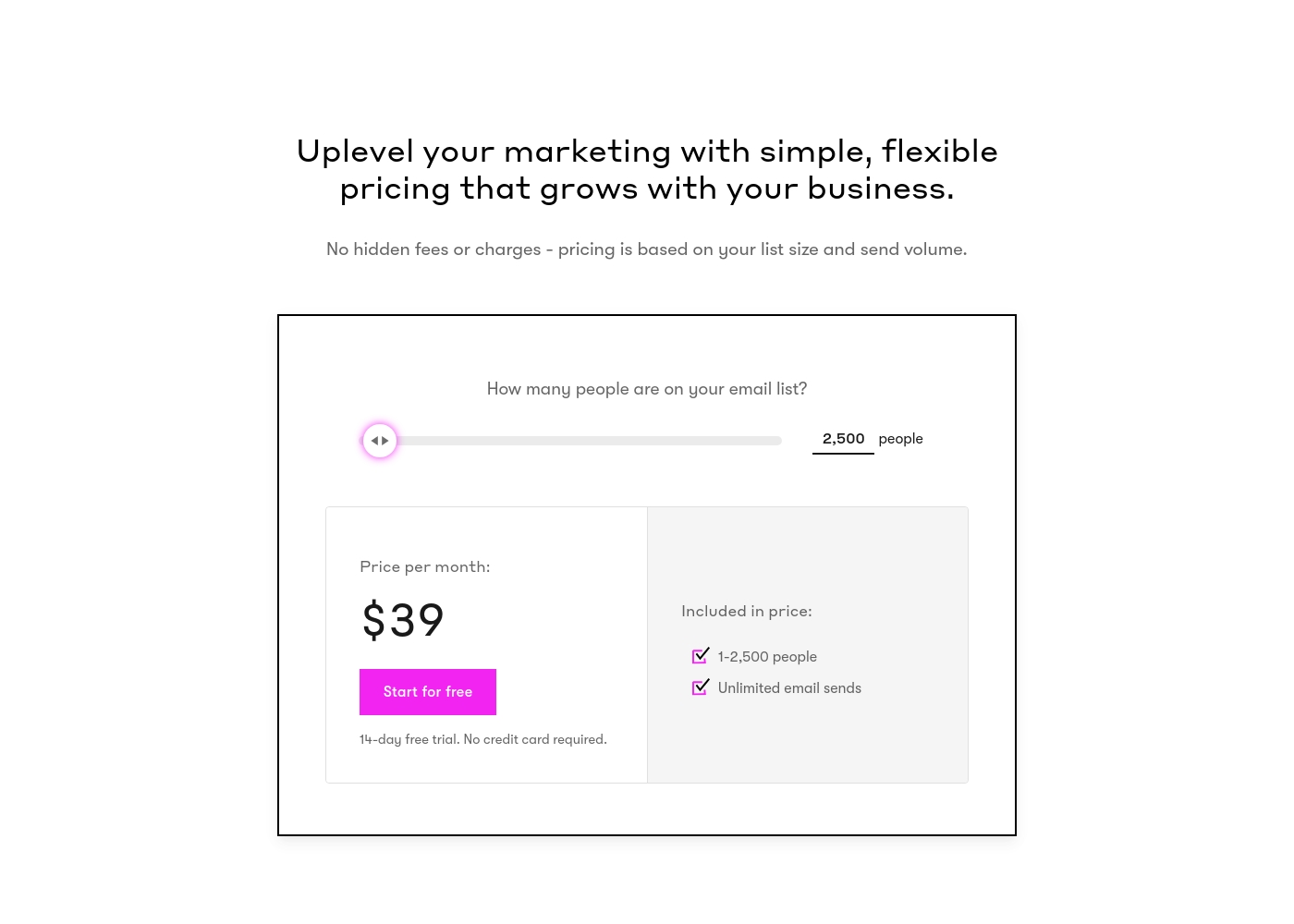
Drip pricing: Drip offers a flexible, usage-based subscription starting at $39/month for up to 2,500 people. Pricing scales based on your email list size and includes a 14-day free trial with no credit card required to start browsing its powerful automation tools tool and visual builder.
Your monthly cost increases as your audience grows, but you always get features like unlimited email sends and onsite campaigns. This ensures you only pay for what you actually use while accessing expert support and pre-built marketing playbooks right from the start.
You can cancel your subscription at any time within your billing settings if your business needs change. This model is specifically designed for e-commerce brands looking for deep segmentation and personalized customer journeys without enterprise-level complexity or hidden fees.
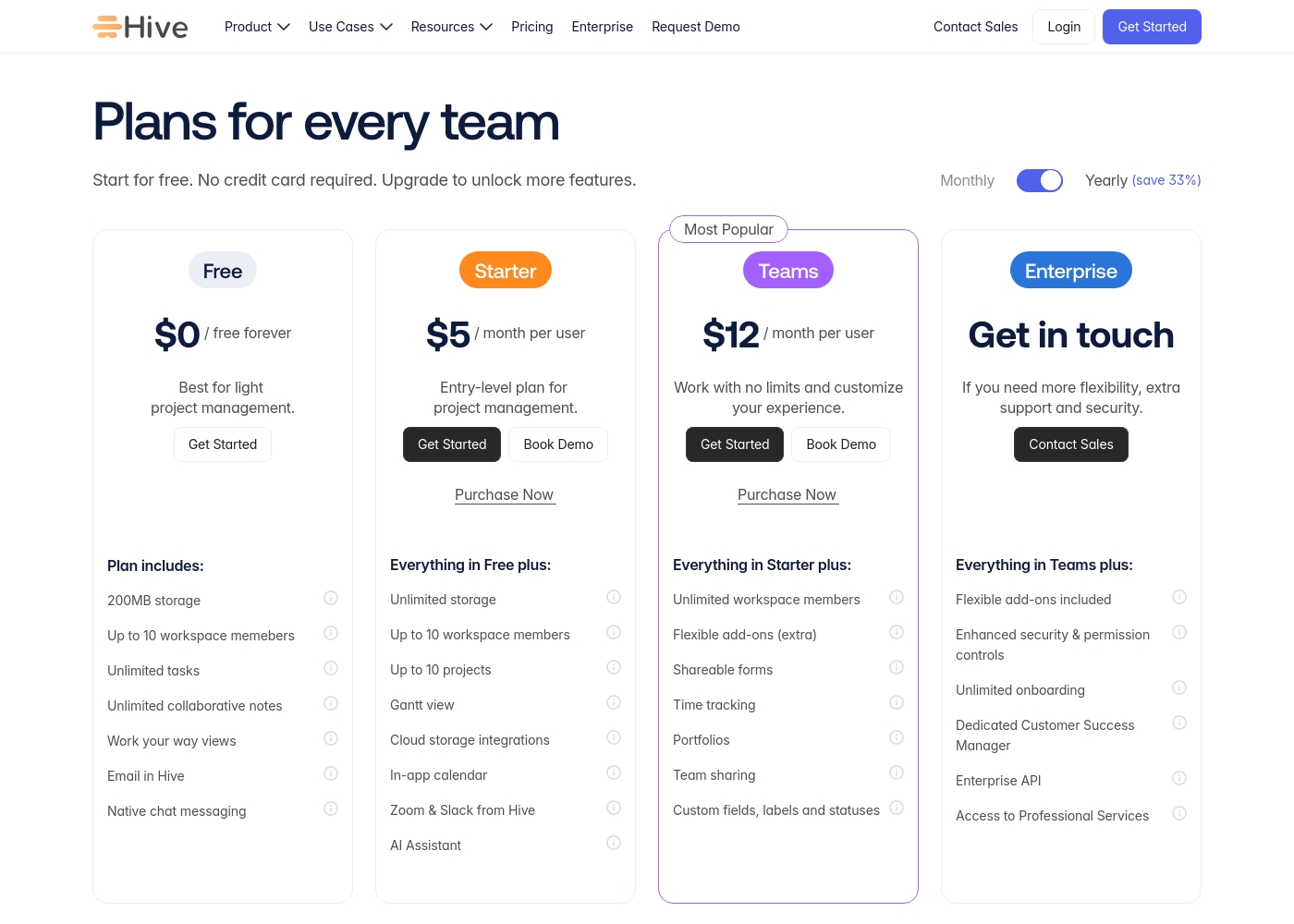
Hive pricing: Hive offers a range of options from a $0 free forever tier to a $12/month per user Teams plan. Subscriptions range from free tools for individuals to robust, feature-rich environments for growing organizations and enterprises alike.
Yearly billing is available to help you save on total costs over time. Monthly plans provide maximum flexibility if you prefer less commitment.
Pricing scales with features, allowing you to pay for only the power you need as your projects grow more complex. Add-ons like Buzz AI and time tracking are extra costs on mid-tier plans, which makes the pricing structure modular and customizable.
Pricing Notes
- Drip's price depends on active contacts, not users. Costs can grow fast with a large list.
- Hive charges per user. A team of 10 on the Teams plan pays $120/month.
- Drip offers a free trial but no permanent free plan. Hive has a free forever tier.
- Hive's advanced features like Buzz AI are paid add-ons on some plans.
Pricing Head-to-Head
Kullanıcı yorumları
We found a mixed bag of user sentiment from Trustpilot, as the Capterra link was inaccessible. Reviews praise Drip's powerful automation and segmentation for driving revenue, with many noting its ease of use for e-commerce.
💡 On the downside, several users report frustration with customer support responsiveness and occasional platform glitches. Pricing is frequently cited as a concern, with some feeling the cost can escalate quickly as contacts grow.
Drip's automation tools are top-notch. We set up abandoned cart sequences that really boosted our recovery rate. The visual builder makes it easy to see the customer journey.
Reviewing Hive's external reputation, we found Trustpilot reviews to be mixed but often positive regarding the product's functionality and customer service responsiveness. Users frequently praise the platform's ease of use and comprehensive features for project management, noting its helpful support team. 📊 On the other hand, some reviews highlight concerns with pricing transparency and occasional billing issues, which can affect overall value perception. ⭐ Capterra's detailed review page was inaccessible due to security restrictions, preventing a full cross-platform synthesis. Based on the available Trustpilot snippets, the sentiment leans towards appreciation for Hive's core toolset and collaborative environment, though experiences with account management and subscription handling are less consistent.
Hive has been a game-changer for our marketing team. The ability to see all our projects in different views, like Gantt charts, helps us stay on top of deadlines. Customer support has also been very responsive whenever we had questions.
Bizim Kararımız
Drip and Hive aren't competitors—they're for completely different jobs. Choosing between them is straightforward once you know your main goal. Drip's superpower is turning email lists into revenue. It automates personalized messages for e-commerce, like abandoned cart emails. Users report segments driving 5x more revenue. Hive's superpower is taming project chaos. It pulls your work from multiple apps into one place. One team saved 810 hours in their first month using its automation. The deciding factor is your primary pain point. If you're losing sales from disengaged subscribers, choose Drip. If you're drowning in tabs and miscommunication, choose Hive. Final verdict: For email marketing automation to boost e-commerce sales, pick Drip. For centralizing team projects and collaboration, pick Hive. They're excellent at their respective jobs, so focus on the problem you need to solve.
Sıkça Sorulan Sorular
Which is better for a small e-commerce store: Drip or Hive?
Drip is better for a small e-commerce store. It's built specifically to automate marketing emails and recover abandoned carts on platforms like Shopify. Hive is for managing projects and wouldn't help with email marketing.
Does Drip have project management features like Hive?
No, Drip does not have project management features. It is solely an email marketing automation platform. For project management, collaboration, and team workflows, you need a tool like Hive.
Is Hive worth it if I'm a solo freelancer?
It can be. Hive's free plan is a great starting point for solo users. You can manage your tasks and integrate a few tools without cost. Paying for a plan adds more features but isn't necessary for basic use.
Can I use Drip and Hive together?
Yes, you can. A common use case is using Hive to manage the marketing project plan, while using Drip to send the automated emails to customers. They serve different functions in a marketing workflow.
Which has a better free plan?
Hive has a better free plan. It offers a free forever tier with basic project management features. Drip does not have a permanent free plan, only a 14-day trial.
Which tool is easier to set up?
Drip is generally easier to set up for its purpose. You connect your store and start building emails. Hive requires more configuration to set up workspaces, connect apps, and define project workflows.
Seçmeye hazır mısınız?
Her iki aracın da güçlü yönleri var. Özel ihtiyaçlarınıza göre seçin.