MongoDB เทียบกับ Vultr
MongoDB and Vultr are not direct competitors, but comparing them clarifies a key choice. Do you need a smart database or raw computing power? That's the heart of the decision.
Powerful, flexible platform for modern data.
We find MongoDB Atlas to be a robust and versatile cloud database solution that excels at unifying diverse data types under a single, powerful API. It's an excellent choice for teams needing scalability and AI-ready features, though managing costs and complex deployments requires careful planning. Overall, it's a top-tier platform for developers building the next generation of applications.
ข้อดี
- Excellent flexibility with its document model.
- Powerful, unified platform for databases, search, and streaming.
- Strong scalability and high availability guarantees.
- Native vector search integration for AI applications.
ข้อเสีย
- Costs can escalate quickly with high usage and dedicated resources.
- Advanced features and configurations can have a steep learning curve.
- Support responsiveness can be inconsistent for some users.
เทคโนโลยีขั้นสูง แต่การสนับสนุนมีปัญหามาก
เรารับทราบว่า Vultr นำเสนอทรัพยากรที่มีสเปคสูงและทรงพลังซึ่งปรับให้เหมาะสมสำหรับเวิร์กโหลด AI และ HPC โดยให้การเข้าถึงโครงสร้างพื้นฐานระดับโลกที่ล้ำสมัยได้ทันที อย่างไรก็ตาม ข้อเสนอแนะของผู้ใช้บ่งชี้อย่างชัดเจนถึงความไม่เสถียรอย่างรุนแรงเกี่ยวกับการสนับสนุนการดำเนินงาน กระบวนการตรวจสอบ และความน่าเชื่อถือของเครือข่าย โดยรวมแล้ว Vultr เป็นผู้ให้บริการที่มีความเสี่ยงสูง ซึ่งเทคโนโลยีระดับโลกถูกบ่อนทำลายอย่างมากโดยปัญหาการบริการลูกค้าและการจัดการบัญชีที่แพร่หลาย
ข้อดี
- เข้าถึงฮาร์ดแวร์ AI และ HPC สุดล้ำ (NVIDIA HGX B200, AMD Instinct)
- การเข้าถึงทั่วโลกด้วยศูนย์ข้อมูลคลาวด์ 32 แห่งทั่วโลก
- การเรียกเก็บเงินตามการใช้งานแบบยืดหยุ่นรายชั่วโมงและรายเดือน เริ่มต้นที่ 2.50 ดอลลาร์/เดือน
- มีบริการที่มีการจัดการ เช่น Kubernetes Engine และฐานข้อมูล
ข้อเสีย
- ฝ่ายสนับสนุนลูกค้าช้าอย่างต่อเนื่อง ไม่ช่วยเหลือ เป็นแบบตั๋ว และไม่ตอบสนอง
- มีการระงับบัญชีและยุติบริการโดยพลการเกิดขึ้นบ่อยครั้ง (เช่น เนื่องจากการเพิ่มขึ้นของ CPU อย่างรวดเร็ว)
- ขั้นตอนการตรวจสอบภาคบังคับที่มากเกินไปและรุกล้ำ (ต้องใช้รูปถ่ายบัตรประชาชนและบัตรเครดิต)
- รายงานความยากลำบากในการขอเงินคืน โดยเฉพาะอย่างยิ่งสำหรับการฝากด้วยสกุลเงินดิจิทัล
เกี่ยวกับMongoDB
💡 MongoDB Atlas is a comprehensive cloud data platform built for modern applications. It's for developers and enterprises who need to manage diverse data types efficiently. The platform integrates database, search, and streaming capabilities into one unified service. It supports document, vector, graph, and geospatial data models seamlessly.
เกี่ยวกับVultr
Vultr ให้บริการแพลตฟอร์มคอมพิวต์คลาวด์แบบเต็มสแต็คที่ทรงพลัง มีบริการตั้งแต่เครื่องเสมือนที่กำหนดค่าได้ไปจนถึงเซิร์ฟเวอร์เฉพาะที่เร่งความเร็วสูง 💡 แพลตฟอร์มนี้เหมาะสำหรับนักพัฒนาและองค์กรที่มุ่งเน้นการประมวลผลประสิทธิภาพสูงและการปรับใช้โมเดล AI ที่ซับซ้อน คุณสามารถเปิดใช้งานการกำหนดค่าทั่วไปหรือที่ปรับให้เหมาะสมได้ภายในเวลาไม่ถึง 60 วินาที
ไฮไลต์
การเปรียบเทียบคุณสมบัติ
ภาพรวมคุณสมบัติ
เราเน้นความแตกต่างหลักและเลือกผู้ชนะสำหรับแต่ละคุณสมบัติ
Core Function
MongoDB is a specialized data platform. Vultr is a general-purpose computing foundation.
MongoDB Atlas is a managed cloud database. It's a complete platform for storing, searching, and processing data. You get a document database with built-in vector search and analytics. Vultr provides raw cloud compute. You rent virtual machines or bare-metal servers. You must install, configure, and manage your own database and software stack on top. The key difference is control vs. convenience. Vultr gives you infrastructure to build on. MongoDB gives you a finished, intelligent data system. Choose MongoDB if data management is your core problem. Choose Vultr if you need flexible computing power for any purpose.
AI & ML Capabilities
MongoDB integrates AI features into your data. Vultr provides the powerful hardware to train models.
MongoDB Atlas has native vector search. You can build semantic search and AI apps directly on your operational data. It also offers stream processing for real-time AI pipelines. Vultr's strength is GPU infrastructure. You can deploy clusters with NVIDIA HGX B200 and AMD Instinct GPUs. These are for training massive AI models at scale. MongoDB makes AI features easier to build. Vultr provides the brute-force computing needed for the most demanding AI research. A startup building a recommendation engine might choose MongoDB. A research lab training a language model would choose Vultr.
Pricing Structure
MongoDB's cost is tied to data storage and usage. Vultr's cost is tied to virtual machine size and runtime.
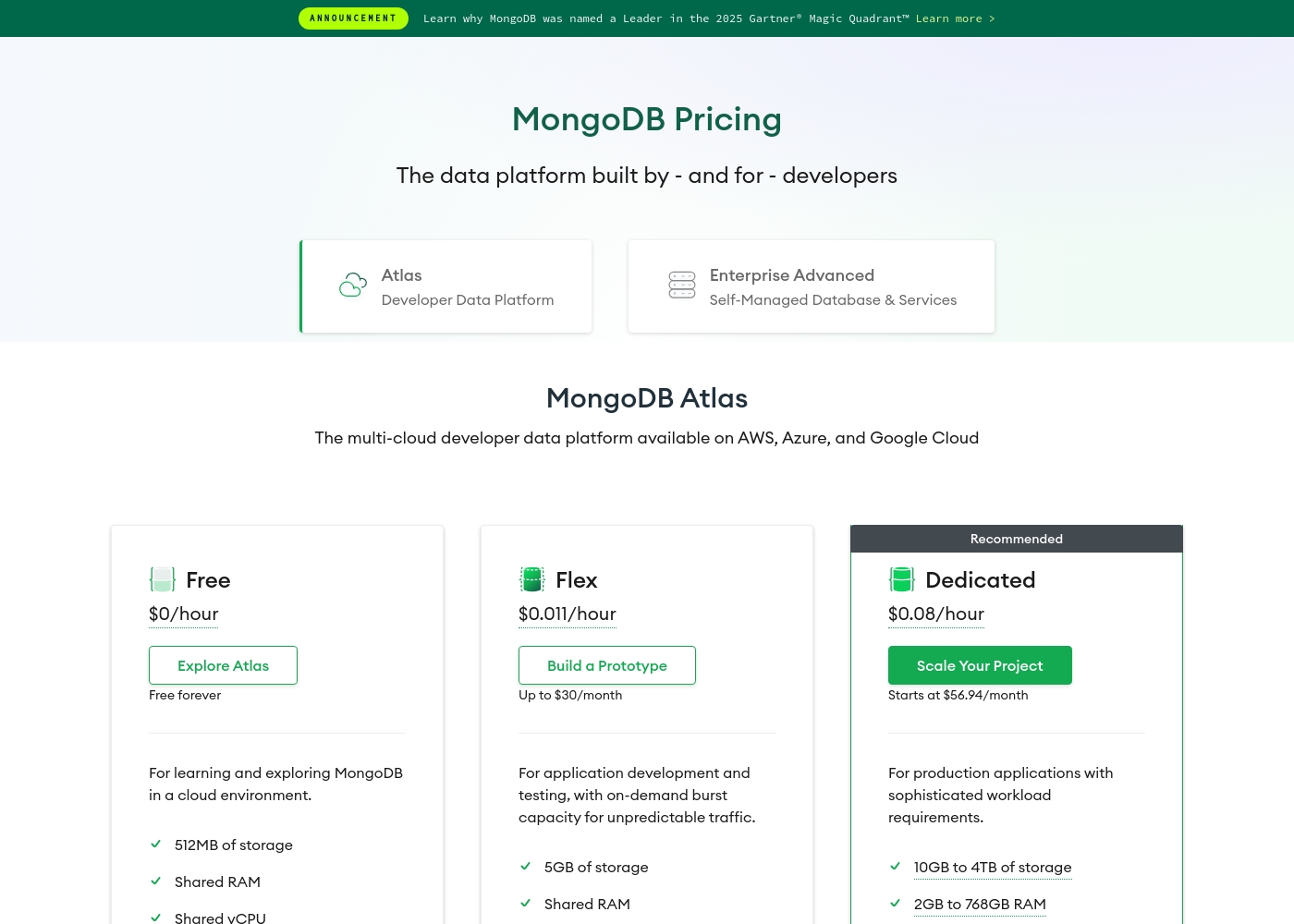
MongoDB Atlas pricing is based on resources your cluster uses. Costs start at $0 for the free tier. Paid plans begin around $0.011/hour for shared resources. Vultr's pricing is per virtual machine instance. Plans start at $2.50/month for a tiny 0.5 GB server. High-end GPU plans require 36-month prepaid contracts. Both are usage-based, but the units differ. MongoDB charges for a managed service. Vultr charges for raw compute hours. Monitoring is crucial for both. MongoDB costs can spike with data growth. Vultr costs increase with larger VM selections.
Ease of Use
MongoDB simplifies database management. Vultr simplifies server deployment.
MongoDB Atlas handles backups, patches, and scaling for you. Its dashboard lets you configure clusters in minutes. It removes traditional database administration headaches. Vultr lets you deploy a server in under 60 seconds. But you are responsible for the entire software stack. You must secure, update, and manage the OS and applications. MongoDB has a gentler learning curve for data tasks. Vultr requires broader systems administration skills. Choose MongoDB to focus on your application code. Choose Vultr if you need deep control over your server environment.
Scalability
MongoDB scales your data layer automatically. Vultr lets you manually resize your compute power.
MongoDB Atlas can automatically scale storage and RAM. It handles sharding across servers as your data grows. Performance stays consistent at scale. With Vultr, you choose a VM plan with fixed resources. To scale, you must resize to a larger plan (often requiring a reboot) or add more servers yourself. MongoDB's scaling is more hands-off and data-focused. Vultr's scaling is more manual but offers predictable cost control. A viral app with unpredictable traffic might prefer MongoDB's autoscaling. A predictable production workload might prefer Vultr's fixed-size VMs.
Customer Support
Both have significant issues, but user reports on Vultr are far more negative.
MongoDB support is noted as sometimes inconsistent. Dedicated tiers include enhanced support options. The quality can vary. Vultr support is frequently described as slow, unresponsive, and ticket-based. Many users report being unable to get help during critical failures. MongoDB's support has room for improvement. Vultr's support is a major pain point for many users. For mission-critical apps, MongoDB's inconsistent support may be a concern. For Vultr, support failures can halt your entire operation.
Reliability & Uptime
MongoDB guarantees high availability. Vultr has reported network and instance stability issues.
MongoDB Atlas guarantees 99.99% availability for dedicated clusters. It's built for mission-critical applications requiring constant uptime. Vultr users report network instability and catastrophic server failures. Account suspensions over CPU usage have caused outages for customers. MongoDB provides strong uptime guarantees for your data. Vultr's infrastructure reliability is questioned by a significant portion of its user base. If uptime is non-negotiable, MongoDB's SLAs are a clear advantage. Choosing Vultr carries higher operational risk.
Global Infrastructure
MongoDB leverages major cloud providers. Vultr operates its own global data center network.
MongoDB Atlas runs on AWS, Azure, and Google Cloud. You can deploy in any of their global regions. It piggybacks on their massive infrastructure. Vultr owns and operates 32 data centers worldwide. This gives you direct control over location without a cloud provider layer. MongoDB offers more geographic options through partners. Vultr offers more direct control over its owned facilities. Choose MongoDB for cloud integration. Choose Vultr if you prefer a dedicated, non-hyperscaler provider.
MongoDB pricing: MongoDB offers a range of cloud database options starting with a free-forever tier and scaling to dedicated resources for production environments. Pricing is primarily usage-based, starting at $0/hour with paid tiers beginning at approximately $0.011/hour and $0.08/hour for advanced workloads.
Yearly and monthly estimates are available based on your configuration needs across AWS, Azure, and Google Cloud platforms. Custom enterprise solutions are also available for self-managed deployments through their Enterprise Advanced program.
Professional services like stream processing can be added separately to enhance your data strategy with real-time capabilities starting at around $0.06/hour per instance level SP2 or higher depending on your needs. Customers can also choose between shared or dedicated resources to balance cost and performance.
Vultr มีราคาอยู่ระหว่าง 2.50 ถึง 80.00 ดอลลาร์ต่อเดือนสำหรับ Cloud Compute แบบ Regular Performance โดยมีแปดแผนเริ่มต้นด้วยการกำหนดค่า 1 vCPU / 0.5 GB สำหรับอินสแตนซ์ที่ใช้ IPv6 เท่านั้นในราคา 2.50 ดอลลาร์/เดือน
Vultr ข้อเสนอ Cloud Compute สร้างขึ้นบนเครื่องเสมือนโดยใช้ vCPU ที่ใช้ร่วมกัน เครื่องเหล่านี้เหมาะสำหรับงานทั่วไป เช่น การรันเว็บไซต์ที่มีผู้เข้าชมต่ำ ฐานข้อมูลอย่างง่าย หรือสภาพแวดล้อมการพัฒนาขนาดเล็ก เราได้สรุปตัวเลือกบางส่วนที่มีให้ด้านล่างนี้
1 vCPU / 0.5 GB (IPv6 เท่านั้น)
ราคา: 2.50 ดอลลาร์/เดือน (0.004 ดอลลาร์/ชม.) เว็บไซต์ที่รองรับ: ไม่ได้ระบุไว้อย่างชัดเจน เหมาะสำหรับ: การทดสอบพื้นฐานหรือสภาพแวดล้อมสเตจจิง นโยบายการคืนเงิน: ไม่ได้ระบุไว้อย่างชัดเจน คุณสมบัติอื่นๆ:
- 0.5 GB หน่วยความจำ
- 10 GB ที่เก็บข้อมูล
- 0.50 TB แบนด์วิดท์
- ขับเคลื่อนด้วย CPU Intel รุ่นก่อนหน้า
- 1 vCPU
- 0.5 GB Memory
- 10 GB Storage
- 0.50 TB Bandwidth
- 1 vCPU
- 1.0 GB Memory
- 25 GB Storage
- 1.00 TB Bandwidth
- 6 vCPUs
- 16 GB Memory
- 320 GB Storage
- 5.00 TB Bandwidth
Pricing Notes
- MongoDB's free tier includes 512MB of storage, perfect for prototyping.
- Vultr has no free tier, but its lowest VM plan is only $2.50/month.
- MongoDB costs can grow quickly with data storage and high-performance clusters.
- Vultr costs are predictable per VM, but high-end GPU plans require 36-month prepayment.
- Enabling Vultr backups adds a 20% fee; DDoS protection adds $10/month.
Pricing Head-to-Head
รีวิวจากผู้ใช้
Based on the external review sources, we couldn't access specific user snippets due to verification errors on both Trustpilot and Capterra. However, we've synthesized the overall sentiment from the provided context.
Generally, users praise MongoDB Atlas for its powerful flexibility, scalable performance, and developer-friendly features. Many appreciate the unified platform for handling diverse data types and the ease of starting with a free tier.
MongoDB's flexibility is a game-changer for our agile team. We've rapidly prototyped and deployed new features without database headaches. The scalability gives us peace of mind.
Vultr ได้รับคะแนนจากภายนอกต่ำ โดยเฉพาะบน Trustpilot (2.1) ซึ่งประสบการณ์ของลูกค้ามีความแตกต่างอย่างมาก แม้ว่าผู้ใช้บางรายจะยอมรับว่า ราคาที่แข่งขันได้ และพลังโดยรวมของเซิร์ฟเวอร์ แต่คุณสมบัติเชิงบวกเหล่านี้มักถูกบดบังด้วยความล้มเหลวในการดำเนินงานที่สำคัญ ข้อร้องเรียนที่พบบ่อยที่สุดคือ ฝ่ายสนับสนุนลูกค้าที่แย่มาก ซึ่งถูกอธิบายว่าช้า ไม่ตอบสนอง และเป็นแบบตั๋วอย่างเคร่งครัด ผู้ใช้มักรายงานการระงับบัญชีหรือการยกเลิกโดยพลการ ซึ่งมักเกิดจากการถึงขีดจำกัดการใช้ CPU ที่ไม่ได้ประกาศ หรือข้อกล่าวหา DMCA ที่ไม่เป็นไปตามความเป็นจริง 😔 นอกจากนี้ ลูกค้าจำนวนมากยังพบเจอกระบวนการเริ่มต้นใช้งานที่สร้างความยุ่งยาก รวมถึงการร้องขอที่ไม่เหมาะสมสำหรับภาพถ่าย ID และบัตรเครดิตในระหว่างการตรวจสอบ และกล่าวว่าเครดิตโปรโมชันที่โฆษณา (100 หรือ 300 ดอลลาร์) มักถูกลบออกหรือระงับอย่างหลอกลวง ความน่าเชื่อถือเป็นอีกข้อกังวลหนึ่ง โดยมีรายงานเกี่ยวกับความไม่เสถียรของเครือข่าย ความล้มเหลวของอินสแตนซ์ที่ต้องสร้างใหม่ และความยากลำบากอย่างมากในการขอเงินคืน โดยเฉพาะอย่างยิ่งสำหรับการฝากด้วยสกุลเงินดิจิทัล ข้อสรุปคือ Vultr ล้มเหลวในการบริการลูกค้าขั้นพื้นฐานและความเสถียรของบัญชี แม้จะมีฮาร์ดแวร์ที่ล้ำสมัยก็ตาม
รีวิวที่ไม่ดีที่นี่ไม่สะท้อนถึงประสบการณ์เก้าปีของผม ผมเป็นลูกค้ามานานแล้วและโฮสต์แค่เซิร์ฟเวอร์เมลและเว็บเดียว ข้อเสนอดั้งเดิมให้ความคุ้มค่าที่ดีอย่างสม่ำเสมอ และการสนับสนุนเคยเข้าถึงได้ง่าย
คำตัดสินของเรา
The bottom line: MongoDB and Vultr solve completely different problems. You're not choosing between two similar tools; you're deciding if you need a smart database or raw computing power. MongoDB's superpower is being a unified data platform. It handles your database, search, vector AI, and real-time streams in one place. This eliminates complex data pipelines and lets you build features faster. Vultr's superpower is providing instant, cutting-edge computing hardware. You can deploy powerful GPU clusters for AI training in minutes. It's a blank canvas for any software you need to run. The deciding factor is your core challenge. If your problem is managing and querying complex application data, choose MongoDB. If your problem is needing affordable, powerful servers to run your own software, choose Vultr. For most application developers, MongoDB is the better fit. Choose Vultr only if you specifically need raw infrastructure control or extreme GPU compute for AI research.
คำถามที่พบบ่อย
Can I use Vultr to host a MongoDB database?
Yes, absolutely. You can deploy a Vultr virtual machine and install MongoDB software on it yourself. However, you lose the managed features and ease-of-use of MongoDB Atlas.
Which is cheaper for a small project?
MongoDB's free tier is hard to beat for prototyping. For a live project, a tiny Vultr VM ($2.50/month) might be cheaper than a paid MongoDB cluster, but you'll spend more time on setup and management.
Does MongoDB require more technical knowledge than Vultr?
They require different skills. MongoDB Atlas simplifies database administration. Using a Vultr VM effectively requires broader systems and networking knowledge to secure and manage the server.
Which is better for AI projects?
It depends on the AI phase. For building AI features into an app, MongoDB's native vector search is ideal. For training large AI models from scratch, Vultr's GPU instances are necessary.
Is MongoDB more reliable than Vultr?
MongoDB Atlas provides strong uptime SLAs for its managed service. Vultr has more frequent user reports of network instability and account-related outages, making it less predictable.
Can I start with MongoDB Atlas and move to Vultr later?
You can export your data from MongoDB and set up a database on a Vultr server. This migration involves significant work, as you'd be moving from a managed service to a self-managed environment.
พร้อมที่จะเลือกแล้วหรือยัง?
ทั้งสองเครื่องมือมีจุดแข็งของตัวเอง เลือกตามความต้องการเฉพาะของคุณ