Google Cloud เทียบกับ MongoDB
Choosing between Google Cloud and MongoDB can be tough. One is a massive cloud infrastructure provider, while the other is a specialized data platform. Here's how to decide which one fits your project.
โครงสร้างพื้นฐานที่ทรงพลัง แต่การเรียกเก็บเงินและการสนับสนุนมีความเสี่ยง
เรายอมรับว่า Google Cloud มอบโครงสร้างพื้นฐานชั้นนำ โดยนำเสนอการผสานรวม AI ที่ทรงพลังและการปรับขนาดสำหรับเวิร์กโหลดระดับองค์กร อย่างไรก็ตาม รายงานจำนวนมากที่กล่าวถึงการสนับสนุนลูกค้าที่ไม่สามารถเข้าถึงได้ และการเรียกเก็บเงินที่สับสนและไม่โปร่งใสเป็นสิ่งที่น่ากังวลอย่างยิ่ง โดยรวมแล้ว เราเห็นว่าแพลตฟอร์มนี้มีความเสี่ยงสูงสำหรับผู้ใช้ที่ให้ความสำคัญกับความช่วยเหลือที่ตอบสนองได้ดีหรือการควบคุมต้นทุนแบบละเอียด
ข้อดี
- เข้าถึงเครื่องมือ Generative AI ระดับแนวหน้า เช่น Gemini และ Vertex AI
- รองรับกลยุทธ์การพัฒนาแบบโอเพนซอร์ส มัลติคลาวด์ และไฮบริด
- ผู้ใช้ใหม่ได้รับเครดิตฟรี 300 ดอลลาร์ทันทีเมื่อลงทะเบียน
- มีโอกาสประหยัดสูงสุดถึง 57% ผ่านส่วนลดการใช้งานแบบมีข้อผูกมัด
ข้อเสีย
- บริการสนับสนุนลูกค้ามักไม่สามารถเข้าถึงได้และถูกซ่อนไว้
- ผู้ใช้รายงานว่าระบบการเรียกเก็บเงินไม่โปร่งใสและมีค่าใช้จ่ายที่ไม่คาดคิด แม้จะมีเครดิตอยู่ก็ตาม
- ค่าใช้จ่ายในการสมัครรับข้อมูลสนับสนุนทางเทคนิคนั้นสูงมาก (สูงถึง 12,500 ดอลลาร์/เดือน)
- การขาดขีดจำกัดการใช้จ่ายที่ตายตัวสำหรับบริการแบบจ่ายตามการใช้งานจริงเป็นประเด็นที่ผู้ใช้กังวลบ่อยครั้ง
Powerful, flexible platform for modern data.
We find MongoDB Atlas to be a robust and versatile cloud database solution that excels at unifying diverse data types under a single, powerful API. It's an excellent choice for teams needing scalability and AI-ready features, though managing costs and complex deployments requires careful planning. Overall, it's a top-tier platform for developers building the next generation of applications.
ข้อดี
- Excellent flexibility with its document model.
- Powerful, unified platform for databases, search, and streaming.
- Strong scalability and high availability guarantees.
- Native vector search integration for AI applications.
ข้อเสีย
- Costs can escalate quickly with high usage and dedicated resources.
- Advanced features and configurations can have a steep learning curve.
- Support responsiveness can be inconsistent for some users.
เกี่ยวกับGoogle Cloud
Google Cloud เป็นแพลตฟอร์มคลาวด์ที่ครอบคลุมซึ่งนำเสนอผลิตภัณฑ์และความสามารถมากกว่า 150 รายการ ช่วยให้ธุรกิจปรับปรุงโครงสร้างพื้นฐานที่มีอยู่หรือสร้างแอปพลิเคชันที่ขับเคลื่อนด้วย AI ใหม่ตั้งแต่เริ่มต้น บริการนี้ออกแบบมาสำหรับนักพัฒนา ผู้นำทางธุรกิจ และสตาร์ทอัพที่พร้อมสำหรับการเติบโตและเปลี่ยนแปลงทางดิจิทัล
ลูกค้าใหม่สามารถทดลองใช้ Google Cloud ด้วยการใช้ผลิตภัณฑ์กว่า 20 รายการฟรี นอกจากนี้ คุณจะได้รับเครดิตฟรี 300 ดอลลาร์ทันทีที่ลงทะเบียนเพื่อช่วยคุณสำรวจ 💡
เกี่ยวกับMongoDB
💡 MongoDB Atlas is a comprehensive cloud data platform built for modern applications. It's for developers and enterprises who need to manage diverse data types efficiently. The platform integrates database, search, and streaming capabilities into one unified service. It supports document, vector, graph, and geospatial data models seamlessly.
ไฮไลต์
การเปรียบเทียบคุณสมบัติ
ภาพรวมคุณสมบัติ
เราเน้นความแตกต่างหลักและเลือกผู้ชนะสำหรับแต่ละคุณสมบัติ
Core Purpose
Google Cloud is a vast cloud infrastructure platform. MongoDB is a specialized data platform.
Google Cloud offers over 150 products. You can run everything from VMs to AI models. It's like renting a supercomputer. MongoDB Atlas focuses on your data layer. It manages your database, search, and streams. It's like having a dedicated, expert DBA. The difference is scope vs. specialization. Google Cloud provides the entire toolbox. MongoDB excels at one critical tool. For a startup building a full app, Google Cloud provides the foundation. For a team optimizing a data-heavy feature, MongoDB is targeted.
AI & Data Analytics
Google Cloud has massive AI/ML and analytics suites. MongoDB has native vector search for AI apps.
Google Cloud's Vertex AI and BigQuery are industry leaders. You can build models with 200+ foundation models. BigQuery runs petabyte-scale analytics. MongoDB's strength is unifying data and vectors. You can store operational data and embeddings together. This simplifies building AI features like semantic search. Google Cloud offers a broader, more complex AI platform. MongoDB makes specific AI workflows simpler. One is a comprehensive lab, the other a focused workbench. Choose Google Cloud for custom model training. Choose MongoDB for integrating AI into your existing app's data flow.
Database Flexibility
Google Cloud offers multiple managed databases. MongoDB offers one highly flexible document database.
Google Cloud provides Cloud SQL, Spanner, Firestore, and more. You pick the right tool for each job. This can mean managing multiple systems. MongoDB uses a single document model for all data. The same API handles operational, graph, and geospatial data. This reduces context switching. Google Cloud gives you specialized databases. MongoDB gives you one versatile database. It's the difference between a Swiss Army knife and a full workshop. For apps with diverse data types in one service, MongoDB is seamless. For needing different database engines, Google Cloud has options.
Real-time Processing
Google Cloud uses multiple services for streams. MongoDB has integrated stream processing.
Google Cloud handles streams with Dataflow, Pub/Sub, and others. It's powerful but requires configuring separate services. This adds architectural complexity. MongoDB Atlas Stream Processing is built in. You use the same query language for streams and batches. This creates a unified developer experience. Google Cloud offers more scalable, global streaming. MongoDB offers simplicity and integration. One is built for massive scale, the other for developer velocity. For processing Kafka streams alongside your app data, MongoDB is simpler. For global, high-throughput event processing, Google Cloud has dedicated tools.
Ease of Getting Started
Both have generous free tiers. Google Cloud has a steeper initial learning curve.
Google Cloud gives $300 in credits and 20+ free products. However, its console can feel slow and complex. New users report difficulty with simple tasks. MongoDB offers a free-forever tier with 512 MB. The Atlas interface is focused and generally intuitive. Many developers find its document model natural. Google Cloud's scale means more to learn upfront. MongoDB's focus makes its core product more approachable. One is a sprawling city, the other a well-organized campus. Your choice depends on your role. A cloud architect might embrace Google Cloud's scope. An app developer might prefer MongoDB's streamlined data focus.
Cost Management
Google Cloud offers committed discounts but billing can be unclear. MongoDB costs scale with resource usage.
Google Cloud's pricing is usage-based with potential for 57% savings. Users complain about non-transparent billing and unexpected charges. Support for cost limits is a pain point. MongoDB's costs scale with storage and compute hours. Users note costs can escalate quickly with high usage. Monitoring your usage is crucial in both cases. Google Cloud has more discount levers but more billing complexity. MongoDB's model is simpler but can surprise you. Both require vigilant monitoring. For predictable, committed workloads, Google Cloud's discounts help. For variable workloads, MongoDB's pay-as-you-go is straightforward.
Customer Support
Google Cloud support is expensive and hard to reach. MongoDB support is included in paid tiers.
Google Cloud's technical support can cost up to $12,500/month. Free users report support is hidden and nearly impossible to contact. This is a major frustration. MongoDB's Dedicated tiers include enhanced support. Users report mixed experiences but availability is better. SLAs are tied to your pricing tier. Google Cloud's paid support is enterprise-grade but costly. MongoDB's included support is more accessible for mid-market. The difference in accessibility is stark. If you're a large enterprise, Google Cloud's support might be justified. For smaller teams, MongoDB's included support is a significant advantage.
Vendor Lock-in Risk
Google Cloud promotes multicloud. MongoDB is an open-source based platform.
Google Cloud actively supports hybrid and multicloud strategies. They offer tools to manage apps across clouds. This reduces lock-in to their specific infrastructure. MongoDB's core is open source. You can run it on-premise or other clouds. Atlas is a managed service on AWS, Azure, and GCP. Google Cloud sells infrastructure flexibility. MongoDB sells data portability. Both address lock-in from different angles. If you fear infrastructure lock-in, Google Cloud's stance is reassuring. If you fear data lock-in, MongoDB's open-source core is a plus.
ค่าใช้จ่ายของ Google Cloud แตกต่างกันมาก เนื่องจากใช้โครงสร้างการชำระเงินตามการใช้งาน โดยให้เครดิตฟรี 300 ดอลลาร์แก่ลูกค้าใหม่ และสามารถเข้าถึงผลิตภัณฑ์ฟรีได้กว่า 20 รายการ
คุณจะไม่พบแผนรายเดือนที่ตายตัวที่นี่ แต่เป็นสามวิธีที่ยืดหยุ่นในการใช้ทรัพยากรการคำนวณของแพลตฟอร์มนี้
จ่ายตามการใช้งาน (ราคามาตรฐาน)
ราคา: ไม่ได้ระบุไว้อย่างชัดเจน (ตามการใช้งาน) เว็บไซต์ที่รองรับ: ไม่ได้ระบุไว้อย่างชัดเจน เหมาะสำหรับ: องค์กรทุกขนาดที่ต้องการความยืดหยุ่นในการปรับขนาด นโยบายการคืนเงิน: ไม่ได้ระบุไว้อย่างชัดเจน คุณสมบัติอื่น ๆ:
- คุณจ่ายเฉพาะบริการที่คุณใช้เท่านั้น
- ไม่มีค่าธรรมเนียมล่วงหน้าหรือค่าธรรมเนียมการยกเลิก
- ประหยัดได้สูงสุด 57% ด้วยส่วนลดการใช้งานแบบมีข้อผูกมัด
- รวมการสนับสนุนการเรียกเก็บเงินฟรีตลอด 24/7
- จ่ายเฉพาะบริการที่คุณใช้เท่านั้น
- ไม่มีค่าธรรมเนียมล่วงหน้าหรือค่าธรรมเนียมการยกเลิก
- ประหยัดสูงสุด 57% ด้วยส่วนลดการใช้งานแบบมีข้อผูกมัด
- สนับสนุนการเรียกเก็บเงินฟรีตลอด 24/7
- $300 ในเครดิตฟรี
- เข้าถึงผลิตภัณฑ์กว่า 20 รายการฟรี
- รัน ทดสอบ และปรับใช้เวิร์กโหลด
- สูงสุด $350,000 ในเครดิต Cloud
- การสนับสนุนและโซลูชันที่ปรับแต่งเอง
- การสนับสนุนการขยายขนาดสำหรับบริษัทที่มีนวัตกรรม
MongoDB pricing: MongoDB offers a range of cloud database options starting with a free-forever tier and scaling to dedicated resources for production environments. Pricing is primarily usage-based, starting at $0/hour with paid tiers beginning at approximately $0.011/hour and $0.08/hour for advanced workloads.
Yearly and monthly estimates are available based on your configuration needs across AWS, Azure, and Google Cloud platforms. Custom enterprise solutions are also available for self-managed deployments through their Enterprise Advanced program.
Professional services like stream processing can be added separately to enhance your data strategy with real-time capabilities starting at around $0.06/hour per instance level SP2 or higher depending on your needs. Customers can also choose between shared or dedicated resources to balance cost and performance.
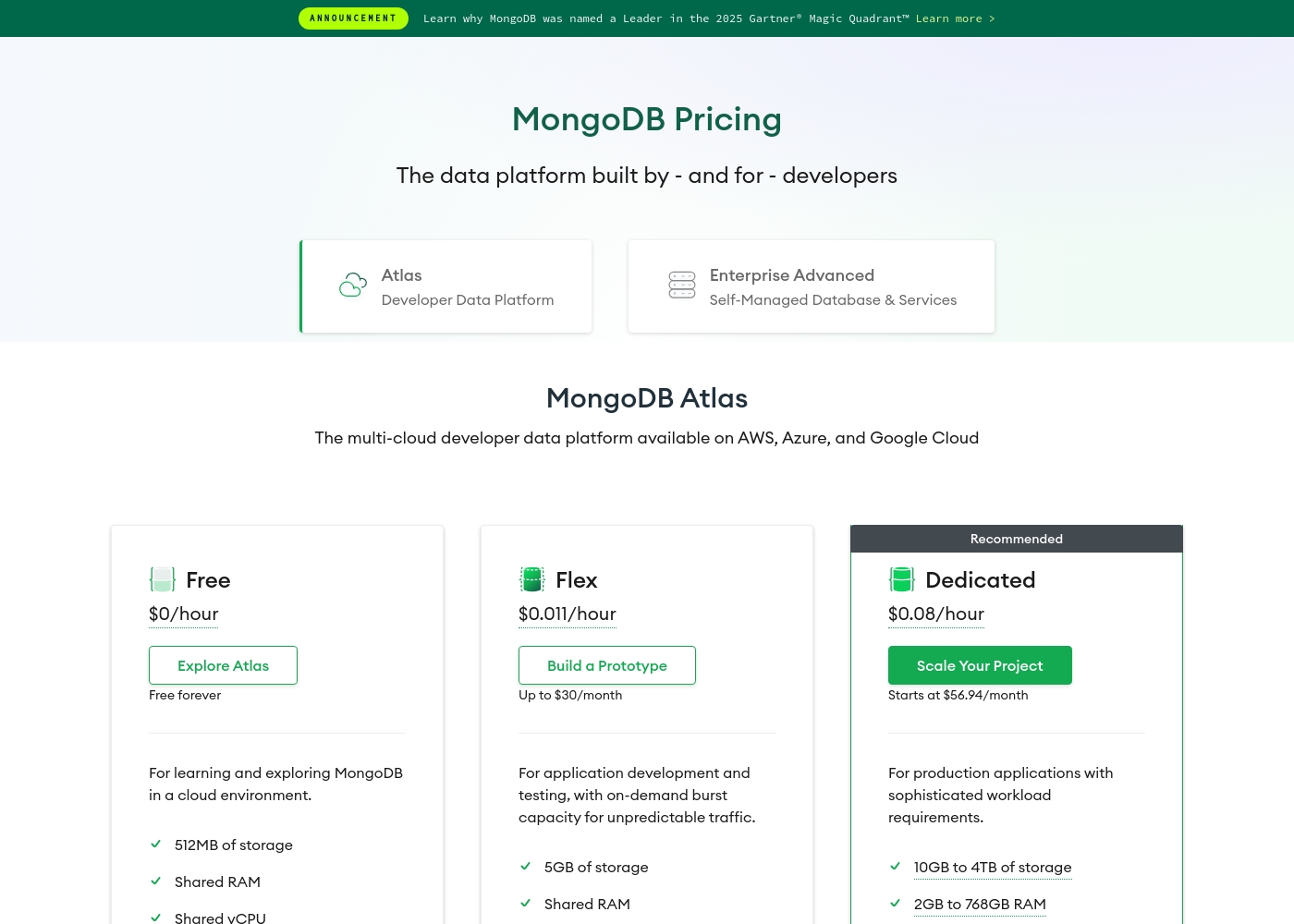
Pricing Notes
- Google Cloud offers $300 in free credits for new customers, while MongoDB has a free-forever tier.
- Google Cloud's technical support is extremely expensive, costing up to $12,500 per month.
- MongoDB's costs scale with cluster resources (storage, RAM, vCPUs), which can escalate quickly.
- Both platforms use usage-based pricing, making it hard to predict costs without careful monitoring.
- Google Cloud provides committed use discounts up to 57% for predictable workloads.
Pricing Head-to-Head
รีวิวจากผู้ใช้
ความคิดเห็นภายนอก ซึ่งบันทึกไว้เป็นหลักโดย Trustpilot นั้นเป็นไปในเชิงลบอย่างท่วมท้น ส่งผลให้คะแนนรวมต่ำมากที่ 1.5 ดาว ประเด็นที่ถูกกล่าวถึงบ่อยที่สุดเกี่ยวข้องกับ การเรียกเก็บเงินที่ไม่โปร่งใส และการสนับสนุนลูกค้าที่ทำงานไม่ได้อย่างสิ้นเชิง ⚠️ ผู้ใช้รายงานค่าใช้จ่ายที่ไม่คาดคิด บางครั้งสูงถึงหลายร้อยดอลลาร์ แม้ว่าจะมีเครดิตฟรีจำนวนมากอยู่ก็ตาม หลายคนรู้สึกว่าการขาดความโปร่งใสนี้เป็น "กับดักที่จงใจ" ซึ่งออกแบบมาสำหรับผู้ใช้ใหม่ นอกจากนี้ การขอความช่วยเหลือแทบจะเป็นไปไม่ได้ ผู้ใช้บรรยายว่าการสนับสนุนถูกซ่อนไว้และเข้าถึงไม่ได้โดยสิ้นเชิง ทำให้พวกเขาต้องติดอยู่ในวงวนที่ไม่รู้จบ ผู้ที่ต้องการความช่วยเหลือด้านเทคนิคต้องเผชิญกับค่าธรรมเนียมที่สูงเกินจริง โดยการสนับสนุนทางเทคนิคเฉพาะทางมีค่าใช้จ่ายสูงถึงหลายพันดอลลาร์ต่อเดือน
นอกเหนือจากการจัดการต้นทุนแล้ว ผู้ใช้ได้ตำหนิเรื่อง ความง่ายในการใช้งาน ที่ต่ำ โดยมีการร้องเรียนว่าคอนโซล "ช้าจนใช้งานไม่ได้" และกระบวนการสำหรับงานง่าย ๆ เช่น การดึงคีย์ API ต้องการการคลิกที่มากเกินไป ผู้ใช้ยังประสบปัญหาในการจัดการบัญชีที่สำคัญ เช่น การลบโปรเจกต์ที่ใช้งานอยู่ซึ่งยังคงสร้างค่าธรรมเนียม หรือการอัปเดตข้อมูลการเรียกเก็บเงิน สิ่งนี้บ่งชี้อย่างชัดเจนว่าแม้ว่าแพลตฟอร์มจะมีประสิทธิภาพทางเทคโนโลยี แต่ประสบการณ์ของผู้ใช้ การดูแลระบบ และการควบคุมทางการเงินโดยรอบนั้นมีข้อบกพร่องอย่างร้ายแรง
บัญชีของฉันถูกเรียกเก็บเงินเป็นค่าใช้จ่าย API 327 ยูโร แม้ว่าฉันจะมีเครดิตฟรี 264 ยูโรอยู่แต่ก็ไม่ได้ถูกนำไปใช้ การสนับสนุนถูกซ่อนไว้และเข้าถึงไม่ได้โดยสิ้นเชิง ทำให้ดูเหมือนเป็นกับดักที่จงใจ แพลตฟอร์มนี้มีโครงสร้างราคาที่ไม่โปร่งใสอย่างยิ่ง
Based on the external review sources, we couldn't access specific user snippets due to verification errors on both Trustpilot and Capterra. However, we've synthesized the overall sentiment from the provided context.
Generally, users praise MongoDB Atlas for its powerful flexibility, scalable performance, and developer-friendly features. Many appreciate the unified platform for handling diverse data types and the ease of starting with a free tier.
MongoDB's flexibility is a game-changer for our agile team. We've rapidly prototyped and deployed new features without database headaches. The scalability gives us peace of mind.
คำตัดสินของเรา
This isn't a simple apples-to-apples comparison. Google Cloud is the full cloud platform. MongoDB is the specialized data platform. Google Cloud's superpower is its sheer scale. It offers everything from world-class AI with Vertex AI to massive analytics with BigQuery. It's your partner for the entire infrastructure stack. MongoDB's superpower is data unification. It seamlessly blends operational data, vector search, and streaming into one system. This simplifies building complex, data-rich applications dramatically. The deciding factor is your core need. If you need a comprehensive cloud foundation, Google Cloud is the answer. If your biggest challenge is managing and querying diverse application data, MongoDB is your tool. For a startup building from scratch, Google Cloud provides the full toolkit. For a team trying to make their app's data layer smarter and faster, MongoDB delivers targeted power.
คำถามที่พบบ่อย
Which is better for small teams: Google Cloud or MongoDB?
MongoDB often wins for small teams focused on their app's database. Its free-forever tier and focused interface are easier to start with. Google Cloud's $300 credit is generous, but its platform can feel overwhelming.
Does Google Cloud have a database like MongoDB?
Yes, Google Cloud offers Firestore and Cloud Datastore as document databases. They serve similar use cases to MongoDB. However, MongoDB's core platform is built entirely around this document model and its associated features.
Is MongoDB worth the extra cost over Google Cloud?
It's not about extra cost, but about value for your specific need. MongoDB's cost is for a specialized data platform. Google Cloud's costs are for a broad infrastructure suite. If you only need a powerful database, MongoDB's pricing can be more predictable.
Can I use Google Cloud and MongoDB together?
Yes, absolutely. You can run MongoDB Atlas as a managed service on Google Cloud infrastructure. This is a common pattern, combining Google's infrastructure with MongoDB's specialized database.
Which is easier to learn for a developer?
Many developers find MongoDB's document model and query API more intuitive initially. Google Cloud requires learning a vast array of services and concepts. The learning curves serve different goals: app development vs. infrastructure management.
Which platform is better for AI applications?
It depends on the AI task. For training custom models at scale, Google Cloud's Vertex AI is more powerful. For adding semantic search or AI features to an app using your existing data, MongoDB's native vector search is simpler.
พร้อมที่จะเลือกแล้วหรือยัง?
ทั้งสองเครื่องมือมีจุดแข็งของตัวเอง เลือกตามความต้องการเฉพาะของคุณ