Demodesk เทียบกับ MongoDB
Demodesk and MongoDB solve completely different problems. Demodesk automates sales conversations and coaching. MongoDB is a powerful cloud database platform for building applications.
Best for: Sales teams overwhelmed with admin tasks, Managers needing better conversation visibility
Best for: Developers building modern, scalable applications, Teams needing a unified platform for database, search, and streams
AI-powered sales efficiency with a learning curve.
We found Demodesk offers a promising AI-driven solution to automate sales admin and provide conversation insights. Its core value lies in freeing up time for revenue-generating activities. However, our assessment is limited by a lack of accessible external user reviews to validate its real-world impact on support, reliability, and overall value for money. Overall, it's a compelling tool for teams focused on automating workflows, but further due diligence on user feedback is recommended before committing.
ข้อดี
- Automates note-taking, follow-up emails, and CRM updates.
- Provides personalized coaching feedback after calls.
- Captures and analyzes conversations from various channels, not just formal meetings.
- Offers AI agents for building autonomous sales workflows.
ข้อเสีย
- Specifics on integration reliability and depth are unclear without user reviews.
- Ease of use and onboarding experience are unverified externally.
- Pricing beyond the starting tier and its value perception are unknown.
- No accessible user feedback on customer support responsiveness.
Powerful, flexible platform for modern data.
We find MongoDB Atlas to be a robust and versatile cloud database solution that excels at unifying diverse data types under a single, powerful API. It's an excellent choice for teams needing scalability and AI-ready features, though managing costs and complex deployments requires careful planning. Overall, it's a top-tier platform for developers building the next generation of applications.
ข้อดี
- Excellent flexibility with its document model.
- Powerful, unified platform for databases, search, and streaming.
- Strong scalability and high availability guarantees.
- Native vector search integration for AI applications.
ข้อเสีย
- Costs can escalate quickly with high usage and dedicated resources.
- Advanced features and configurations can have a steep learning curve.
- Support responsiveness can be inconsistent for some users.
เกี่ยวกับDemodesk
✨ Demodesk is a platform with AI sales agents. It's built for sales teams and their managers. The AI listens to conversations, writes notes, and studies what was said. This gives you back your time and clear insights into every deal.
เกี่ยวกับMongoDB
💡 MongoDB Atlas is a comprehensive cloud data platform built for modern applications. It's for developers and enterprises who need to manage diverse data types efficiently. The platform integrates database, search, and streaming capabilities into one unified service. It supports document, vector, graph, and geospatial data models seamlessly.
ไฮไลต์
การเปรียบเทียบคุณสมบัติ
ภาพรวมคุณสมบัติ
เราเน้นความแตกต่างหลักและเลือกผู้ชนะสำหรับแต่ละคุณสมบัติ
Core Functionality
Demodesk is an AI sales agent. MongoDB is a comprehensive cloud database platform.
Demodesk focuses on automating sales conversations. It records calls, writes notes, and sends follow-up emails. MongoDB provides a full database service. It handles operational data, vector search, and real-time streams. The key difference is domain. Demodesk is for sales productivity. MongoDB is for application development.
AI & Automation
Demodesk uses AI for sales coaching. MongoDB offers AI features for data applications.
Demodesk's AI listens to sales calls. It provides personalized coaching feedback and automates CRM updates. MongoDB integrates native vector search. This lets developers build AI apps like recommendation engines. Demodesk's AI is end-user focused. MongoDB's AI is for developers building features.
Data Handling
MongoDB is a flexible data platform. Demodesk stores conversation data.
MongoDB excels at managing diverse data. It supports documents, vectors, graphs, and geospatial data. Demodesk captures and transcribes conversation data. This data feeds its coaching and insights engine. MongoDB is the underlying data infrastructure. Demodesk is an application that uses data.
Scalability
Both scale, but for different resources.
Demodesk scales with team size and workflow runs. Pricing includes usage-based packages for automation. MongoDB scales data storage and compute power. It offers dedicated clusters for high performance. Demodesk scales your sales team's output. MongoDB scales your application's data needs.
Ease of Use
Demodesk targets sales users. MongoDB targets developers.
Demodesk is designed for sales reps. It automates tasks they find tedious, like note-taking. MongoDB requires technical knowledge. Developers and DevOps manage clusters and queries. Each tool is easy for its intended user. Misalignment creates a steep learning curve.
Integration Ecosystem
Demodesk integrates with sales tools. MongoDB connects to developer infrastructure.
Demodesk connects to CRMs and communication tools. It integrates with workflows sales teams already use. MongoDB integrates with over 100 technologies. This includes cloud services, data pipelines, and BI tools. Demodesk's integrations are sales-specific. MongoDB's are broad and technical.
Mobile Experience
Demodesk captures mobile conversations. MongoDB management is primarily web/API.
Demodesk allows capturing conversations from your phone. This is crucial for spontaneous sales chats. MongoDB Atlas is managed via a web console and command-line tools. It's not a mobile app for data entry. Demodesk has a direct mobile use case. MongoDB does not.
Customer Support
Support details are unclear for both.
Demodesk mentions priority support on its Enterprise plan. Specifics on responsiveness are not detailed. MongoDB's support varies by tier. Dedicated clusters may include enhanced support options. Without clear SLAs or user reviews, it's hard to compare. Both offer contact options.
Value Proposition
Demodesk sells time saved. MongoDB sells platform power.
Demodesk's value is reducing sales admin work. It claims to free up hours each week for selling. MongoDB's value is unifying your data stack. It can eliminate complex, separate database systems. Demodesk offers a productivity gain. MongoDB offers an architectural advantage.
Learning Curve
Each has a learning curve for its target user.
Demodesk requires sales teams to adopt new conversation capture habits. The AI features are intuitive. MongoDB requires developers to learn its query language and data modeling patterns. The curve for Demodesk is about workflow change. For MongoDB, it's about technical skill.
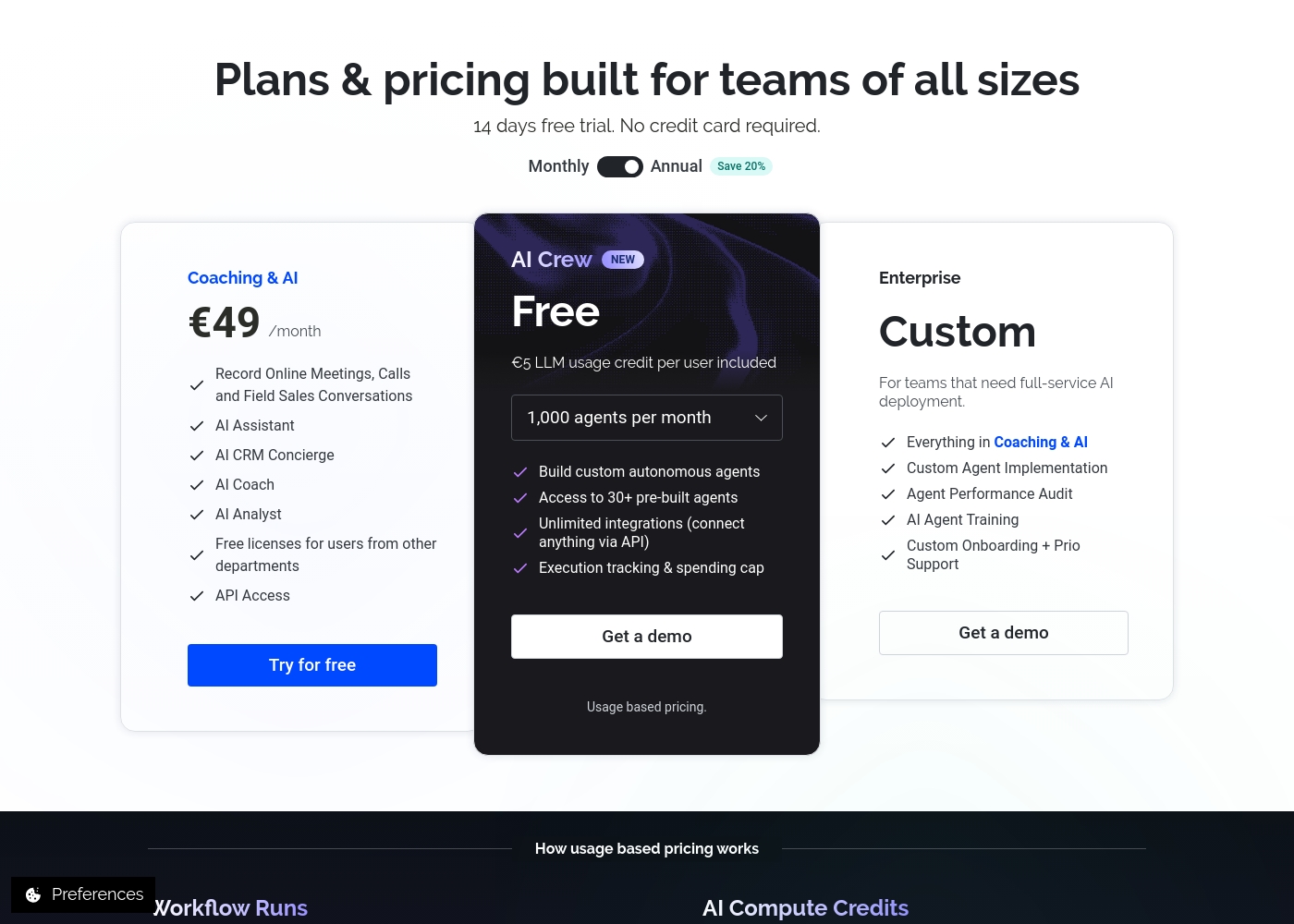
Demodesk pricing: Demodesk offers a flexible pricing model starting at €49/month per user, alongside a free AI Crew tier for building autonomous agents. The platform scales based on feature requirements and usage-based workflow runs.
building autonomous agents. The platform scales based on feature requirements and usage-based workflow runs.
building autonomous agents. The platform scales based on feature requirements and usage-based workflow runs.
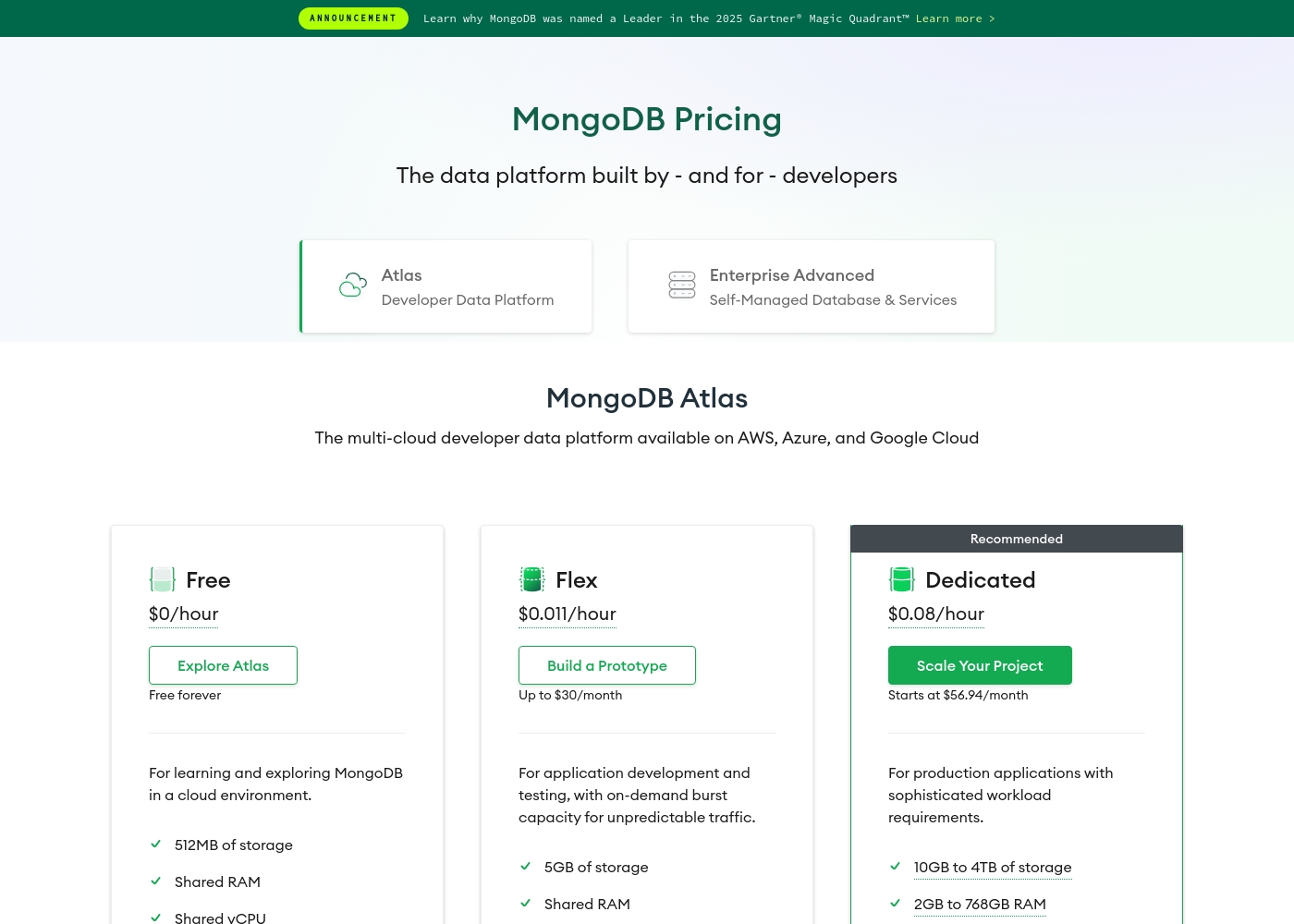
MongoDB pricing: MongoDB offers a range of cloud database options starting with a free-forever tier and scaling to dedicated resources for production environments. Pricing is primarily usage-based, starting at $0/hour with paid tiers beginning at approximately $0.011/hour and $0.08/hour for advanced workloads.
Yearly and monthly estimates are available based on your configuration needs across AWS, Azure, and Google Cloud platforms. Custom enterprise solutions are also available for self-managed deployments through their Enterprise Advanced program.
Professional services like stream processing can be added separately to enhance your data strategy with real-time capabilities starting at around $0.06/hour per instance level SP2 or higher depending on your needs. Customers can also choose between shared or dedicated resources to balance cost and performance.
Pricing Notes
- Demodesk's paid Coaching & AI plan is €49 per user monthly.
- MongoDB's paid tiers start around $0.011/hour for Flex and $0.08/hour for Dedicated clusters.
- Both offer free starting points, but cost structures are fundamentally different.
- MongoDB costs can escalate significantly with increased data and compute usage.
Pricing Head-to-Head
รีวิวจากผู้ใช้
Based on our review of external sources, we were unable to access user reviews on Trustpilot or Capterra for Demodesk. The Capterra link returned a security error, preventing us from gathering specific sentiment on accuracy, ease of use, support, or pricing.
Without accessible review data, we cannot synthesize a balanced external summary at this time. We recommend checking these platforms directly for the latest user feedback.
We reviewed Demodesk's website and found a clear focus on automating sales admin. The promise of capturing conversations anywhere is strong, but without user reviews, we can't confirm how well it delivers. The AI agents feature is intriguing for advanced workflows.
Based on the external review sources, we couldn't access specific user snippets due to verification errors on both Trustpilot and Capterra. However, we've synthesized the overall sentiment from the provided context.
Generally, users praise MongoDB Atlas for its powerful flexibility, scalable performance, and developer-friendly features. Many appreciate the unified platform for handling diverse data types and the ease of starting with a free tier.
MongoDB's flexibility is a game-changer for our agile team. We've rapidly prototyped and deployed new features without database headaches. The scalability gives us peace of mind.
คำตัดสินของเรา
This isn't a close fight. Demodesk and MongoDB are tools for entirely different jobs. Choosing between them is like comparing a sports car to a freight train. Demodesk's superpower is automating sales busywork. It listens to your calls, writes the notes, and sends the follow-ups. It's built to give sales reps their time back. MongoDB's superpower is being a versatile data powerhouse. It unifies databases, search, and real-time streams into one platform. It's built for developers to scale applications. The deciding factor is your problem. If your team dreads CRM updates, Demodesk helps. If your app needs a flexible, scalable database, MongoDB is the answer. Choose Demodesk if you're a sales leader trying to boost team productivity. Choose MongoDB if you're a developer building the next big app. They operate in different worlds.
คำถามที่พบบ่อย
Are Demodesk and MongoDB competitors?
No. They serve different purposes. Demodesk is an AI sales agent for conversation automation. MongoDB is a cloud database platform for application development.
Which is easier to set up: Demodesk or MongoDB?
Demodesk is likely simpler for a non-technical sales team. MongoDB Atlas requires more technical knowledge to configure clusters and queries properly.
Can I use Demodesk to store my application's database?
No. Demodesk stores conversation transcripts and sales data. It is not designed to be a general-purpose database for applications like MongoDB.
Does MongoDB offer AI features like Demodesk's coaching?
No. MongoDB offers AI features for developers, like vector search for building apps. Demodesk's AI coaching is specific to sales performance.
Which tool is better for a small startup?
It depends on your need. A sales-focused startup might use Demodesk to automate. A tech startup building an app would likely need MongoDB.
Is there a significant price difference?
Their pricing models differ. Demodesk has per-user fees. MongoDB's costs scale with data storage and compute usage. One isn't inherently cheaper.
พร้อมที่จะเลือกแล้วหรือยัง?
ทั้งสองเครื่องมือมีจุดแข็งของตัวเอง เลือกตามความต้องการเฉพาะของคุณ