Coast เทียบกับ Travel Code
Coast and Travel Code both tackle corporate expenses, but they serve very different teams. Coast is a smart card and platform for fleet fuel and field spending. Travel Code is a unified travel and expense system for mid-market finance teams. Picking between them comes down to whether you need to manage vehicles or manage business trips.
Smart fuel card, real control.
We found Coast to be a strong, unified solution for fleet-based businesses tired of juggling separate fuel and expense cards. It delivers powerful controls and real-time tracking that can genuinely cut down on admin and prevent fraud. Overall, it's a compelling choice for teams ready to consolidate their spending into one efficient platform.
ข้อดี
- All-in-one card for fuel, field, and office expenses simplifies tracking.
- Strong custom controls and telematics integrations help prevent fuel fraud.
- Real-time spending visibility and alerts for immediate oversight.
- Competitive fuel rebates and discounts at 30,000+ stations.
ข้อเสีย
- $4 monthly fee per active user can become significant for large teams.
- 2.5% fee on foreign transactions limits international use.
- Customer support responsiveness is inconsistent according to some users.
- Requires integrations with telematics/accounting software for maximum value.
Unified travel platform for modern finance.
We find Travel Code to be a solid, unified solution for companies looking to consolidate their travel, expense, and card management. It offers clear value through its single ledger and onboarding speed. Overall, it's a compelling option for mid-market teams aiming to replace multiple point solutions.
ข้อดี
- Unified platform for travel, expenses, and cards on a single ledger.
- Transparent, predictable flat-rate pricing without per-seat fees.
- Promises fast onboarding from legacy systems (around 9 days).
- Automated reconciliation and a dedicated tool for recovering unused credits.
ข้อเสีย
- External review data was unavailable, so user sentiment is unverified.
- Pricing may be less cost-effective for very small teams beyond the free tier.
- Dependence on a single vendor for core financial processes.
- The promised speed and savings may vary based on individual company complexity.
เกี่ยวกับCoast
Coast is an all-in-one fuel card, corporate card, and expense management platform built for businesses with fleets. It's designed to replace multiple card programs and manual processes, giving companies like landscaping, construction, and field service teams a single tool to control and track all their spending. The platform provides powerful fraud prevention, integrates with existing telematics and accounting software, and aims to help businesses save significantly on fuel and admin time.
เกี่ยวกับTravel Code
Travel Code is a unified corporate travel, expense, and card management platform. 🧳 It’s built for mid-market finance and travel teams who want to eliminate vendor sprawl and gain full visibility into spend. Think of it as your modern command center for all business travel.
ไฮไลต์
การเปรียบเทียบคุณสมบัติ
ภาพรวมคุณสมบัติ
เราเน้นความแตกต่างหลักและเลือกผู้ชนะสำหรับแต่ละคุณสมบัติ
Core Purpose
Coast is built for fleets. Travel Code is built for travel.
Coast's sole focus is giving businesses a single, smart card for all fleet-related spending—fuel, maintenance, and job supplies. It replaces multiple cards and manual expense tracking for field teams. Travel Code is a complete platform for booking, managing, and expensing all business travel. It aims to replace a legacy TMC, separate expense tool, and card program with one system. The key difference is scope. Coast is a specialized tool for controlling vehicle and field expenses. Travel Code is a broader system for managing the entire corporate travel lifecycle. If your team is mostly in the field with vehicles, Coast is purpose-built for that pain. If your team travels frequently for business, Travel Code solves a wider set of problems.
Expense Control
Coast locks cards by default for fraud prevention. Travel Code enforces policies during booking.
Coast cards are locked by default. You set custom rules per driver, vehicle, or category. Its killer feature is integrating with telematics like Samsara to block transactions if a vehicle isn't at a gas pump. Travel Code issues virtual cards with limits tied to specific trips or merchants. Its control happens earlier—during booking—by showing only policy-compliant options first and routing exceptions for approval. Coast prevents fraud after the fact at the point of sale. Travel Code prevents out-of-policy spending before it even happens. For a construction company worried about unauthorized fuel purchases, Coast's telematics integration is a game-changer. For a finance team trying to cut rogue travel spend, Travel Code's policy filter is essential.
Booking & Reconciliation
Travel Code offers full booking and AI-powered reconciliation. Coast focuses on syncing purchases.
Travel Code is a full booking engine for flights, hotels, and cars. It also uses AI with 99.2% accurate OCR to auto-match every receipt line to bookings, cards, and your general ledger. Coast doesn't handle travel bookings. Its reconciliation power comes from automating the sync of its own transactions to accounting software like QuickBooks, attaching digital receipts. Travel Code provides an end-to-end, auditable trail from trip booking to final reconciliation. Coast provides an efficient, automated feed for field-related purchases. A company organizing a leadership summit would use Travel Code for the entire process. A landscaping crew buying supplies at a job site would use Coast.
AI & Automation
Travel Code has proactive AI agents. Coast automates via integrations.
Travel Code features Robert, an AI assistant, and other background agents. They auto-rebook cheaper flights (RateGuard) and recover unused airline credits, saving companies an average of $24K per year. Coast's automation is focused on data flow. It automatically categorizes expenses and syncs receipts to your accounting system, cutting down manual data entry. Travel Code's AI actively works to save you money and answer questions. Coast's automation saves you admin time by streamlining your existing workflow. If your biggest pain is administrative overhead, Coast's integrations help. If your goal is to actively reduce travel spend and recover lost value, Travel Code's AI is unique.
Mobile Experience
Both offer mobile access. Coast's app gets mixed reviews for stability.
Travel Code provides a mobile app for managing cards, receipts, and approvals on the go, supporting its 24/7 in-platform support model. Coast offers a mobile app for managing card controls and seeing real-time transactions. Some user reviews note occasional app glitches and a desire for a more stable experience. While both have mobile apps, user feedback on Coast's app suggests there may be room for improvement in stability. For a field tech needing to unlock a card for a quick gas purchase, a stable app is crucial. The data suggests Travel Code might have a slight edge in user-reported mobile reliability.
Customer Support
Both offer responsive support. Coast is US-based; Travel Code offers 24/7 tiers.
Coast provides 100% US-based support and aims to solve issues on the first call. Some users report inconsistent responsiveness when issues arise. Travel Code includes 24/7 in-platform support on all plans. Higher-tier plans offer priority support and a dedicated account manager. Coast's support is US-focused. Travel Code offers structured support tiers with global availability. If having a US-based point of contact is critical, Coast delivers. If you need 24/7 access and potentially a dedicated manager, Travel Code's model offers more scaling options.
Security & Compliance
Travel Code has documented SOC 2 and GDPR compliance. Coast's security is focused on controls.
Travel Code is SOC 2 Type II and GDPR audited annually. It also holds IATA/ARC accreditation, important for a travel platform. Coast's security model is built around its locked-by-default cards and custom controls. It offers a $25,000 fraud guarantee when using advanced features. Travel Code provides formal, documented compliance certifications for enterprise procurement. Coast provides a strong fraud guarantee as part of its operational security. For a mid-market company with strict procurement requirements, Travel Code's compliance paperwork is a clear advantage. For a fleet worried about immediate fuel theft, Coast's fraud guarantee is a direct benefit.
Pricing Structure
Coast is pay-per-active-user. Travel Code offers a flat rate with a free tier.
Coast charges $4 per active user per month. You only pay for users who make at least one transaction, making it usage-based. Travel Code offers a free Starter plan and flat monthly plans ($85, $247) that support unlimited travelers. This makes costs predictable regardless of team size. Coast's cost scales directly with usage, which can be great for small teams but expensive for large ones. Travel Code's flat rate offers cost certainty. A startup with 5 drivers might prefer Coast's low entry point. A 500-person company might find Travel Code's flat rate far more predictable for budgeting.
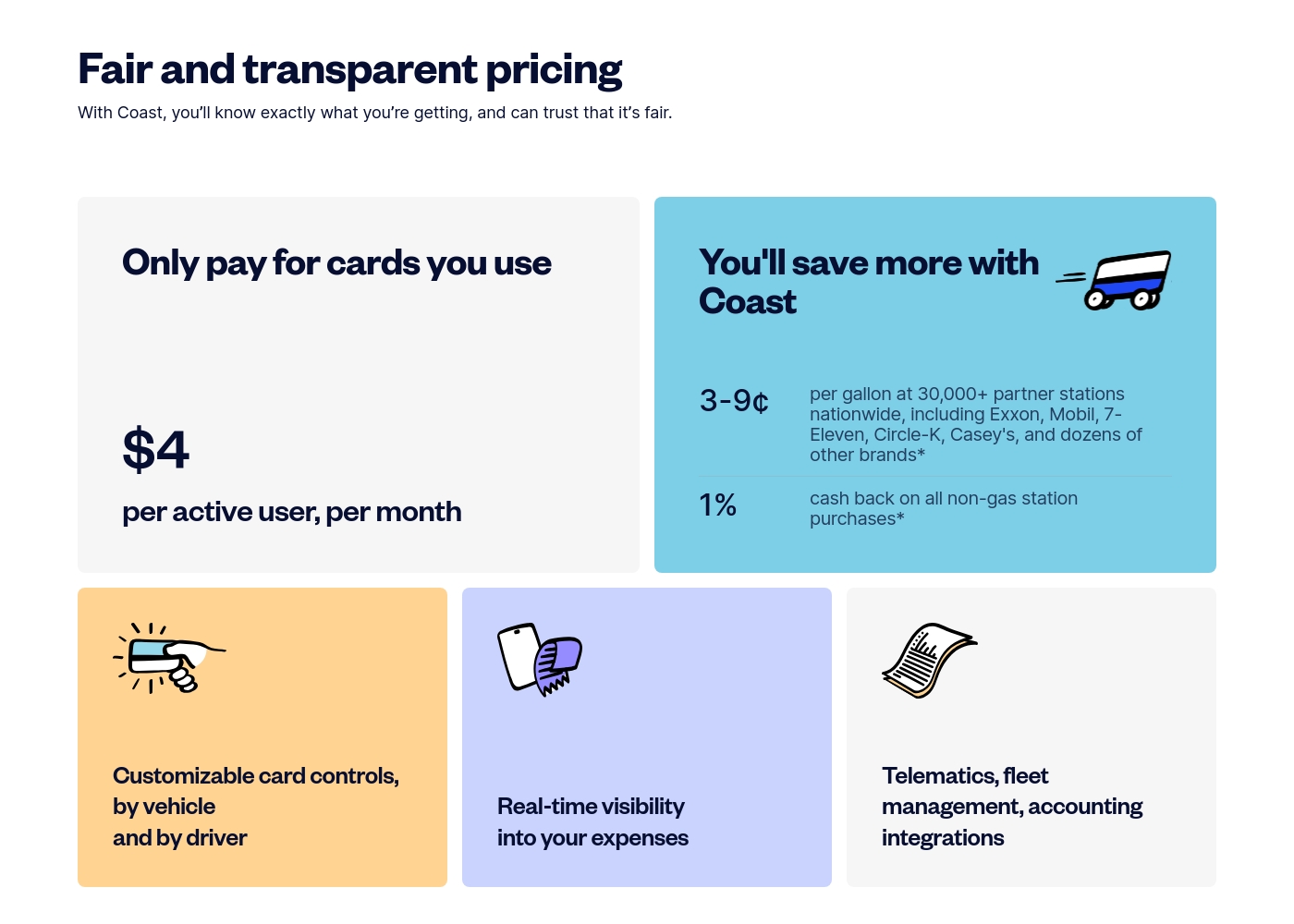
Coast costs $4 per active user per month with 1 plan: Coast Fleet & Fuel Card at $4 per active user per month.
Take a look at how our simple, usage-based model works for your team.
Coast Fleet & Fuel Card
Price: $4 per active user per month Websites Supported: Not explicitly stated Best For: Growing fleets needing fuel and expense management Refund Policy: Not explicitly stated Other Features: 3–9¢ fuel rebates per gallon, 1% cashback on non-gas purchases, customizable card controls, Visa acceptance everywhere, real-time expense visibility
- 3–9¢ per gallon rebates at 30,000+ partners
- 1% cash back on all non-gas station purchases
- Customizable card controls by vehicle and driver
- Real-time visibility into expenses
- Accounting and telematics integrations
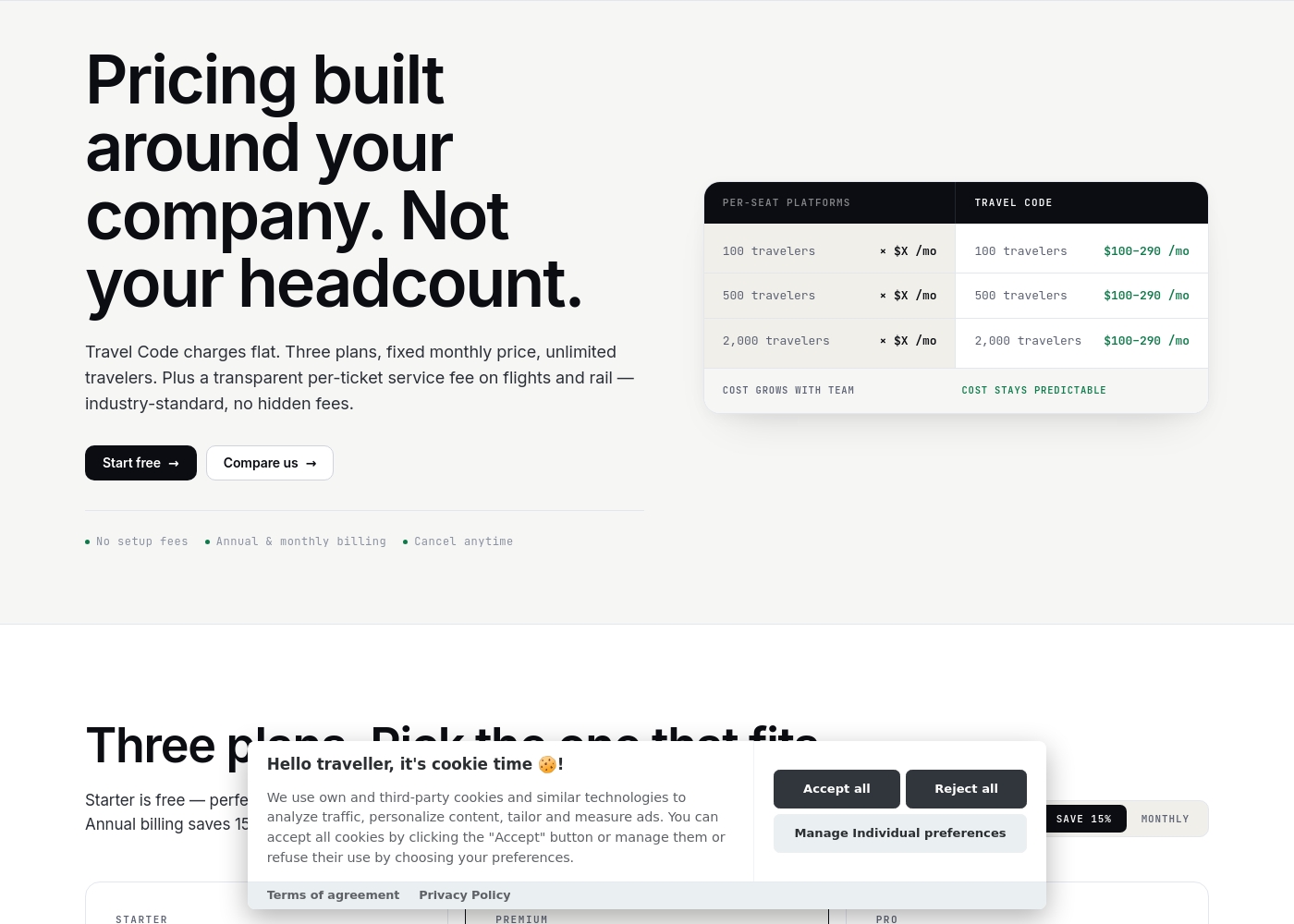
Travel Code pricing: Travel Code offers flat-rate monthly plans starting at $0 for small teams, with paid tiers at $85 and $247 per month on annual billing. Unlike per-seat models, these plans support unlimited travelers for a predictable fixed price plus transparent ticket service fees. Plans range: $0–$800/month Billing options: Free plan, Monthly subscription, Yearly subscription, Usage-based pricing
Pricing Notes
- Coast's cost is purely usage-based: $4 per user making a transaction. This can be very cost-effective for small, active teams.
- Travel Code offers a free Starter plan for small teams with basic features, which is a unique entry point.
- Travel Code's flat-rate pricing ($85-$247/mo) includes unlimited travelers, making budgeting simple for growing companies.
- Neither platform explicitly advertises a free trial or money-back guarantee in their provided data.
Pricing Head-to-Head
รีวิวจากผู้ใช้
We couldn't access detailed reviews from Capterra due to a security block. From Trustpilot, users praise Coast's easy setup and the real-time visibility it provides over fleet spending.
Many highlight the fuel rebates and the simplicity of having one card for all expenses. However, some note that customer support can be slow to resolve issues and that the $4 per user monthly fee adds up for larger teams.
Signing up was incredibly fast. The card gives me real-time notifications for every purchase, which is perfect for managing my crew's spending. The fuel rebates are a nice bonus that adds up.
We were unable to access specific user reviews from Trustpilot or Capterra due to a 403 error and a missing URL. This means we cannot synthesize a balanced external sentiment summary based on actual user feedback. Our assessment is therefore based solely on the provided website and pricing details. We advise checking these review sites directly for the latest user experiences.
คำตัดสินของเรา
Coast and Travel Code are both strong expense management platforms, but they're built for completely different missions. Coast's superpower is its laser focus on fleet and field expenses. It turns a single Visa card into a fraud-proof control center, especially when integrated with telematics like Samsara. Travel Code's superpower is its unified command center for business travel. It connects booking, expenses, and cards on one ledger, using AI to save money and automate reconciliation. The deciding factor is your team's primary headache. If it's unauthorized fuel purchases and juggling multiple field cards, Coast is your specialist. If it's managing business travel from booking to close, Travel Code is your all-in-one solution. For a landscaping crew, Coast is the clear choice. For a mid-market company's finance department, Travel Code delivers broader value. They solve similar problems in fundamentally different ways.
คำถามที่พบบ่อย
Which is better for small teams: Coast or Travel Code?
For a small team with vehicles, Coast's $4/user model is cost-effective. For a small team needing travel booking, Travel Code's free Starter plan is a great starting point.
Does Coast have travel booking like Travel Code?
No, Coast is focused purely on fuel and field expense management. Travel Code is a full corporate travel platform that handles flights, hotels, and car rentals.
Is Travel Code worth the extra cost over Coast?
It's not about extra cost, but different value. Travel Code's flat rate is ideal for mid-sized companies managing complex travel programs. Coast's per-user fee is better for fleet control.
Can I use Coast for regular business travel?
You can use the Coast card anywhere Visa is accepted. However, it lacks travel booking, policy enforcement, and reconciliation features designed for business travel.
How does the onboarding compare?
Coast can be approved in minutes, with cards shipping in 5-10 days. Travel Code typically migrates companies from legacy systems in about 9 days for a full setup.
Which has better mobile apps?
Both offer mobile apps. Some user reviews mention stability issues with Coast's app. Travel Code's mobile experience is part of its integrated platform.
พร้อมที่จะเลือกแล้วหรือยัง?
ทั้งสองเครื่องมือมีจุดแข็งของตัวเอง เลือกตามความต้องการเฉพาะของคุณ