Angels Partners เทียบกับ Assembly
Angels Partners and Assembly solve very different problems. One helps startups find investors, while the other helps service firms manage clients. Your choice depends entirely on your goal.
Solid tools for founder-led outreach.
We find Angels Partners offers a clear, community-focused platform for connecting founders with investors through secure document sharing and engagement tracking. Overall, it provides valuable structure for fundraising, though a lack of public reviews makes it hard to fully assess long-term reliability and user support.
ข้อดี
- Community-driven model helps founders get discovered by active investors.
- Secure document sharing with real-time engagement tracking and analytics.
- Multiple pricing tiers cater to different stages, from self-managed to fully supported.
- No equity taken on raised capital; subscription model with a free trial available.
ข้อเสีย
- No accessible external user reviews found for independent validation.
- Limited transparency on refund policies and specific platform limitations.
- Pricing can escalate quickly for higher tiers, which may strain early-stage budgets.
- Reliance on the community model may not suit founders preferring a more direct, algorithmic approach.
Solid all-in-one client portal
Overall, we find Assembly to be a strong, user-friendly platform for professional firms aiming to centralize client management and present a polished brand. It delivers on its core promise of a modern portal but may require consideration for specific integration needs or advanced customization.
ข้อดี
- Intuitive, modern interface that is easy for clients and staff to navigate.
- Comprehensive all-in-one platform replacing scattered emails, files, and invoices.
- Strong branding and white-labeling options, especially on higher-tier plans.
- Includes key features like invoicing, messaging, and eSignatures without add-ons.
ข้อเสีย
- Pricing escalates significantly for team seats and advanced features like HIPAA.
- Some users report navigation friction or layout issues when accessing specific features under time pressure.
- Integration options may require setup work if your specific software isn't listed.
- Not ideal for very simple or infrequent client interactions due to pricing structure.
เกี่ยวกับAngels Partners
Angels Partners is a platform built for startup founders and investors. It creates a space where founders can get discovered by an active investor community. At the same time, it provides tools for secure document sharing and engagement tracking. Think of it as a focused network for fundraising conversations and connections. 💡
เกี่ยวกับAssembly
💡 Assembly is a client portal and back-office platform for professional service firms. It's built for businesses in accounting, law, marketing, real estate, and tech. The goal is to replace clutter with a single, client-friendly hub.
ไฮไลต์
การเปรียบเทียบคุณสมบัติ
ภาพรวมคุณสมบัติ
เราเน้นความแตกต่างหลักและเลือกผู้ชนะสำหรับแต่ละคุณสมบัติ
Core Purpose
Angels Partners is a fundraising network. Assembly is a client management portal.
**Angels Partners** focuses on connecting founders with investors. You create a profile and get discovered by over 100,000 investors in its network. **Assembly** is built for professional service firms. It replaces scattered emails with a branded hub for client communication, files, and payments. The key difference is your goal. Angels Partners helps you raise capital. Assembly helps you manage and bill clients. A startup founder uses Angels Partners. A marketing agency or law firm uses Assembly.
User Interface
Assembly has a modern, praised interface. Angels Partners' UI is less documented.
**Angels Partners** provides tools for document sharing and tracking. The specific design and ease of use aren't highlighted in its review. **Assembly** users praise its modern, intuitive interface. Reviews on Capterra note it's quick to navigate and creates a strong first impression. Assembly clearly wins on design and user experience feedback. It's built to impress your clients. If a clean, client-facing look matters, Assembly is the proven choice.
Document Management
Angels Partners offers secure sharing with tracking. Assembly integrates files into the client portal.
**Angels Partners** lets you share pitch decks securely. You can use email or password protection and revoke access instantly. **Assembly** includes file sharing as part of its client portal. Clients upload and download documents directly in their branded hub. Angels Partners gives you more control over sensitive fundraising docs. Assembly makes file exchange routine and centralized. Choose based on what you're sharing: confidential investor materials or routine client deliverables.
Analytics & Reporting
Angels Partners tracks investor engagement. Assembly tracks client activity.
**Angels Partners** provides detailed analytics for shared documents. You see open rates, view duration, and click activity in real-time. **Assembly** uses AI to help organize client data. You get a timeline view of every interaction, contract, and invoice. Angels Partners' analytics are specific to fundraising interest. Assembly's are for ongoing client relationship health. The tool with better analytics depends entirely on whether you're gauging investor or client engagement.
Collaboration
Angels Partners has a founder community. Assembly is built for team collaboration.
**Angels Partners** offers a free Founder Community. You can connect with peers and exchange warm investor introductions. **Assembly** is designed for team collaboration on client accounts. You can assign tasks and see shared client timelines. The collaboration models are completely different. One is peer-to-peer for fundraising. The other is internal for service delivery. Pick Angels Partners for fundraising support. Pick Assembly for team-based client work.
Security & Compliance
Assembly offers enterprise security and HIPAA compliance. Angels Partners focuses on document protection.
**Angels Partners** focuses on document security with password protection and access revocation. **Assembly** offers enterprise-grade security. This includes SOC2, and the Advanced plan provides HIPAA compliance with a signed BAA. Assembly has a much deeper, certified security posture. This is critical for healthcare, legal, or financial firms. If you handle regulated client data, Assembly's compliance features are essential.
Scalability
Angels Partners scales via pricing tiers. Assembly scales via user seats and client limits.
**Angels Partners** scales by moving to higher-priced plans like Prime or Managed. This increases your contact limits and support level. **Assembly** scales by adding team seats ($39-$59 each) and moving to plans with unlimited clients. The Starter plan limits you to 50 clients. Angels Partners scales with your fundraising intensity. Assembly scales with your business headcount and client volume. Your growth path is different: more fundraising activity vs. more team members and clients.
Customer Support
Assembly details clear support tiers. Angels Partners' support is plan-dependent but less detailed.
**Angels Partners** offers 'Priority Support' on higher plans. Specific response times or an SLA aren't stated. **Assembly** has clear support levels. The Advanced plan includes priority call support, and Enterprise gets a dedicated success manager. Assembly provides more transparent and likely more robust support for scaling teams. Its support structure is a clear selling point. For predictable, high-touch support, Assembly's tiered model is easier to evaluate.
Angels Partners pricing: Angels Partners offers subscription-based plans starting at $79/month billed annually, designed to help founders connect with over 100,000 investors. They provide a range of tiers from self-managed tools to a fully managed fundraising account.
- Basic Plan: $79/mo (Annual)
- Boost Plan: $119/mo (Annual)
- Prime Plan: $329/mo (Annual)
- Managed Account: $599/mo (Annual)
A 7-day free trial is available for new users.

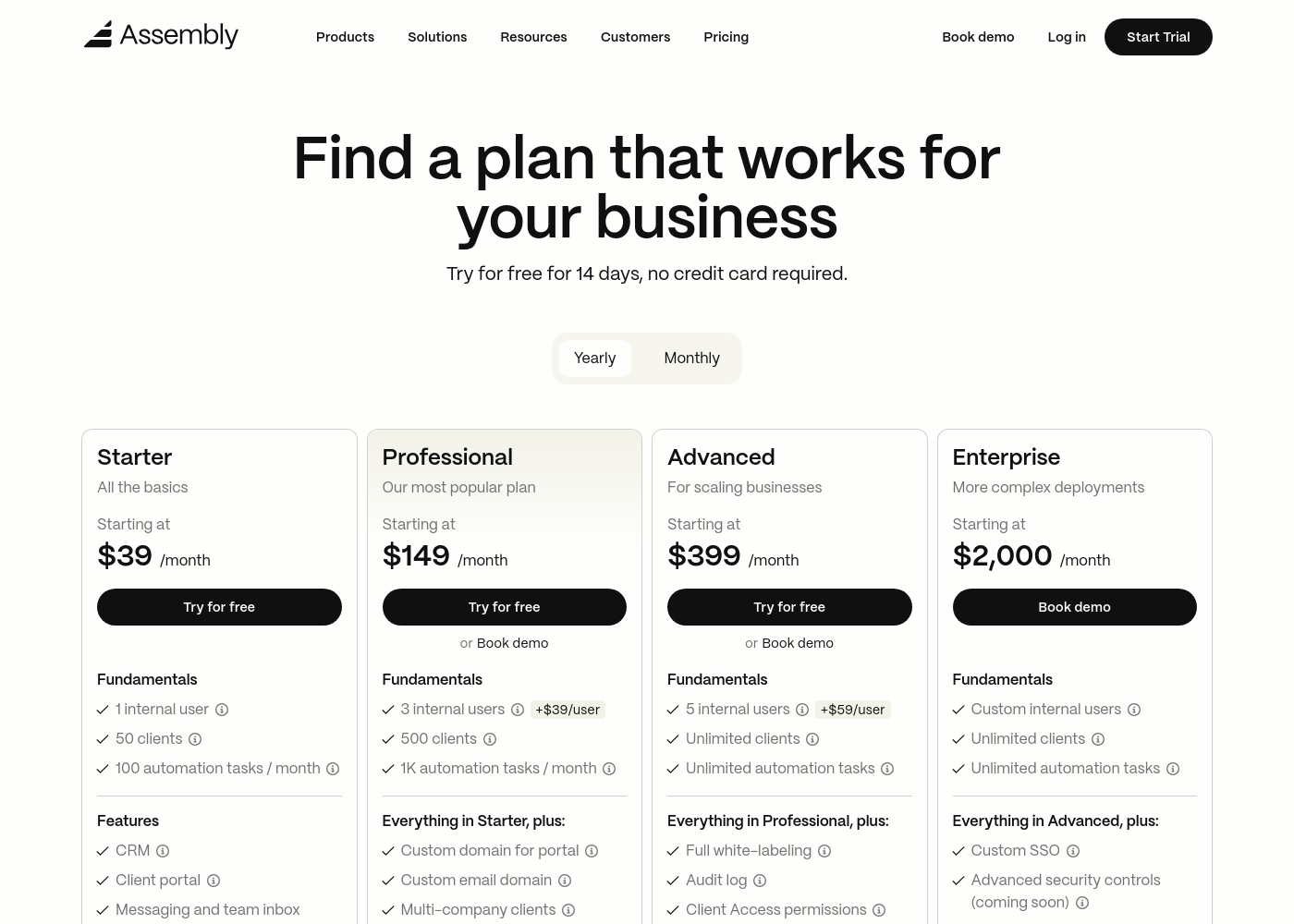
Assembly costs between $39 and $2,000 per month with 4 plans: Starter at $39, Professional at $149, Advanced at $399, and Enterprise at $2,000.
Take a look at the feature breakdown for each tier below.
Starter
Price: $39 / month Websites Supported: Not explicitly stated Best For: Solo entrepreneurs and small service providers Refund Policy: 30-day satisfaction guarantee Other Features: CRM, white-labeled client portal, messaging, invoicing, and task management.
- CRM
- Client portal
- Messaging & inbox
- Invoices & pay links
- Proposals & contracts
- Custom domain
- API & Zapier/Make
- Multi-company clients
- Low payment fees
- Full white-labeling
- Audit log
- HIPAA compliance
- Client access permissions
- Custom SSO
- Sandbox workspace
- Dedicated success manager
- Technical advisor
Pricing Notes
- Angels Partners offers a 7-day free trial. Assembly offers a 14-day free trial plus a 30-day satisfaction guarantee.
- Angels Partners has a free Founder Community tier. Assembly has no free long-term plan.
- Angels Partners' price jumps from $329 to $599 for a Managed Account. Assembly's price jumps from $399 to $2,000 for Enterprise.
- Assembly charges extra for additional team seats (e.g., $39/user on Professional). Angels Partners is a flat per-plan subscription.
- Neither platform takes equity or success fees on capital raised or payments processed.
- Angels Partners offers deep discounts for annual billing (33% off). Assembly also offers annual billing options.
Pricing Head-to-Head
รีวิวจากผู้ใช้
We couldn't access any substantive user reviews for Angels Partners during our research. The Trustpilot link returned a 403 Forbidden error, and no Capterra profile was found.
This means we have no external sentiment to balance our website-based assessment. We recommend checking these platforms again later or seeking direct references from current users to gauge real-world satisfaction with accuracy, support, and overall value.
From our research on Trustpilot and Capterra, users consistently praise Assembly for its modern, intuitive interface and the ease with which it centralizes client communication. The platform is frequently described as a clean, all-in-one hub that simplifies operations.
However, some users on Capterra note occasional friction in navigation under time pressure and desire more robust customization. Support responsiveness and the value of included features like invoicing and portals are highlighted as major positives, while pricing for higher tiers is seen as a consideration for scaling firms.
Assembly's interface is quick to navigate and simple to operate. It has been great for keeping our client recognition tasks organized in one place without a steep learning curve.
คำตัดสินของเรา
There's no single winner here. These tools solve completely different problems. Angels Partners is your fundraising co-pilot. Its superpower is connecting you with 100,000+ investors and showing you exactly who's engaging with your pitch deck. You get discovery, secure sharing, and community. Assembly's superpower is transforming your client experience. It replaces scattered emails with a modern, branded portal. You get a unified hub for files, invoices, signatures, and billing. The deciding factor is your goal. If you need to raise capital, Angels Partners is purpose-built. If you need to manage and impress clients, Assembly is the all-in-one solution. Choose Angels Partners if you're a startup founder. Choose Assembly if you run a professional service firm.
คำถามที่พบบ่อย
Which is better for small teams: Angels Partners or Assembly?
It depends on the type of team. Angels Partners is for startup founding teams. Assembly is for service firm teams. A small accounting firm picks Assembly. A small startup picks Angels Partners.
Does Angels Partners have invoicing like Assembly?
No. Angels Partners does not include invoicing or billing tools. Its focus is purely on fundraising and investor engagement. Assembly includes built-in invoicing and payment links.
Is Assembly worth the extra cost over Angels Partners?
They serve different markets, so cost isn't directly comparable. Assembly starts cheaper at $39/month but costs more at scale with per-seat fees. Angels Partners starts at $79/month. Value depends on your specific need.
Can I migrate from Angels Partners to Assembly easily?
No, because they do completely different jobs. You wouldn't migrate from one to the other. You would choose Angels Partners for fundraising and Assembly for client management.
Which platform has better customer support?
Assembly provides clearer support tiers, including a dedicated success manager for large firms. Angels Partners mentions priority support on higher plans but lacks details. Assembly's offering appears more robust.
Do these tools integrate with QuickBooks or other accounting software?
Assembly offers API and Zapier integrations on higher plans, which could connect to accounting tools. Angels Partners does not mention any integrations. Check Assembly's integrations list for specifics.
พร้อมที่จะเลือกแล้วหรือยัง?
ทั้งสองเครื่องมือมีจุดแข็งของตัวเอง เลือกตามความต้องการเฉพาะของคุณ