MongoDB vs Volza
MongoDB and Volza solve completely different problems, making this a fascinating comparison. MongoDB is a cloud data platform for developers building apps. Volza is a specialized database of global trade shipment records and contacts. The right choice depends entirely on whether you need a database for your software or market intelligence for your business.
Best for: Software developers building new applications, Teams needing a scalable cloud database backend
Best for: Exporters and importers finding new business contacts, Trade analysts researching global market trends
Powerful, flexible platform for modern data.
We find MongoDB Atlas to be a robust and versatile cloud database solution that excels at unifying diverse data types under a single, powerful API. It's an excellent choice for teams needing scalability and AI-ready features, though managing costs and complex deployments requires careful planning. Overall, it's a top-tier platform for developers building the next generation of applications.
Плюсы
- Excellent flexibility with its document model.
- Powerful, unified platform for databases, search, and streaming.
- Strong scalability and high availability guarantees.
- Native vector search integration for AI applications.
Минусы
- Costs can escalate quickly with high usage and dedicated resources.
- Advanced features and configurations can have a steep learning curve.
- Support responsiveness can be inconsistent for some users.
Solid data core, review access blocked.
We found Volza to be a comprehensive platform offering verified global trade data and contact details, backed by a money-back guarantee. However, our independent review is significantly limited by the inability to access any user reviews from Trustpilot or Capterra, preventing a full assessment of real-world sentiment on support, pricing, and ease of use.
Плюсы
- Offers verified contact details for decision-makers.
- Covers a vast database of 203 countries.
- Provides a 100% money-back guarantee.
- Features ready-to-use dashboards for analysis.
Минусы
- Actual user feedback could not be retrieved for review.
- Specific pricing details are not publicly listed.
- The true value proposition remains unverified by external reviews.
ОMongoDB
💡 MongoDB Atlas is a comprehensive cloud data platform built for modern applications. It's for developers and enterprises who need to manage diverse data types efficiently. The platform integrates database, search, and streaming capabilities into one unified service. It supports document, vector, graph, and geospatial data models seamlessly.
ОVolza
Volza is the world's leading trade data platform. 🌍 It offers a massive, continuously updated database of global import and export shipments. Designed for exporters, importers, and trade analysts, it transforms raw shipment records into actionable business intelligence. Think of it as your personal detective for international commerce.
Основные моменты
Сравнение функций
Обзор функций
Мы выделяем основные различия и выбираем победителя для каждой функции.
Core Purpose
MongoDB is a cloud database for your apps. Volza is a database of global trade shipments.
MongoDB Atlas is a managed cloud platform where you store and query your own application data. It supports documents, vectors, and streams. It's the backend for software you build. Volza is a pre-built database containing import/export shipment records. It provides verified contact information for businesses involved in trade. It's a source of market intelligence you consume. The key difference is ownership: MongoDB holds your data, while Volza provides you with data. Your choice depends on whether you need a system to build on or information to act upon.
Data Model & Flexibility
MongoDB offers ultimate flexibility for your data. Volza has a fixed, specialized trade data model.
MongoDB uses a flexible document model (BSON/JSON). You define your own schema. This means you can store any structure your app needs, from user profiles to product catalogs. Volza's data model is fixed. It structures trade data with fields like HS codes, shipper/consignee, and shipment values. You query this predefined structure. MongoDB's flexibility is its superpower for developers. Volza's specialization makes its trade data instantly usable and consistent.
Scalability & Performance
MongoDB scales to millions of users. Volza handles billions of records for fast querying.
MongoDB guarantees millisecond response times at scale. It can support applications with millions of users and massive datasets with 99.99% availability. Volza's infrastructure is built to handle billions of records and millions of platform visits. It provides high-speed querying for instant access to specific shipment data. Both scale impressively for their domains. MongoDB scales for application workloads, while Volza scales for the volume of global trade information.
AI & Analytics Capabilities
MongoDB has built-in AI tools. Volza offers pre-made trade dashboards.
MongoDB includes native vector search for building semantic search and AI apps. You can also run complex aggregations and analytics directly on your operational data in real-time. Volza provides ready-to-use dashboards for analyzing trade trends, top products, and market indicators. The analytics are specialized for import/export patterns. MongoDB gives you the tools to build custom analytics. Volza delivers pre-baked insights for trade analysis. One is a toolkit, the other is a finished report.
Contact & Lead Generation
Volza provides verified business contacts. MongoDB does not.
Volza is designed to help you find and connect with decision-makers. It provides verified phone numbers, email addresses, and LinkedIn profiles for import/export businesses. MongoDB is a database platform. It does not provide business contact information or lead generation features. This is a clear, category-defining feature for Volza. If finding trade contacts is your goal, MongoDB isn't even in this competition.
Ease of Setup
Volza is plug-and-play for data lookup. MongoDB requires app integration.
With Volza, you sign up, search, and get trade data and contacts. The platform is ready to use for market research immediately after creating an account. With MongoDB, you set up a cluster and then integrate it into your application code. You need to design your data model and queries. Volza is a tool you use. MongoDB is infrastructure you build with. The learning curve is fundamentally different.
Pricing & Guarantees
MongoDB has a free tier but complex costs. Volza offers a money-back guarantee.
MongoDB starts with a free-forever tier (512MB). Paid plans are usage-based, with costs scaling for storage and compute. This can lead to unpredictable bills if not monitored. Volza offers a free trial and then subscription plans. Its key promise is a 100% money-back guarantee and no double-charges for data. MongoDB's model suits unpredictable scaling. Volza's guarantee reduces risk for a focused, predictable expense.
Support & Community
Volza promises 24/7 support. MongoDB's support varies by plan.
Volza highlights its 'fanatical' 24/7 dedicated customer support team. This is a core part of its value proposition for trade professionals. MongoDB offers tiered support options. Dedicated clusters include enhanced support, but responsiveness can vary based on the plan and issue. For always-on help, Volza makes a stronger commitment. MongoDB's support is more typical of a cloud platform.
MongoDB pricing: MongoDB offers a range of cloud database options starting with a free-forever tier and scaling to dedicated resources for production environments. Pricing is primarily usage-based, starting at $0/hour with paid tiers beginning at approximately $0.011/hour and $0.08/hour for advanced workloads.
Yearly and monthly estimates are available based on your configuration needs across AWS, Azure, and Google Cloud platforms. Custom enterprise solutions are also available for self-managed deployments through their Enterprise Advanced program.
Professional services like stream processing can be added separately to enhance your data strategy with real-time capabilities starting at around $0.06/hour per instance level SP2 or higher depending on your needs. Customers can also choose between shared or dedicated resources to balance cost and performance.
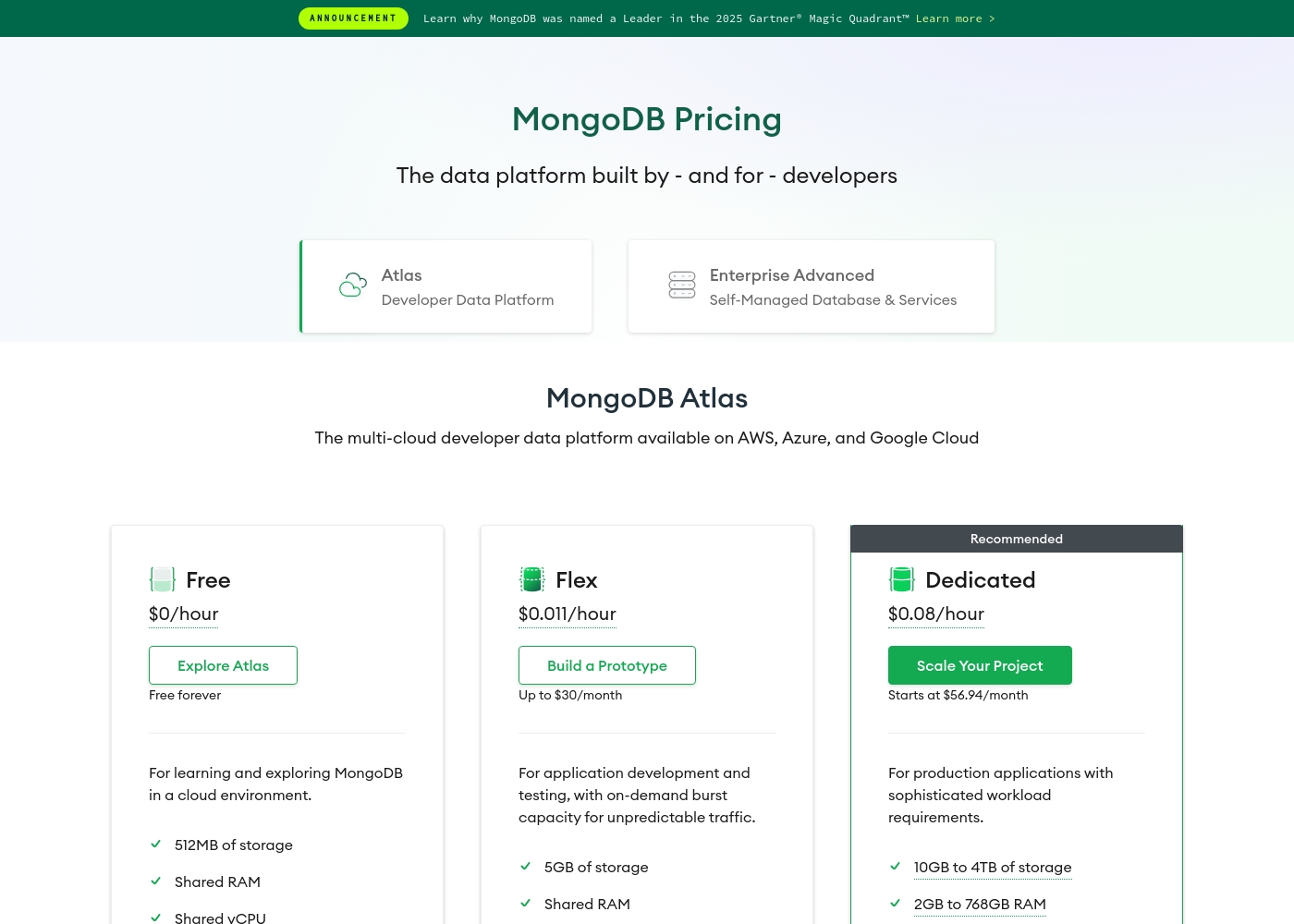
Take a look at the specific features and the secure guarantee offered below.
Volza Subscription
Best For: Exporters and importers needing verified global trade leads. Refund Policy: 100% money-back guarantee Other Features: Verified contact details for decision makers, 203 country coverage, dash-to-use dashboards, 24/7 fanatical support.
This subscription is designed for trade professionals who need consistent, legal-grade accuracy for market research. It's a great fit if you're looking to outmaneuver competitors by finding hidden suppliers or buyers in underrepresented regions.
- Access to 203 countries
- Over 3 billion shipment records
- Verified contact details (Phone, Email, LinkedIn)
- Ready-to-use dashboards
- 24/7 dedicated support
Pricing Notes
- MongoDB has a clear 'free forever' tier, making it easy to start prototyping.
- MongoDB's costs are usage-based and can scale unpredictably with high resource consumption.
- Volza's exact subscription prices are not listed publicly, requiring a quote.
- Volza offers a strong 100% money-back guarantee, reducing financial risk.
- Volza has a 'no double-charge' policy for downloaded data records.
Pricing Head-to-Head
Отзывы пользователей
Based on the external review sources, we couldn't access specific user snippets due to verification errors on both Trustpilot and Capterra. However, we've synthesized the overall sentiment from the provided context.
Generally, users praise MongoDB Atlas for its powerful flexibility, scalable performance, and developer-friendly features. Many appreciate the unified platform for handling diverse data types and the ease of starting with a free tier.
MongoDB's flexibility is a game-changer for our agile team. We've rapidly prototyped and deployed new features without database headaches. The scalability gives us peace of mind.
We could not access any substantive user reviews from Trustpilot or Capterra for this analysis. The provided snippets indicate that both platforms were protected by security verification pages or returned errors, preventing the retrieval of specific user feedback, ratings, or recurring themes like accuracy, ease of use, support, or pricing. Therefore, a balanced summary combining external sentiment cannot be formulated from the given inputs.
Наш вердикт
There's no single winner here—it's like comparing a smartphone to a telescope. MongoDB and Volza serve entirely different masters. Your choice comes down to one simple question: Are you building a tool, or are you looking for information? MongoDB's superpower is being the ultimate foundation for modern apps. It combines a flexible database, AI-ready vector search, and real-time streaming into one platform. If you're a developer building the next big SaaS product, this is your powerhouse backend. Volza's superpower is delivering instant, verified global trade intelligence. It turns billions of shipment records into actionable contacts and insights. If you're in international business, this is your detective for finding buyers, suppliers, and market trends. The deciding factor is your role. Pick MongoDB if you write code and need to manage data for an application. Pick Volza if you manage trade operations and need external data to make business decisions. They solve problems on opposite sides of the business-tech divide. Final verdict: Choose MongoDB Atlas if you're a developer or team building scalable, data-driven applications. Choose Volza if you're a trade professional, sales team, or business analyst needing global import/export data and verified contacts. They're not competitors; they're specialists for completely different jobs.
Часто задаваемые вопросы
Can I use MongoDB to find trade data like Volza?
No. MongoDB is a database platform for storing your own application data. It does not contain pre-built global trade or shipment records. You would need to source that data elsewhere and build an app with MongoDB to analyze it.
Is Volza a database I can use for my own app?
No. Volza is a specialized trade intelligence platform. You query its database for market research and contacts, but you cannot use it as a backend database for your own software application like MongoDB.
Which is cheaper for a small business?
It depends entirely on your need. For a software project, MongoDB's free tier is unbeatable. For finding international leads, Volza's trial and money-back guarantee may offer better risk-free value for a trade business.
Does Volza offer a free tier like MongoDB?
Volza offers a free trial, but not a permanent 'free forever' tier like MongoDB's 512MB plan. The trial lets you explore the platform before committing to a paid subscription.
Can I migrate data from MongoDB to Volza?
This wouldn't make sense. They are fundamentally different systems. MongoDB holds your app's data; Volza provides external trade data. You wouldn't migrate between them; you might use both for different purposes.
Which has better customer support?
Volza prominently advertises 24/7 dedicated support as a key feature. MongoDB offers tiered support options, with responsiveness varying by plan. For always-on help, Volza makes the stronger promise.
Готовы выбрать?
Оба инструмента имеют свои сильные стороны. Выбирайте в соответствии с вашими конкретными потребностями.