Google Cloud vs MongoDB
Choosing between Google Cloud and MongoDB can be tough. One is a massive cloud infrastructure provider, while the other is a specialized data platform. Here's how to decide which one fits your project.
Infraestrutura Poderosa, Faturação e Suporte Arriscados.
Reconhecemos que o Google Cloud oferece infraestrutura líder, oferecendo integração poderosa de IA e escalabilidade significativa para cargas de trabalho empresariais. No entanto, o alto volume de relatórios que detalham suporte ao cliente inacessível e faturação confusa e não transparente é profundamente preocupante. No geral, vemos esta plataforma como de alto risco para utilizadores que priorizam ajuda responsiva ou controlo granular de custos.
Prós
- Acesso a ferramentas de IA generativa de topo como Gemini e Vertex AI.
- Suporta estratégias de desenvolvimento de código aberto, multicloud e híbridas.
- Novos utilizadores recebem 300 $ em créditos gratuitos ao se inscreverem.
- Oferece poupanças potenciais de até 57% através de descontos de utilização comprometida.
Contras
- O suporte ao cliente é frequentemente inacessível e oculto.
- Os utilizadores relatam faturação não transparente e cobranças inesperadas, apesar de terem créditos.
- Custos extremamente altos para subscrições de suporte técnico (até 12.500 $/mês).
- A falta de limites de gastos rígidos para serviços de pagamento por utilização é um problema comum.
Powerful, flexible platform for modern data.
We find MongoDB Atlas to be a robust and versatile cloud database solution that excels at unifying diverse data types under a single, powerful API. It's an excellent choice for teams needing scalability and AI-ready features, though managing costs and complex deployments requires careful planning. Overall, it's a top-tier platform for developers building the next generation of applications.
Prós
- Excellent flexibility with its document model.
- Powerful, unified platform for databases, search, and streaming.
- Strong scalability and high availability guarantees.
- Native vector search integration for AI applications.
Contras
- Costs can escalate quickly with high usage and dedicated resources.
- Advanced features and configurations can have a steep learning curve.
- Support responsiveness can be inconsistent for some users.
SobreGoogle Cloud
O Google Cloud é uma plataforma de computação em nuvem abrangente que oferece mais de 150 produtos e capacidades. Ajuda as empresas a modernizar a infraestrutura existente ou a construir aplicações totalmente novas orientadas por IA a partir do zero. O serviço é concebido para programadores, líderes empresariais e startups prontos para crescer e se transformar digitalmente.
Novos clientes podem experimentar o Google Cloud com uso gratuito de mais de 20 produtos. Além disso, receberá 300 $ em créditos gratuitos ao se inscrever para ajudar na sua exploração. 💡
SobreMongoDB
💡 MongoDB Atlas is a comprehensive cloud data platform built for modern applications. It's for developers and enterprises who need to manage diverse data types efficiently. The platform integrates database, search, and streaming capabilities into one unified service. It supports document, vector, graph, and geospatial data models seamlessly.
Destaques
Comparação de recursos
Visão Geral de Recursos
Destacamos as principais diferenças e escolhemos um vencedor para cada recurso.
Core Purpose
Google Cloud is a vast cloud infrastructure platform. MongoDB is a specialized data platform.
Google Cloud offers over 150 products. You can run everything from VMs to AI models. It's like renting a supercomputer. MongoDB Atlas focuses on your data layer. It manages your database, search, and streams. It's like having a dedicated, expert DBA. The difference is scope vs. specialization. Google Cloud provides the entire toolbox. MongoDB excels at one critical tool. For a startup building a full app, Google Cloud provides the foundation. For a team optimizing a data-heavy feature, MongoDB is targeted.
AI & Data Analytics
Google Cloud has massive AI/ML and analytics suites. MongoDB has native vector search for AI apps.
Google Cloud's Vertex AI and BigQuery are industry leaders. You can build models with 200+ foundation models. BigQuery runs petabyte-scale analytics. MongoDB's strength is unifying data and vectors. You can store operational data and embeddings together. This simplifies building AI features like semantic search. Google Cloud offers a broader, more complex AI platform. MongoDB makes specific AI workflows simpler. One is a comprehensive lab, the other a focused workbench. Choose Google Cloud for custom model training. Choose MongoDB for integrating AI into your existing app's data flow.
Database Flexibility
Google Cloud offers multiple managed databases. MongoDB offers one highly flexible document database.
Google Cloud provides Cloud SQL, Spanner, Firestore, and more. You pick the right tool for each job. This can mean managing multiple systems. MongoDB uses a single document model for all data. The same API handles operational, graph, and geospatial data. This reduces context switching. Google Cloud gives you specialized databases. MongoDB gives you one versatile database. It's the difference between a Swiss Army knife and a full workshop. For apps with diverse data types in one service, MongoDB is seamless. For needing different database engines, Google Cloud has options.
Real-time Processing
Google Cloud uses multiple services for streams. MongoDB has integrated stream processing.
Google Cloud handles streams with Dataflow, Pub/Sub, and others. It's powerful but requires configuring separate services. This adds architectural complexity. MongoDB Atlas Stream Processing is built in. You use the same query language for streams and batches. This creates a unified developer experience. Google Cloud offers more scalable, global streaming. MongoDB offers simplicity and integration. One is built for massive scale, the other for developer velocity. For processing Kafka streams alongside your app data, MongoDB is simpler. For global, high-throughput event processing, Google Cloud has dedicated tools.
Ease of Getting Started
Both have generous free tiers. Google Cloud has a steeper initial learning curve.
Google Cloud gives $300 in credits and 20+ free products. However, its console can feel slow and complex. New users report difficulty with simple tasks. MongoDB offers a free-forever tier with 512 MB. The Atlas interface is focused and generally intuitive. Many developers find its document model natural. Google Cloud's scale means more to learn upfront. MongoDB's focus makes its core product more approachable. One is a sprawling city, the other a well-organized campus. Your choice depends on your role. A cloud architect might embrace Google Cloud's scope. An app developer might prefer MongoDB's streamlined data focus.
Cost Management
Google Cloud offers committed discounts but billing can be unclear. MongoDB costs scale with resource usage.
Google Cloud's pricing is usage-based with potential for 57% savings. Users complain about non-transparent billing and unexpected charges. Support for cost limits is a pain point. MongoDB's costs scale with storage and compute hours. Users note costs can escalate quickly with high usage. Monitoring your usage is crucial in both cases. Google Cloud has more discount levers but more billing complexity. MongoDB's model is simpler but can surprise you. Both require vigilant monitoring. For predictable, committed workloads, Google Cloud's discounts help. For variable workloads, MongoDB's pay-as-you-go is straightforward.
Customer Support
Google Cloud support is expensive and hard to reach. MongoDB support is included in paid tiers.
Google Cloud's technical support can cost up to $12,500/month. Free users report support is hidden and nearly impossible to contact. This is a major frustration. MongoDB's Dedicated tiers include enhanced support. Users report mixed experiences but availability is better. SLAs are tied to your pricing tier. Google Cloud's paid support is enterprise-grade but costly. MongoDB's included support is more accessible for mid-market. The difference in accessibility is stark. If you're a large enterprise, Google Cloud's support might be justified. For smaller teams, MongoDB's included support is a significant advantage.
Vendor Lock-in Risk
Google Cloud promotes multicloud. MongoDB is an open-source based platform.
Google Cloud actively supports hybrid and multicloud strategies. They offer tools to manage apps across clouds. This reduces lock-in to their specific infrastructure. MongoDB's core is open source. You can run it on-premise or other clouds. Atlas is a managed service on AWS, Azure, and GCP. Google Cloud sells infrastructure flexibility. MongoDB sells data portability. Both address lock-in from different angles. If you fear infrastructure lock-in, Google Cloud's stance is reassuring. If you fear data lock-in, MongoDB's open-source core is a plus.
Os custos do Google Cloud variam amplamente, uma vez que utiliza uma estrutura de pagamento baseada na utilização, oferecendo a novos clientes 300 $ em créditos gratuitos e acesso a mais de 20 produtos gratuitos.
Não encontrará planos mensais fixos aqui, mas sim três formas flexíveis de utilizar os recursos computacionais da plataforma.
Pagamento por utilização (Preço Padrão)
Preço: Não indicado explicitamente (Baseado na utilização) Sites Suportados: Não indicado explicitamente Melhor Para: Organizações de todas as dimensões que necessitam de escalabilidade flexível Política de Reembolso: Não indicada explicitamente Outras Funcionalidades:
- Paga apenas pelos serviços que usa.
- Sem taxas iniciais ou taxas de rescisão.
- Poupanças potenciais de até 57% com descontos de utilização comprometida.
- Inclui suporte de faturação 24/7 gratuito.
- Pague apenas pelos serviços que utiliza
- Sem taxas iniciais ou taxas de rescisão
- Poupança de até 57% com descontos de utilização comprometida
- Suporte de faturação 24/7 gratuito
- 300 $ em créditos gratuitos
- Acesso a mais de 20 produtos gratuitamente
- Executar, testar e implementar cargas de trabalho
- Até 350.000 $ em créditos de Cloud
- Suporte e soluções personalizadas
- Suporte de escalabilidade para empresas inovadoras
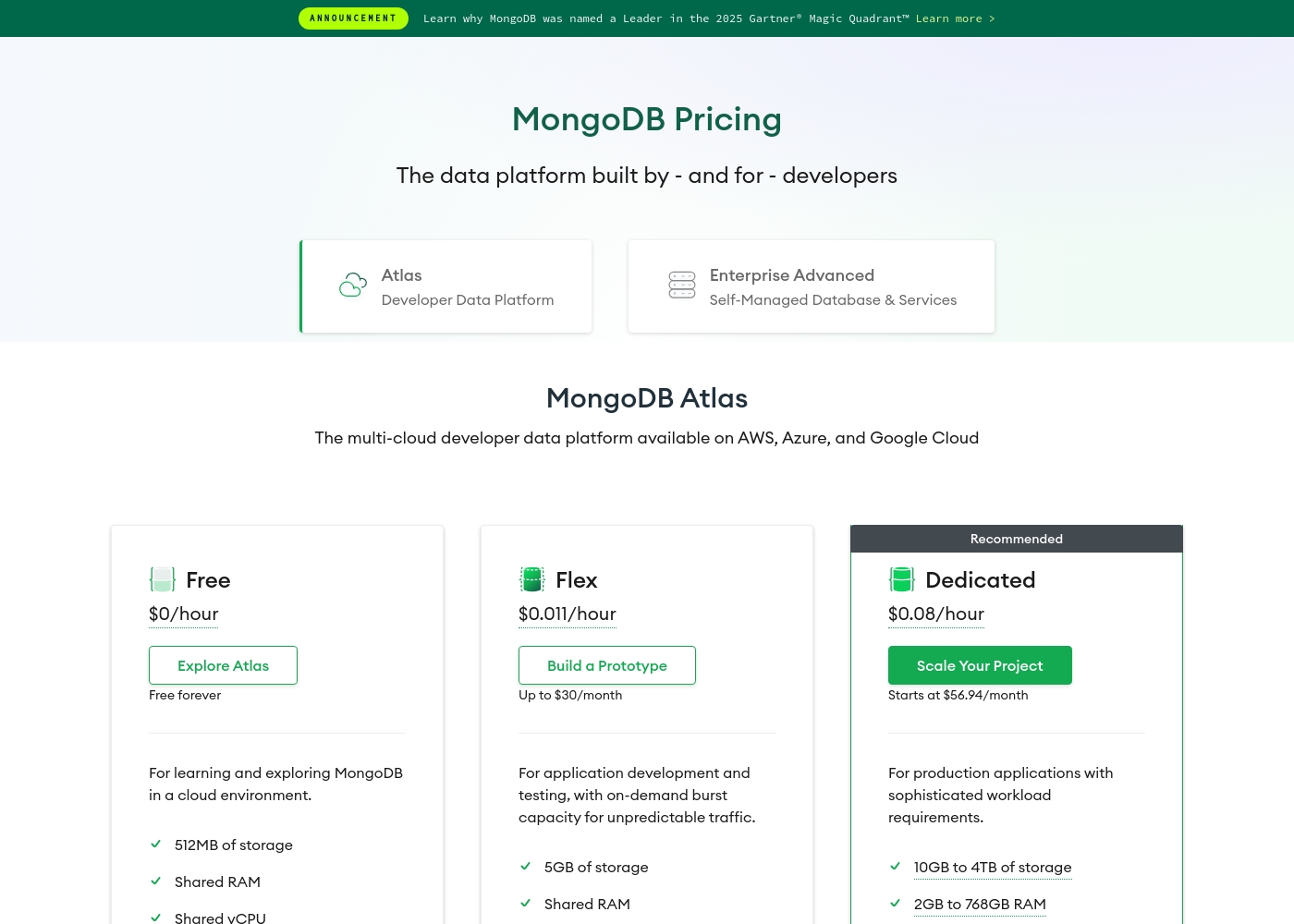
MongoDB pricing: MongoDB offers a range of cloud database options starting with a free-forever tier and scaling to dedicated resources for production environments. Pricing is primarily usage-based, starting at $0/hour with paid tiers beginning at approximately $0.011/hour and $0.08/hour for advanced workloads.
Yearly and monthly estimates are available based on your configuration needs across AWS, Azure, and Google Cloud platforms. Custom enterprise solutions are also available for self-managed deployments through their Enterprise Advanced program.
Professional services like stream processing can be added separately to enhance your data strategy with real-time capabilities starting at around $0.06/hour per instance level SP2 or higher depending on your needs. Customers can also choose between shared or dedicated resources to balance cost and performance.
Pricing Notes
- Google Cloud offers $300 in free credits for new customers, while MongoDB has a free-forever tier.
- Google Cloud's technical support is extremely expensive, costing up to $12,500 per month.
- MongoDB's costs scale with cluster resources (storage, RAM, vCPUs), which can escalate quickly.
- Both platforms use usage-based pricing, making it hard to predict costs without careful monitoring.
- Google Cloud provides committed use discounts up to 57% for predictable workloads.
Pricing Head-to-Head
Avaliações de usuários
O sentimento externo, capturado principalmente pelo Trustpilot, é esmagadoramente negativo, resultando numa classificação muito fraca de 1,5 estrelas. As questões mais citadas giram em torno da faturação não transparente e de um suporte ao cliente absolutamente disfuncional ⚠️. Os utilizadores relatam cobranças inesperadas, por vezes totalizando centenas de dólares, mesmo quando possuem créditos gratuitos substanciais. Muitos sentem que esta falta de transparência é uma "armadilha deliberada" concebida para novos utilizadores. Além disso, obter ajuda é quase impossível; os utilizadores descrevem o suporte como intencionalmente oculto e inalcançável, enviando-os para loops frustrantes e infinitos. Aqueles que necessitam de ajuda técnica enfrentam taxas exorbitantes, com o suporte técnico especializado a custar milhares íngremes por mês.
Além da gestão de custos, os utilizadores criticam a baixa facilidade de utilização. As queixas incluem a consola ser "inutilizavelmente lenta" e o processo para tarefas simples, como obter uma chave de API, exigir cliques excessivos. Os utilizadores também têm dificuldades com funções importantes de gestão de contas, como a eliminação de projetos ativos que continuam a gerar taxas ou a atualização de informações de faturação. Isto indica fortemente que, embora a plataforma seja tecnologicamente poderosa, a experiência geral do utilizador, administração e controlo financeiro são gravemente falhos.
A minha conta incorreu em custos de API de 327 €, mesmo tendo 264 € em créditos gratuitos disponíveis que não foram utilizados. O suporte está completamente oculto e impossível de alcançar, parecendo uma armadilha deliberada. Esta plataforma tem uma estrutura de preços extremamente não transparente.
Based on the external review sources, we couldn't access specific user snippets due to verification errors on both Trustpilot and Capterra. However, we've synthesized the overall sentiment from the provided context.
Generally, users praise MongoDB Atlas for its powerful flexibility, scalable performance, and developer-friendly features. Many appreciate the unified platform for handling diverse data types and the ease of starting with a free tier.
MongoDB's flexibility is a game-changer for our agile team. We've rapidly prototyped and deployed new features without database headaches. The scalability gives us peace of mind.
Nosso veredicto
This isn't a simple apples-to-apples comparison. Google Cloud is the full cloud platform. MongoDB is the specialized data platform. Google Cloud's superpower is its sheer scale. It offers everything from world-class AI with Vertex AI to massive analytics with BigQuery. It's your partner for the entire infrastructure stack. MongoDB's superpower is data unification. It seamlessly blends operational data, vector search, and streaming into one system. This simplifies building complex, data-rich applications dramatically. The deciding factor is your core need. If you need a comprehensive cloud foundation, Google Cloud is the answer. If your biggest challenge is managing and querying diverse application data, MongoDB is your tool. For a startup building from scratch, Google Cloud provides the full toolkit. For a team trying to make their app's data layer smarter and faster, MongoDB delivers targeted power.
Perguntas Frequentes
Which is better for small teams: Google Cloud or MongoDB?
MongoDB often wins for small teams focused on their app's database. Its free-forever tier and focused interface are easier to start with. Google Cloud's $300 credit is generous, but its platform can feel overwhelming.
Does Google Cloud have a database like MongoDB?
Yes, Google Cloud offers Firestore and Cloud Datastore as document databases. They serve similar use cases to MongoDB. However, MongoDB's core platform is built entirely around this document model and its associated features.
Is MongoDB worth the extra cost over Google Cloud?
It's not about extra cost, but about value for your specific need. MongoDB's cost is for a specialized data platform. Google Cloud's costs are for a broad infrastructure suite. If you only need a powerful database, MongoDB's pricing can be more predictable.
Can I use Google Cloud and MongoDB together?
Yes, absolutely. You can run MongoDB Atlas as a managed service on Google Cloud infrastructure. This is a common pattern, combining Google's infrastructure with MongoDB's specialized database.
Which is easier to learn for a developer?
Many developers find MongoDB's document model and query API more intuitive initially. Google Cloud requires learning a vast array of services and concepts. The learning curves serve different goals: app development vs. infrastructure management.
Which platform is better for AI applications?
It depends on the AI task. For training custom models at scale, Google Cloud's Vertex AI is more powerful. For adding semantic search or AI features to an app using your existing data, MongoDB's native vector search is simpler.
Pronto para escolher?
Ambas as ferramentas têm seus pontos fortes. Escolha com base nas suas necessidades específicas.