DataHawk vs MongoDB
DataHawk and MongoDB both handle data, but they solve very different problems. DataHawk is a specialized e-commerce analytics dashboard. MongoDB is a full-scale cloud database platform. Your choice depends entirely on whether you're analyzing sales or building an app.
Best for: E-commerce brands selling on Amazon and Walmart, Marketing agencies managing multiple seller accounts
Best for: Software developers building new applications, Companies needing a scalable, managed database
Powerful Analytics, But Opaque Pricing
We see DataHawk as a strong contender for businesses needing a unified, AI-powered view of their ecommerce data. The platform promises to simplify complex analytics. Overall, it appears capable, but the custom pricing model and lack of public reviews are key considerations for potential buyers.
Prós
- Unifies data from multiple marketplaces into one dashboard.
- Includes AI-guided insights to uncover performance opportunities.
- Designed for ease of use, reducing manual data work.
- Scalable platform with features like daily alerts.
Contras
- Pricing is entirely custom and not publicly disclosed.
- Requires booking a demo for any cost information.
- No standard or transparent monthly/annual rates listed.
- Limited public user reviews make independent validation difficult.
Powerful, flexible platform for modern data.
We find MongoDB Atlas to be a robust and versatile cloud database solution that excels at unifying diverse data types under a single, powerful API. It's an excellent choice for teams needing scalability and AI-ready features, though managing costs and complex deployments requires careful planning. Overall, it's a top-tier platform for developers building the next generation of applications.
Prós
- Excellent flexibility with its document model.
- Powerful, unified platform for databases, search, and streaming.
- Strong scalability and high availability guarantees.
- Native vector search integration for AI applications.
Contras
- Costs can escalate quickly with high usage and dedicated resources.
- Advanced features and configurations can have a steep learning curve.
- Support responsiveness can be inconsistent for some users.
SobreDataHawk
DataHawk is a unified analytics platform for ecommerce. 🎯 It combines data from different sources into one place. The system uses artificial intelligence to help you understand your performance better. It’s designed for ecommerce businesses that want clearer, smarter insights.
SobreMongoDB
💡 MongoDB Atlas is a comprehensive cloud data platform built for modern applications. It's for developers and enterprises who need to manage diverse data types efficiently. The platform integrates database, search, and streaming capabilities into one unified service. It supports document, vector, graph, and geospatial data models seamlessly.
Destaques
Comparação de recursos
Visão Geral de Recursos
Destacamos as principais diferenças e escolhemos um vencedor para cada recurso.
Core Purpose
DataHawk analyzes e-commerce sales. MongoDB stores and powers your entire application.
DataHawk is a specialized analytics tool. It pulls data from Amazon and Walmart into one dashboard. You use it to report on sales and ad performance.\n\nMongoDB is a cloud database platform. It stores your application's data. Developers use it to build websites, mobile apps, and AI tools.\n\nThe key difference is that DataHawk is a reporting tool. MongoDB is a foundational building block for software. You wouldn't use DataHawk to build an app.
Data Connectivity
DataHawk connects to marketplaces. MongoDB connects to your application's code.
DataHawk has built-in integrations for Amazon and Walmart. It automatically pulls your sales, ad, and product data. This saves hours of manual spreadsheet work.\n\nMongoDB connects to your application via APIs. You write code to store and retrieve data. It works with thousands of languages and frameworks.\n\nDataHawk's connectivity is plug-and-play for sellers. MongoDB's connectivity requires developer effort but is infinitely flexible.
AI Capabilities
DataHawk offers guided insights. MongoDB provides raw AI power for developers.
DataHawk's AI helps you understand your sales data. It suggests reasons for performance changes. Think of it as a smart business analyst in your dashboard.\n\nMongoDB's vector search lets you build AI features. You can create recommendation engines and semantic search. It stores the data your AI models need.\n\nDataHawk's AI is for analysis. MongoDB's AI tools are for building new product features.
Pricing Transparency
DataHawk's pricing is opaque. MongoDB offers clear, tiered options.
DataHawk requires a demo to get pricing. It offers custom annual contracts based on your needs. There are no public rates.\n\nMongoDB has a free tier and clear paid plans. Costs start at $0/hour and scale with usage. You can estimate your bill upfront.\n\nYou can sign up for MongoDB today. For DataHawk, you must talk to sales first.
Technical Skill Required
DataHawk is for business users. MongoDB is for technical teams.
DataHawk is designed for e-commerce managers. You get dashboards and alerts without writing code. The goal is to simplify analytics.\n\nMongoDB requires developers to set up and manage. You need to understand databases, APIs, and cloud services. It's a powerful tool for technical users.\n\nChoose DataHawk if you want reports. Choose MongoDB if you want to build software.
Real-Time Data
DataHawk sends daily alerts. MongoDB processes live data streams.
DataHawk monitors your data and sends daily alerts. You get notified of important changes. It's proactive but not truly real-time.\n\nMongoDB Atlas Stream Processing handles live data from sources like Kafka. You can build apps that react instantly to events. This is for high-speed, real-time systems.\n\nDataHawk keeps you informed. MongoDB lets you build instant-reaction applications.
Scalability
DataHawk scales with your e-commerce data. MongoDB scales with global traffic.
DataHawk's platform scales to handle more marketplace data. It's designed for growing brands. The focus is on data volume.\n\nMongoDB guarantees 99.99% uptime and millisecond response times. It's built for apps serving millions of users. Companies like eBay and Forbes use it.\n\nDataHawk scales for analytics. MongoDB scales for mission-critical applications.
Reporting & Visualization
DataHawk is built for dashboards. MongoDB stores data for you to visualize.
DataHawk provides ready-made, executive-ready dashboards. You can see key metrics at a glance. Reporting is a core feature.\n\nMongoDB stores the data. You need separate BI tools (like Tableau or Looker) to visualize it. The database doesn't create charts.\n\nDataHawk is a complete reporting solution. MongoDB is just the data source for your reports.
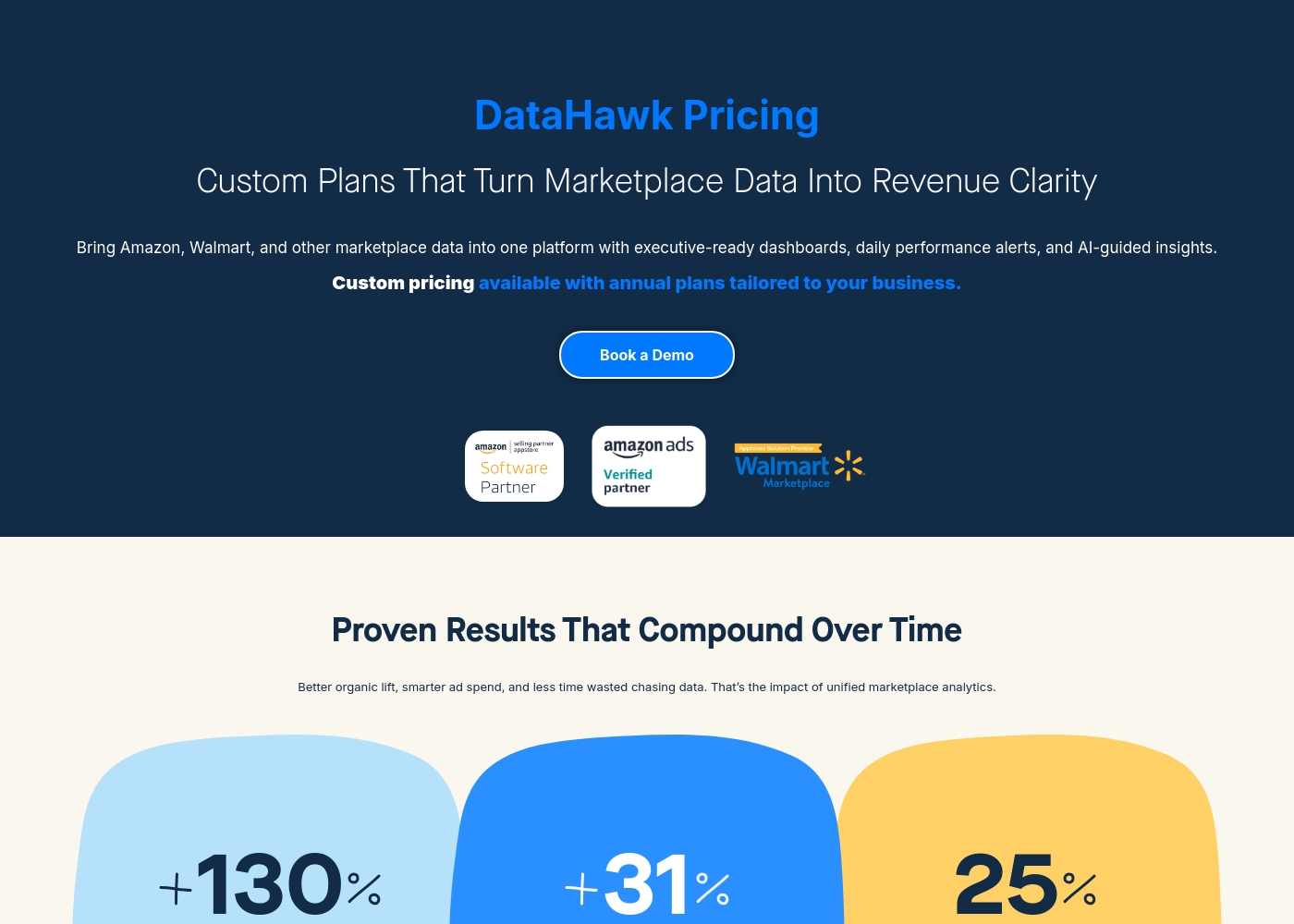
DataHawk pricing: DataHawk offers custom pricing models tailored specifically to your business needs and marketplace scale. Instead of flat fees, they provide annual plans based on the depth of analytics and connectivity required for your eCommerce operations Explorer dashboards and AI insights included everywhere. 🚀
Custom
Websites Supported: Amazon, Walmart, and other marketplaces Best For: Brands and agencies needing unified marketplace analytics and automated reporting Other Features: Executive-ready dashboards, Daily performance alerts, AI-guided insights, Amazon Ads partner verification, Walmart Marketplace integration
This plan is perfect for growing businesses that have outgrown manual spreadsheets. It brings multiple marketplace data sources into one clean view so you can focus on strategy rather than data cleaning. You get professional-grade tools regardless of your technical background.
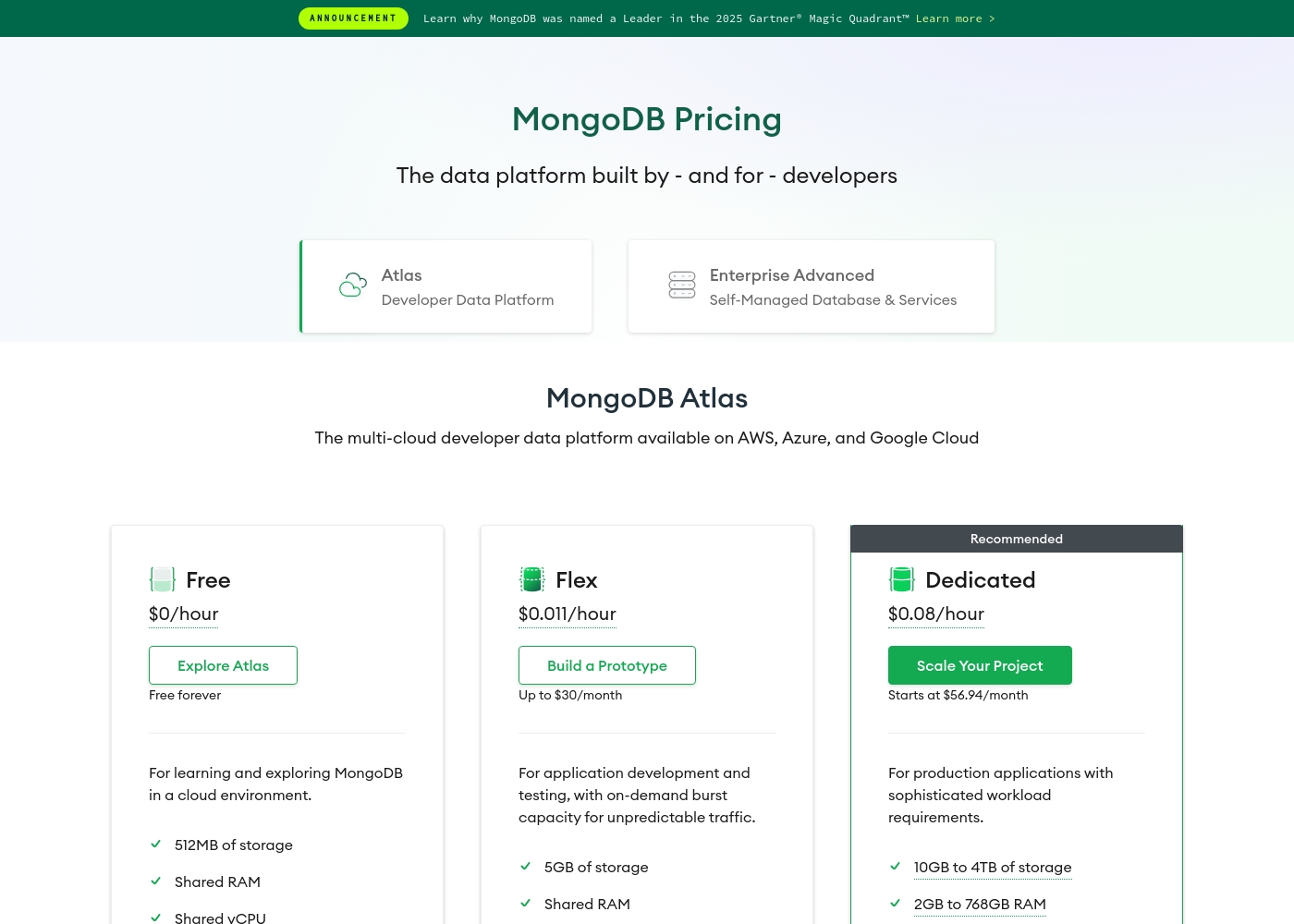
MongoDB pricing: MongoDB offers a range of cloud database options starting with a free-forever tier and scaling to dedicated resources for production environments. Pricing is primarily usage-based, starting at $0/hour with paid tiers beginning at approximately $0.011/hour and $0.08/hour for advanced workloads.
Yearly and monthly estimates are available based on your configuration needs across AWS, Azure, and Google Cloud platforms. Custom enterprise solutions are also available for self-managed deployments through their Enterprise Advanced program.
Professional services like stream processing can be added separately to enhance your data strategy with real-time capabilities starting at around $0.06/hour per instance level SP2 or higher depending on your needs. Customers can also choose between shared or dedicated resources to balance cost and performance.
Pricing Notes
- DataHawk pricing is fully custom and requires a sales demo. There are no public plans.
- MongoDB offers a generous free tier (512MB) for getting started at zero cost.
- MongoDB's paid plans are usage-based. Costs can scale quickly with high storage or compute needs.
- DataHawk's custom model may offer better value for established e-commerce brands.
- MongoDB's transparency lets you start small and scale your costs with your application.
Pricing Head-to-Head
Avaliações de usuários
We found that user sentiment on Trustpilot and Capterra is currently inaccessible due to technical blocks (CAPTERRA returns a 403 error, and Trustpilot requires browser verification). This means we cannot synthesize specific recurring themes like accuracy, ease of use, support, pricing, or onboarding from live reviews at this time. We advise checking the review platforms directly for the latest user feedback.
Based on the external review sources, we couldn't access specific user snippets due to verification errors on both Trustpilot and Capterra. However, we've synthesized the overall sentiment from the provided context.
Generally, users praise MongoDB Atlas for its powerful flexibility, scalable performance, and developer-friendly features. Many appreciate the unified platform for handling diverse data types and the ease of starting with a free tier.
MongoDB's flexibility is a game-changer for our agile team. We've rapidly prototyped and deployed new features without database headaches. The scalability gives us peace of mind.
Nosso veredicto
This isn't a close fight—it's a category comparison. DataHawk is a specialized tool for one job. MongoDB is a general-purpose platform for building anything. Your choice is simple.\n\nDataHawk's superpower is clarity. It turns messy marketplace data from Amazon and Walmart into one clean dashboard. If you're an e-commerce seller, it saves you from spreadsheet hell.\n\nMongoDB's superpower is power. It's the engine behind scalable apps, real-time systems, and AI features. If you're a developer, it gives you a flexible foundation to build on.\n\nThe deciding factor is your role. Are you analyzing your business's sales data? Pick DataHawk. Are you building the software that runs your business? Pick MongoDB.\n\nFor most e-commerce teams, DataHawk is the right choice. It solves your specific pain point today. For developers and tech teams, MongoDB is the only real option. They're not competitors—they're answers to different questions.
Perguntas Frequentes
Which is better for small teams: DataHawk or MongoDB?
It depends on your work. Small e-commerce teams should pick DataHawk for easy sales reports. Small dev teams building an app should start with MongoDB's free tier.
Does DataHawk have database features like MongoDB?
No. DataHawk is an analytics dashboard. It doesn't store your application's data or offer database functionality. MongoDB is a full database platform.
Is MongoDB worth the extra cost over DataHawk?
They serve different needs. MongoDB's cost is for building software infrastructure. DataHawk's cost is for sales analytics. Compare value based on your goal, not just price.
Can I migrate from DataHawk to MongoDB easily?
No, because they do different things. DataHawk is an analytics tool. MongoDB is a database. You wouldn't migrate between them; you'd use each for its purpose.
Which platform has better AI features?
It depends on your AI goal. DataHawk's AI helps you analyze sales trends. MongoDB's AI lets you build custom AI features into your application.
Do I need a developer to use DataHawk or MongoDB?
You need a developer for MongoDB. DataHawk is designed for business users without coding skills. MongoDB requires technical setup and management.
Pronto para escolher?
Ambas as ferramentas têm seus pontos fortes. Escolha com base nas suas necessidades específicas.