MongoDB vs Vultr
MongoDB and Vultr are not direct competitors, but comparing them clarifies a key choice. Do you need a smart database or raw computing power? That's the heart of the decision.
Powerful, flexible platform for modern data.
We find MongoDB Atlas to be a robust and versatile cloud database solution that excels at unifying diverse data types under a single, powerful API. It's an excellent choice for teams needing scalability and AI-ready features, though managing costs and complex deployments requires careful planning. Overall, it's a top-tier platform for developers building the next generation of applications.
Zalety
- Excellent flexibility with its document model.
- Powerful, unified platform for databases, search, and streaming.
- Strong scalability and high availability guarantees.
- Native vector search integration for AI applications.
Wady
- Costs can escalate quickly with high usage and dedicated resources.
- Advanced features and configurations can have a steep learning curve.
- Support responsiveness can be inconsistent for some users.
Zaawansowana technologia, bardzo problematyczne wsparcie.
Uznajemy, że Vultr oferuje potężne zasoby o wysokiej specyfikacji, zoptymalizowane pod kątem obciążeń AI i HPC, zapewniając natychmiastowy dostęp do najnowocześniejszej globalnej infrastruktury. Jednak opinie użytkowników wyraźnie wskazują na poważną niestabilność w zakresie wsparcia operacyjnego, procesów weryfikacji i niezawodności sieci. Ogólnie rzecz biorąc, Vultr jest dostawcą wysokiego ryzyka, w którym światowej klasy technologia jest znacznie osłabiona przez wszechobecne niepowodzenia w zakresie obsługi klienta i zarządzania kontem.
Zalety
- Dostęp do najnowocześniejszego sprzętu AI i HPC (NVIDIA HGX B200, AMD Instinct).
- Globalny zasięg z 32 centrami danych na całym świecie.
- Elastyczne rozliczanie godzinowe i miesięczne, zaczynające się od 2,50 USD/miesiąc.
- Dostępne usługi zarządzane, takie jak Kubernetes Engine i bazy danych.
Wady
- Obsługa klienta jest stale powolna, niepomocna, oparta na zgłoszeniach i nie reaguje.
- Często występują dowolne zawieszenia konta i zamknięcia usług (np. z powodu skoków obciążenia procesora).
- Nierozsądne, inwazyjne obowiązkowe kroki weryfikacyjne (wymagające zdjęć dowodu osobistego, karty kredytowej).
- Zgłaszane trudności z uzyskaniem zwrotów, zwłaszcza w przypadku depozytów kryptowalutowych.
OMongoDB
💡 MongoDB Atlas is a comprehensive cloud data platform built for modern applications. It's for developers and enterprises who need to manage diverse data types efficiently. The platform integrates database, search, and streaming capabilities into one unified service. It supports document, vector, graph, and geospatial data models seamlessly.
OVultr
Vultr oferuje potężną, pełnostanową platformę chmurową. Zapewnia usługi od konfigurowalnych maszyn wirtualnych po wysoce przyspieszone serwery dedykowane 💡. Platforma ta jest idealna dla programistów i firm skoncentrowanych na obliczeniach o wysokiej wydajności i złożonym wdrażaniu modeli AI. Możesz uruchomić ogólne lub zoptymalizowane konfiguracje w mniej niż 60 sekund.
Najważniejsze
Porównanie funkcji
Przegląd funkcji
Podkreślamy główne różnice i wybieramy zwycięzcę dla każdej funkcji.
Core Function
MongoDB is a specialized data platform. Vultr is a general-purpose computing foundation.
MongoDB Atlas is a managed cloud database. It's a complete platform for storing, searching, and processing data. You get a document database with built-in vector search and analytics. Vultr provides raw cloud compute. You rent virtual machines or bare-metal servers. You must install, configure, and manage your own database and software stack on top. The key difference is control vs. convenience. Vultr gives you infrastructure to build on. MongoDB gives you a finished, intelligent data system. Choose MongoDB if data management is your core problem. Choose Vultr if you need flexible computing power for any purpose.
AI & ML Capabilities
MongoDB integrates AI features into your data. Vultr provides the powerful hardware to train models.
MongoDB Atlas has native vector search. You can build semantic search and AI apps directly on your operational data. It also offers stream processing for real-time AI pipelines. Vultr's strength is GPU infrastructure. You can deploy clusters with NVIDIA HGX B200 and AMD Instinct GPUs. These are for training massive AI models at scale. MongoDB makes AI features easier to build. Vultr provides the brute-force computing needed for the most demanding AI research. A startup building a recommendation engine might choose MongoDB. A research lab training a language model would choose Vultr.
Pricing Structure
MongoDB's cost is tied to data storage and usage. Vultr's cost is tied to virtual machine size and runtime.
MongoDB Atlas pricing is based on resources your cluster uses. Costs start at $0 for the free tier. Paid plans begin around $0.011/hour for shared resources. Vultr's pricing is per virtual machine instance. Plans start at $2.50/month for a tiny 0.5 GB server. High-end GPU plans require 36-month prepaid contracts. Both are usage-based, but the units differ. MongoDB charges for a managed service. Vultr charges for raw compute hours. Monitoring is crucial for both. MongoDB costs can spike with data growth. Vultr costs increase with larger VM selections.
Ease of Use
MongoDB simplifies database management. Vultr simplifies server deployment.
MongoDB Atlas handles backups, patches, and scaling for you. Its dashboard lets you configure clusters in minutes. It removes traditional database administration headaches. Vultr lets you deploy a server in under 60 seconds. But you are responsible for the entire software stack. You must secure, update, and manage the OS and applications. MongoDB has a gentler learning curve for data tasks. Vultr requires broader systems administration skills. Choose MongoDB to focus on your application code. Choose Vultr if you need deep control over your server environment.
Scalability
MongoDB scales your data layer automatically. Vultr lets you manually resize your compute power.
MongoDB Atlas can automatically scale storage and RAM. It handles sharding across servers as your data grows. Performance stays consistent at scale. With Vultr, you choose a VM plan with fixed resources. To scale, you must resize to a larger plan (often requiring a reboot) or add more servers yourself. MongoDB's scaling is more hands-off and data-focused. Vultr's scaling is more manual but offers predictable cost control. A viral app with unpredictable traffic might prefer MongoDB's autoscaling. A predictable production workload might prefer Vultr's fixed-size VMs.
Customer Support
Both have significant issues, but user reports on Vultr are far more negative.
MongoDB support is noted as sometimes inconsistent. Dedicated tiers include enhanced support options. The quality can vary. Vultr support is frequently described as slow, unresponsive, and ticket-based. Many users report being unable to get help during critical failures. MongoDB's support has room for improvement. Vultr's support is a major pain point for many users. For mission-critical apps, MongoDB's inconsistent support may be a concern. For Vultr, support failures can halt your entire operation.
Reliability & Uptime
MongoDB guarantees high availability. Vultr has reported network and instance stability issues.
MongoDB Atlas guarantees 99.99% availability for dedicated clusters. It's built for mission-critical applications requiring constant uptime. Vultr users report network instability and catastrophic server failures. Account suspensions over CPU usage have caused outages for customers. MongoDB provides strong uptime guarantees for your data. Vultr's infrastructure reliability is questioned by a significant portion of its user base. If uptime is non-negotiable, MongoDB's SLAs are a clear advantage. Choosing Vultr carries higher operational risk.
Global Infrastructure
MongoDB leverages major cloud providers. Vultr operates its own global data center network.
MongoDB Atlas runs on AWS, Azure, and Google Cloud. You can deploy in any of their global regions. It piggybacks on their massive infrastructure. Vultr owns and operates 32 data centers worldwide. This gives you direct control over location without a cloud provider layer. MongoDB offers more geographic options through partners. Vultr offers more direct control over its owned facilities. Choose MongoDB for cloud integration. Choose Vultr if you prefer a dedicated, non-hyperscaler provider.
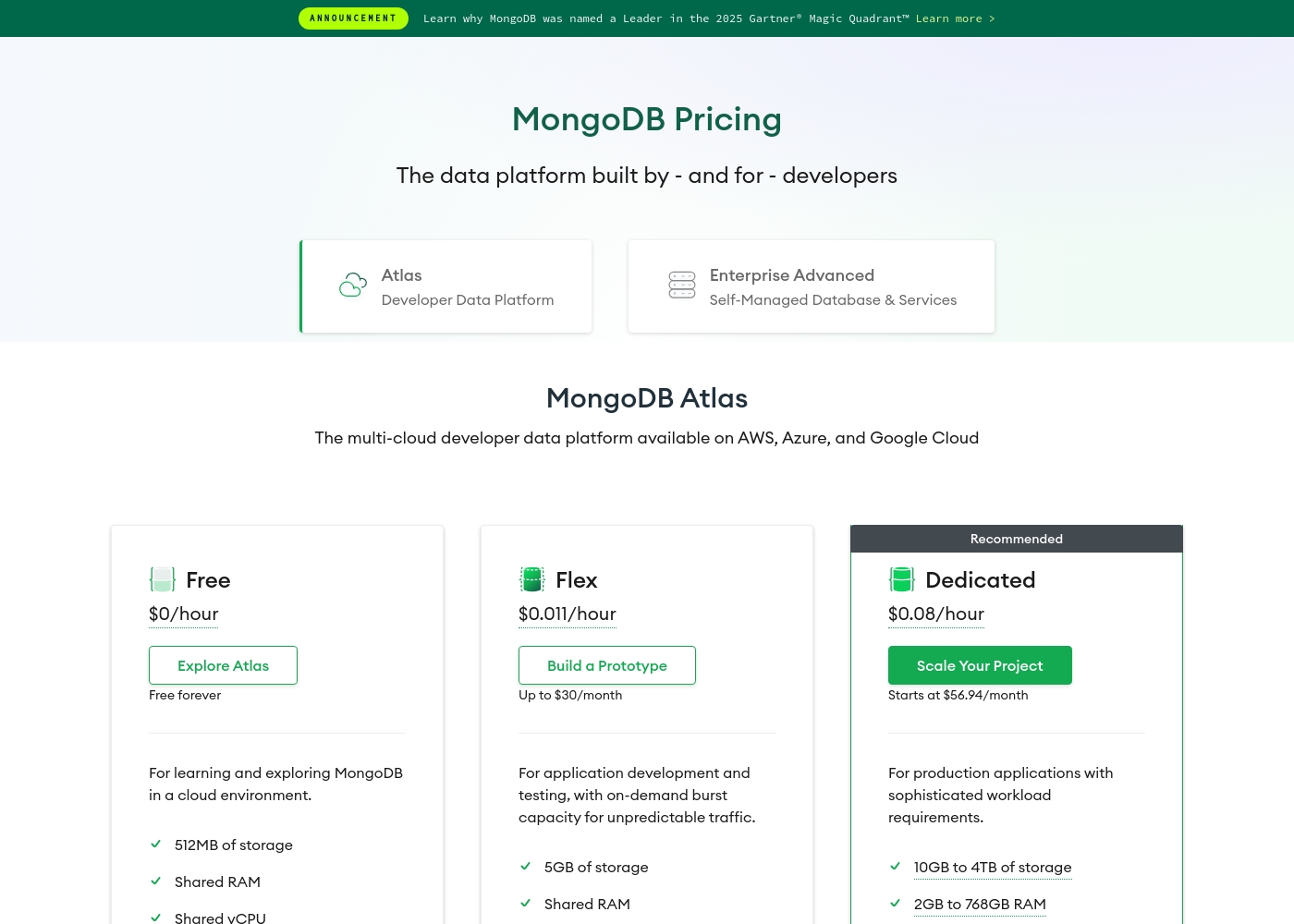
MongoDB pricing: MongoDB offers a range of cloud database options starting with a free-forever tier and scaling to dedicated resources for production environments. Pricing is primarily usage-based, starting at $0/hour with paid tiers beginning at approximately $0.011/hour and $0.08/hour for advanced workloads.
Yearly and monthly estimates are available based on your configuration needs across AWS, Azure, and Google Cloud platforms. Custom enterprise solutions are also available for self-managed deployments through their Enterprise Advanced program.
Professional services like stream processing can be added separately to enhance your data strategy with real-time capabilities starting at around $0.06/hour per instance level SP2 or higher depending on your needs. Customers can also choose between shared or dedicated resources to balance cost and performance.
Ceny Vultr wahają się od 2,50 USD do 80,00 USD miesięcznie za Cloud Compute Regular Performance, oferując osiem planów, zaczynając od konfiguracji 1 vCPU / 0,5 GB (tylko IPv6) za 2,50 USD/miesiąc.
Oferty Cloud Compute Vultr opierają się na maszynach wirtualnych wykorzystujących udostępniane vCPU. Te maszyny świetnie nadają się do codziennych zadań, takich jak prowadzenie stron internetowych o małym ruchu, prostych baz danych czy małych środowisk deweloperskich. Poniżej przedstawiliśmy kilka dostępnych opcji.
1 vCPU / 0,5 GB (Tylko IPv6)
Cena: 2,50 USD /miesiąc (0,004 USD /godz) Obsługiwane strony internetowe: Nieokreślono Najlepsze dla: Podstawowego testowania lub środowisk przejściowych Polityka zwrotów: Nieokreślono Inne funkcje:
- 0,5 GB Pamięci
- 10 GB Przestrzeni dyskowej
- 0,50 TB Przepustowości
- Zasilane procesorami Intel starszej generacji
- 1 vCPU
- 0,5 GB Pamięci
- 10 GB Przestrzeni dyskowej
- 0,50 TB Przepustowości
- 1 vCPU
- 1,0 GB Pamięci
- 25 GB Przestrzeni dyskowej
- 1,00 TB Przepustowości
- 6 vCPU
- 16 GB Pamięci
- 320 GB Przestrzeni dyskowej
- 5,00 TB Przepustowości
Pricing Notes
- MongoDB's free tier includes 512MB of storage, perfect for prototyping.
- Vultr has no free tier, but its lowest VM plan is only $2.50/month.
- MongoDB costs can grow quickly with data storage and high-performance clusters.
- Vultr costs are predictable per VM, but high-end GPU plans require 36-month prepayment.
- Enabling Vultr backups adds a 20% fee; DDoS protection adds $10/month.
Pricing Head-to-Head
Opinie użytkowników
Based on the external review sources, we couldn't access specific user snippets due to verification errors on both Trustpilot and Capterra. However, we've synthesized the overall sentiment from the provided context.
Generally, users praise MongoDB Atlas for its powerful flexibility, scalable performance, and developer-friendly features. Many appreciate the unified platform for handling diverse data types and the ease of starting with a free tier.
MongoDB's flexibility is a game-changer for our agile team. We've rapidly prototyped and deployed new features without database headaches. The scalability gives us peace of mind.
Vultr otrzymuje niskie oceny zewnętrzne, zwłaszcza na Trustpilot (2,1), gdzie doświadczenia klientów są spolaryzowane. Chociaż niektórzy użytkownicy doceniają konkurencyjne ceny Vultr i ogólną moc serwerów, te pozytywne cechy są często przyćmione przez krytyczne awarie operacyjne.
Najczęstsza skarga dotyczy fatalnej obsługi klienta, która jest opisywana jako powolna, nieodpowiadająca i ściśle oparta na zgłoszeniach. Użytkownicy często zgłaszają arbitralne zawieszenia konta lub zamknięcia, często wywołane przez przekroczenie nieokreślonych limitów użycia procesora lub fałszywe roszczenia DMCA 😔.
Negatywne recenzje tutaj nie odzwierciedlają moich dziewięcioletnich doświadczeń. Korzystam z usług tylko do hostowania jednego serwera pocztowego i internetowego. Początkowe oferty konsekwentnie zapewniały świetną wartość, a wsparcie było łatwo dostępne.
Nasz werdykt
The bottom line: MongoDB and Vultr solve completely different problems. You're not choosing between two similar tools; you're deciding if you need a smart database or raw computing power. MongoDB's superpower is being a unified data platform. It handles your database, search, vector AI, and real-time streams in one place. This eliminates complex data pipelines and lets you build features faster. Vultr's superpower is providing instant, cutting-edge computing hardware. You can deploy powerful GPU clusters for AI training in minutes. It's a blank canvas for any software you need to run. The deciding factor is your core challenge. If your problem is managing and querying complex application data, choose MongoDB. If your problem is needing affordable, powerful servers to run your own software, choose Vultr. For most application developers, MongoDB is the better fit. Choose Vultr only if you specifically need raw infrastructure control or extreme GPU compute for AI research.
Często zadawane pytania
Can I use Vultr to host a MongoDB database?
Yes, absolutely. You can deploy a Vultr virtual machine and install MongoDB software on it yourself. However, you lose the managed features and ease-of-use of MongoDB Atlas.
Which is cheaper for a small project?
MongoDB's free tier is hard to beat for prototyping. For a live project, a tiny Vultr VM ($2.50/month) might be cheaper than a paid MongoDB cluster, but you'll spend more time on setup and management.
Does MongoDB require more technical knowledge than Vultr?
They require different skills. MongoDB Atlas simplifies database administration. Using a Vultr VM effectively requires broader systems and networking knowledge to secure and manage the server.
Which is better for AI projects?
It depends on the AI phase. For building AI features into an app, MongoDB's native vector search is ideal. For training large AI models from scratch, Vultr's GPU instances are necessary.
Is MongoDB more reliable than Vultr?
MongoDB Atlas provides strong uptime SLAs for its managed service. Vultr has more frequent user reports of network instability and account-related outages, making it less predictable.
Can I start with MongoDB Atlas and move to Vultr later?
You can export your data from MongoDB and set up a database on a Vultr server. This migration involves significant work, as you'd be moving from a managed service to a self-managed environment.
Gotowy do wyboru?
Oba narzędzia mają swoje mocne strony. Wybierz w oparciu o swoje konkretne potrzeby.