MongoDB vs VMmanager
MongoDB and VMmanager are both powerful, but they solve completely different problems. MongoDB is a cloud database platform for app developers, while VMmanager automates virtual server management for hosting providers. Your choice depends entirely on whether you're building an application or managing infrastructure.
Best for: Developers building modern web or mobile applications, Teams needing a managed, scalable database in the cloud
Best for: Hosting providers automating VPS rental businesses, IT teams building internal IaaS cloud platforms
Powerful, flexible platform for modern data.
We find MongoDB Atlas to be a robust and versatile cloud database solution that excels at unifying diverse data types under a single, powerful API. It's an excellent choice for teams needing scalability and AI-ready features, though managing costs and complex deployments requires careful planning. Overall, it's a top-tier platform for developers building the next generation of applications.
Zalety
- Excellent flexibility with its document model.
- Powerful, unified platform for databases, search, and streaming.
- Strong scalability and high availability guarantees.
- Native vector search integration for AI applications.
Wady
- Costs can escalate quickly with high usage and dedicated resources.
- Advanced features and configurations can have a steep learning curve.
- Support responsiveness can be inconsistent for some users.
Zalety
Wady
OMongoDB
💡 MongoDB Atlas is a comprehensive cloud data platform built for modern applications. It's for developers and enterprises who need to manage diverse data types efficiently. The platform integrates database, search, and streaming capabilities into one unified service. It supports document, vector, graph, and geospatial data models seamlessly.
OVMmanager
Najważniejsze
Porównanie funkcji
Przegląd funkcji
Podkreślamy główne różnice i wybieramy zwycięzcę dla każdej funkcji.
Core Purpose
MongoDB is a database for your application's data. VMmanager is software to manage the servers your applications run on.
MongoDB Atlas is a cloud platform for storing and querying your application data. It's built for developers building software. VMmanager is a platform for creating and managing virtual machines. It's built for hosting companies and IT departments. The key difference is scope. MongoDB handles data inside an app. VMmanager handles the infrastructure underneath. If you're choosing between them, you're likely confusing a data layer with a server management layer.
User Interface
MongoDB's interface is for querying data. VMmanager's interface is for managing servers and networks.
MongoDB Atlas provides a web dashboard for managing database clusters, collections, and queries. It's designed for database tasks. VMmanager's interface lets you create VMs, manage IP addresses, and configure networks. It's designed for infrastructure tasks. MongoDB's UI helps developers explore data. VMmanager's UI helps admins provision servers for customers. A developer would feel at home in MongoDB's UI. A hosting provider's technician would feel at home in VMmanager's.
Scalability
MongoDB scales your database to millions of users. VMmanager scales your server fleet to thousands of VMs.
MongoDB Atlas scales to handle massive query loads and petabytes of data with automatic sharding. VMmanager scales to manage over 22,000 virtual machines from a single installation. MongoDB's scale is about data and traffic. VMmanager's scale is about hardware and virtualization. You'd use MongoDB if your app's database becomes a bottleneck. You'd use VMmanager if your server management becomes a bottleneck.
Automation
MongoDB automates database backups and scaling. VMmanager automates server provisioning and billing.
MongoDB automates database tasks like backups, failover, and scaling resources based on load. VMmanager automates creating a new VPS in 4 seconds, assigning IPs, and integrating with billing systems. MongoDB's automation is for database reliability. VMmanager's automation is for business operations. A developer uses MongoDB automation to avoid downtime. A hosting provider uses VMmanager automation to sell more servers.
AI & Advanced Features
MongoDB has native AI features like vector search. VMmanager has no AI features; it's focused on core virtualization.
MongoDB includes vector search for building semantic search and generative AI applications directly on your data. VMmanager focuses on virtualization features like KVM, LXC, and network management. It does not include AI capabilities. This is a major difference in focus. MongoDB is moving into AI-ready data platforms. VMmanager is staying focused on being a best-in-class virtualization tool for hosting.
Customer Support
Support for both is reported as inconsistent. MongoDB's is for database issues, VMmanager's for virtualization.
MongoDB support responsiveness varies. Some users report quick help, while others mention delays, especially on lower tiers. VMmanager reviews also note inconsistent support. Some praise the team, while others report slow second-line responses. Both tools have mixed feedback on support. The type of issue differs greatly. You'd contact MongoDB support about a slow query. You'd contact VMmanager support about a failed VM migration.
Learning Curve
MongoDB's curve is about mastering a database platform. VMmanager's curve is about mastering virtualization management.
MongoDB has a learning curve for its query language, data modeling, and advanced features like sharding. VMmanager has a learning curve for concepts like KVM, networking, clusters, and high-availability. The difficulty comes from different domains. One is database science, the other is infrastructure engineering. A database administrator would find MongoDB familiar. A systems administrator would find VMmanager familiar.
Pricing Transparency
MongoDB shows clear usage-based pricing. VMmanager uses custom quotes, which lacks transparency.
MongoDB's pricing is public. You can calculate costs based on storage, RAM, and vCPU usage per hour. VMmanager's pricing requires a custom quote. You must contact sales based on your physical core count. MongoDB lets you estimate costs before signing up. VMmanager requires a conversation with sales. For budget planning, MongoDB's transparency is a significant advantage for many teams.
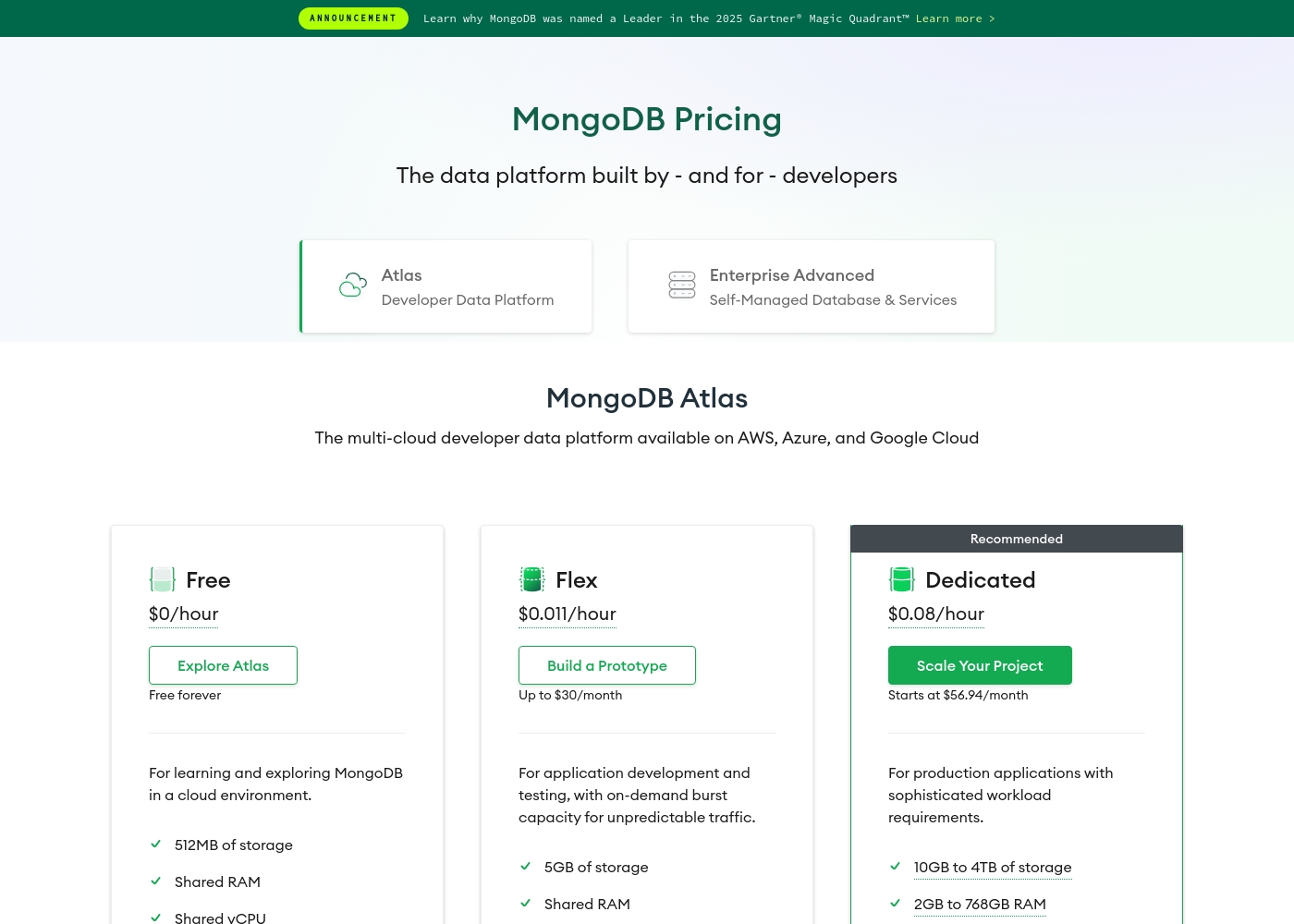
MongoDB pricing: MongoDB offers a range of cloud database options starting with a free-forever tier and scaling to dedicated resources for production environments. Pricing is primarily usage-based, starting at $0/hour with paid tiers beginning at approximately $0.011/hour and $0.08/hour for advanced workloads.
Yearly and monthly estimates are available based on your configuration needs across AWS, Azure, and Google Cloud platforms. Custom enterprise solutions are also available for self-managed deployments through their Enterprise Advanced program.
Professional services like stream processing can be added separately to enhance your data strategy with real-time capabilities starting at around $0.06/hour per instance level SP2 or higher depending on your needs. Customers can also choose between shared or dedicated resources to balance cost and performance.
Pricing Notes
- MongoDB offers a free tier and transparent hourly pricing starting at $0.011/hour.
- VMmanager pricing is custom, based on your physical CPU core count, with no public rates.
- MongoDB's costs can scale unpredictably with high resource usage.
- VMmanager's custom pricing model lacks transparency and can lead to aggressive price increases, per user reviews.
- Both offer trials: MongoDB has a free forever tier, VMmanager has a 30-day trial.
Pricing Head-to-Head
Opinie użytkowników
Based on the external review sources, we couldn't access specific user snippets due to verification errors on both Trustpilot and Capterra. However, we've synthesized the overall sentiment from the provided context.
Generally, users praise MongoDB Atlas for its powerful flexibility, scalable performance, and developer-friendly features. Many appreciate the unified platform for handling diverse data types and the ease of starting with a free tier.
MongoDB's flexibility is a game-changer for our agile team. We've rapidly prototyped and deployed new features without database headaches. The scalability gives us peace of mind.
Nasz werdykt
This isn't really a fair fight. MongoDB and VMmanager live in completely different worlds. Choosing between them is like choosing between a word processor and a car engine. MongoDB's superpower is being an all-in-one data platform. It unifies your database, search, and real-time streaming. You get native vector search to build AI features without a separate tool. VMmanager's superpower is automating virtual infrastructure at massive scale. It provisions a VPS in 4 seconds and manages over 22,000 VMs from one dashboard. It's built for hosting businesses. The deciding factor is your problem. Are you a developer struggling with your app's database layer? You need MongoDB. Are you a hosting provider drowning in manual server setups? You need VMmanager. Final verdict: For application developers, choose MongoDB Atlas for its scalable, AI-ready data platform. For hosting providers, choose VMmanager to automate your virtual machine rental business. They aren't competitors; they solve opposite problems.
Często zadawane pytania
Can I use MongoDB and VMmanager together?
Yes, they can be complementary. You could use VMmanager to manage your server infrastructure and then install MongoDB Atlas or a self-hosted MongoDB on those virtual machines. They solve different layers of the stack.
Which is better for a small startup?
It depends on what you're building. If your startup needs a cloud database, MongoDB's free tier is perfect. If your startup is selling virtual servers, VMmanager automates that business.
Is VMmanager a database like MongoDB?
No. VMmanager manages virtual machines and servers. MongoDB is a database for storing and querying application data. They serve entirely different purposes.
Does MongoDB manage virtual servers?
No. MongoDB Atlas is a managed database service. For managing virtual servers, you'd use a hypervisor like KVM (which VMmanager uses) or a cloud provider's compute service.
Which has better pricing transparency?
MongoDB. Its pricing is public and usage-based. VMmanager requires custom quotes, making it hard to compare costs without contacting sales.
I'm a system administrator. Which tool is for me?
VMmanager is the clear choice for a system administrator managing virtualized infrastructure. MongoDB is for database administrators and developers.
Gotowy do wyboru?
Oba narzędzia mają swoje mocne strony. Wybierz w oparciu o swoje konkretne potrzeby.