MongoDB vs Vultr
MongoDB and Vultr are not direct competitors, but comparing them clarifies a key choice. Do you need a smart database or raw computing power? That's the heart of the decision.
Powerful, flexible platform for modern data.
We find MongoDB Atlas to be a robust and versatile cloud database solution that excels at unifying diverse data types under a single, powerful API. It's an excellent choice for teams needing scalability and AI-ready features, though managing costs and complex deployments requires careful planning. Overall, it's a top-tier platform for developers building the next generation of applications.
장점
- Excellent flexibility with its document model.
- Powerful, unified platform for databases, search, and streaming.
- Strong scalability and high availability guarantees.
- Native vector search integration for AI applications.
단점
- Costs can escalate quickly with high usage and dedicated resources.
- Advanced features and configurations can have a steep learning curve.
- Support responsiveness can be inconsistent for some users.
최첨단 기술, 심각하게 문제가 있는 지원.
Vultr는 AI 및 HPC 워크로드를 위해 최적화된 강력하고 사양이 높은 리소스를 제공하여 최첨단 글로벌 인프라에 즉시 액세스할 수 있도록 한다는 점을 인식하고 있습니다. 그러나 사용자 피드백은 운영 지원, 인증 프로세스 및 네트워크 안정성과 관련하여 심각한 불안정성이 있음을 분명히 보여줍니다. 전반적인 평가는 Vultr가 세계적 수준의 기술을 제공하지만, 만연한 고객 서비스 및 계정 관리 실패로 인해 상당한 위험에 처한 공급자라는 것입니다.
장점
- 최첨단 AI 및 HPC 하드웨어 액세스 가능(NVIDIA HGX B200, AMD Instinct).
- 전 세계 32개 클라우드 데이터 센터 위치를 통한 글로벌 도달 범위.
- 월 $2.50부터 시작하는 유연한 시간당 및 월별 사용량 기반 청구.
- Kubernetes Engine 및 데이터베이스와 같은 관리형 서비스 이용 가능.
단점
- 고객 지원이 일관되게 느리고, 도움이 되지 않으며, 티켓 기반이며, 응답이 없습니다.
- CPU 급증과 같은 이유로 임의의 계정 일시 중지 및 서비스 해지가 자주 발생합니다.
- 신분증, 신용카드 사진 등을 요구하는 부당하고 침해적인 필수 인증 단계가 있습니다.
- 특히 암호화폐 입금의 경우 환불을 받는 데 어려움이 보고되었습니다.
소개MongoDB
💡 MongoDB Atlas is a comprehensive cloud data platform built for modern applications. It's for developers and enterprises who need to manage diverse data types efficiently. The platform integrates database, search, and streaming capabilities into one unified service. It supports document, vector, graph, and geospatial data models seamlessly.
소개Vultr
Vultr는 구성 가능한 가상 머신부터 고도로 가속화된 전용 서버에 이르기까지 서비스를 제공하는 강력한 풀스택 클라우드 컴퓨팅 플랫폼입니다 💡. 이 플랫폼은 고성능 컴퓨팅 및 복잡한 AI 모델 배포에 중점을 둔 개발자 및 기업에 이상적입니다. 60초 이내에 일반 목적 또는 최적화된 구성을 즉시 생성할 수 있습니다.
하이라이트
기능 비교
기능 개요
주요 차이점을 강조하고 각 기능에 대한 승자를 선택합니다.
Core Function
MongoDB is a specialized data platform. Vultr is a general-purpose computing foundation.
MongoDB Atlas is a managed cloud database. It's a complete platform for storing, searching, and processing data. You get a document database with built-in vector search and analytics. Vultr provides raw cloud compute. You rent virtual machines or bare-metal servers. You must install, configure, and manage your own database and software stack on top. The key difference is control vs. convenience. Vultr gives you infrastructure to build on. MongoDB gives you a finished, intelligent data system. Choose MongoDB if data management is your core problem. Choose Vultr if you need flexible computing power for any purpose.
AI & ML Capabilities
MongoDB integrates AI features into your data. Vultr provides the powerful hardware to train models.
MongoDB Atlas has native vector search. You can build semantic search and AI apps directly on your operational data. It also offers stream processing for real-time AI pipelines. Vultr's strength is GPU infrastructure. You can deploy clusters with NVIDIA HGX B200 and AMD Instinct GPUs. These are for training massive AI models at scale. MongoDB makes AI features easier to build. Vultr provides the brute-force computing needed for the most demanding AI research. A startup building a recommendation engine might choose MongoDB. A research lab training a language model would choose Vultr.
Pricing Structure
MongoDB's cost is tied to data storage and usage. Vultr's cost is tied to virtual machine size and runtime.
MongoDB Atlas pricing is based on resources your cluster uses. Costs start at $0 for the free tier. Paid plans begin around $0.011/hour for shared resources. Vultr's pricing is per virtual machine instance. Plans start at $2.50/month for a tiny 0.5 GB server. High-end GPU plans require 36-month prepaid contracts. Both are usage-based, but the units differ. MongoDB charges for a managed service. Vultr charges for raw compute hours. Monitoring is crucial for both. MongoDB costs can spike with data growth. Vultr costs increase with larger VM selections.
Ease of Use
MongoDB simplifies database management. Vultr simplifies server deployment.
MongoDB Atlas handles backups, patches, and scaling for you. Its dashboard lets you configure clusters in minutes. It removes traditional database administration headaches. Vultr lets you deploy a server in under 60 seconds. But you are responsible for the entire software stack. You must secure, update, and manage the OS and applications. MongoDB has a gentler learning curve for data tasks. Vultr requires broader systems administration skills. Choose MongoDB to focus on your application code. Choose Vultr if you need deep control over your server environment.
Scalability
MongoDB scales your data layer automatically. Vultr lets you manually resize your compute power.
MongoDB Atlas can automatically scale storage and RAM. It handles sharding across servers as your data grows. Performance stays consistent at scale. With Vultr, you choose a VM plan with fixed resources. To scale, you must resize to a larger plan (often requiring a reboot) or add more servers yourself. MongoDB's scaling is more hands-off and data-focused. Vultr's scaling is more manual but offers predictable cost control. A viral app with unpredictable traffic might prefer MongoDB's autoscaling. A predictable production workload might prefer Vultr's fixed-size VMs.
Customer Support
Both have significant issues, but user reports on Vultr are far more negative.
MongoDB support is noted as sometimes inconsistent. Dedicated tiers include enhanced support options. The quality can vary. Vultr support is frequently described as slow, unresponsive, and ticket-based. Many users report being unable to get help during critical failures. MongoDB's support has room for improvement. Vultr's support is a major pain point for many users. For mission-critical apps, MongoDB's inconsistent support may be a concern. For Vultr, support failures can halt your entire operation.
Reliability & Uptime
MongoDB guarantees high availability. Vultr has reported network and instance stability issues.
MongoDB Atlas guarantees 99.99% availability for dedicated clusters. It's built for mission-critical applications requiring constant uptime. Vultr users report network instability and catastrophic server failures. Account suspensions over CPU usage have caused outages for customers. MongoDB provides strong uptime guarantees for your data. Vultr's infrastructure reliability is questioned by a significant portion of its user base. If uptime is non-negotiable, MongoDB's SLAs are a clear advantage. Choosing Vultr carries higher operational risk.
Global Infrastructure
MongoDB leverages major cloud providers. Vultr operates its own global data center network.
MongoDB Atlas runs on AWS, Azure, and Google Cloud. You can deploy in any of their global regions. It piggybacks on their massive infrastructure. Vultr owns and operates 32 data centers worldwide. This gives you direct control over location without a cloud provider layer. MongoDB offers more geographic options through partners. Vultr offers more direct control over its owned facilities. Choose MongoDB for cloud integration. Choose Vultr if you prefer a dedicated, non-hyperscaler provider.
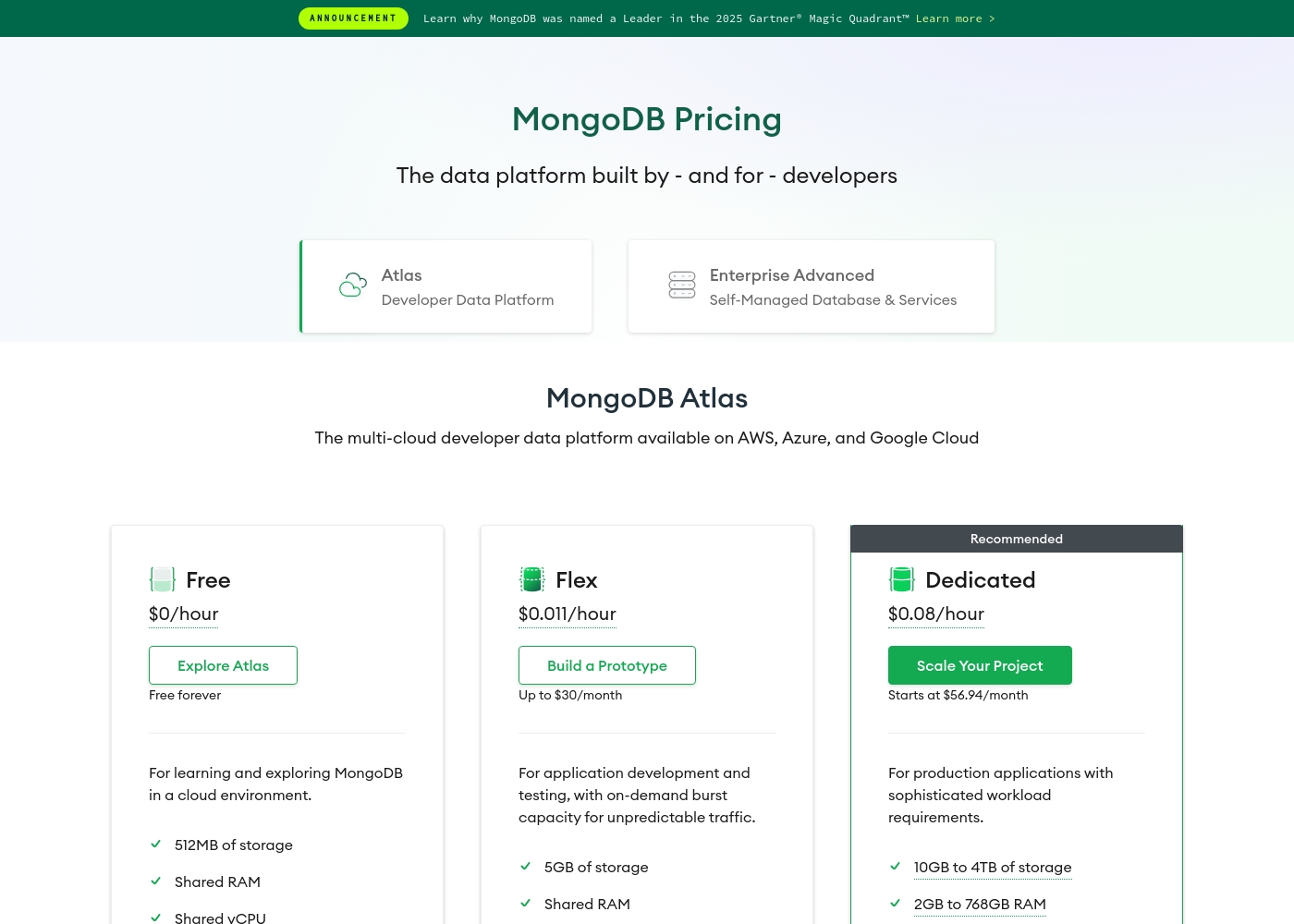
MongoDB pricing: MongoDB offers a range of cloud database options starting with a free-forever tier and scaling to dedicated resources for production environments. Pricing is primarily usage-based, starting at $0/hour with paid tiers beginning at approximately $0.011/hour and $0.08/hour for advanced workloads.
Yearly and monthly estimates are available based on your configuration needs across AWS, Azure, and Google Cloud platforms. Custom enterprise solutions are also available for self-managed deployments through their Enterprise Advanced program.
Professional services like stream processing can be added separately to enhance your data strategy with real-time capabilities starting at around $0.06/hour per instance level SP2 or higher depending on your needs. Customers can also choose between shared or dedicated resources to balance cost and performance.
Vultr의 Regular Performance Cloud Compute 비용은 월 $2.50에서 $80.00 사이이며, 1 vCPU / 0.5GB 구성이 월 $2.50로 시작하는 8가지 요금제가 있습니다.
Vultr의 Cloud Compute 제품은 공유 vCPU를 사용하는 가상 머신을 기반으로 구축됩니다. 이러한 머신은 낮은 트래픽 웹사이트, 간단한 데이터베이스 또는 소규모 개발 환경 실행과 같은 일상적인 작업에 매우 적합합니다. 사용 가능한 옵션 중 일부를 아래에 요약했습니다.
1 vCPU / 0.5 GB (IPv6 전용)
가격: 월 $2.50 ($0.004/시간) 지원 웹사이트: 명시되지 않음 최적: 기본 테스트 또는 스테이징 환경 환불 정책: 명시되지 않음 기타 기능:
- 0.5 GB 메모리
- 10 GB 스토리지
- 0.50 TB 대역폭
- 이전 세대 Intel CPU 기반
- 1 vCPU
- 0.5 GB 메모리
- 10 GB 스토리지
- 0.50 TB 대역폭
- 1 vCPU
- 1.0 GB 메모리
- 25 GB 스토리지
- 1.00 TB 대역폭
- 6 vCPUs
- 16 GB 메모리
- 320 GB 스토리지
- 5.00 TB 대역폭
Pricing Notes
- MongoDB's free tier includes 512MB of storage, perfect for prototyping.
- Vultr has no free tier, but its lowest VM plan is only $2.50/month.
- MongoDB costs can grow quickly with data storage and high-performance clusters.
- Vultr costs are predictable per VM, but high-end GPU plans require 36-month prepayment.
- Enabling Vultr backups adds a 20% fee; DDoS protection adds $10/month.
Pricing Head-to-Head
사용자 리뷰
Based on the external review sources, we couldn't access specific user snippets due to verification errors on both Trustpilot and Capterra. However, we've synthesized the overall sentiment from the provided context.
Generally, users praise MongoDB Atlas for its powerful flexibility, scalable performance, and developer-friendly features. Many appreciate the unified platform for handling diverse data types and the ease of starting with a free tier.
MongoDB's flexibility is a game-changer for our agile team. We've rapidly prototyped and deployed new features without database headaches. The scalability gives us peace of mind.
Vultr는 Trustpilot에서 낮은 평점(2.1점)을 받았는데, 고객 경험이 매우 양극화되어 있기 때문입니다. 일부 사용자는 Vultr의 경쟁력 있는 가격과 서버의 전반적인 강력함을 인정하지만, 이러한 긍정적인 특성은 심각한 운영상의 실패로 인해 자주 가려집니다.
가장 흔한 불만 사항은 형편없는 고객 지원으로, 느리고 응답이 없으며 엄격하게 티켓 기반으로 진행된다는 것입니다. 사용자들은 종종 명시되지 않은 CPU 사용량 제한이나 경솔한 DMCA 신고로 인해 유발되는 임의의 계정 일시 중지 또는 해지를 보고합니다 😔.
여기에 있는 나쁜 리뷰는 저의 9년간의 경험을 반영하지 않습니다. 저는 오랫동안 단일 메일 및 웹 서버만 호스팅해 온 고객이었습니다. 초기 상품은 항상 훌륭한 가치를 지녔고 지원팀에 연락하기도 쉬웠습니다.
우리의 판정
The bottom line: MongoDB and Vultr solve completely different problems. You're not choosing between two similar tools; you're deciding if you need a smart database or raw computing power. MongoDB's superpower is being a unified data platform. It handles your database, search, vector AI, and real-time streams in one place. This eliminates complex data pipelines and lets you build features faster. Vultr's superpower is providing instant, cutting-edge computing hardware. You can deploy powerful GPU clusters for AI training in minutes. It's a blank canvas for any software you need to run. The deciding factor is your core challenge. If your problem is managing and querying complex application data, choose MongoDB. If your problem is needing affordable, powerful servers to run your own software, choose Vultr. For most application developers, MongoDB is the better fit. Choose Vultr only if you specifically need raw infrastructure control or extreme GPU compute for AI research.
자주 묻는 질문
Can I use Vultr to host a MongoDB database?
Yes, absolutely. You can deploy a Vultr virtual machine and install MongoDB software on it yourself. However, you lose the managed features and ease-of-use of MongoDB Atlas.
Which is cheaper for a small project?
MongoDB's free tier is hard to beat for prototyping. For a live project, a tiny Vultr VM ($2.50/month) might be cheaper than a paid MongoDB cluster, but you'll spend more time on setup and management.
Does MongoDB require more technical knowledge than Vultr?
They require different skills. MongoDB Atlas simplifies database administration. Using a Vultr VM effectively requires broader systems and networking knowledge to secure and manage the server.
Which is better for AI projects?
It depends on the AI phase. For building AI features into an app, MongoDB's native vector search is ideal. For training large AI models from scratch, Vultr's GPU instances are necessary.
Is MongoDB more reliable than Vultr?
MongoDB Atlas provides strong uptime SLAs for its managed service. Vultr has more frequent user reports of network instability and account-related outages, making it less predictable.
Can I start with MongoDB Atlas and move to Vultr later?
You can export your data from MongoDB and set up a database on a Vultr server. This migration involves significant work, as you'd be moving from a managed service to a self-managed environment.
선택할 준비가 되셨나요?
두 도구 모두 강점이 있습니다. 특정 요구 사항에 따라 선택하세요.