Google Cloud vs MongoDB
Choosing between Google Cloud and MongoDB can be tough. One is a massive cloud infrastructure provider, while the other is a specialized data platform. Here's how to decide which one fits your project.
강력한 인프라, 위험한 청구 및 지원
Google Cloud가 선도적인 인프라를 제공하며, 강력한 AI 통합과 엔터프라이즈 워크로드를 위한 상당한 확장을 제공한다는 점은 인정합니다. 그러나 접근 불가능한 고객 지원과 혼란스럽고 투명하지 않은 청구에 대한 다수의 보고는 깊은 우려를 낳습니다. 전반적으로, 우리는 이 플랫폼이 응답성 높은 지원이나 세부적인 비용 통제를 우선시하는 사용자에게는 높은 위험을 안겨준다고 봅니다.
장점
- Gemini 및 Vertex AI와 같은 최고 수준의 생성형 AI 도구에 대한 액세스.
- 오픈 소스, 멀티클라우드 및 하이브리드 개발 전략 지원.
- 신규 사용자는 가입 시 300달러의 무료 크레딧을 받습니다.
- 약정 사용 할인을 통해 최대 57%의 잠재적 절약 효과 제공.
단점
- 고객 서비스 지원은 접근하기 어렵고 숨겨져 있는 경우가 많습니다.
- 크레딧이 있는 경우에도 투명하지 않은 청구 및 예기치 않은 비용이 발생한다는 보고가 있습니다.
- 기술 지원 구독 비용이 매우 높습니다(월 최대 $12,500).
- 종량제 서비스에 대한 확정 지출 한도가 부족하다는 것이 일반적인 불만 사항입니다.
Powerful, flexible platform for modern data.
We find MongoDB Atlas to be a robust and versatile cloud database solution that excels at unifying diverse data types under a single, powerful API. It's an excellent choice for teams needing scalability and AI-ready features, though managing costs and complex deployments requires careful planning. Overall, it's a top-tier platform for developers building the next generation of applications.
장점
- Excellent flexibility with its document model.
- Powerful, unified platform for databases, search, and streaming.
- Strong scalability and high availability guarantees.
- Native vector search integration for AI applications.
단점
- Costs can escalate quickly with high usage and dedicated resources.
- Advanced features and configurations can have a steep learning curve.
- Support responsiveness can be inconsistent for some users.
소개Google Cloud
Google Cloud는 150개 이상의 제품과 기능을 제공하는 포괄적인 클라우드 플랫폼입니다. 기존 인프라를 현대화하거나 처음부터 완전히 새로운 AI 기반 애플리케이션을 구축하는 데 도움이 됩니다. 이 서비스는 디지털 성장을 원하고 혁신할 준비가 된 개발자, 비즈니스 리더 및 스타트업을 위해 설계되었습니다.
신규 고객은 20개 이상의 제품을 무료로 사용해 보고 Google Cloud를 체험할 수 있습니다. 게다가 가입 시 300달러의 무료 크레딧을 받아 탐색에 도움을 받을 수 있습니다. 💡
소개MongoDB
💡 MongoDB Atlas is a comprehensive cloud data platform built for modern applications. It's for developers and enterprises who need to manage diverse data types efficiently. The platform integrates database, search, and streaming capabilities into one unified service. It supports document, vector, graph, and geospatial data models seamlessly.
하이라이트
기능 비교
기능 개요
주요 차이점을 강조하고 각 기능에 대한 승자를 선택합니다.
Core Purpose
Google Cloud is a vast cloud infrastructure platform. MongoDB is a specialized data platform.
Google Cloud offers over 150 products. You can run everything from VMs to AI models. It's like renting a supercomputer. MongoDB Atlas focuses on your data layer. It manages your database, search, and streams. It's like having a dedicated, expert DBA. The difference is scope vs. specialization. Google Cloud provides the entire toolbox. MongoDB excels at one critical tool. For a startup building a full app, Google Cloud provides the foundation. For a team optimizing a data-heavy feature, MongoDB is targeted.
AI & Data Analytics
Google Cloud has massive AI/ML and analytics suites. MongoDB has native vector search for AI apps.
Google Cloud's Vertex AI and BigQuery are industry leaders. You can build models with 200+ foundation models. BigQuery runs petabyte-scale analytics. MongoDB's strength is unifying data and vectors. You can store operational data and embeddings together. This simplifies building AI features like semantic search. Google Cloud offers a broader, more complex AI platform. MongoDB makes specific AI workflows simpler. One is a comprehensive lab, the other a focused workbench. Choose Google Cloud for custom model training. Choose MongoDB for integrating AI into your existing app's data flow.
Database Flexibility
Google Cloud offers multiple managed databases. MongoDB offers one highly flexible document database.
Google Cloud provides Cloud SQL, Spanner, Firestore, and more. You pick the right tool for each job. This can mean managing multiple systems. MongoDB uses a single document model for all data. The same API handles operational, graph, and geospatial data. This reduces context switching. Google Cloud gives you specialized databases. MongoDB gives you one versatile database. It's the difference between a Swiss Army knife and a full workshop. For apps with diverse data types in one service, MongoDB is seamless. For needing different database engines, Google Cloud has options.
Real-time Processing
Google Cloud uses multiple services for streams. MongoDB has integrated stream processing.
Google Cloud handles streams with Dataflow, Pub/Sub, and others. It's powerful but requires configuring separate services. This adds architectural complexity. MongoDB Atlas Stream Processing is built in. You use the same query language for streams and batches. This creates a unified developer experience. Google Cloud offers more scalable, global streaming. MongoDB offers simplicity and integration. One is built for massive scale, the other for developer velocity. For processing Kafka streams alongside your app data, MongoDB is simpler. For global, high-throughput event processing, Google Cloud has dedicated tools.
Ease of Getting Started
Both have generous free tiers. Google Cloud has a steeper initial learning curve.
Google Cloud gives $300 in credits and 20+ free products. However, its console can feel slow and complex. New users report difficulty with simple tasks. MongoDB offers a free-forever tier with 512 MB. The Atlas interface is focused and generally intuitive. Many developers find its document model natural. Google Cloud's scale means more to learn upfront. MongoDB's focus makes its core product more approachable. One is a sprawling city, the other a well-organized campus. Your choice depends on your role. A cloud architect might embrace Google Cloud's scope. An app developer might prefer MongoDB's streamlined data focus.
Cost Management
Google Cloud offers committed discounts but billing can be unclear. MongoDB costs scale with resource usage.
Google Cloud's pricing is usage-based with potential for 57% savings. Users complain about non-transparent billing and unexpected charges. Support for cost limits is a pain point. MongoDB's costs scale with storage and compute hours. Users note costs can escalate quickly with high usage. Monitoring your usage is crucial in both cases. Google Cloud has more discount levers but more billing complexity. MongoDB's model is simpler but can surprise you. Both require vigilant monitoring. For predictable, committed workloads, Google Cloud's discounts help. For variable workloads, MongoDB's pay-as-you-go is straightforward.
Customer Support
Google Cloud support is expensive and hard to reach. MongoDB support is included in paid tiers.
Google Cloud's technical support can cost up to $12,500/month. Free users report support is hidden and nearly impossible to contact. This is a major frustration. MongoDB's Dedicated tiers include enhanced support. Users report mixed experiences but availability is better. SLAs are tied to your pricing tier. Google Cloud's paid support is enterprise-grade but costly. MongoDB's included support is more accessible for mid-market. The difference in accessibility is stark. If you're a large enterprise, Google Cloud's support might be justified. For smaller teams, MongoDB's included support is a significant advantage.
Vendor Lock-in Risk
Google Cloud promotes multicloud. MongoDB is an open-source based platform.
Google Cloud actively supports hybrid and multicloud strategies. They offer tools to manage apps across clouds. This reduces lock-in to their specific infrastructure. MongoDB's core is open source. You can run it on-premise or other clouds. Atlas is a managed service on AWS, Azure, and GCP. Google Cloud sells infrastructure flexibility. MongoDB sells data portability. Both address lock-in from different angles. If you fear infrastructure lock-in, Google Cloud's stance is reassuring. If you fear data lock-in, MongoDB's open-source core is a plus.
Google Cloud 비용은 사용 기반 결제 구조를 사용하므로 사용한 특정 제품에 따라 광범위하게 달라집니다. 신규 고객에게는 300달러의 무료 크레딧과 20개 이상의 무료 제품 사용 기회가 제공됩니다.
고정 월별 요금제는 없으며, 대신 플랫폼의 컴퓨팅 리소스를 유연하게 활용할 수 있는 세 가지 방법이 있습니다.
종량제 (표준 가격 책정)
가격: 명시되지 않음 (사용량 기반) 지원 웹사이트: 명시되지 않음 최적 대상: 유연한 확장이 필요한 모든 규모의 조직 환불 정책: 명시되지 않음 기타 기능:
- 사용한 서비스에 대해서만 비용을 지불합니다.
- 선불 수수료 또는 해지 수수료가 없습니다.
- 약정 사용 할인을 통해 최대 57% 절약 가능성이 있습니다.
- 연중무휴 24시간 무료 청구 지원 포함.
- 사용한 서비스에 대해서만 비용 지불
- 선불 수수료 또는 해지 수수료 없음
- 약정 사용 할인을 통해 최대 57% 절약
- 연중무휴 24시간 무료 청구 지원 포함
- 300달러 무료 크레딧
- 20개 이상의 제품 무료 액세스
- 워크로드 실행, 테스트 및 배포
- 최대 350,000달러 클라우드 크레딧
- 맞춤형 지원 및 솔루션
- 혁신적인 기업을 위한 확장 지원
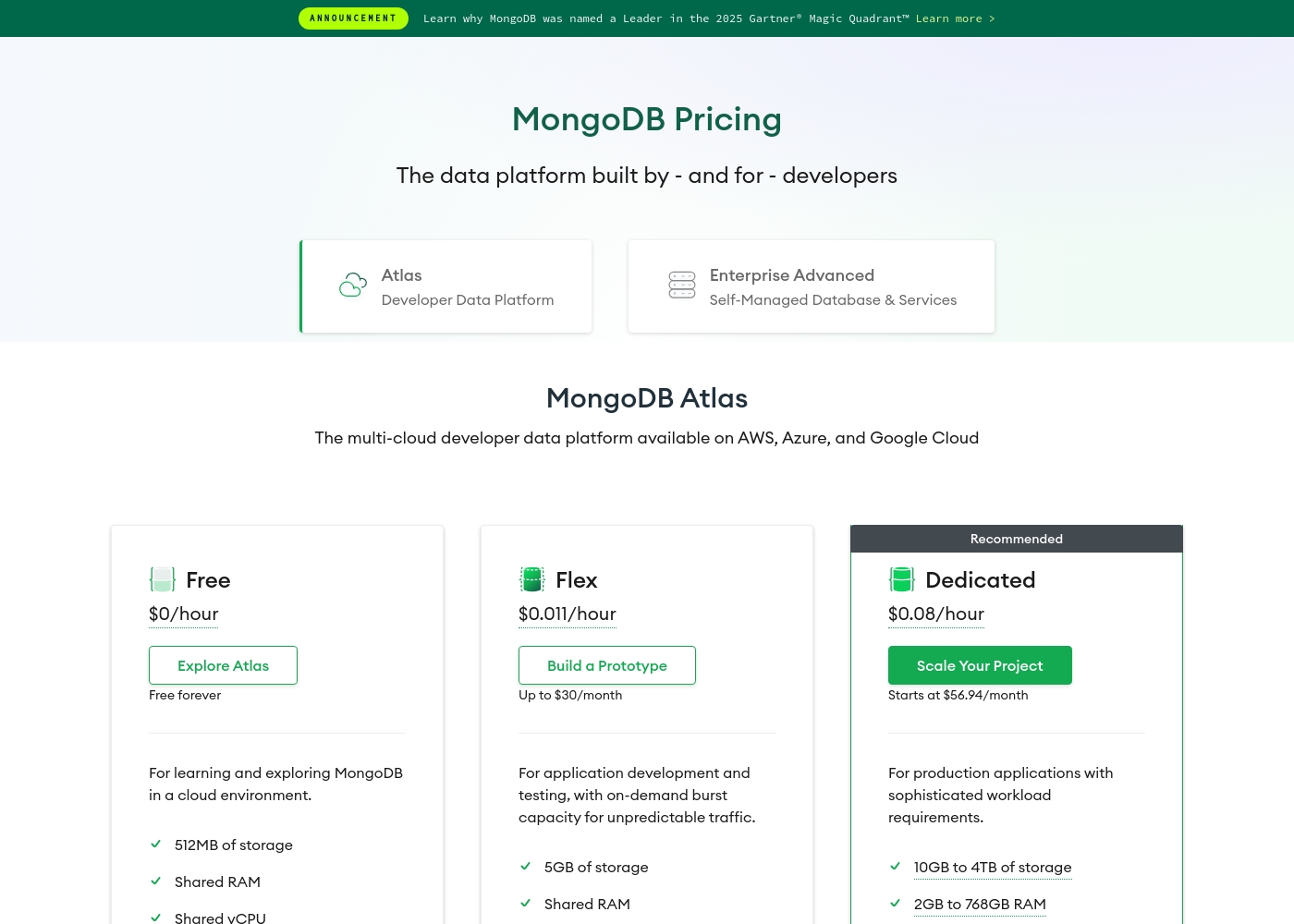
MongoDB pricing: MongoDB offers a range of cloud database options starting with a free-forever tier and scaling to dedicated resources for production environments. Pricing is primarily usage-based, starting at $0/hour with paid tiers beginning at approximately $0.011/hour and $0.08/hour for advanced workloads.
Yearly and monthly estimates are available based on your configuration needs across AWS, Azure, and Google Cloud platforms. Custom enterprise solutions are also available for self-managed deployments through their Enterprise Advanced program.
Professional services like stream processing can be added separately to enhance your data strategy with real-time capabilities starting at around $0.06/hour per instance level SP2 or higher depending on your needs. Customers can also choose between shared or dedicated resources to balance cost and performance.
Pricing Notes
- Google Cloud offers $300 in free credits for new customers, while MongoDB has a free-forever tier.
- Google Cloud's technical support is extremely expensive, costing up to $12,500 per month.
- MongoDB's costs scale with cluster resources (storage, RAM, vCPUs), which can escalate quickly.
- Both platforms use usage-based pricing, making it hard to predict costs without careful monitoring.
- Google Cloud provides committed use discounts up to 57% for predictable workloads.
Pricing Head-to-Head
사용자 리뷰
Trustpilot에서 주로 포착된 외부 정서는 압도적으로 부정적이며 매우 낮은 별점 1.5점을 기록했습니다. 가장 자주 언급되는 문제는 투명하지 않은 청구와 완전히 비정상적인 고객 지원이었습니다 ⚠️. 사용자들은 상당한 무료 크레딧을 보유하고 있음에도 불구하고 종종 수백 달러에 달하는 예기치 않은 비용이 발생했다고 보고했습니다. 많은 사람들이 이러한 투명성 부족이 신규 사용자를 노린 "의도적인 함정"이라고 느낍니다. 게다가 도움을 받는 것은 거의 불가능합니다. 사용자들이 지원팀이 의도적으로 숨겨져 있고 연락할 수 없으며 정신 나갈 것 같은 끊임없는 루프에 빠지게 만든다고 묘사합니다. 기술 지원이 필요한 사용자들은 월 수천 달러에 달하는 막대한 비용을 부담합니다.
비용 관리 외에도 사용자들은 종량제 서비스에 대한 확정 지출 한도를 설정할 수 없는 점을 비판합니다. 예상치 못한 상황이나 사용자 실수를 관리하기 위해 하드 한도를 제공해야 하지만, 이를 제공하지 않는 것은 사용자의 실수를 이용하는 것으로 브랜드 평판을 훼손합니다.
사용 가능한 264달러의 무료 크레딧이 있었고 사용되지 않았음에도 불구하고 제 계정에 327유로의 API 비용이 청구되었습니다. 지원팀은 완전히 숨겨져 있고 연락이 불가능하여 이것이 의도적인 함정처럼 보입니다. 이 플랫폼은 매우 투명하지 않은 가격 구조를 가지고 있습니다.
Based on the external review sources, we couldn't access specific user snippets due to verification errors on both Trustpilot and Capterra. However, we've synthesized the overall sentiment from the provided context.
Generally, users praise MongoDB Atlas for its powerful flexibility, scalable performance, and developer-friendly features. Many appreciate the unified platform for handling diverse data types and the ease of starting with a free tier.
MongoDB's flexibility is a game-changer for our agile team. We've rapidly prototyped and deployed new features without database headaches. The scalability gives us peace of mind.
우리의 판정
This isn't a simple apples-to-apples comparison. Google Cloud is the full cloud platform. MongoDB is the specialized data platform. Google Cloud's superpower is its sheer scale. It offers everything from world-class AI with Vertex AI to massive analytics with BigQuery. It's your partner for the entire infrastructure stack. MongoDB's superpower is data unification. It seamlessly blends operational data, vector search, and streaming into one system. This simplifies building complex, data-rich applications dramatically. The deciding factor is your core need. If you need a comprehensive cloud foundation, Google Cloud is the answer. If your biggest challenge is managing and querying diverse application data, MongoDB is your tool. For a startup building from scratch, Google Cloud provides the full toolkit. For a team trying to make their app's data layer smarter and faster, MongoDB delivers targeted power.
자주 묻는 질문
Which is better for small teams: Google Cloud or MongoDB?
MongoDB often wins for small teams focused on their app's database. Its free-forever tier and focused interface are easier to start with. Google Cloud's $300 credit is generous, but its platform can feel overwhelming.
Does Google Cloud have a database like MongoDB?
Yes, Google Cloud offers Firestore and Cloud Datastore as document databases. They serve similar use cases to MongoDB. However, MongoDB's core platform is built entirely around this document model and its associated features.
Is MongoDB worth the extra cost over Google Cloud?
It's not about extra cost, but about value for your specific need. MongoDB's cost is for a specialized data platform. Google Cloud's costs are for a broad infrastructure suite. If you only need a powerful database, MongoDB's pricing can be more predictable.
Can I use Google Cloud and MongoDB together?
Yes, absolutely. You can run MongoDB Atlas as a managed service on Google Cloud infrastructure. This is a common pattern, combining Google's infrastructure with MongoDB's specialized database.
Which is easier to learn for a developer?
Many developers find MongoDB's document model and query API more intuitive initially. Google Cloud requires learning a vast array of services and concepts. The learning curves serve different goals: app development vs. infrastructure management.
Which platform is better for AI applications?
It depends on the AI task. For training custom models at scale, Google Cloud's Vertex AI is more powerful. For adding semantic search or AI features to an app using your existing data, MongoDB's native vector search is simpler.
선택할 준비가 되셨나요?
두 도구 모두 강점이 있습니다. 특정 요구 사항에 따라 선택하세요.