Drip vs Kit (formerly ConvertKit)
Choosing between Drip and Kit (formerly ConvertKit) means picking between e-commerce power and creator simplicity. Drip is built for online stores selling physical or digital goods. Kit (formerly ConvertKit) is for creators like authors and podcasters building an audience. Here's how to decide.

Powerful for e-commerce, but check the support.
We find Drip to be a highly capable email automation platform built specifically for B2C e-commerce. Its visual builder and smart segmentation are standout features for creating personalized customer journeys. Overall, it's a strong choice for online brands, provided your team can manage the learning curve and verify support levels.
장점
- Excellent visual workflow builder for automation
- Deep e-commerce integrations (Shopify, WooCommerce)
- Powerful, behavior-based segmentation tools
- Free migration for large lists (17,500+)
단점
- Pricing can become expensive as contacts scale
- Some users report slow or inconsistent customer support
- Requires integration with compatible platforms
- Advanced features may have a learning curve
Creator-friendly, but check support.
We find Kit a capable and intuitive email marketing platform tailored specifically for creators, offering strong automation and a clean interface. Overall, it's a great starting point for growing an audience, though users should weigh the mixed customer support reviews and potential pricing scale against their needs.
장점
- Intuitive, clean interface designed for creators and non-technical users.
- Powerful visual automations and sequences to nurture audiences.
- Generous free plan for up to 10,000 subscribers.
- Strong focus on deliverability and building owned audiences.
단점
- Customer support responsiveness and quality receive frequent criticism.
- Pricing can become steep as subscriber counts increase significantly.
- Some users report unexpected account suspensions or deliverability issues.
- Advanced analytics and collaboration features are limited.
소개Drip
Drip is an email marketing automation platform built for B2C companies that sell online. Whether you're an e-commerce brand, a course creator, or a travel provider, it gives you the tools to move beyond generic newsletters. It's designed to be a powerful yet simple engine for driving revenue through personalization. 💡
소개Kit (formerly ConvertKit)
Kit is an email marketing platform specifically for creators like authors, podcasters, YouTubers, and entrepreneurs. It's the hub for growing your email list, sending beautiful newsletters, and selling digital products—all while keeping the experience intuitive and straightforward. 💡
하이라이트
기능 비교
기능 개요
주요 차이점을 강조하고 각 기능에 대한 승자를 선택합니다.
E-commerce Focus
Drip is built for online stores. Kit (formerly ConvertKit) is built for creators.
Drip integrates deeply with platforms like Shopify, BigCommerce, and WooCommerce. It's designed to trigger emails based on shopping behavior, like abandoned carts or product views. Kit (formerly ConvertKit) offers basic Shopify integration but its core is audience growth and newsletters. It's not built for complex e-commerce workflows. The key difference is specialization. Drip turns your store data into automated sales. Kit (formerly ConvertKit) turns followers into subscribers. If you sell physical goods, Drip is your tool. If you sell digital products or ideas, Kit (formerly ConvertKit) is better.
Ease of Use
Kit (formerly ConvertKit) is famously simple. Drip has a steeper learning curve for its power.
Kit (formerly ConvertKit) has a clean, intuitive interface designed for non-technical creators. Users often call it easy to learn and use day-to-day. Drip's visual builder is powerful but packed with options. Some users report a learning curve to master its segmentation and automation features. Kit (formerly ConvertKit) wins on pure simplicity. Drip wins on what's possible once you learn it. A solo author will love Kit (formerly ConvertKit)'s simplicity. An e-commerce manager needs Drip's power.
Automation
Both offer powerful visual automations, but for different goals.
Drip's automations are built for revenue. They use behavior and purchase data to send highly targeted campaigns automatically. Kit (formerly ConvertKit)'s automations nurture relationships. They're great for welcome sequences and educational drips for creators. Drip's automation is more complex and revenue-focused. Kit (formerly ConvertKit)'s is simpler and relationship-focused. Recovering a $500 cart? Use Drip. Onboarding a new subscriber? Kit (formerly ConvertKit) is perfect.
Pricing & Value
Kit (formerly ConvertKit) has a free plan. Drip's pricing can escalate quickly with contacts.
Kit (formerly ConvertKit) offers a free Newsletter plan for up to 10,000 subscribers. Paid plans start at $39/month for 1,000 subscribers. Drip starts at $39/month for 2,500 contacts with no free plan. Costs increase as your contact list grows. Kit (formerly ConvertKit) is cheaper for small lists. Drip may offer better value for large e-commerce lists needing advanced segmentation. For a creator with 5,000 subscribers, Kit (formerly ConvertKit) is likely cheaper. For a store with 20,000 contacts, Drip's value is in its features.
Customer Support
Both have mixed reviews. Kit (formerly ConvertKit) offers 24/7 support on paid plans.
Drip offers email support to all paid users. Live chat is available on plans $99/month or higher. Response times are generally fast. Kit (formerly ConvertKit) provides 24/7 email and chat support on its Creator and Pro plans. The Pro plan gets priority support. Drip's support is more limited to higher-paying customers. Kit (formerly ConvertKit) offers broader access but with mixed quality reviews. Neither is perfect. If you need guaranteed live chat, Drip's $99+ plans are the option. Kit (formerly ConvertKit)'s broader access might help smaller users.
Creator Tools
Kit (formerly ConvertKit) is packed with tools for creators. Drip lacks these specific features.
Kit (formerly ConvertKit) includes unlimited landing pages, forms, and a tool to sell digital products directly. It also has a Recommendations feature for cross-promotion. Drip does not offer built-in landing page or digital product sales tools. It focuses purely on email automation for existing businesses. This is a core difference in philosophy. Kit (formerly ConvertKit) is an all-in-one for creators. Drip is a specialized email engine. If you need to build an audience from scratch, Kit (formerly ConvertKit) is the clear choice. If you already have a store, Drip is built for you.
Integrations
Kit (formerly ConvertKit) has more total integrations. Drip has deeper e-commerce connections.
Kit (formerly ConvertKit) boasts over 100 integrations in its App Store, connecting to tools like Canva, Circle, and Shopify. Drip lists 50+ integrations but focuses on deep connections with e-commerce platforms like BigCommerce and WooCommerce. Kit (formerly ConvertKit) connects to more apps overall. Drip connects more deeply with the tools online stores use. Your choice depends on your stack. Need Canva integration? Go with Kit (formerly ConvertKit). Need a robust BigCommerce sync? Drip is better.
Analytics & Reporting
Drip offers standard reporting. Kit (formerly ConvertKit) has advanced reporting on its Pro plan.
Drip provides standard reports on email performance and revenue from campaigns. The dashboard is functional but not deeply advanced. Kit (formerly ConvertKit) offers an Insights Dashboard and Deliverability Reporting on its high-end Pro plan ($79/month). Kit (formerly ConvertKit) gives more detailed data to paying users on the top tier. Drip's reporting is more uniform across plans. For a deep dive into subscriber behavior and deliverability, Kit (formerly ConvertKit)'s Pro plan is superior. Drip's reporting is sufficient for most e-commerce needs.
Scalability
Both scale with your list size, but Drip is built for higher-volume e-commerce.
Drip's pricing and features are designed for businesses as they grow from hundreds to hundreds of thousands of contacts. Kit (formerly ConvertKit) scales well for individual creators but some users report pricing becomes steep for very large lists. Drip is engineered for high-volume e-commerce data. Kit (formerly ConvertKit) is optimized for audience growth at scale. A store with 100,000 customers will find Drip more aligned. A creator with 100,000 subscribers might find Kit (formerly ConvertKit) costly but functional.
Monetization
Kit (formerly ConvertKit) helps you monetize your audience directly. Drip helps you monetize through your store.
Kit (formerly ConvertKit) includes built-in tools to sell digital products and subscriptions. It also has Sponsorships and Kit Ads for newsletter revenue. Drip does not sell products for you. It automates marketing to drive sales through your existing e-commerce store. These are fundamentally different monetization models. Kit (formerly ConvertKit) is the storefront. Drip is the marketing engine. If you sell courses or memberships, Kit (formerly ConvertKit) is a complete solution. If you sell sneakers, Drip is the right tool.
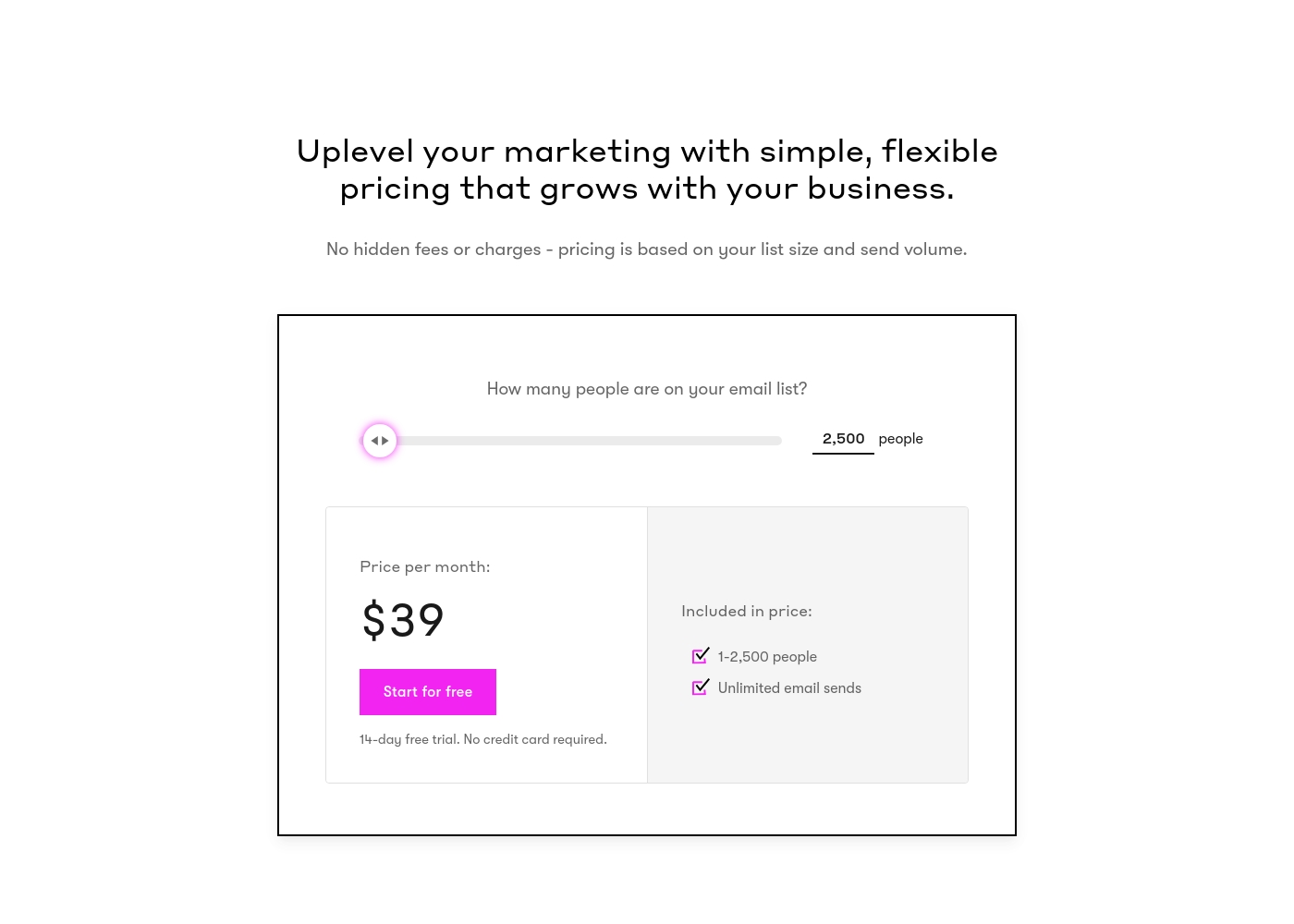
Drip pricing: Drip offers a flexible, usage-based subscription starting at $39/month for up to 2,500 people. Pricing scales based on your email list size and includes a 14-day free trial with no credit card required to start browsing its powerful automation tools tool and visual builder.
Your monthly cost increases as your audience grows, but you always get features like unlimited email sends and onsite campaigns. This ensures you only pay for what you actually use while accessing expert support and pre-built marketing playbooks right from the start.
You can cancel your subscription at any time within your billing settings if your business needs change. This model is specifically designed for e-commerce brands looking for deep segmentation and personalized customer journeys without enterprise-level complexity or hidden fees.
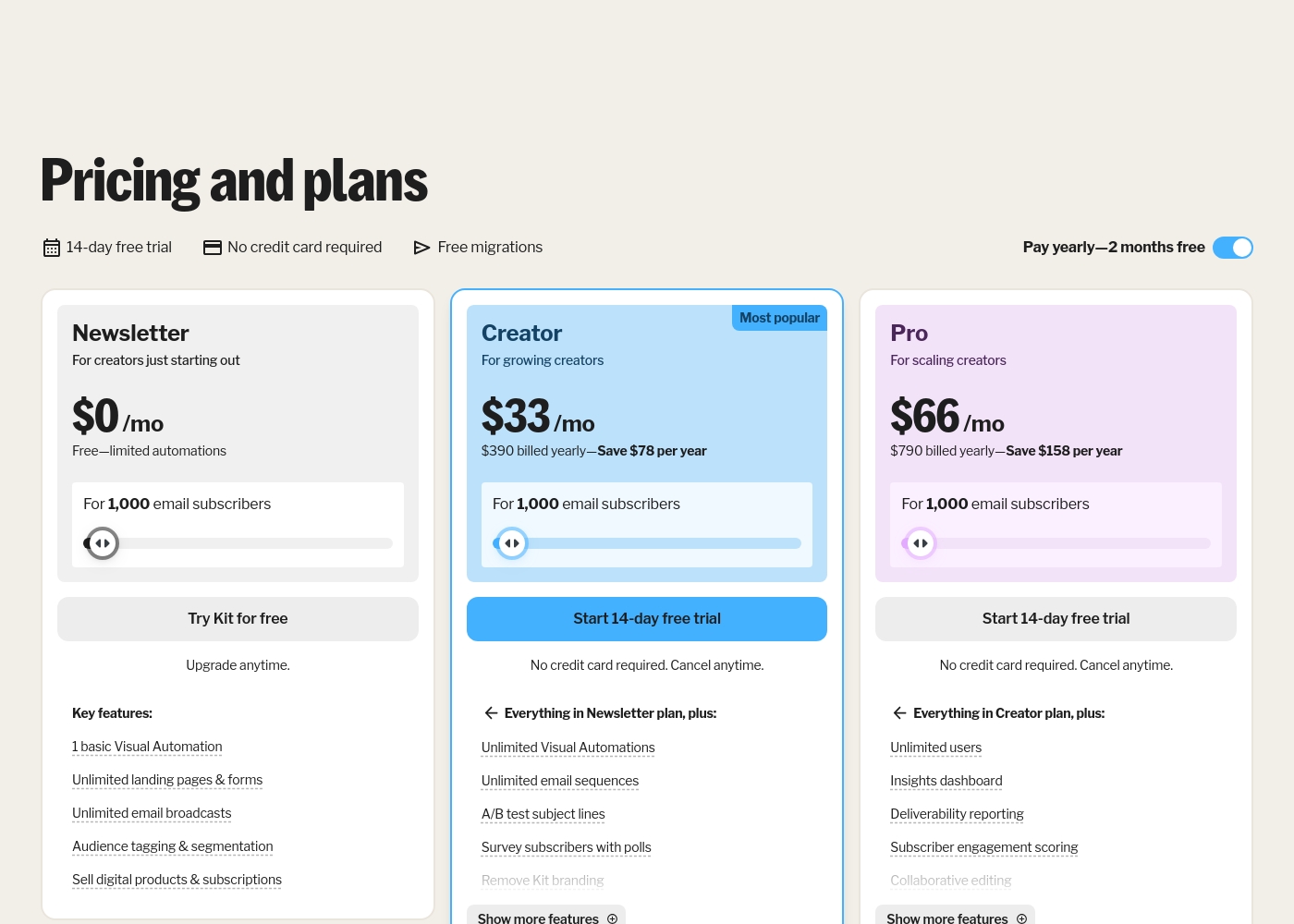
Kit (formerly ConvertKit) costs between $0 and $790 per year for 1,000 subscribers with 3 plans: Newsletter at $0, Creator at $390 billed yearly, and Pro at $790 billed yearly.
Take a look at the breakdown below to see which features fit your current creative goals.
Newsletter
Price: $0 per month Websites Supported: Not explicitly stated Best For: New creators starting out Refund Policy: Not explicitly stated Other Features: Unlimited landing pages, Audience tagging, Digital product sales, 1 basic Visual Automation
- 1 basic Visual Automation
- Unlimited landing pages & forms
- Unlimited email broadcasts
- Audience tagging & segmentation
- Sell digital products & subscriptions
- Everything in Newsletter plan
- Unlimited Visual Automations
- Unlimited email sequences
- A/B test subject lines
- Remove Kit branding
- Everything in Creator plan
- Unlimited users
- Insights dashboard
- Deliverability reporting
- Newsletter referral system
Pricing Notes
- Drip's pricing starts at $39/month for up to 2,500 contacts and scales based on list size and send volume. There's no free plan.
- Kit (formerly ConvertKit) has a free Newsletter plan for up to 10,000 subscribers, but it lacks automation sequences.
- Kit (formerly ConvertKit)'s paid plans (Creator at $39/mo, Pro at $79/mo for 1,000 subscribers) offer a 14-day free trial.
- Drip's 14-day free trial requires no credit card and gives full feature access (but not unlimited sends).
- Kit (formerly ConvertKit) charges a 3.5% + $0.30 transaction fee on all digital product sales.
- Both platforms can become expensive as your subscriber/contact list grows significantly.
Pricing Head-to-Head
사용자 리뷰
We found a mixed bag of user sentiment from Trustpilot, as the Capterra link was inaccessible. Reviews praise Drip's powerful automation and segmentation for driving revenue, with many noting its ease of use for e-commerce.
💡 On the downside, several users report frustration with customer support responsiveness and occasional platform glitches. Pricing is frequently cited as a concern, with some feeling the cost can escalate quickly as contacts grow.
Drip's automation tools are top-notch. We set up abandoned cart sequences that really boosted our recovery rate. The visual builder makes it easy to see the customer journey.
On Trustpilot, Kit (formerly ConvertKit) receives mixed feedback. Users frequently praise its ease of use, highlighting a simple, intuitive interface perfect for creators and beginners.
Many appreciate the automation features and clean design for emails and landing pages. However, a significant number of reviews cite poor customer support, with long response times and unhelpful agents.
ConvertKit is super easy to use. I love how simple it is to set up automations and sequences without any tech headaches. It's perfect for my newsletter.
우리의 판정
For most e-commerce brands, Drip is the clear winner. It's built to turn your store's data into automated sales. For creators building an audience from scratch, Kit (formerly ConvertKit) is the simpler, more affordable choice. Drip's superpower is its deep integration with online stores. It excels at automated cart recovery and behavior-based sequences. This directly impacts your bottom line by recovering lost revenue. Kit (formerly ConvertKit)'s superpower is creator simplicity. It gives you everything you need to grow, email, and sell to an audience without the complexity. It's designed for you to focus on creating. The deciding factor is your business model. If you sell physical or digital goods through a store, choose Drip. If you're an individual creator building a personal brand, choose Kit (formerly ConvertKit). Go with Drip if you run an online store and need marketing automation tied to sales data. Go with Kit (formerly ConvertKit) if you're a creator who wants a simple hub to grow and email your audience.
자주 묻는 질문
Which is better for small teams: Drip or Kit (formerly ConvertKit)?
It depends on your business. For a small e-commerce team, Drip is better. For a solo creator or a small content team, Kit (formerly ConvertKit) is simpler and more affordable. Kit (formerly ConvertKit)'s free plan is ideal for getting started with no cost.
Can I migrate from Kit (formerly ConvertKit) to Drip easily?
Yes, Drip offers free migration for lists over 17,500 contacts. Their team helps transfer your data and set up initial workflows. For smaller lists, you can use their self-serve guides.
Does Drip have landing pages like Kit (formerly ConvertKit)?
No, Drip does not include built-in landing pages. Its focus is on email automation for existing audiences. Kit (formerly ConvertKit) offers unlimited landing pages and forms on all plans, including its free tier.
Is Kit (formerly ConvertKit) worth the extra cost over Drip for creators?
For most creators, yes. Kit (formerly ConvertKit) includes tools creators need—like digital product sales and audience recommendations—that Drip lacks. The cost is for a complete creator platform, not just email.
Which tool has better customer support?
Reviews for both are mixed. Kit (formerly ConvertKit) offers 24/7 support on paid plans. Drip offers email support to all, with live chat on plans over $99/month. Neither has a flawless reputation.
Can I sell digital products with Drip?
No, Drip is an email automation platform, not a storefront. You would need to use a separate tool to sell and then integrate it with Drip. Kit (formerly ConvertKit) has built-in digital product sales.
선택할 준비가 되셨나요?
두 도구 모두 강점이 있습니다. 특정 요구 사항에 따라 선택하세요.