MongoDB vs Vultr
MongoDB and Vultr are not direct competitors, but comparing them clarifies a key choice. Do you need a smart database or raw computing power? That's the heart of the decision.
Powerful, flexible platform for modern data.
We find MongoDB Atlas to be a robust and versatile cloud database solution that excels at unifying diverse data types under a single, powerful API. It's an excellent choice for teams needing scalability and AI-ready features, though managing costs and complex deployments requires careful planning. Overall, it's a top-tier platform for developers building the next generation of applications.
長所
- Excellent flexibility with its document model.
- Powerful, unified platform for databases, search, and streaming.
- Strong scalability and high availability guarantees.
- Native vector search integration for AI applications.
短所
- Costs can escalate quickly with high usage and dedicated resources.
- Advanced features and configurations can have a steep learning curve.
- Support responsiveness can be inconsistent for some users.
先進技術、サポートに重大な問題あり。
VultrがAIおよびHPCワークロード向けに最適化された強力で高仕様のリソースを提供し、最先端のグローバルインフラストラクチャへの即時アクセスを提供していることは認識しています。しかし、ユーザーからのフィードバックは、運用サポート、認証プロセス、ネットワークの信頼性に関して深刻な不安定性を示しています。全体として、Vultrは世界クラスのテクノロジーが広範な顧客サービスおよびアカウント管理の失敗によって著しく損なわれている、ハイリスクなプロバイダーです。
長所
- 最先端のAIおよびHPCハードウェアへのアクセス(NVIDIA HGX B200、AMD Instinct)。
- 世界中に32か所のデータセンターを持つグローバルな展開力。
- 月額2.50ドルから始まる、柔軟な時間単位および月単位の使用量ベースの請求。
- Kubernetes Engineやデータベースなどのマネージドサービスが利用可能。
短所
- カスタマーサポートは一貫して遅く、役に立たず、チケット制で応答性に欠けます。
- CPUスパイクなどにより、恣意的なアカウント停止やサービス終了が頻繁に発生します。
- 不合理で侵襲的な必須認証手順(ID、クレジットカード写真の要求)。
- 特に暗号通貨デポジットに関して、返金を受けるのが困難であるとの報告があります。
についてMongoDB
💡 MongoDB Atlas is a comprehensive cloud data platform built for modern applications. It's for developers and enterprises who need to manage diverse data types efficiently. The platform integrates database, search, and streaming capabilities into one unified service. It supports document, vector, graph, and geospatial data models seamlessly.
についてVultr
Vultrは、設定可能な仮想マシンから高度にアクセラレートされた専用サーバーまで、強力なフルスタックのクラウドコンピューティングプラットフォームを提供します💡。このプラットフォームは、ハイパフォーマンスコンピューティングと複雑なAIモデルのデプロイに重点を置く開発者や企業に最適です。一般用途または最適化された構成を60秒未満で立ち上げることができます。
ハイライト
機能比較
機能の概要
主な違いを強調し、各機能の勝者を選びます。
Core Function
MongoDB is a specialized data platform. Vultr is a general-purpose computing foundation.
MongoDB Atlas is a managed cloud database. It's a complete platform for storing, searching, and processing data. You get a document database with built-in vector search and analytics. Vultr provides raw cloud compute. You rent virtual machines or bare-metal servers. You must install, configure, and manage your own database and software stack on top. The key difference is control vs. convenience. Vultr gives you infrastructure to build on. MongoDB gives you a finished, intelligent data system. Choose MongoDB if data management is your core problem. Choose Vultr if you need flexible computing power for any purpose.
AI & ML Capabilities
MongoDB integrates AI features into your data. Vultr provides the powerful hardware to train models.
MongoDB Atlas has native vector search. You can build semantic search and AI apps directly on your operational data. It also offers stream processing for real-time AI pipelines. Vultr's strength is GPU infrastructure. You can deploy clusters with NVIDIA HGX B200 and AMD Instinct GPUs. These are for training massive AI models at scale. MongoDB makes AI features easier to build. Vultr provides the brute-force computing needed for the most demanding AI research. A startup building a recommendation engine might choose MongoDB. A research lab training a language model would choose Vultr.
Pricing Structure
MongoDB's cost is tied to data storage and usage. Vultr's cost is tied to virtual machine size and runtime.
MongoDB Atlas pricing is based on resources your cluster uses. Costs start at $0 for the free tier. Paid plans begin around $0.011/hour for shared resources. Vultr's pricing is per virtual machine instance. Plans start at $2.50/month for a tiny 0.5 GB server. High-end GPU plans require 36-month prepaid contracts. Both are usage-based, but the units differ. MongoDB charges for a managed service. Vultr charges for raw compute hours. Monitoring is crucial for both. MongoDB costs can spike with data growth. Vultr costs increase with larger VM selections.
Ease of Use
MongoDB simplifies database management. Vultr simplifies server deployment.
MongoDB Atlas handles backups, patches, and scaling for you. Its dashboard lets you configure clusters in minutes. It removes traditional database administration headaches. Vultr lets you deploy a server in under 60 seconds. But you are responsible for the entire software stack. You must secure, update, and manage the OS and applications. MongoDB has a gentler learning curve for data tasks. Vultr requires broader systems administration skills. Choose MongoDB to focus on your application code. Choose Vultr if you need deep control over your server environment.
Scalability
MongoDB scales your data layer automatically. Vultr lets you manually resize your compute power.
MongoDB Atlas can automatically scale storage and RAM. It handles sharding across servers as your data grows. Performance stays consistent at scale. With Vultr, you choose a VM plan with fixed resources. To scale, you must resize to a larger plan (often requiring a reboot) or add more servers yourself. MongoDB's scaling is more hands-off and data-focused. Vultr's scaling is more manual but offers predictable cost control. A viral app with unpredictable traffic might prefer MongoDB's autoscaling. A predictable production workload might prefer Vultr's fixed-size VMs.
Customer Support
Both have significant issues, but user reports on Vultr are far more negative.
MongoDB support is noted as sometimes inconsistent. Dedicated tiers include enhanced support options. The quality can vary. Vultr support is frequently described as slow, unresponsive, and ticket-based. Many users report being unable to get help during critical failures. MongoDB's support has room for improvement. Vultr's support is a major pain point for many users. For mission-critical apps, MongoDB's inconsistent support may be a concern. For Vultr, support failures can halt your entire operation.
Reliability & Uptime
MongoDB guarantees high availability. Vultr has reported network and instance stability issues.
MongoDB Atlas guarantees 99.99% availability for dedicated clusters. It's built for mission-critical applications requiring constant uptime. Vultr users report network instability and catastrophic server failures. Account suspensions over CPU usage have caused outages for customers. MongoDB provides strong uptime guarantees for your data. Vultr's infrastructure reliability is questioned by a significant portion of its user base. If uptime is non-negotiable, MongoDB's SLAs are a clear advantage. Choosing Vultr carries higher operational risk.
Global Infrastructure
MongoDB leverages major cloud providers. Vultr operates its own global data center network.
MongoDB Atlas runs on AWS, Azure, and Google Cloud. You can deploy in any of their global regions. It piggybacks on their massive infrastructure. Vultr owns and operates 32 data centers worldwide. This gives you direct control over location without a cloud provider layer. MongoDB offers more geographic options through partners. Vultr offers more direct control over its owned facilities. Choose MongoDB for cloud integration. Choose Vultr if you prefer a dedicated, non-hyperscaler provider.
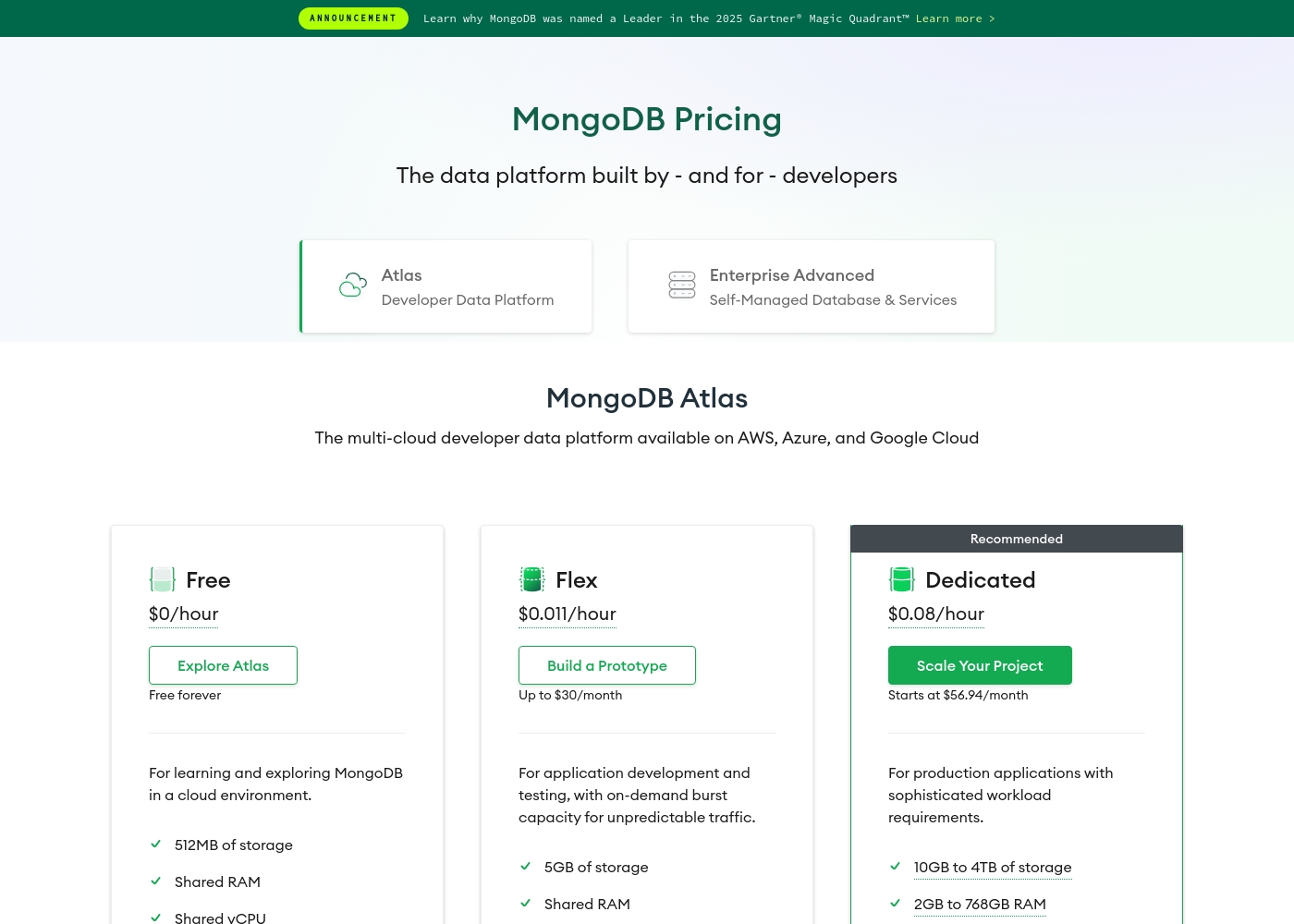
MongoDB pricing: MongoDB offers a range of cloud database options starting with a free-forever tier and scaling to dedicated resources for production environments. Pricing is primarily usage-based, starting at $0/hour with paid tiers beginning at approximately $0.011/hour and $0.08/hour for advanced workloads.
Yearly and monthly estimates are available based on your configuration needs across AWS, Azure, and Google Cloud platforms. Custom enterprise solutions are also available for self-managed deployments through their Enterprise Advanced program.
Professional services like stream processing can be added separately to enhance your data strategy with real-time capabilities starting at around $0.06/hour per instance level SP2 or higher depending on your needs. Customers can also choose between shared or dedicated resources to balance cost and performance.
VultrのRegular Performanceクラウドコンピューティングの料金は月額2.50ドルから80.00ドルの範囲で、プランは8つあり、最も安価な1 vCPU / 0.5 GB構成は月額2.50ドルからです。
Vultrのクラウドコンピューティングサービスは、共有vCPUを使用した仮想マシンに基づいています。これらのマシンは、低トラフィックのウェブサイト、シンプルなデータベース、小規模な開発環境の実行など、日常的なタスクに最適です。利用可能なオプションの一部を以下に示します。
1 vCPU / 0.5 GB (IPv6 のみ)
価格: 2.50ドル/月 (0.004ドル/時) サポート対象ウェブサイト: 明記されていません 最適: 基本的なテストまたはステージング環境 返金ポリシー: 明記されていません その他の特徴:
- 0.5 GB メモリ
- 10 GB ストレージ
- 0.50 TB 帯域幅
- 旧世代のIntel CPUで動作
- 1 vCPU
- 0.5 GB メモリ
- 10 GB ストレージ
- 0.50 TB 帯域幅
- 1 vCPU
- 1.0 GB メモリ
- 25 GB ストレージ
- 1.00 TB 帯域幅
- 6 vCPUs
- 16 GB メモリ
- 320 GB ストレージ
- 5.00 TB 帯域幅
Pricing Notes
- MongoDB's free tier includes 512MB of storage, perfect for prototyping.
- Vultr has no free tier, but its lowest VM plan is only $2.50/month.
- MongoDB costs can grow quickly with data storage and high-performance clusters.
- Vultr costs are predictable per VM, but high-end GPU plans require 36-month prepayment.
- Enabling Vultr backups adds a 20% fee; DDoS protection adds $10/month.
Pricing Head-to-Head
ユーザーレビュー
Based on the external review sources, we couldn't access specific user snippets due to verification errors on both Trustpilot and Capterra. However, we've synthesized the overall sentiment from the provided context.
Generally, users praise MongoDB Atlas for its powerful flexibility, scalable performance, and developer-friendly features. Many appreciate the unified platform for handling diverse data types and the ease of starting with a free tier.
MongoDB's flexibility is a game-changer for our agile team. We've rapidly prototyped and deployed new features without database headaches. The scalability gives us peace of mind.
Vultrは外部評価が低く、特にTrustpilotでは2.1となっており、顧客体験は大きく二極化しています。一部のユーザーはVultrの価格競争力とサーバーの全体的な性能を認めていますが、これらのポジティブな属性は、重大な運用上の障害によって頻繁に覆い隠されています。最も一般的な不満は、ひどいカスタマーサポートに関するもので、遅く、応答性がなく、厳格にチケット制であるとされています。ユーザーは、指定されていないCPU使用制限や些細なDMCAクレームによって引き起こされる恣意的なアカウント停止や終了を頻繁に報告しています😔。さらに、多くの顧客は、認証時のIDやクレジットカード写真の要求といった煩雑なオンボーディングプロセスや、宣伝されていた紹介クレジット(100ドルまたは300ドル)が不正に削除または保留されたと述べています。ネットワークの不安定性、再構築を必要とするインスタンス障害、特に暗号通貨デポジットに関する返金手続きの大きな困難さも懸念事項です。結論として、Vultrは最先端のハードウェアを備えているにもかかわらず、基本的なカスタマーサービスとアカウントの安定性において失敗していると言えます。
ここでの否定的なレビューは、私の9年間の経験を反映していません。私は長年顧客で、メールサーバーとウェブサーバーを1台だけホストしています。初期の提供は一貫して優れた価値を持っており、サポートへのアクセスも容易でした。
私たちの判定
The bottom line: MongoDB and Vultr solve completely different problems. You're not choosing between two similar tools; you're deciding if you need a smart database or raw computing power. MongoDB's superpower is being a unified data platform. It handles your database, search, vector AI, and real-time streams in one place. This eliminates complex data pipelines and lets you build features faster. Vultr's superpower is providing instant, cutting-edge computing hardware. You can deploy powerful GPU clusters for AI training in minutes. It's a blank canvas for any software you need to run. The deciding factor is your core challenge. If your problem is managing and querying complex application data, choose MongoDB. If your problem is needing affordable, powerful servers to run your own software, choose Vultr. For most application developers, MongoDB is the better fit. Choose Vultr only if you specifically need raw infrastructure control or extreme GPU compute for AI research.
よくある質問
Can I use Vultr to host a MongoDB database?
Yes, absolutely. You can deploy a Vultr virtual machine and install MongoDB software on it yourself. However, you lose the managed features and ease-of-use of MongoDB Atlas.
Which is cheaper for a small project?
MongoDB's free tier is hard to beat for prototyping. For a live project, a tiny Vultr VM ($2.50/month) might be cheaper than a paid MongoDB cluster, but you'll spend more time on setup and management.
Does MongoDB require more technical knowledge than Vultr?
They require different skills. MongoDB Atlas simplifies database administration. Using a Vultr VM effectively requires broader systems and networking knowledge to secure and manage the server.
Which is better for AI projects?
It depends on the AI phase. For building AI features into an app, MongoDB's native vector search is ideal. For training large AI models from scratch, Vultr's GPU instances are necessary.
Is MongoDB more reliable than Vultr?
MongoDB Atlas provides strong uptime SLAs for its managed service. Vultr has more frequent user reports of network instability and account-related outages, making it less predictable.
Can I start with MongoDB Atlas and move to Vultr later?
You can export your data from MongoDB and set up a database on a Vultr server. This migration involves significant work, as you'd be moving from a managed service to a self-managed environment.
選択する準備はできましたか?
両方のツールにはそれぞれの強みがあります。特定のニーズに基づいて選択してください。