Google Cloud vs MongoDB
Choosing between Google Cloud and MongoDB can be tough. One is a massive cloud infrastructure provider, while the other is a specialized data platform. Here's how to decide which one fits your project.
強力なインフラストラクチャ、しかし請求とサポートにリスクあり。
Google Cloud は、強力な AI 統合とエンタープライズ ワークロードのスケーリングのための重要な機能を提供する最先端のインフラストラクチャを提供していると認識しています。しかし、アクセス不能なカスタマーサポートと混乱を招く不透明な請求に関する多数の報告は非常に懸念されます。全体として、応答性の高いヘルプやきめ細かなコスト管理を優先するユーザーにとって、このプラットフォームはハイリスクであると見なしています。
長所
- Gemini や Vertex AI などのトップクラスの生成 AI ツールへのアクセス。
- オープンソース、マルチクラウド、ハイブリッド開発戦略をサポート。
- 新規ユーザーはサインアップ時に 300 ドルの無料クレジットを受け取る。
- コミットメント割引により最大 57% の節約が可能になる可能性がある。
短所
- カスタマーサービスサポートはアクセスしにくく、隠されていることが多い。
- クレジットを保有しているにもかかわらず、不透明な請求や予期せぬ請求が発生するという報告がユーザーからある。
- 技術サポートサブスクリプションのコストが非常に高い(月額最大 12,500 ドル)。
- 従量課金サービスに対する厳密な支出制限がないことが一般的な懸念点である。
Powerful, flexible platform for modern data.
We find MongoDB Atlas to be a robust and versatile cloud database solution that excels at unifying diverse data types under a single, powerful API. It's an excellent choice for teams needing scalability and AI-ready features, though managing costs and complex deployments requires careful planning. Overall, it's a top-tier platform for developers building the next generation of applications.
長所
- Excellent flexibility with its document model.
- Powerful, unified platform for databases, search, and streaming.
- Strong scalability and high availability guarantees.
- Native vector search integration for AI applications.
短所
- Costs can escalate quickly with high usage and dedicated resources.
- Advanced features and configurations can have a steep learning curve.
- Support responsiveness can be inconsistent for some users.
についてGoogle Cloud
Google Cloud は、150 以上の製品と機能を提供する包括的なクラウドプラットフォームです。既存のインフラストラクチャを最新化したり、AI 駆動の新しいアプリケーションをゼロから構築したりするのに役立ちます。このサービスは、デジタルで成長・変革する準備ができている開発者、ビジネスリーダー、スタートアップ向けに設計されています。
新規のお客様は、20 以上の製品を無料で試すことができます。さらに、探索を支援するためにサインアップ時に 300 ドルの無料クレジットを受け取れます。💡
についてMongoDB
💡 MongoDB Atlas is a comprehensive cloud data platform built for modern applications. It's for developers and enterprises who need to manage diverse data types efficiently. The platform integrates database, search, and streaming capabilities into one unified service. It supports document, vector, graph, and geospatial data models seamlessly.
ハイライト
機能比較
機能の概要
主な違いを強調し、各機能の勝者を選びます。
Core Purpose
Google Cloud is a vast cloud infrastructure platform. MongoDB is a specialized data platform.
Google Cloud offers over 150 products. You can run everything from VMs to AI models. It's like renting a supercomputer. MongoDB Atlas focuses on your data layer. It manages your database, search, and streams. It's like having a dedicated, expert DBA. The difference is scope vs. specialization. Google Cloud provides the entire toolbox. MongoDB excels at one critical tool. For a startup building a full app, Google Cloud provides the foundation. For a team optimizing a data-heavy feature, MongoDB is targeted.
AI & Data Analytics
Google Cloud has massive AI/ML and analytics suites. MongoDB has native vector search for AI apps.
Google Cloud's Vertex AI and BigQuery are industry leaders. You can build models with 200+ foundation models. BigQuery runs petabyte-scale analytics. MongoDB's strength is unifying data and vectors. You can store operational data and embeddings together. This simplifies building AI features like semantic search. Google Cloud offers a broader, more complex AI platform. MongoDB makes specific AI workflows simpler. One is a comprehensive lab, the other a focused workbench. Choose Google Cloud for custom model training. Choose MongoDB for integrating AI into your existing app's data flow.
Database Flexibility
Google Cloud offers multiple managed databases. MongoDB offers one highly flexible document database.
Google Cloud provides Cloud SQL, Spanner, Firestore, and more. You pick the right tool for each job. This can mean managing multiple systems. MongoDB uses a single document model for all data. The same API handles operational, graph, and geospatial data. This reduces context switching. Google Cloud gives you specialized databases. MongoDB gives you one versatile database. It's the difference between a Swiss Army knife and a full workshop. For apps with diverse data types in one service, MongoDB is seamless. For needing different database engines, Google Cloud has options.
Real-time Processing
Google Cloud uses multiple services for streams. MongoDB has integrated stream processing.
Google Cloud handles streams with Dataflow, Pub/Sub, and others. It's powerful but requires configuring separate services. This adds architectural complexity. MongoDB Atlas Stream Processing is built in. You use the same query language for streams and batches. This creates a unified developer experience. Google Cloud offers more scalable, global streaming. MongoDB offers simplicity and integration. One is built for massive scale, the other for developer velocity. For processing Kafka streams alongside your app data, MongoDB is simpler. For global, high-throughput event processing, Google Cloud has dedicated tools.
Ease of Getting Started
Both have generous free tiers. Google Cloud has a steeper initial learning curve.
Google Cloud gives $300 in credits and 20+ free products. However, its console can feel slow and complex. New users report difficulty with simple tasks. MongoDB offers a free-forever tier with 512 MB. The Atlas interface is focused and generally intuitive. Many developers find its document model natural. Google Cloud's scale means more to learn upfront. MongoDB's focus makes its core product more approachable. One is a sprawling city, the other a well-organized campus. Your choice depends on your role. A cloud architect might embrace Google Cloud's scope. An app developer might prefer MongoDB's streamlined data focus.
Cost Management
Google Cloud offers committed discounts but billing can be unclear. MongoDB costs scale with resource usage.
Google Cloud's pricing is usage-based with potential for 57% savings. Users complain about non-transparent billing and unexpected charges. Support for cost limits is a pain point. MongoDB's costs scale with storage and compute hours. Users note costs can escalate quickly with high usage. Monitoring your usage is crucial in both cases. Google Cloud has more discount levers but more billing complexity. MongoDB's model is simpler but can surprise you. Both require vigilant monitoring. For predictable, committed workloads, Google Cloud's discounts help. For variable workloads, MongoDB's pay-as-you-go is straightforward.
Customer Support
Google Cloud support is expensive and hard to reach. MongoDB support is included in paid tiers.
Google Cloud's technical support can cost up to $12,500/month. Free users report support is hidden and nearly impossible to contact. This is a major frustration. MongoDB's Dedicated tiers include enhanced support. Users report mixed experiences but availability is better. SLAs are tied to your pricing tier. Google Cloud's paid support is enterprise-grade but costly. MongoDB's included support is more accessible for mid-market. The difference in accessibility is stark. If you're a large enterprise, Google Cloud's support might be justified. For smaller teams, MongoDB's included support is a significant advantage.
Vendor Lock-in Risk
Google Cloud promotes multicloud. MongoDB is an open-source based platform.
Google Cloud actively supports hybrid and multicloud strategies. They offer tools to manage apps across clouds. This reduces lock-in to their specific infrastructure. MongoDB's core is open source. You can run it on-premise or other clouds. Atlas is a managed service on AWS, Azure, and GCP. Google Cloud sells infrastructure flexibility. MongoDB sells data portability. Both address lock-in from different angles. If you fear infrastructure lock-in, Google Cloud's stance is reassuring. If you fear data lock-in, MongoDB's open-source core is a plus.
Google Cloud の費用は、使用ベースの支払い構造を採用しているため大きく異なります。新規顧客には 300 ドルの無料クレジットと 20 以上の無料製品へのアクセスが提供されます。
ここでは固定の月額プランはなく、プラットフォームの計算リソースを利用するための 3 つの柔軟な方法があります。
ペイ・アズ・ユー・ゴー(標準価格設定)
価格:明記されていません(使用量ベース) サポート対象ウェブサイト:明記されていません 最適:柔軟なスケーリングを必要とするあらゆる規模の組織 返金ポリシー:明記されていません その他の機能:
- 使用したサービスに対してのみ支払います。
- 前払いや解約手数料はありません。
- コミットメント割引で最大 57% の節約が可能になります。
- 無料の 24 時間年中無休の請求サポートが含まれます。
- 使用したサービスに対してのみ支払う
- 前払いや解約手数料なし
- コミットメント割引で最大 57% 節約
- 無料の 24 時間年中無休の請求サポート
- 300 ドルの無料クレジット
- 20 以上の製品を無料で利用可能
- ワークロードの実行、テスト、デプロイ
- 最大 350,000 ドルのクラウドクレジット
- カスタマイズされたサポートとソリューション
- 革新的な企業向けのスケーリングサポート
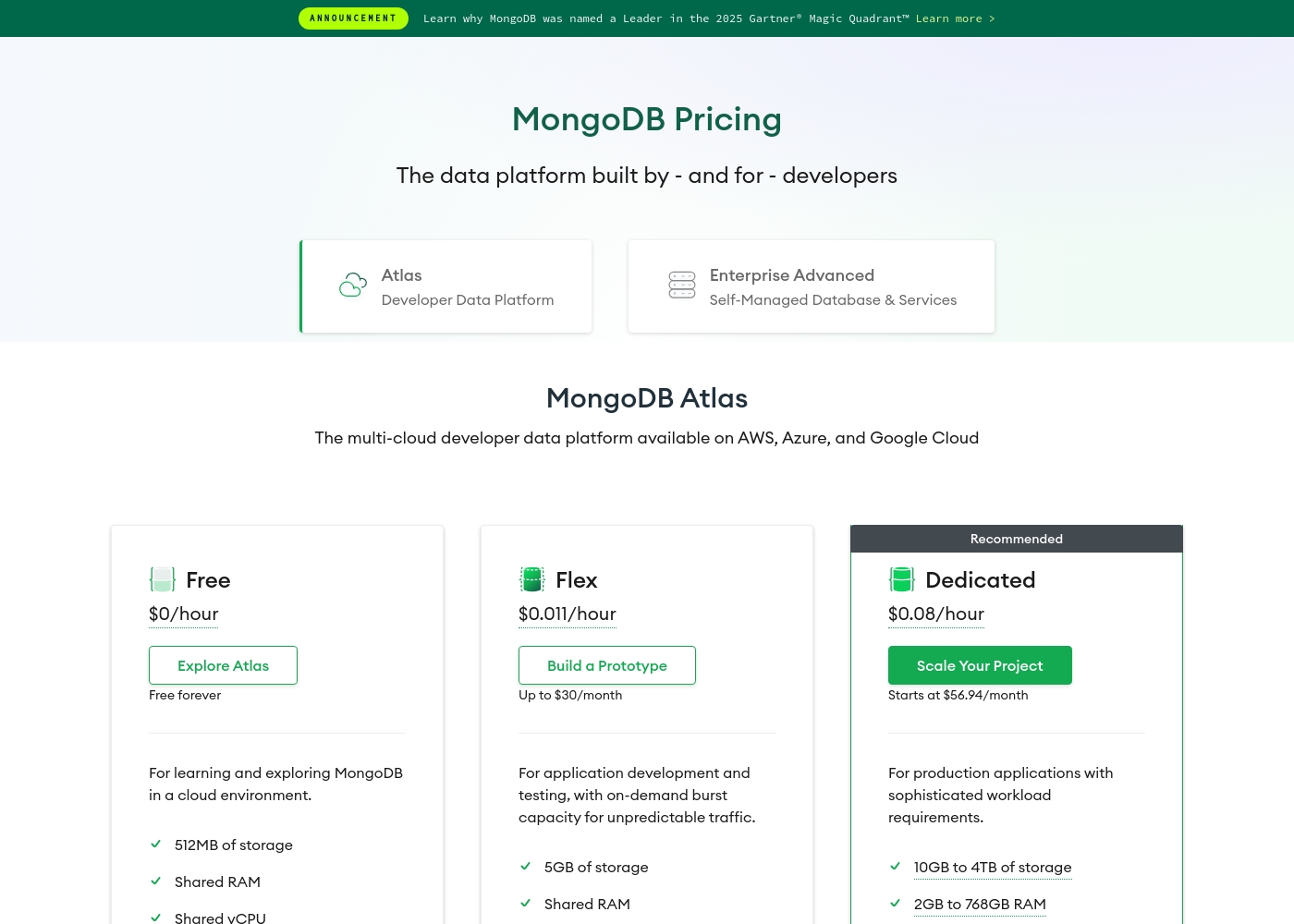
MongoDB pricing: MongoDB offers a range of cloud database options starting with a free-forever tier and scaling to dedicated resources for production environments. Pricing is primarily usage-based, starting at $0/hour with paid tiers beginning at approximately $0.011/hour and $0.08/hour for advanced workloads.
Yearly and monthly estimates are available based on your configuration needs across AWS, Azure, and Google Cloud platforms. Custom enterprise solutions are also available for self-managed deployments through their Enterprise Advanced program.
Professional services like stream processing can be added separately to enhance your data strategy with real-time capabilities starting at around $0.06/hour per instance level SP2 or higher depending on your needs. Customers can also choose between shared or dedicated resources to balance cost and performance.
Pricing Notes
- Google Cloud offers $300 in free credits for new customers, while MongoDB has a free-forever tier.
- Google Cloud's technical support is extremely expensive, costing up to $12,500 per month.
- MongoDB's costs scale with cluster resources (storage, RAM, vCPUs), which can escalate quickly.
- Both platforms use usage-based pricing, making it hard to predict costs without careful monitoring.
- Google Cloud provides committed use discounts up to 57% for predictable workloads.
Pricing Head-to-Head
ユーザーレビュー
Trustpilot で主に収集された外部の感情は圧倒的に否定的であり、非常に悪い 1.5 つ星評価につながっています。最も頻繁に挙げられる問題点は、不透明な請求と完全に機能しないカスタマーサポートに関するものです⚠️。ユーザーは、多額の無料クレジットを保有しているにもかかわらず、予期せぬ請求が発生し、それが数百ドルに上る場合があると報告しています。多くの人が、これを新規ユーザーを食い物にするために設計された「意図的な罠」だと感じています。さらに、ヘルプを得ることはほぼ不可能です。ユーザーはサポートが意図的に隠されており、到達不可能で、彼らをイライラする無限ループに陥らせると述べています。技術的なヘルプを必要とする人は、専門的な技術サポートが月に数千ドルもかかるため、法外な料金に直面します。
利用可能な 264 ドルの無料クレジット(使用されなかった)があったにもかかわらず、私の С アカウントでは 327 ユーロの API 料金が発生しました。サポートは完全に隠されており、アクセスできず、意図的な罠のように見えます。このプラットフォームは極めて不透明な価格構造をしています。
Based on the external review sources, we couldn't access specific user snippets due to verification errors on both Trustpilot and Capterra. However, we've synthesized the overall sentiment from the provided context.
Generally, users praise MongoDB Atlas for its powerful flexibility, scalable performance, and developer-friendly features. Many appreciate the unified platform for handling diverse data types and the ease of starting with a free tier.
MongoDB's flexibility is a game-changer for our agile team. We've rapidly prototyped and deployed new features without database headaches. The scalability gives us peace of mind.
私たちの判定
This isn't a simple apples-to-apples comparison. Google Cloud is the full cloud platform. MongoDB is the specialized data platform. Google Cloud's superpower is its sheer scale. It offers everything from world-class AI with Vertex AI to massive analytics with BigQuery. It's your partner for the entire infrastructure stack. MongoDB's superpower is data unification. It seamlessly blends operational data, vector search, and streaming into one system. This simplifies building complex, data-rich applications dramatically. The deciding factor is your core need. If you need a comprehensive cloud foundation, Google Cloud is the answer. If your biggest challenge is managing and querying diverse application data, MongoDB is your tool. For a startup building from scratch, Google Cloud provides the full toolkit. For a team trying to make their app's data layer smarter and faster, MongoDB delivers targeted power.
よくある質問
Which is better for small teams: Google Cloud or MongoDB?
MongoDB often wins for small teams focused on their app's database. Its free-forever tier and focused interface are easier to start with. Google Cloud's $300 credit is generous, but its platform can feel overwhelming.
Does Google Cloud have a database like MongoDB?
Yes, Google Cloud offers Firestore and Cloud Datastore as document databases. They serve similar use cases to MongoDB. However, MongoDB's core platform is built entirely around this document model and its associated features.
Is MongoDB worth the extra cost over Google Cloud?
It's not about extra cost, but about value for your specific need. MongoDB's cost is for a specialized data platform. Google Cloud's costs are for a broad infrastructure suite. If you only need a powerful database, MongoDB's pricing can be more predictable.
Can I use Google Cloud and MongoDB together?
Yes, absolutely. You can run MongoDB Atlas as a managed service on Google Cloud infrastructure. This is a common pattern, combining Google's infrastructure with MongoDB's specialized database.
Which is easier to learn for a developer?
Many developers find MongoDB's document model and query API more intuitive initially. Google Cloud requires learning a vast array of services and concepts. The learning curves serve different goals: app development vs. infrastructure management.
Which platform is better for AI applications?
It depends on the AI task. For training custom models at scale, Google Cloud's Vertex AI is more powerful. For adding semantic search or AI features to an app using your existing data, MongoDB's native vector search is simpler.
選択する準備はできましたか?
両方のツールにはそれぞれの強みがあります。特定のニーズに基づいて選択してください。