Engine vs MongoDB
Engine and MongoDB solve very different problems. Engine is a free travel platform for business teams, while MongoDB is a powerful database for developers. The right choice depends entirely on whether you're booking hotels or building apps.
Best for: Construction crews needing to book group hotel travel, Event planners managing conference lodging blocks
Best for: Software developers building modern applications, Enterprises needing a scalable cloud database
A free, solid platform for basic travel management.
We find Engine delivers on its core promise of being a free, all-in-one travel platform for businesses. It excels at consolidating bookings, billing, and reporting to save time and money. Overall, it's a strong, no-cost option for teams needing straightforward travel logistics, though it may lack advanced customization for complex needs.
長所
- Truly free core platform with no contracts or hidden fees.
- Saves significant time by centralizing flights, hotels, and car bookings.
- Users report savings of up to 60% through exclusive corporate rates.
- Consolidated DirectBill invoicing simplifies expense tracking.
短所
- Optional FlexPro upgrade for maximum flexibility has undisclosed pricing.
- Some users mention occasional slow or inconsistent customer support.
- Travel inventory may be limited for certain specific dates or locations.
- Reporting and policy controls, while present, may be basic for larger enterprises.
Powerful, flexible platform for modern data.
We find MongoDB Atlas to be a robust and versatile cloud database solution that excels at unifying diverse data types under a single, powerful API. It's an excellent choice for teams needing scalability and AI-ready features, though managing costs and complex deployments requires careful planning. Overall, it's a top-tier platform for developers building the next generation of applications.
長所
- Excellent flexibility with its document model.
- Powerful, unified platform for databases, search, and streaming.
- Strong scalability and high availability guarantees.
- Native vector search integration for AI applications.
短所
- Costs can escalate quickly with high usage and dedicated resources.
- Advanced features and configurations can have a steep learning curve.
- Support responsiveness can be inconsistent for some users.
についてEngine
Engine is an all-in-one travel management platform for businesses. It helps companies book, manage, and track travel for teams, crews, or groups. Whether you're in construction, events, or the public sector, it centralizes your bookings and spending. 💡
についてMongoDB
💡 MongoDB Atlas is a comprehensive cloud data platform built for modern applications. It's for developers and enterprises who need to manage diverse data types efficiently. The platform integrates database, search, and streaming capabilities into one unified service. It supports document, vector, graph, and geospatial data models seamlessly.
ハイライト
機能比較
機能の概要
主な違いを強調し、各機能の勝者を選びます。
Core Platform
Engine is a complete travel management system. MongoDB is a comprehensive cloud data platform.
Engine provides an all-in-one platform to book flights, hotels, and rental cars. It includes tools for expense tracking, reporting, and policy enforcement. Everything is designed for business travel logistics. MongoDB Atlas is a unified cloud service for operational data, vector search, and streaming. It uses a flexible document model and a single query API. It's built for developers building modern applications. The key difference is domain: Engine handles physical travel bookings, while MongoDB manages digital data and application infrastructure.
Pricing Model
Engine is free for users. MongoDB charges based on resource usage.
Engine's Standard plan is completely free. Hotels pay a commission for bookings. There are no contracts, subscription fees, or minimum spends required from your business. MongoDB starts with a free-forever tier (512MB). Paid tiers are usage-based, starting around $0.011/hour. Costs scale with storage and compute resources you consume. Engine's model is simple and risk-free for travelers. MongoDB's model requires careful monitoring to avoid unexpected cloud bills.
Scalability
Engine scales for team size. MongoDB scales for data volume and performance.
Engine is designed for businesses of all sizes. It can handle bookings for individuals, small crews, or large enterprise teams. The focus is on managing growing travel programs. MongoDB Atlas guarantees millisecond response times and 99.99% availability. It scales from gigabytes to petabytes of data. Dedicated tiers offer up to 96 vCPUs and 768GB RAM. Engine scales horizontally for more users. MongoDB scales vertically and horizontally for more data and higher throughput.
Ease of Use
Engine aims for simplicity in travel booking. MongoDB has a steeper learning curve.
Engine is built for straightforward travel booking. The interface is described as intuitive, letting managers book for crews in minutes. Setup involves creating an account and inviting travelers. MongoDB is powerful but complex. Features like vector search and stream processing require technical knowledge. The document model is flexible but different from traditional SQL databases. Engine is simpler for its specific purpose. MongoDB requires developer expertise to leverage its full potential.
Customer Support
Both offer support, but responsiveness can vary for each platform.
Engine provides 24/7 live U.S.-based support. User reviews generally praise the team as responsive and helpful, though some mention occasional delays during peak times. MongoDB offers support that varies by tier. Dedicated plans may include enhanced options. Reviews indicate support quality can be inconsistent, with some users experiencing quick help and others delays. Neither platform guarantees perfect support. Engine's reviews seem slightly more positive on this specific aspect.
Integration Ecosystem
Engine connects with workplace tools. MongoDB integrates with development technologies.
Engine mentions 'streamlined integrations' to connect with ERP, HR, and other workplace tools. The specific list of platforms is not detailed on their site. MongoDB Atlas integrates with over 100 technologies. This includes cloud providers, data pipelines, and developer tools. It's designed to fit into complex tech stacks. Engine's integrations are for business operations. MongoDB's integrations are for software development and data architecture.
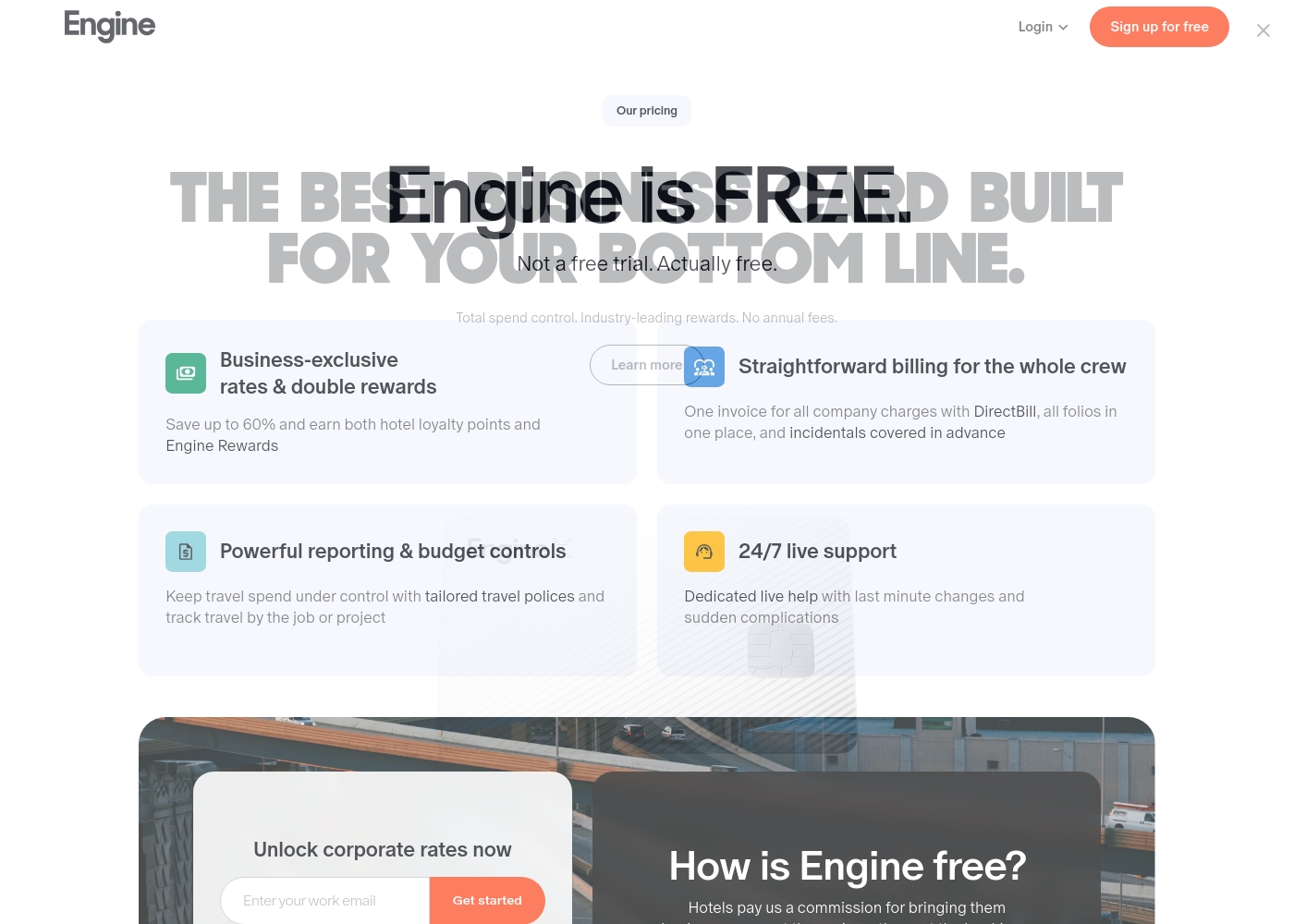
Engine costs $0 with 1 plan: Standard at $0 per month.
See how our free platform helps your business save on every trip.
Standard
Price: $0 per month Best For: Businesses and crews of all sizes Other Features: Exclusive rates up to 60% off, consolidated billing via DirectBill, 24/7 live support, Engine Rewards and hotel points, budget controls and reporting
- Save up to 60% on rates
- Earn hotel points and Engine Rewards
- Consolidated DirectBill invoicing
- 24/7 live support
- Travel policies and reporting
- Cancel until noon day-of check-in
- Pay only for nights used
- Unlimited changes
- No blackout dates
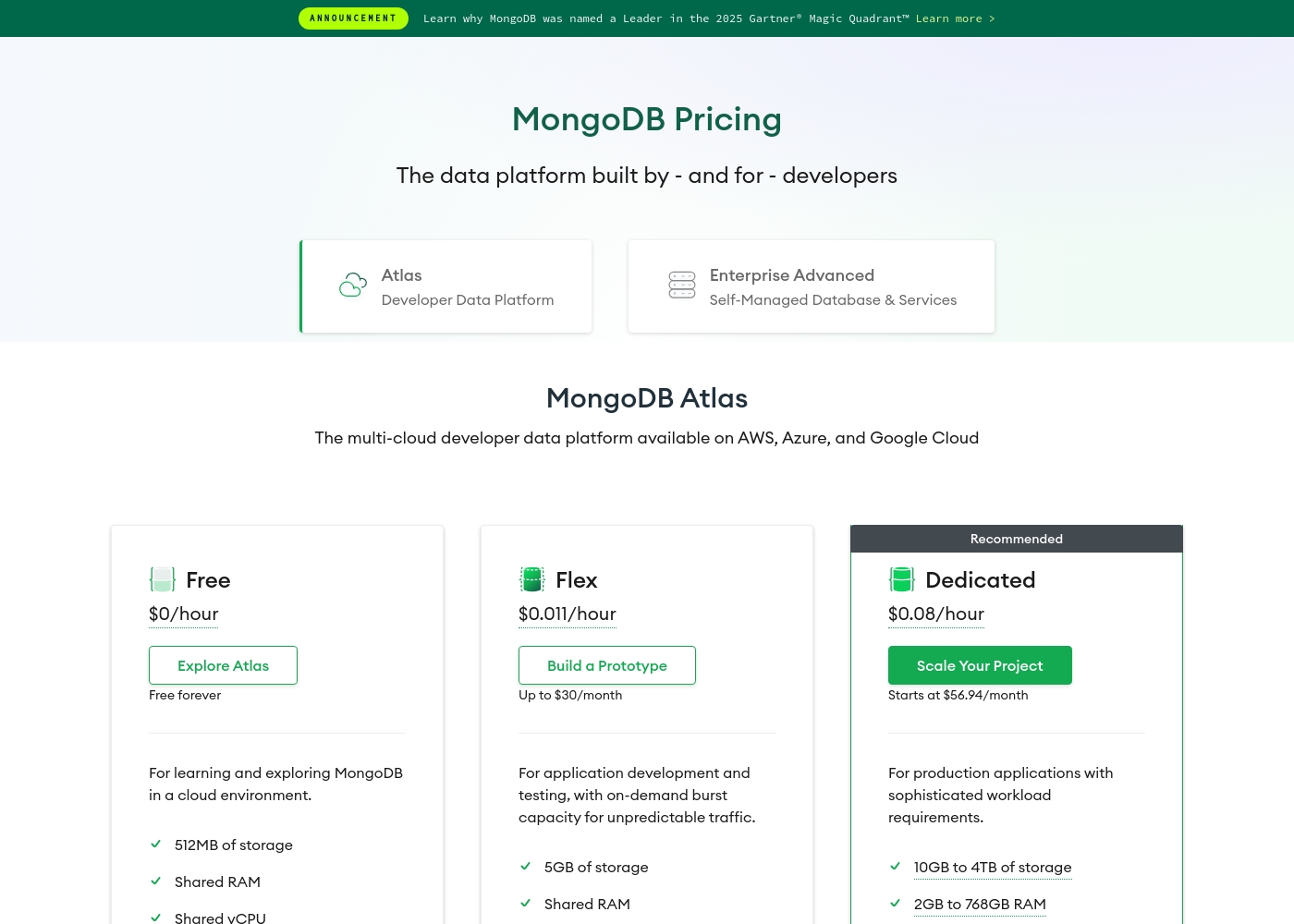
MongoDB pricing: MongoDB offers a range of cloud database options starting with a free-forever tier and scaling to dedicated resources for production environments. Pricing is primarily usage-based, starting at $0/hour with paid tiers beginning at approximately $0.011/hour and $0.08/hour for advanced workloads.
Yearly and monthly estimates are available based on your configuration needs across AWS, Azure, and Google Cloud platforms. Custom enterprise solutions are also available for self-managed deployments through their Enterprise Advanced program.
Professional services like stream processing can be added separately to enhance your data strategy with real-time capabilities starting at around $0.06/hour per instance level SP2 or higher depending on your needs. Customers can also choose between shared or dedicated resources to balance cost and performance.
Pricing Notes
- Engine's core platform is entirely free. The optional FlexPro upgrade for cancellation flexibility has undisclosed pricing.
- MongoDB's free tier includes 512MB storage. Costs can escalate quickly with high usage of dedicated resources.
- Engine's value is immediate cost savings on travel. MongoDB's value is in scalable infrastructure for applications.
- MongoDB offers custom enterprise solutions. Engine's free model is designed for businesses of all sizes.
Pricing Head-to-Head
ユーザーレビュー
Based on external review platforms, Engine consistently earns praise for its truly free model and ease of use. Users highlight the significant cost savings (up to 60% off) and the simplicity of having all bookings and billing in one place.
The support team is frequently described as responsive and helpful. However, some reviewers note occasional issues with customer service response times and limited inventory for specific dates or locations.
Engine has been a game-changer for booking travel for our field crews. The interface is simple, and the savings on hotels are real. Consolidated billing makes my accounting life so much easier.
Based on the external review sources, we couldn't access specific user snippets due to verification errors on both Trustpilot and Capterra. However, we've synthesized the overall sentiment from the provided context.
Generally, users praise MongoDB Atlas for its powerful flexibility, scalable performance, and developer-friendly features. Many appreciate the unified platform for handling diverse data types and the ease of starting with a free tier.
MongoDB's flexibility is a game-changer for our agile team. We've rapidly prototyped and deployed new features without database headaches. The scalability gives us peace of mind.
私たちの判定
Choosing between Engine and MongoDB is like comparing a hotel concierge to a data architect. They solve completely different problems. Engine's superpower is making business travel simple and free. You get exclusive rates up to 60% off, consolidated billing, and a dashboard for your whole team. It eliminates expense reports and saves real money on trips. MongoDB's superpower is flexible, scalable data infrastructure. It unifies databases, vector search, and streaming into one platform. Developers build AI apps and real-time systems faster without juggling multiple tools. The deciding factor is your need. If you're managing travel for a team, Engine saves time and money instantly. If you're building software that needs a powerful data layer, MongoDB is the foundation. For business travel, pick Engine. For application development, pick MongoDB. Don't use a database to book hotels or a travel tool to run your app. Choose the right tool for the job.
よくある質問
Can I use Engine to build a database-driven application?
No. Engine is specifically a travel management platform. It helps book flights, hotels, and cars. For building applications with a database, you need MongoDB Atlas.
Is MongoDB cheaper than Engine for my small business?
It depends on your need. Engine is free for travel management. MongoDB's free tier is for prototyping. If your small business needs a database, MongoDB costs based on usage. If you need travel management, Engine is free.
Does Engine have AI features like MongoDB's vector search?
No. Engine focuses on travel logistics and savings. MongoDB Atlas includes native vector search for building AI applications like semantic search and recommendation engines.
Which is easier for a non-technical team to set up?
Engine is significantly easier. Its interface is designed for booking travel. MongoDB requires developer knowledge to set up clusters, configure databases, and manage data models.
Can MongoDB help me track my company's travel expenses?
Not directly. MongoDB is a database platform. You could theoretically build a custom app on MongoDB to track expenses, but Engine provides this functionality out-of-the-box with its travel platform.
Which tool offers better guarantees for uptime and performance?
MongoDB Atlas offers explicit SLAs up to 99.99% availability and millisecond response times. Engine's site mentions 24/7 support but does not state specific uptime guarantees for its platform.
選択する準備はできましたか?
両方のツールにはそれぞれの強みがあります。特定のニーズに基づいて選択してください。