BLACKBOX AI vs MongoDB
BLACKBOX AI and MongoDB tackle completely different parts of building software. BLACKBOX AI automates coding tasks with AI agents. MongoDB is a cloud database platform for storing and managing data. It's not a direct apples-to-apples comparison.
Best for: Development teams looking to automate repetitive coding tasks, Projects needing to compare solutions from multiple AI models
Best for: Developers building modern web, mobile, or real-time applications, Teams needing a flexible database for diverse data types (documents, vectors, graphs)
Powerful automation with unproven reliability.
We find BLACKBOX AI to be a feature-rich platform with ambitious automation for the full development lifecycle. Its multi-agent approach and broad integration options are compelling. Overall, we see strong potential for teams seeking AI-driven speed, but we await broader user validation to confirm its real-world support and value.
長所
- Comprehensive automation from scaffolding to deployment.
- Multi-agent system for parallel task execution and evaluation.
- Wide accessibility via CLI, IDE, cloud, and API.
- Built-in safety features like security checks and schema validation.
短所
- Lack of verified user reviews for real-world reliability assessment.
- Complex multi-agent workflows may have a steep learning curve.
- Enterprise pricing and onboarding details are not fully transparent.
Powerful, flexible platform for modern data.
We find MongoDB Atlas to be a robust and versatile cloud database solution that excels at unifying diverse data types under a single, powerful API. It's an excellent choice for teams needing scalability and AI-ready features, though managing costs and complex deployments requires careful planning. Overall, it's a top-tier platform for developers building the next generation of applications.
長所
- Excellent flexibility with its document model.
- Powerful, unified platform for databases, search, and streaming.
- Strong scalability and high availability guarantees.
- Native vector search integration for AI applications.
短所
- Costs can escalate quickly with high usage and dedicated resources.
- Advanced features and configurations can have a steep learning curve.
- Support responsiveness can be inconsistent for some users.
についてBLACKBOX AI
💡 BLACKBOX AI is an enterprise-grade agent platform for software development. 🤖 It lets you run autonomous coding agents from a single API, your terminal, IDE, or the cloud.
Whether you use Claude Code, Codex, or its own models, the platform orchestrates them to compete, collaborate, and complete tasks like refactoring, testing, and deployment.
についてMongoDB
💡 MongoDB Atlas is a comprehensive cloud data platform built for modern applications. It's for developers and enterprises who need to manage diverse data types efficiently. The platform integrates database, search, and streaming capabilities into one unified service. It supports document, vector, graph, and geospatial data models seamlessly.
ハイライト
機能比較
機能の概要
主な違いを強調し、各機能の勝者を選びます。
Core Function
BLACKBOX AI automates coding tasks. MongoDB stores and manages application data.
BLACKBOX AI uses autonomous agents to handle entire development tasks like refactoring, testing, and deployment. It's designed to speed up the coding process. MongoDB Atlas is a comprehensive data platform. It unifies operational data, vector search, and stream processing into one service for building applications. The key difference is their fundamental role. BLACKBOX AI is a development tool, while MongoDB is the data layer for your application. This distinction is crucial. You might use both in a project: BLACKBOX AI to write code that interacts with a MongoDB database.
AI & Automation
BLACKBOX AI is built around multi-agent AI automation. MongoDB integrates AI for data queries.
BLACKBOX AI's core feature is its parallel multi-agent system. It dispatches the same task to multiple AI models simultaneously and uses a 'Chairman LLM' to select the best solution. MongoDB's AI integration is native vector search. This allows you to build semantic search and generative AI applications by storing and querying vector embeddings alongside your data. BLACKBOX AI uses AI to perform developer tasks. MongoDB uses AI to enable intelligent features within the applications you build. For a practical example: BLACKBOX AI could write the code for a recommendation engine. MongoDB would then store the user and product data and perform the vector search for recommendations.
Target User
BLACKBOX AI targets software developers. MongoDB targets developers building data-heavy apps.
BLACKBOX AI is built for development teams and individual developers. It aims to automate repetitive tasks like writing boilerplate code, fixing bugs, and handling deployments. MongoDB is also for developers, but specifically those building applications that need a flexible, scalable database. It's popular for web, mobile, and real-time applications. The overlap is that both serve developers. The divergence is their focus: BLACKBOX AI on the development process itself, MongoDB on the application's data foundation. A solo developer might use BLACKBOX AI to speed up their work. A startup building a new social app would likely choose MongoDB to store user profiles and posts.
Deployment & Access
BLACKBOX AI is a cloud platform accessed via CLI/IDE/API. MongoDB Atlas is a managed cloud database.
BLACKBOX AI provides multiple access points: a CLI for terminals, IDE extensions like VS Code, a cloud dashboard, and a REST API. This lets you run agents from anywhere. MongoDB Atlas is accessed through database drivers, SDKs, and a web dashboard. Your application code connects to the database cluster to read and write data. BLACKBOX AI's interfaces are for controlling the AI agents. MongoDB's interfaces are for your application to interact with its data. Think of it this way: you use BLACKBOX AI to build your app. Your app uses MongoDB to store its information.
Pricing Structure
BLACKBOX AI uses per-seat usage-based pricing. MongoDB Atlas is usage-based on resources.
BLACKBOX AI's pricing starts at $8/month for individuals, with plans scaling by features and team size. It's a subscription model with usage-based elements for AI model credits. MongoDB Atlas has a free tier. Paid plans are usage-based, charging per hour for compute and storage resources, with costs starting at $0.011/hour. BLACKBOX AI's pricing ties to the number of users and AI agent usage. MongoDB's pricing scales directly with your database's resource consumption. A small team could have predictable costs with BLACKBOX AI's plan. MongoDB's costs could vary significantly based on your application's traffic and data growth.
Learning Curve
BLACKBOX AI's multi-agent workflows may be complex. MongoDB has a steep curve for advanced features.
BLACKBOX AI involves learning a new paradigm of autonomous agents and orchestration. Setting up complex parallel workflows and understanding the 'Chairman LLM' evaluation requires investment. MongoDB Atlas is designed for developers, but mastering advanced features like vector search, stream processing, and performance tuning at scale has a learning curve. Cost management also requires knowledge. Both tools have complexity at advanced levels. BLACKBOX AI's complexity is in its unique AI automation approach. MongoDB's complexity is in its powerful, diverse data platform features. For a simple use case, like adding search to an app, MongoDB might be quicker to start. For automating a legacy code refactoring, BLACKBOX AI's agent setup might be the steeper path.
Scalability
BLACKBOX AI scales agent workflows. MongoDB scales data storage and query performance.
BLACKBOX AI offers scalable pricing and a 99.997% uptime SLA for its cloud platform. It's designed to handle parallel agent execution efficiently. MongoDB Atlas provides guaranteed millisecond response times at scale. It scales from a free 512MB tier to dedicated clusters with up to 4TB storage and massive RAM/CPU resources. The scalability focus is different. BLACKBOX AI scales the *process* of development automation. MongoDB scales the *performance and storage* of your application's data. A growing e-commerce site would rely on MongoDB to handle increasing product catalogs and user traffic. BLACKBOX AI's scalability ensures their development pipeline remains fast as their team and codebase grow.
Integration Ecosystem
BLACKBOX AI integrates with 35+ developer tools. MongoDB integrates with 100+ technologies via drivers.
BLACKBOX AI integrates with a wide range of IDEs (VS Code, etc.), plus Slack, Figma, and offers a full REST API for custom workflows. It's focused on the development toolchain. MongoDB has drivers and SDKs for virtually every major programming language and framework. It integrates with the broader data and application ecosystem, including tools for BI and data visualization. BLACKBOX AI's ecosystem is about connecting to where developers work. MongoDB's ecosystem is about connecting to how applications are built and where data is processed. You'd integrate BLACKBOX AI into your CI/CD pipeline or editor. You'd integrate MongoDB into your application's backend service code.
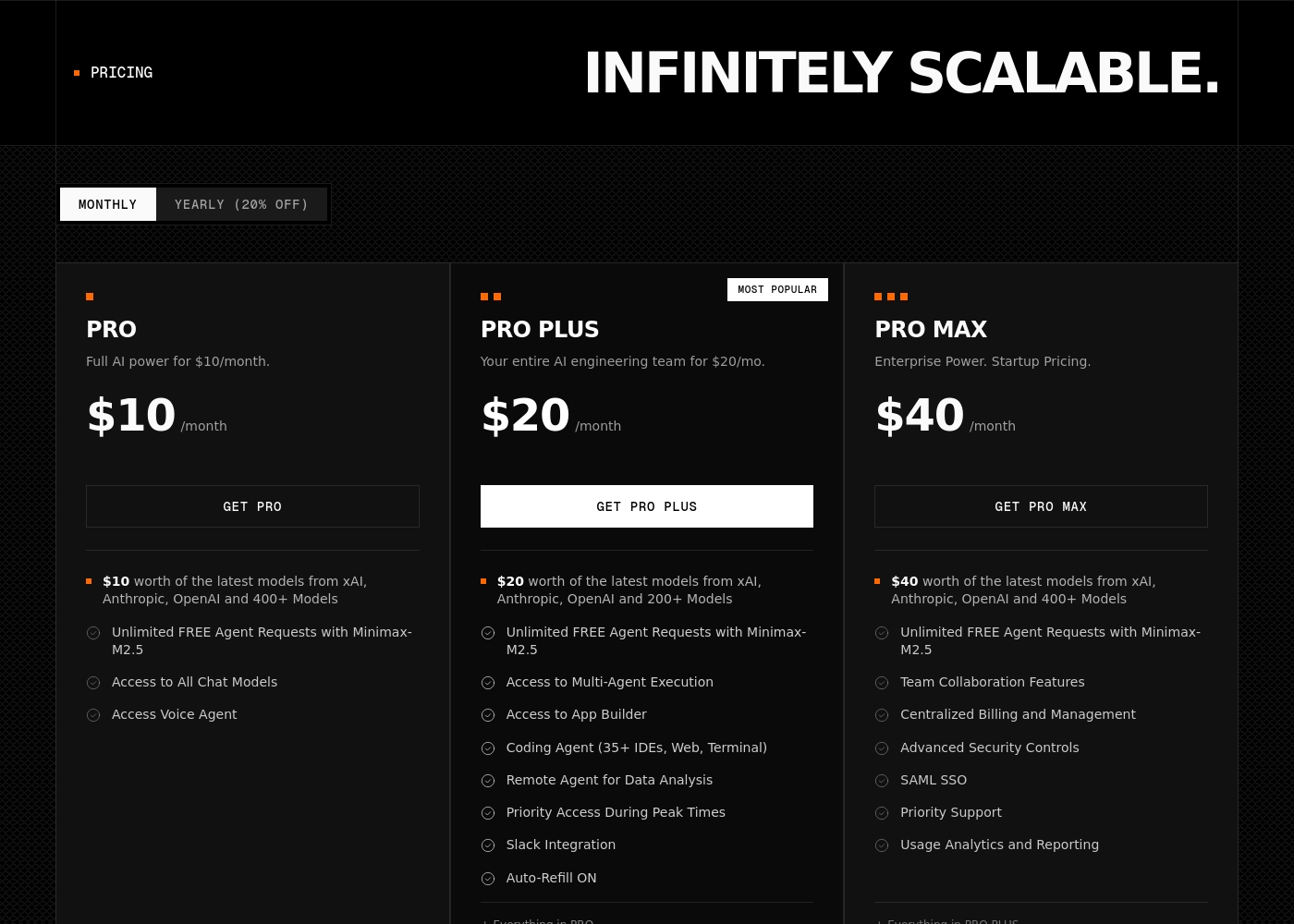
BLACKBOX AI pricing: BLACKBOX AI offers scalable subscription plans starting at $8/month (billed annually) for individual developers and teams. Professional tiers vary by feature access, with custom enterprise solutions available for larger organizations needing on-premise deployment and advanced security controls. Plans range: 2–35 Billing options: Usage-based pricing
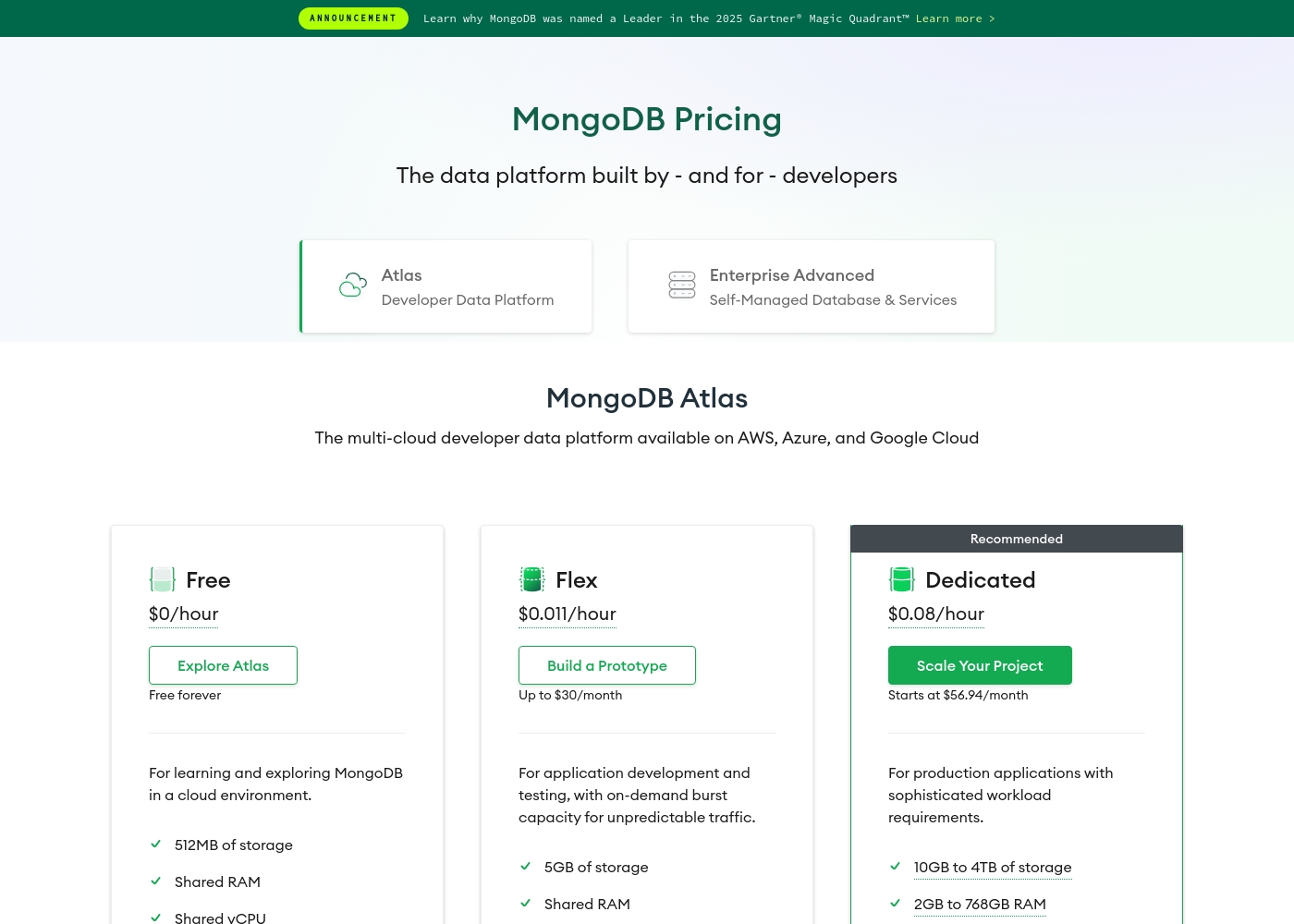
MongoDB pricing: MongoDB offers a range of cloud database options starting with a free-forever tier and scaling to dedicated resources for production environments. Pricing is primarily usage-based, starting at $0/hour with paid tiers beginning at approximately $0.011/hour and $0.08/hour for advanced workloads.
Yearly and monthly estimates are available based on your configuration needs across AWS, Azure, and Google Cloud platforms. Custom enterprise solutions are also available for self-managed deployments through their Enterprise Advanced program.
Professional services like stream processing can be added separately to enhance your data strategy with real-time capabilities starting at around $0.06/hour per instance level SP2 or higher depending on your needs. Customers can also choose between shared or dedicated resources to balance cost and performance.
Pricing Notes
- BLACKBOX AI's pricing starts at $8/month for individuals, scaling with features and team size.
- MongoDB Atlas offers a free-forever tier with 512MB storage, making it very accessible for prototyping.
- BLACKBOX AI's costs include credits for AI model usage, which could vary with agent activity.
- MongoDB Atlas costs scale directly with cloud resources (storage, compute hours), requiring careful monitoring to avoid surprises.
- Enterprise solutions for both require contacting sales for custom quotes.
Pricing Head-to-Head
ユーザーレビュー
Based on the available Trustpilot review snippet, the sentiment is currently inconclusive due to a verification error preventing full access to user feedback. ⚠️ This means we cannot synthesize specific recurring themes about accuracy, ease of use, or support. Our final rating will therefore rely primarily on our assessment of the platform's features and stated value proposition, as external review data is not accessible for a balanced analysis.
Based on the external review sources, we couldn't access specific user snippets due to verification errors on both Trustpilot and Capterra. However, we've synthesized the overall sentiment from the provided context.
Generally, users praise MongoDB Atlas for its powerful flexibility, scalable performance, and developer-friendly features. Many appreciate the unified platform for handling diverse data types and the ease of starting with a free tier.
MongoDB's flexibility is a game-changer for our agile team. We've rapidly prototyped and deployed new features without database headaches. The scalability gives us peace of mind.
私たちの判定
Here's the bottom line: BLACKBOX AI and MongoDB aren't competitors. They're tools for completely different jobs. BLACKBOX AI's superpower is automating the *process* of coding. It uses multiple AI agents to refactor code, write tests, and even handle deployments in parallel. If you're a developer drowning in repetitive tasks, it's a potential game-changer. MongoDB's superpower is being a rock-solid, flexible *data foundation*. It unifies your database, search, and streaming into one scalable platform. If your application needs to store and query varied data reliably, it's a top-tier choice. The deciding factor is your actual need. Are you trying to speed up your development workflow? Look at BLACKBOX AI. Do you need a database for your application? Look at MongoDB Atlas. In fact, you could use both! BLACKBOX AI could automate writing the code that connects to your MongoDB database. Choose the tool that solves your most pressing problem today: faster coding or better data management.
よくある質問
Can I use BLACKBOX AI to write code that interacts with MongoDB?
Yes. BLACKBOX AI is a coding automation tool. You could use its agents to generate code, including database schemas, queries, and application logic that connects to a MongoDB database. They serve complementary purposes in a development stack.
Is MongoDB better than BLACKBOX AI for storing user data?
For storing and managing application data like user profiles, yes. MongoDB is a database platform designed for that. BLACKBOX AI is an automation tool for coding tasks, not for storing your application's live data.
Which one is cheaper for a small startup?
It depends on your need. MongoDB Atlas offers a free-forever tier, which is excellent for prototyping. BLACKBOX AI's plans start at $8/month. If you only need database storage, MongoDB is cheaper to start. If you need coding automation, BLACKBOX AI is your only option of the two.
Does BLACKBOX AI have its own database?
No. BLACKBOX AI is a cloud platform that orchestrates AI coding agents. It doesn't provide database services for your application. For that, you'd use a dedicated database like MongoDB Atlas.
Which tool has better security features?
Both offer robust but different security. BLACKBOX AI includes automated code security scanning and offers on-premise deployment. MongoDB Atlas provides data encryption, access controls, and compliance certifications. The better choice depends if you're securing code generation or application data.
Is there a free trial for BLACKBOX AI?
The official site doesn't explicitly mention a free trial. Pricing starts at a monthly subscription. It's best to check their signup process directly for any introductory offers or free tier details.
選択する準備はできましたか?
両方のツールにはそれぞれの強みがあります。特定のニーズに基づいて選択してください。