Airia vs MongoDB
Airia and MongoDB are both powerful platforms, but they serve very different masters. Airia is an AI orchestration hub for building and governing AI agents. MongoDB is a versatile data platform for developers building modern applications. The choice hinges on whether your core problem is AI management or data infrastructure.
Best for: Enterprise teams needing to manage and govern multiple AI agents., Organizations with strict compliance requirements for AI usage.
Best for: Developers building modern, data-intensive applications., Teams requiring a flexible database for varied data models (documents, vectors, graphs).
Solid enterprise platform with clear governance.
We found Airia is a robust, unified platform for building and governing enterprise AI agents at scale. It emphasizes security, compliance, and integration with thousands of systems. Overall, it's a promising choice for organizations needing a single command center to reduce tool sprawl and manage AI responsibly.
長所
- Unified platform for AI orchestration, security, and governance.
- Connects to over 1,000 enterprise systems for rich context.
- Scalable from individuals to large enterprises with custom plans.
- Strong focus on built-in security and real-time compliance.
短所
- Public user reviews are currently inaccessible, limiting external validation.
- Advanced features like SSO and audit logs are locked to higher, costly tiers.
- Specific performance metrics like accuracy aren't detailed in provided context.
- Onboarding and integration depth may require dedicated setup time.
Powerful, flexible platform for modern data.
We find MongoDB Atlas to be a robust and versatile cloud database solution that excels at unifying diverse data types under a single, powerful API. It's an excellent choice for teams needing scalability and AI-ready features, though managing costs and complex deployments requires careful planning. Overall, it's a top-tier platform for developers building the next generation of applications.
長所
- Excellent flexibility with its document model.
- Powerful, unified platform for databases, search, and streaming.
- Strong scalability and high availability guarantees.
- Native vector search integration for AI applications.
短所
- Costs can escalate quickly with high usage and dedicated resources.
- Advanced features and configurations can have a steep learning curve.
- Support responsiveness can be inconsistent for some users.
についてAiria
Airia is an enterprise AI platform designed for organizations that need more than just innovation. It's a single solution that lets you build, deploy, and govern AI agents at scale. 🤖 It’s built for businesses across industries like manufacturing, education, and telecommunications. Whether you're a business user or a developer, Airia provides the tools to manage AI responsibly.
についてMongoDB
💡 MongoDB Atlas is a comprehensive cloud data platform built for modern applications. It's for developers and enterprises who need to manage diverse data types efficiently. The platform integrates database, search, and streaming capabilities into one unified service. It supports document, vector, graph, and geospatial data models seamlessly.
ハイライト
機能比較
機能の概要
主な違いを強調し、各機能の勝者を選びます。
Core Platform & Purpose
Airia is a command center for managing AI agents. MongoDB is a cloud database platform for building applications.
Airia provides a unified hub for the entire AI lifecycle. You can build, deploy, and govern AI agents from a single interface. It replaces a patchwork of disparate tools. MongoDB Atlas is a comprehensive cloud data platform. It unifies operational databases, vector search, and stream processing. It's built for developers to handle diverse data needs. The fundamental difference is scope. Airia manages AI *operations*. MongoDB manages your application's *data*.
Data Integration & Querying
Airia connects AI to external enterprise systems. MongoDB provides a single API to query all your data models.
Airia's strength is integration. It securely connects AI agents to thousands of external systems like CRMs, databases, and SaaS tools for real-time context. MongoDB offers a powerful, unified query API. You use the same language to query documents, run vector searches, or process streams. It's built for developer efficiency. Airia pulls data *in* for AI. MongoDB provides a flexible way to store, search, and analyze data *within* its own ecosystem.
AI & Machine Learning Capabilities
Airia focuses on orchestrating AI agents. MongoDB provides the data foundation for building AI applications.
Airia is designed specifically for AI orchestration. It handles building, testing, deploying, and monitoring AI agents with governance baked in. It's for *running* AI at scale. MongoDB has native vector search and can store embeddings alongside operational data. This makes it excellent for *building* AI features like semantic search and recommendations. You might use MongoDB to store the data that powers an AI agent. You might then use Airia to orchestrate and govern that agent across the enterprise.
Scalability & Performance
Both offer enterprise-grade scalability. MongoDB provides explicit performance guarantees like 99.99% uptime.
Airia is built to scale AI deployments across large organizations. It manages increasing agent counts and execution loads without added complexity. MongoDB Atlas guarantees millisecond response times and 99.99% availability for its dedicated clusters. It's designed to serve millions of users reliably. Both platforms scale, but MongoDB's promises are more concrete for database performance. Airia's scalability is more about operational governance for AI.
Governance & Security
Airia has governance as a core feature. MongoDB provides standard database security and access controls.
Security and governance are central to Airia's value proposition. It offers risk controls, agent behavior management, audit trails, and policy enforcement. SSO is in the Enterprise tier. MongoDB Atlas provides essential data security: encryption, access controls, and compliance certifications. Detailed governance features are managed through cloud provider settings. Airia offers proactive, operational governance *for AI*. MongoDB focuses on securing the underlying data infrastructure.
User Interface & Experience
Airia offers a command center for AI teams. MongoDB's UI is geared towards developers managing databases.
Airia provides a dashboard for designing, deploying, and monitoring AI agents. It aims to be a single pane of glass for AI operations across teams. MongoDB Atlas has a web console for managing clusters, data, and configurations. Its primary interface is the developer-friendly query API and SDKs. The Airia UI is for AI management. The MongoDB UI is for database management. They serve fundamentally different workflows.
Learning Curve & Skillset
Airia caters to both business and technical users. MongoDB requires more developer expertise.
Airia offers no-code, low-code, and pro-code tools. This democratizes AI creation for business analysts and developers alike within the platform. MongoDB's power comes from its flexible document model and aggregation framework. Leveraging it fully typically requires a developer background and comfort with code. Airia lowers the barrier for AI *usage*. MongoDB's complexity is a feature for developers building sophisticated data logic.
Integration Ecosystem
Airia integrates with 1000s of external systems. MongoDB integrates with cloud services and data tools.
A key Airia feature is its integration framework. It's designed to connect to your existing SaaS, databases, and enterprise systems to feed context to AI agents. MongoDB integrates deeply with cloud platforms (AWS, Azure, GCP) and a broad ecosystem of developer tools. Its integrations are about data movement and application development. Airia connects *to* your tech stack. MongoDB is often a core *part* of your tech stack.
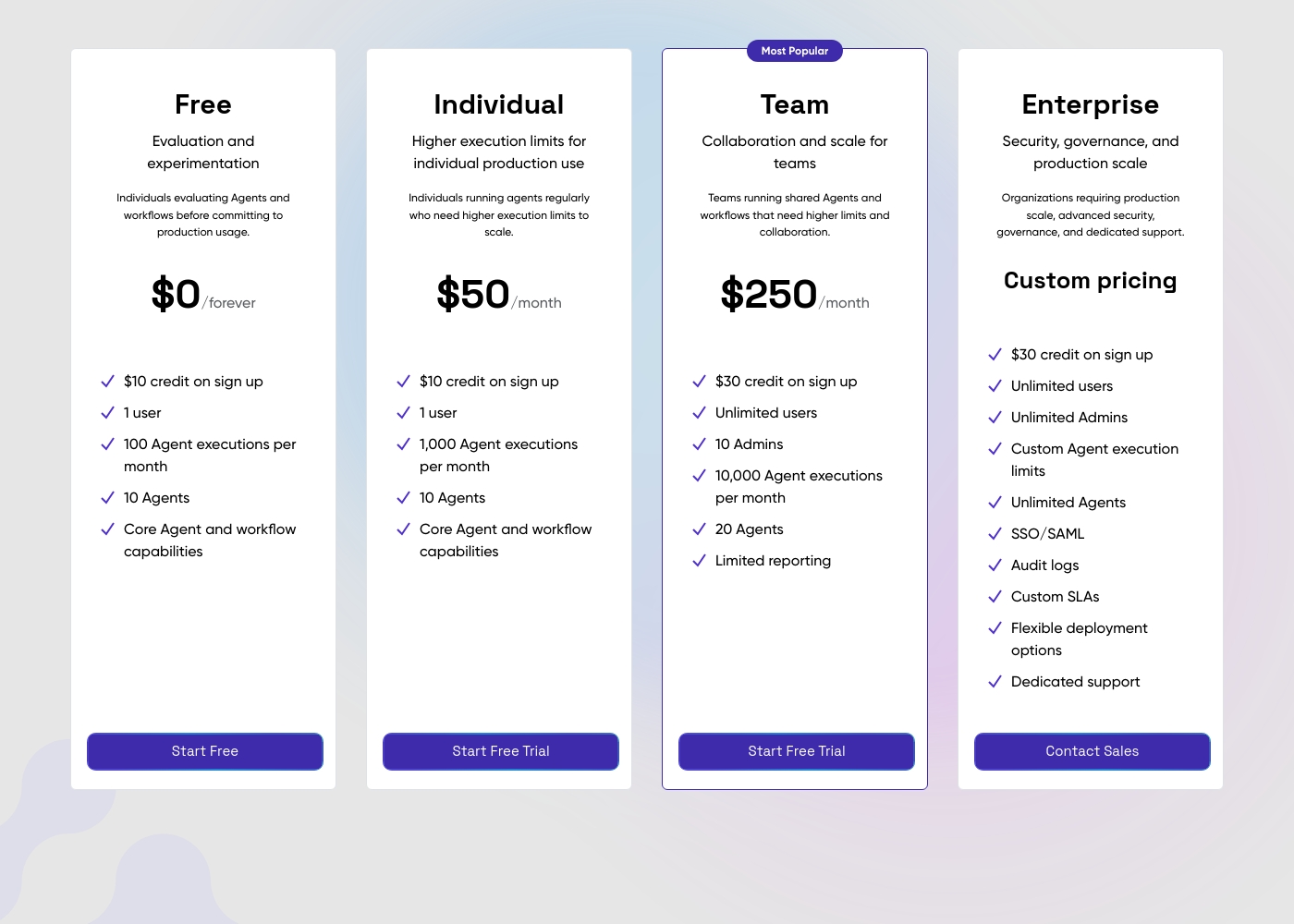
Airia costs between $0 and $250 per month with 4 plans: Free at $0, Individual at $50, Team at $250, and Enterprise at custom pricing.
Here is a breakdown of our current service tiers to help you find the best fit.
Free
Price: $0 /forever Best For: Individuals evaluating Agents and workflows before committing to production usage. Other Features: $10 credit on sign up, 1 user, 100 Agent executions per month, 10 Agents, Core Agent and workflow capabilities
- $10 credit on sign up
- 1 user
- 100 Agent executions per month
- 10 Agents
- Core Agent and workflow capabilities
- $10 credit on sign up
- 1 user
- 1,000 Agent executions per month
- 10 Agents
- Core Agent and workflow capabilities
- $30 credit on sign up
- Unlimited users
- 10 Admins
- 10,000 Agent executions per month
- 20 Agents
- $30 credit on sign up
- Unlimited users
- Unlimited Admins
- Custom Agent execution limits
- SSO/SAML
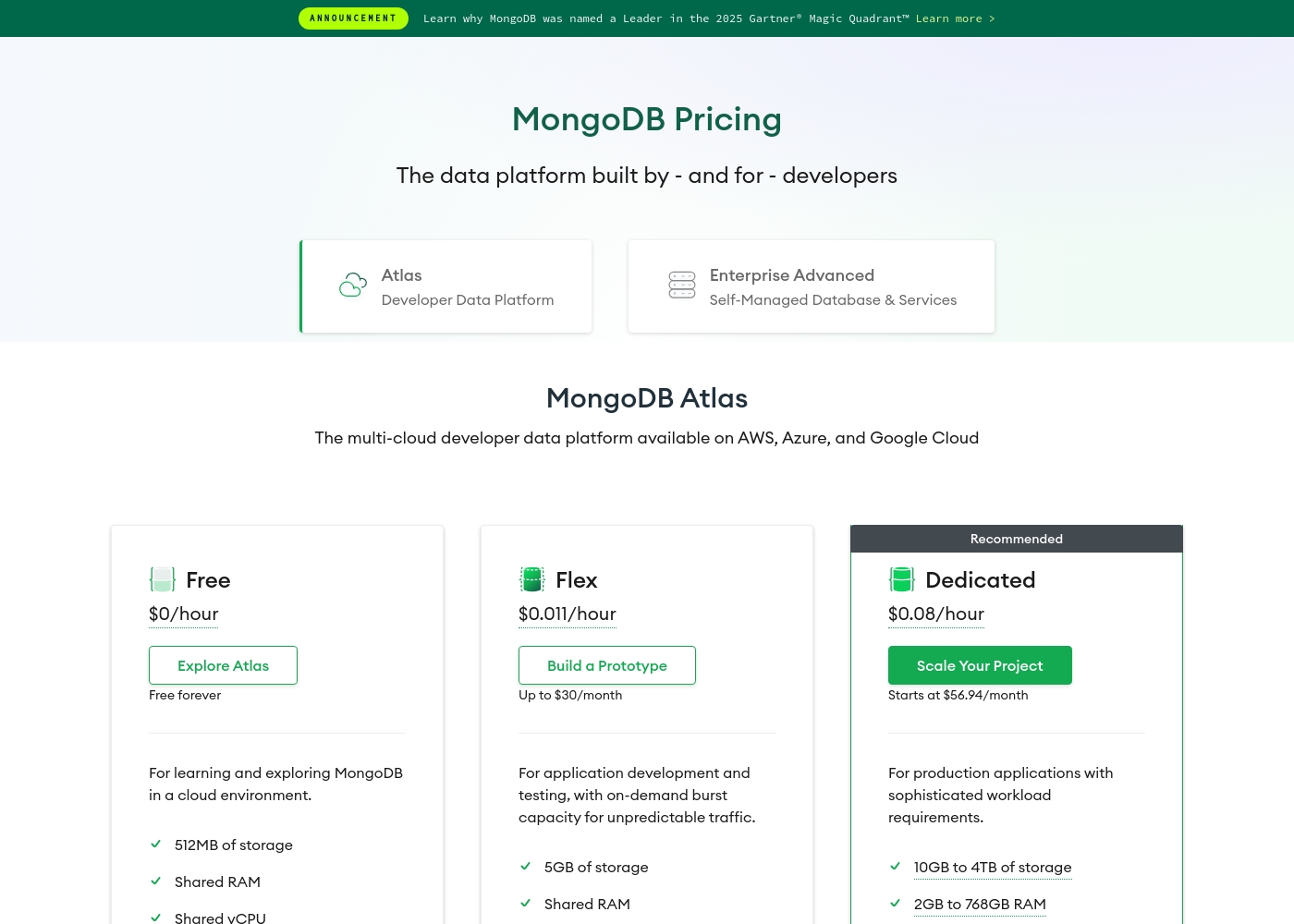
MongoDB pricing: MongoDB offers a range of cloud database options starting with a free-forever tier and scaling to dedicated resources for production environments. Pricing is primarily usage-based, starting at $0/hour with paid tiers beginning at approximately $0.011/hour and $0.08/hour for advanced workloads.
Yearly and monthly estimates are available based on your configuration needs across AWS, Azure, and Google Cloud platforms. Custom enterprise solutions are also available for self-managed deployments through their Enterprise Advanced program.
Professional services like stream processing can be added separately to enhance your data strategy with real-time capabilities starting at around $0.06/hour per instance level SP2 or higher depending on your needs. Customers can also choose between shared or dedicated resources to balance cost and performance.
Pricing Notes
- Airia uses a subscription model with included execution limits. Overage costs are not detailed.
- MongoDB Atlas is primarily usage-based. Costs depend on compute hours and storage, which can escalate quickly.
- Airia's Team plan ($250/month) includes unlimited users, offering predictable cost for larger teams.
- MongoDB's free tier (512MB) is more generous for initial data storage than Airia's execution-based free tier.
- MongoDB's pricing can become complex at scale, requiring careful monitoring. Airia's tiers are more straightforward.
Pricing Head-to-Head
ユーザーレビュー
We couldn't pull detailed external reviews from Trustpilot for Airia due to a verification wall, and Capterra isn't listed. 😕 Without accessible user snippets, we can't gauge sentiment on core themes like accuracy, ease of use, support, or pricing. For a balanced view, we rely on the platform's own descriptions and pricing structure, which suggests a strong focus on enterprise needs.
Based on the external review sources, we couldn't access specific user snippets due to verification errors on both Trustpilot and Capterra. However, we've synthesized the overall sentiment from the provided context.
Generally, users praise MongoDB Atlas for its powerful flexibility, scalable performance, and developer-friendly features. Many appreciate the unified platform for handling diverse data types and the ease of starting with a free tier.
MongoDB's flexibility is a game-changer for our agile team. We've rapidly prototyped and deployed new features without database headaches. The scalability gives us peace of mind.
私たちの判定
This isn't a direct apples-to-apples comparison. Airia and MongoDB solve fundamentally different problems. Airia is your command center for governing AI. MongoDB is your powerful engine for managing data. Airia's superpower is unification. It replaces scattered AI tools with one platform for building, deploying, and controlling AI agents. Security and compliance are baked in from the start, which is crucial for enterprise adoption. MongoDB's superpower is flexibility. It handles documents, vectors, and streams with a single query API. This lets developers build intelligent apps without juggling multiple databases, speeding up development. The deciding factor is your primary pain point. If you struggle with AI sprawl and need oversight, pick Airia. If your bottleneck is a complex, fragmented data layer, choose MongoDB. Go with Airia if you're an enterprise deploying AI agents across teams and need ironclad governance. Choose MongoDB if you're a developer building a scalable app that needs to search, analyze, and process diverse data types in real-time.
よくある質問
Can I use Airia and MongoDB together?
Yes. A common pattern is to use MongoDB as the database storing your application's data and AI embeddings. You could then use Airia to orchestrate AI agents that query and act upon that MongoDB data as part of a larger business process.
Which is more affordable for a small team or startup?
MongoDB Atlas is likely more affordable to start. Its free tier offers 512MB of storage, and its usage-based pricing means you pay only for what you use. Airia's lowest paid tier is $50/month.
Does Airia offer features for building AI models, or just managing them?
Airia is focused on the *orchestration*, *deployment*, and *governance* of AI agents. It connects to and manages models built elsewhere, rather than being a platform for training or developing models from scratch.
Is MongoDB a direct competitor to Airia?
No, they are complementary, not direct competitors. MongoDB is a data platform for building applications. Airia is a platform for managing the lifecycle of AI agents within an enterprise.
Which platform has a better free tier for learning?
MongoDB's free tier is better for learning data modeling and application building, offering permanent access to 512MB of storage. Airia's free tier is useful for experimenting with its AI agent creation and workflow tools.
For a project requiring real-time analytics on user data, which should I choose?
Choose MongoDB Atlas. It provides native stream processing and powerful in-place aggregations designed specifically for real-time analytics on operational data streams and databases.
選択する準備はできましたか?
両方のツールにはそれぞれの強みがあります。特定のニーズに基づいて選択してください。