Google Cloud vs MongoDB
Choosing between Google Cloud and MongoDB can be tough. One is a massive cloud infrastructure provider, while the other is a specialized data platform. Here's how to decide which one fits your project.
Une Infrastructure Puissante, une Facturation et un Support à Risque.
Nous reconnaissons que Google Cloud fournit une infrastructure de pointe, offrant une intégration IA puissante et une mise à l'échelle significative pour les charges de travail d'entreprise. Cependant, le volume élevé de rapports détaillant un support client inaccessible et une facturation confuse et non transparente est profondément préoccupant. Dans l'ensemble, nous considérons cette plateforme comme à haut risque pour les utilisateurs qui privilégient une aide réactive ou un contrôle granulaire des coûts.
Avantages
- Accès à des outils d'IA générative de premier plan comme Gemini et Vertex AI.
- Prend en charge les stratégies de développement open source, multicloud et hybrides.
- Les nouveaux utilisateurs reçoivent 300 $ de crédits gratuits dès leur inscription.
- Offre des économies potentielles jusqu'à 57 % via les remises pour engagement.
Inconvénients
- Le support client est souvent inaccessible et caché.
- Les utilisateurs signalent une facturation non transparente et des frais inattendus malgré des crédits.
- Coûts extrêmement élevés pour les abonnements de support technique (jusqu'à 12 500 $/mois).
- Le manque de limites de dépenses strictes pour les services à l'utilisation est une préoccupation fréquente.
Powerful, flexible platform for modern data.
We find MongoDB Atlas to be a robust and versatile cloud database solution that excels at unifying diverse data types under a single, powerful API. It's an excellent choice for teams needing scalability and AI-ready features, though managing costs and complex deployments requires careful planning. Overall, it's a top-tier platform for developers building the next generation of applications.
Avantages
- Excellent flexibility with its document model.
- Powerful, unified platform for databases, search, and streaming.
- Strong scalability and high availability guarantees.
- Native vector search integration for AI applications.
Inconvénients
- Costs can escalate quickly with high usage and dedicated resources.
- Advanced features and configurations can have a steep learning curve.
- Support responsiveness can be inconsistent for some users.
À propos deGoogle Cloud
Google Cloud est une plateforme cloud complète offrant plus de 150 produits et capacités. Elle aide les entreprises à moderniser les infrastructures existantes ou à créer entièrement de nouvelles applications pilotées par l'IA à partir de zéro. Le service est conçu pour les développeurs, les chefs d'entreprise et les startups prêts à croître numériquement et à se transformer.
Les nouveaux clients peuvent essayer Google Cloud avec l'utilisation gratuite de plus de 20 produits. De plus, vous recevrez 300 $ de crédits gratuits lors de votre inscription pour vous aider à explorer. 💡
À propos deMongoDB
💡 MongoDB Atlas is a comprehensive cloud data platform built for modern applications. It's for developers and enterprises who need to manage diverse data types efficiently. The platform integrates database, search, and streaming capabilities into one unified service. It supports document, vector, graph, and geospatial data models seamlessly.
Points forts
Comparaison des fonctionnalités
Aperçu des fonctionnalités
Nous mettons en évidence les principales différences et désignons un gagnant pour chaque fonctionnalité.
Core Purpose
Google Cloud is a vast cloud infrastructure platform. MongoDB is a specialized data platform.
Google Cloud offers over 150 products. You can run everything from VMs to AI models. It's like renting a supercomputer. MongoDB Atlas focuses on your data layer. It manages your database, search, and streams. It's like having a dedicated, expert DBA. The difference is scope vs. specialization. Google Cloud provides the entire toolbox. MongoDB excels at one critical tool. For a startup building a full app, Google Cloud provides the foundation. For a team optimizing a data-heavy feature, MongoDB is targeted.
AI & Data Analytics
Google Cloud has massive AI/ML and analytics suites. MongoDB has native vector search for AI apps.
Google Cloud's Vertex AI and BigQuery are industry leaders. You can build models with 200+ foundation models. BigQuery runs petabyte-scale analytics. MongoDB's strength is unifying data and vectors. You can store operational data and embeddings together. This simplifies building AI features like semantic search. Google Cloud offers a broader, more complex AI platform. MongoDB makes specific AI workflows simpler. One is a comprehensive lab, the other a focused workbench. Choose Google Cloud for custom model training. Choose MongoDB for integrating AI into your existing app's data flow.
Database Flexibility
Google Cloud offers multiple managed databases. MongoDB offers one highly flexible document database.
Google Cloud provides Cloud SQL, Spanner, Firestore, and more. You pick the right tool for each job. This can mean managing multiple systems. MongoDB uses a single document model for all data. The same API handles operational, graph, and geospatial data. This reduces context switching. Google Cloud gives you specialized databases. MongoDB gives you one versatile database. It's the difference between a Swiss Army knife and a full workshop. For apps with diverse data types in one service, MongoDB is seamless. For needing different database engines, Google Cloud has options.
Real-time Processing
Google Cloud uses multiple services for streams. MongoDB has integrated stream processing.
Google Cloud handles streams with Dataflow, Pub/Sub, and others. It's powerful but requires configuring separate services. This adds architectural complexity. MongoDB Atlas Stream Processing is built in. You use the same query language for streams and batches. This creates a unified developer experience. Google Cloud offers more scalable, global streaming. MongoDB offers simplicity and integration. One is built for massive scale, the other for developer velocity. For processing Kafka streams alongside your app data, MongoDB is simpler. For global, high-throughput event processing, Google Cloud has dedicated tools.
Ease of Getting Started
Both have generous free tiers. Google Cloud has a steeper initial learning curve.
Google Cloud gives $300 in credits and 20+ free products. However, its console can feel slow and complex. New users report difficulty with simple tasks. MongoDB offers a free-forever tier with 512 MB. The Atlas interface is focused and generally intuitive. Many developers find its document model natural. Google Cloud's scale means more to learn upfront. MongoDB's focus makes its core product more approachable. One is a sprawling city, the other a well-organized campus. Your choice depends on your role. A cloud architect might embrace Google Cloud's scope. An app developer might prefer MongoDB's streamlined data focus.
Cost Management
Google Cloud offers committed discounts but billing can be unclear. MongoDB costs scale with resource usage.
Google Cloud's pricing is usage-based with potential for 57% savings. Users complain about non-transparent billing and unexpected charges. Support for cost limits is a pain point. MongoDB's costs scale with storage and compute hours. Users note costs can escalate quickly with high usage. Monitoring your usage is crucial in both cases. Google Cloud has more discount levers but more billing complexity. MongoDB's model is simpler but can surprise you. Both require vigilant monitoring. For predictable, committed workloads, Google Cloud's discounts help. For variable workloads, MongoDB's pay-as-you-go is straightforward.
Customer Support
Google Cloud support is expensive and hard to reach. MongoDB support is included in paid tiers.
Google Cloud's technical support can cost up to $12,500/month. Free users report support is hidden and nearly impossible to contact. This is a major frustration. MongoDB's Dedicated tiers include enhanced support. Users report mixed experiences but availability is better. SLAs are tied to your pricing tier. Google Cloud's paid support is enterprise-grade but costly. MongoDB's included support is more accessible for mid-market. The difference in accessibility is stark. If you're a large enterprise, Google Cloud's support might be justified. For smaller teams, MongoDB's included support is a significant advantage.
Vendor Lock-in Risk
Google Cloud promotes multicloud. MongoDB is an open-source based platform.
Google Cloud actively supports hybrid and multicloud strategies. They offer tools to manage apps across clouds. This reduces lock-in to their specific infrastructure. MongoDB's core is open source. You can run it on-premise or other clouds. Atlas is a managed service on AWS, Azure, and GCP. Google Cloud sells infrastructure flexibility. MongoDB sells data portability. Both address lock-in from different angles. If you fear infrastructure lock-in, Google Cloud's stance is reassuring. If you fear data lock-in, MongoDB's open-source core is a plus.
Les coûts de Google Cloud varient considérablement car il utilise une structure de paiement basée sur l'utilisation, offrant aux nouveaux clients 300 $ de crédits gratuits et un accès à plus de 20 produits gratuits.
Vous ne trouverez pas de forfaits mensuels fixes ici, mais plutôt trois façons flexibles d'utiliser les ressources informatiques de la plateforme.
Paiement à l'utilisation (Tarification standard)
Prix : Non indiqué explicitement (Basé sur l'utilisation) Sites Web pris en charge : Non indiqué explicitement Idéal pour : Organisations de toutes tailles nécessitant une mise à l'échelle flexible Politique de remboursement : Non indiqué explicitement Autres fonctionnalités :
- Vous ne payez que pour les services que vous utilisez.
- Pas de frais initiaux ni de frais de résiliation.
- Économies potentielles jusqu'à 57 % avec les remises pour engagement.
- Inclut une assistance facturation gratuite 24h/24 et 7j/7.
- Payer uniquement pour les services que vous utilisez
- Pas de frais initiaux ni de frais de résiliation
- Économisez jusqu'à 57 % avec les remises pour engagement
- Support facturation gratuit 24h/24 et 7j/7
- 300 $ de crédits gratuits
- Accès gratuit à plus de 20 produits
- Exécuter, tester et déployer des charges de travail
- Jusqu'à 350 000 $ de crédits cloud
- Support et solutions personnalisés
- Support à la mise à l'échelle pour les entreprises innovantes
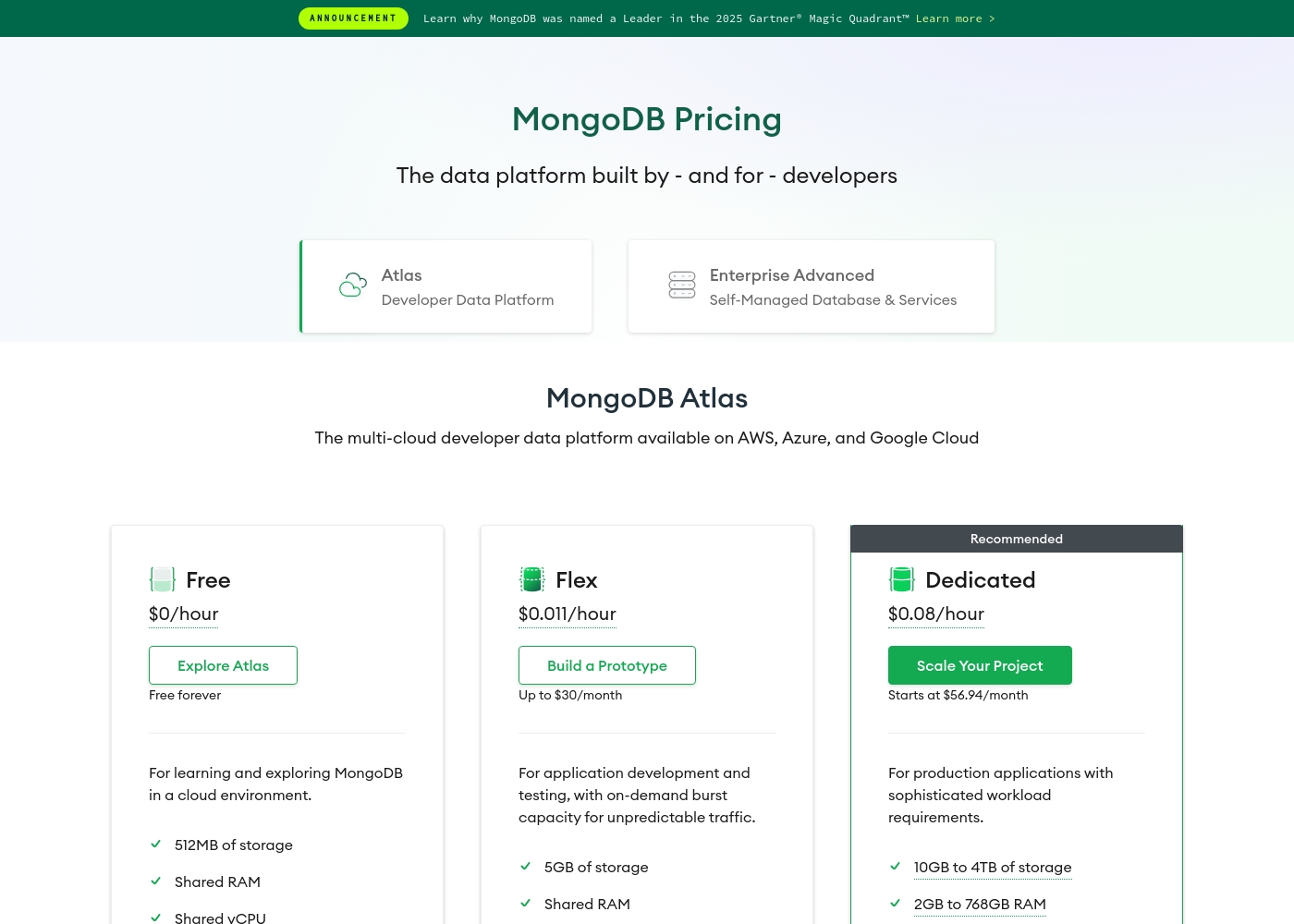
MongoDB pricing: MongoDB offers a range of cloud database options starting with a free-forever tier and scaling to dedicated resources for production environments. Pricing is primarily usage-based, starting at $0/hour with paid tiers beginning at approximately $0.011/hour and $0.08/hour for advanced workloads.
Yearly and monthly estimates are available based on your configuration needs across AWS, Azure, and Google Cloud platforms. Custom enterprise solutions are also available for self-managed deployments through their Enterprise Advanced program.
Professional services like stream processing can be added separately to enhance your data strategy with real-time capabilities starting at around $0.06/hour per instance level SP2 or higher depending on your needs. Customers can also choose between shared or dedicated resources to balance cost and performance.
Pricing Notes
- Google Cloud offers $300 in free credits for new customers, while MongoDB has a free-forever tier.
- Google Cloud's technical support is extremely expensive, costing up to $12,500 per month.
- MongoDB's costs scale with cluster resources (storage, RAM, vCPUs), which can escalate quickly.
- Both platforms use usage-based pricing, making it hard to predict costs without careful monitoring.
- Google Cloud provides committed use discounts up to 57% for predictable workloads.
Pricing Head-to-Head
Avis des utilisateurs
Le sentiment externe, principalement capturé par Trustpilot, est extrêmement négatif, ce qui donne une très mauvaise note de 1,5 étoile. Les problèmes les plus fréquemment cités concernent la facturation non transparente et un support client absolument dysfonctionnel ⚠️. Les utilisateurs signalent des frais inattendus, totalisant parfois des centaines de dollars, même s'ils disposent de crédits gratuits substantiels. Beaucoup estiment que ce manque de transparence est un « piège délibéré » destiné aux nouveaux utilisateurs. De plus, obtenir de l'aide est quasi impossible ; les utilisateurs décrivent le support comme intentionnellement caché et injoignable, les envoyant dans des boucles frustrantes sans fin. Ceux qui ont besoin d'une aide technique font face à des frais exorbitants, le support technique spécialisé coûtant jusqu'à des milliers de dollars par mois.
Au-delà de la gestion des coûts, les utilisateurs critiquent la faible facilité d'utilisation. Les plaintes incluent une console « inutilisablement lente » et des processus pour des tâches simples, comme récupérer une clé API, exigeant trop de clics. Les utilisateurs ont également du mal avec des fonctions de gestion de compte importantes, comme la suppression de projets actifs qui continuent de générer des frais ou la mise à jour des informations de facturation. Cela indique fortement que si la plateforme est technologiquement puissante, l'expérience utilisateur environnante, l'administration et le contrôle financier sont gravement défectueux.
Mon compte a engendré 327 € de frais d'API, même si j'avais 264 € de crédits gratuits disponibles qui n'ont pas été utilisés. Le support est complètement caché et impossible à joindre, ce qui ressemble à un piège délibéré. Cette plateforme a une structure de tarification extrêmement non transparente.
Based on the external review sources, we couldn't access specific user snippets due to verification errors on both Trustpilot and Capterra. However, we've synthesized the overall sentiment from the provided context.
Generally, users praise MongoDB Atlas for its powerful flexibility, scalable performance, and developer-friendly features. Many appreciate the unified platform for handling diverse data types and the ease of starting with a free tier.
MongoDB's flexibility is a game-changer for our agile team. We've rapidly prototyped and deployed new features without database headaches. The scalability gives us peace of mind.
Notre verdict
This isn't a simple apples-to-apples comparison. Google Cloud is the full cloud platform. MongoDB is the specialized data platform. Google Cloud's superpower is its sheer scale. It offers everything from world-class AI with Vertex AI to massive analytics with BigQuery. It's your partner for the entire infrastructure stack. MongoDB's superpower is data unification. It seamlessly blends operational data, vector search, and streaming into one system. This simplifies building complex, data-rich applications dramatically. The deciding factor is your core need. If you need a comprehensive cloud foundation, Google Cloud is the answer. If your biggest challenge is managing and querying diverse application data, MongoDB is your tool. For a startup building from scratch, Google Cloud provides the full toolkit. For a team trying to make their app's data layer smarter and faster, MongoDB delivers targeted power.
Questions fréquemment posées
Which is better for small teams: Google Cloud or MongoDB?
MongoDB often wins for small teams focused on their app's database. Its free-forever tier and focused interface are easier to start with. Google Cloud's $300 credit is generous, but its platform can feel overwhelming.
Does Google Cloud have a database like MongoDB?
Yes, Google Cloud offers Firestore and Cloud Datastore as document databases. They serve similar use cases to MongoDB. However, MongoDB's core platform is built entirely around this document model and its associated features.
Is MongoDB worth the extra cost over Google Cloud?
It's not about extra cost, but about value for your specific need. MongoDB's cost is for a specialized data platform. Google Cloud's costs are for a broad infrastructure suite. If you only need a powerful database, MongoDB's pricing can be more predictable.
Can I use Google Cloud and MongoDB together?
Yes, absolutely. You can run MongoDB Atlas as a managed service on Google Cloud infrastructure. This is a common pattern, combining Google's infrastructure with MongoDB's specialized database.
Which is easier to learn for a developer?
Many developers find MongoDB's document model and query API more intuitive initially. Google Cloud requires learning a vast array of services and concepts. The learning curves serve different goals: app development vs. infrastructure management.
Which platform is better for AI applications?
It depends on the AI task. For training custom models at scale, Google Cloud's Vertex AI is more powerful. For adding semantic search or AI features to an app using your existing data, MongoDB's native vector search is simpler.
Prêt à choisir ?
Chaque outil a ses forces. Choisissez selon vos besoins.