GitLab vs Wiz
GitLab and Wiz both care about security, but they live in different worlds. GitLab is your all-in-one DevOps command center. Wiz is your specialized cloud security guard. The choice depends on what you're building and protecting.
Best for: Teams wanting a single platform for all DevOps and security needs, Organizations with tight budgets who need a transparent free or low-cost tier
Best for: Security teams needing unified visibility across multi-cloud environments (AWS, Azure, GCP), Enterprises with complex cloud workloads and AI models requiring protection
Comprehensive DevSecOps, but complex.
GitLab is a powerful, all-in-one platform that unifies the entire software lifecycle. We find it delivers on its promise of acceleration and unified security, though its depth can create a steep learning curve for smaller teams. Overall, it's an excellent choice for organizations seeking a single, scalable solution for planning, building, and deploying software securely.
Avantages
- Single platform for the entire DevSecOps lifecycle
- Built-in security scanning accelerates vulnerability detection
- AI-powered workflows (Duo Agent) enhance productivity
- Offers a functional Free tier for individuals and small projects
Inconvénients
- Learning curve can be steep due to platform breadth
- Enterprise features like advanced security require costly Ultimate tier
- Compute and storage limits on lower tiers may require paid add-ons
- Annual billing commitment for paid plans
Top-tier, unified cloud security platform.
We find Wiz to be a powerful and comprehensive cloud security solution. It excels at unifying visibility across code, cloud, and runtime, which is crucial for modern, fast-moving teams. Overall, it's a top-tier platform for organizations needing deep context and automated protection at scale.
Avantages
- Unified security graph connects code, cloud, and runtime for complete context.
- Trusted by over half of the Fortune 100 for proven risk reduction.
- Enables automated threat response and even code fixes to speed up remediation.
- Designed to protect modern AI workloads and agents.
Inconvénients
- Custom, consumption-based pricing requires a sales consultation, lacking upfront transparency.
- Platform scope and depth may be more than needed for very small or simple cloud setups.
- Implementation and full value realization likely require significant enterprise-level commitment.
À propos deGitLab
GitLab is an end-to-end DevSecOps platform for teams of all sizes, from startups to large enterprises. It’s the single place to plan, build, test, secure, and deploy your software. You get all your projects, releases, and code in one data plane, so both your team and AI agents work from the same information. 💡
À propos deWiz
✨ Wiz is a comprehensive cloud security platform. It's designed for security teams, developers, and DevOps professionals who need to protect modern cloud-native applications. The platform unifies visibility across your entire stack, helping you secure what you build from the start.
Points forts
Comparaison des fonctionnalités
Aperçu des fonctionnalités
Nous mettons en évidence les principales différences et désignons un gagnant pour chaque fonctionnalité.
Core Purpose
GitLab builds software. Wiz protects cloud software. They solve different problems.
GitLab is a complete DevSecOps platform. It replaces your separate tools for planning, coding, CI/CD, and security. Your team uses it for the entire software creation process. Wiz is a Cloud-Native Application Protection Platform (CNAPP). It doesn't build software. It continuously scans your cloud environment to find and fix risks across code, infrastructure, and data. The key difference is scope. GitLab is the factory where software is made. Wiz is the security team that guards the factory and its products in the cloud. Think of a team shipping 10 features a week. GitLab manages the entire pipeline. Wiz would monitor the cloud security of those 10 features once deployed.
Security Capabilities
GitLab has security built into the build process. Wiz provides deep, unified cloud security.
GitLab includes security scanners (SAST, SCA, secret detection) that run during your CI/CD pipeline. Findings appear directly in merge requests, helping developers fix issues early. The best features require the Ultimate tier. Wiz provides a unified security graph connecting code, cloud, and runtime. It offers advanced protection like real-time threat blocking, AI workload security, and automated code fixes. It's purpose-built for complex cloud environments. GitLab's security is integrated for developers during the build. Wiz's security is holistic for the cloud runtime environment. A company worried about dev-time bugs might lean GitLab. A company worried about live cloud breaches would choose Wiz.
AI Features
GitLab's AI helps developers code faster. Wiz's AI protects your cloud and AI models.
GitLab's Duo Agent Platform helps with development tasks. AI agents can create merge requests, review code, and triage issues. It's focused on accelerating the software delivery lifecycle. Wiz's AI agents are for security operations. The Green agent automatically fixes code vulnerabilities. The Red agent performs penetration testing. The Blue agent automates threat hunting. It also discovers and protects your own AI models and services. GitLab's AI is a developer productivity tool. Wiz's AI is a security automation and protection tool. If you want to write code faster, look at GitLab's AI. If you want to secure your AI infrastructure, look at Wiz's AI.
Pricing Model
GitLab has clear, public pricing. Wiz uses custom, enterprise quotes.
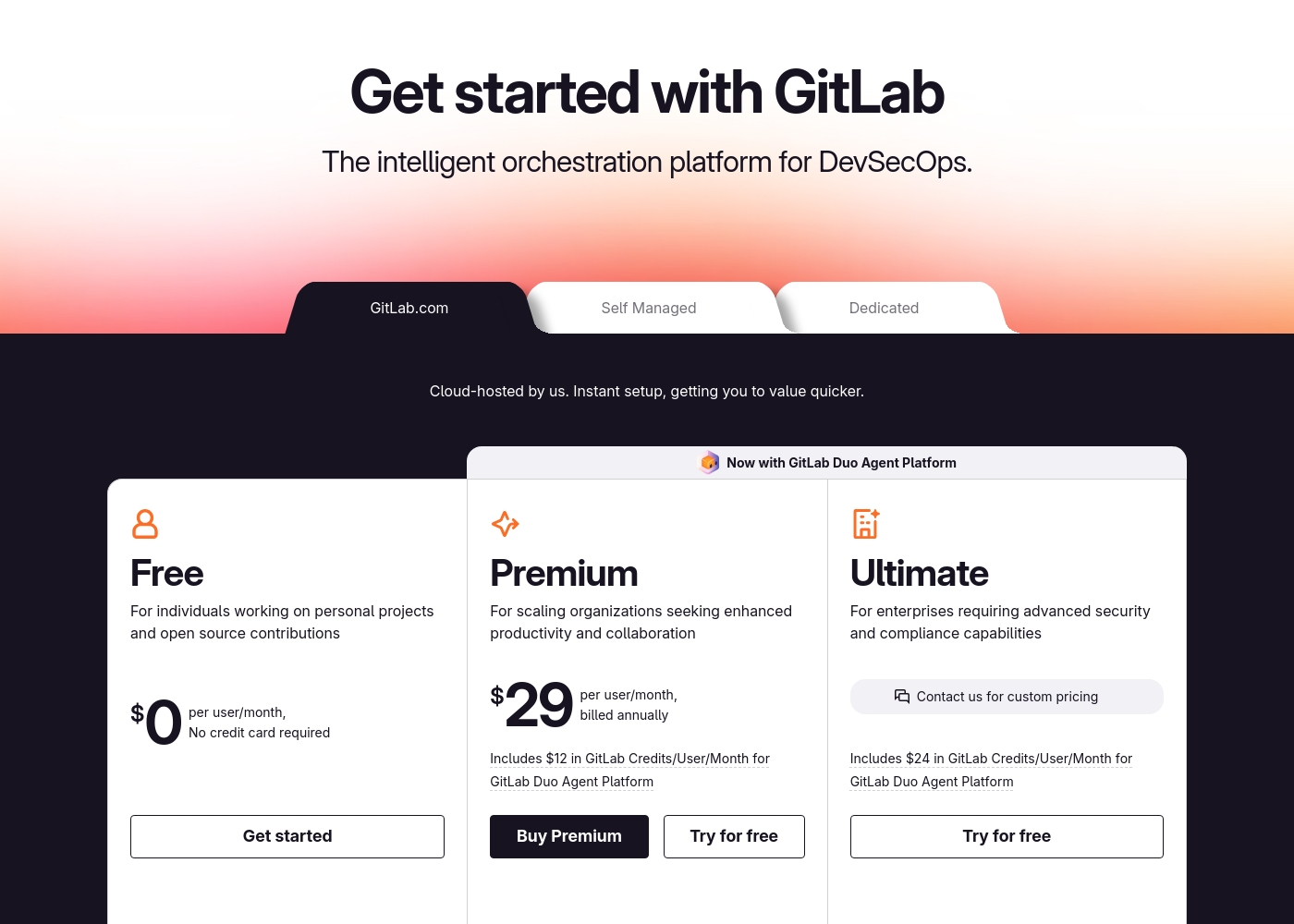
GitLab offers transparent, per-user pricing. You can see Free ($0), Premium ($29/user/month), and Ultimate ($99/user/month) plans on their website. You know the cost before you talk to sales. Wiz uses a custom licensing model. The price depends on your cloud workload volume and number of cloud providers (AWS, GCP, Azure). You must contact sales for a personalized quote. The trade-off is predictability vs. customization. GitLab's model is simple to budget. Wiz's model scales precisely with your usage but requires negotiation. A startup with 5 developers will prefer GitLab's predictable costs. A large enterprise with complex cloud bills might prefer Wiz's tailored approach.
Ease of Onboarding
GitLab's free tier lets you start immediately. Wiz requires a sales process.
With GitLab, you can sign up for the free plan in minutes. You can start using core features like code management and CI/CD right away. There's a learning curve, but access is instant. With Wiz, you schedule a demo, have a consultation, get a custom quote, and then onboard. The process is designed for enterprise procurement cycles, not quick trials. GitLab offers self-service onboarding. Wiz offers white-glove enterprise onboarding. Need to prototype a project today? GitLab is ready. Planning a 3-month security initiative? The Wiz sales process fits that timeline.
Target Team Fit
GitLab serves the whole software team. Wiz primarily serves the security team.
GitLab is built for cross-functional software teams. Product managers plan, developers code, QA tests, and security scans—all in one place. It's a collaboration hub for building software. Wiz is primarily built for security professionals. Security engineers, DevSecOps, and cloud architects use it to assess risk, respond to threats, and ensure compliance across clouds. GitLab centralizes the software creation process. Wiz centralizes cloud security operations and visibility. A 20-person dev team will live in GitLab daily. A 5-person security team might use Wiz as their primary command center.
GitLab pricing: GitLab offers a range of DevSecOps plans from a free tier for individuals to an Ultimate enterprise solution for $99/month. Subscriptions include various compute minutes, storage allocations, and security features to fit different team sizes and needs.
Please note: the provided screenshot shows $29/user/month for Premium, while the text mentions $99 for Ultimate elsewhere; we have prioritized the current primary source values below for clarity. Actually, the provided text includes $0, $29 annually, and custom pricing options depending on the deployment method (SaaS or Self-Managed).
Overall it is a per-seat annual subscription model with usage-based add-ons for credits and compute time. For current SaaS pricing: Free $0, Premium $29/mo annually, Ultimate $99/mo annually (implied for custom).
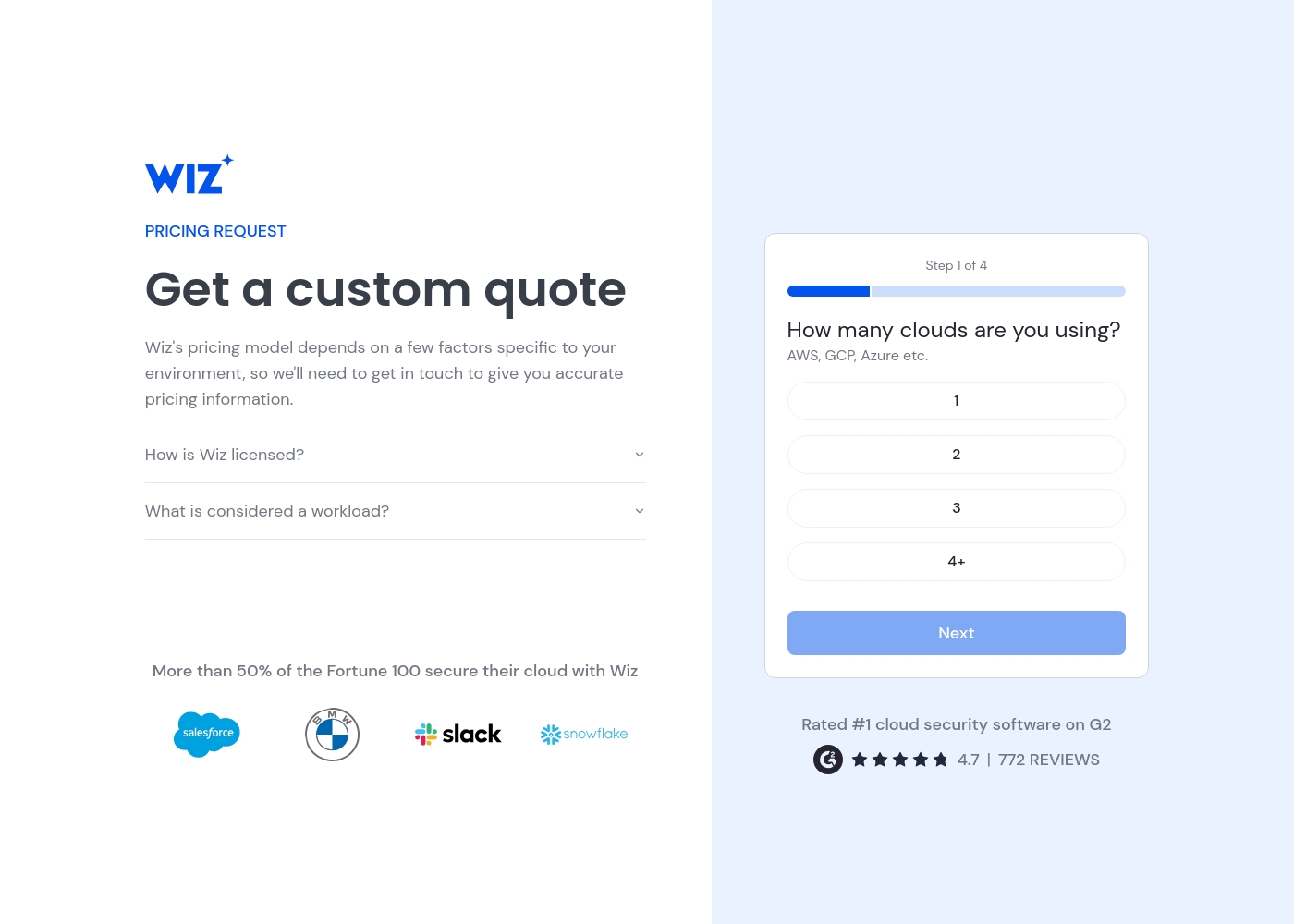
Wiz pricing: Wiz uses a custom pricing model tailored to your specific cloud environment. Costs are license-based and scale with your workload and the number of cloud platforms you use, such as AWS, GCP, or Azure.
To get exact numbers, you'll need to request a personalized quote from their sales team. This ensures you pay for the specific resources and features your enterprise actually needs for total cloud protection.
It is a flexible, consumption-driven approach for security at scale. You can start the process by providing details about your cloud infrastructure on their pricing page.
Pricing Notes
- GitLab's pricing is public and transparent. You can see plans and costs on their website.
- Wiz requires contacting sales for a custom quote. Pricing is not publicly listed.
- GitLab's free tier is functional for small projects. Wiz has no free tier.
- GitLab's paid plans are per-user, billed annually. Wiz's model scales with your cloud footprint, not user seats.
Pricing Head-to-Head
Avis des utilisateurs
External user reviews for GitLab are currently inaccessible for a full synthesis, as both Trustpilot and Capterra returned security verification errors. 📄 Therefore, we cannot provide a balanced, specific summary of recurring user themes on accuracy, ease of use, support, or pricing at this time. We recommend checking these sources directly for up-to-date sentiment.
GitLab streamlined our entire development pipeline. Having CI/CD, security, and planning in one place saves our team significant time each week.
External review sites for Wiz were inaccessible during our analysis, preventing a direct sentiment synthesis. 😔 This means we couldn't verify recurring user themes on platforms like Trustpilot and Capterra regarding accuracy, ease of use, support, pricing, or onboarding. Our review therefore relies solely on the provided marketing content and our internal assessment.
Notre verdict
This is a classic 'build vs. protect' comparison. GitLab and Wiz aren't direct competitors; they solve different problems for different parts of your team. GitLab's superpower is unification. It brings planning, coding, building, testing, and security into a single platform. Teams report saving 4 hours per engineer weekly by eliminating tool-switching. It's the command center for creating software. Wiz's superpower is deep cloud context. Its unified security graph connects code, cloud, and runtime to show real risk. It can even automatically fix code and block live threats. It's the command center for securing what you build in the cloud. The deciding factor is your primary need. If you need to streamline how your team builds and delivers software, GitLab is the answer. If you need to secure complex cloud and AI workloads, Wiz is the specialist. Choose GitLab if you're a development team seeking an all-in-one DevSecOps platform with transparent pricing. Choose Wiz if you're a security team needing advanced protection for multi-cloud and AI environments. For many organizations, they could even be complementary—using GitLab to build and Wiz to protect.
Questions fréquemment posées
Can I use GitLab and Wiz together?
Yes, they can complement each other. GitLab can handle your development and CI/CD pipeline. Wiz can then provide deep security monitoring and protection for the cloud environment where that software runs.
Which is easier to get started with?
GitLab is easier. You can sign up for its free tier in minutes and start using core features. Wiz requires scheduling a demo and going through a custom sales and onboarding process.
Is Wiz worth the extra cost over GitLab's security features?
It depends on your cloud complexity. GitLab's built-in security is great for finding issues during development. Wiz is for organizations needing advanced runtime protection, AI security, and unified cloud visibility that go beyond basic scanning.
Which tool is better for a small startup?
GitLab is likely better for most startups. Its free tier and per-user pricing make it accessible. Wiz's custom, consumption-based model is typically aimed at mid-to-large enterprises with established cloud footprints.
Does Wiz replace my need for GitLab?
No. Wiz is a security platform, not a development platform. You would still need a tool like GitLab for source code management, issue tracking, and CI/CD pipelines. Wiz focuses on protecting the output of that process in the cloud.
How does the security focus differ between GitLab and Wiz?
GitLab integrates security scanning into the build process (dev-time). Wiz focuses on continuous cloud security, runtime protection, and threat response (run-time).
Prêt à choisir ?
Chaque outil a ses forces. Choisissez selon vos besoins.