Drip vs Mailchimp
Drip and Mailchimp are both email marketing powerhouses, but they play different games. Drip specializes in deep e-commerce automation for B2C brands. Mailchimp is the all-in-one platform for broader marketing needs. Here's how they stack up.

Powerful for e-commerce, but check the support.
We find Drip to be a highly capable email automation platform built specifically for B2C e-commerce. Its visual builder and smart segmentation are standout features for creating personalized customer journeys. Overall, it's a strong choice for online brands, provided your team can manage the learning curve and verify support levels.
Ventajas
- Excellent visual workflow builder for automation
- Deep e-commerce integrations (Shopify, WooCommerce)
- Powerful, behavior-based segmentation tools
- Free migration for large lists (17,500+)
Desventajas
- Pricing can become expensive as contacts scale
- Some users report slow or inconsistent customer support
- Requires integration with compatible platforms
- Advanced features may have a learning curve
Funciones Líderes en la Industria, Red de Soporte Inestable
Descubrimos que Mailchimp ofrece un conjunto de funciones de email marketing líder en la industria, respaldado por una sólida automatización y herramientas de IA valiosas para la optimización de contenido. En general, la plataforma es una excelente opción para empresas que necesitan capacidades robustas de diseño y prueba, siempre que anticipen una posible fricción con el servicio al cliente y las estructuras de facturación complejas.
Ventajas
- La interfaz de usuario intuitiva y el constructor de arrastrar y soltar simplifican el diseño de campañas.
- Potentes funciones de automatización ayudan a ahorrar tiempo significativo a los especialistas en marketing.
- Valiosas herramientas de elaboración de informes que ofrecen información y evaluación comparativa del sector.
- Funciones de IA generativa que ayudan a mejorar el contenido, incluidas las líneas de asunto.
Desventajas
- El soporte al cliente es citado frecuentemente como inexistente, poco útil o lento en responder.
- Las prácticas de facturación se reportan como predatorias, con cargos inesperados por pequeños excedentes.
- Los usuarios a menudo enfrentan problemas de acceso técnico, especialmente con la autenticación de dos factores.
- La interfaz a veces se describe como incómoda o difícil de navegar.
Acerca deDrip
Drip is an email marketing automation platform built for B2C companies that sell online. Whether you're an e-commerce brand, a course creator, or a travel provider, it gives you the tools to move beyond generic newsletters. It's designed to be a powerful yet simple engine for driving revenue through personalization. 💡
Acerca deMailchimp
Mailchimp es reconocida como la plataforma líder centrada en el email marketing y las automatizaciones avanzadas. Está diseñada para ayudar a las empresas a aumentar sus ingresos dominando la comunicación digital. Con más de 11 millones de usuarios globales y 22 años de experiencia, es una opción de confianza para vender más.
Esta robusta plataforma es ideal para empresas que buscan herramientas de conversión fluidas, incluidas campañas de SMS integradas. Puedes empezar a enviar tu primer correo electrónico sin riesgo, y ni siquiera necesitas una tarjeta de crédito para empezar. Los usuarios de los planes Standard o Premium pueden acceder a una visita guiada personalizada del producto para empezar con confianza. 💡
Aspectos destacados
Comparación de características
Resumen de Funcionalidades
Destacamos las principales diferencias y elegimos un ganador para cada característica.
User Interface
Drip's builder is focused on e-commerce personalization. Mailchimp's is broader with more templates and AI help.
Drip provides a clean, visual email builder designed to pull in product data from your store. It feels tailored for creating dynamic, personalized e-commerce messages. Mailchimp offers a highly intuitive drag-and-drop builder with a massive library of expert templates. Its recent generative AI features help write subject lines and copy faster. The key difference is specialization vs. breadth. Drip's UI feels built for a single purpose. Mailchimp's feels like a full-service marketing studio.
Automation
Drip excels at deep, behavior-driven e-commerce workflows. Mailchimp offers powerful, more general-purpose automations.
Drip shines with pre-built workflows for cart abandonment, browse abandonment, and post-purchase sequences. It connects directly to store data for hyper-targeted actions. Mailchimp provides enhanced automations on its Standard plan, including customer journeys and conditional logic. It's great for welcome series, lead nurturing, and re-engagement campaigns across industries. Drip's automations are a scalpel for e-commerce revenue. Mailchimp's are a Swiss Army knife for general marketing tasks. Both are powerful, just for different goals.
Reporting & Analytics
Mailchimp offers deeper, industry-benchmarked reports. Drip focuses on e-commerce revenue metrics.
Mailchimp's analytics include funnel visualizations and unique industry benchmarking. You can compare your open rates directly to competitors in your sector. Drip's reports are laser-focused on revenue attribution. It tracks how much money your email campaigns and segments generate. It claims segmented users earn 5x more revenue. Mailchimp gives you a broader marketing view. Drip gives you a clear ROI view for e-commerce. For most, Mailchimp's insights are more comprehensive.
Integration Ecosystem
Mailchimp has a significantly larger library of integrations. Drip has deep, focused e-commerce connections.
Mailchimp connects to over 300 platforms, including Shopify, Google Analytics, Canva, and QuickBooks. It's designed to be the central hub of your marketing stack. Drip offers 50+ integrations, but they are heavily weighted toward e-commerce and booking platforms like Shopify, BigCommerce, and WooCommerce. The connections are deep and purpose-built. If you use many different tools, Mailchimp wins on sheer quantity. If you're in e-commerce, Drip's focused integrations might feel more relevant.
Pricing Model
Drip is pure usage-based. Mailchimp uses tiered plans with per-seat limits.
Drip's pricing is straightforward: you pay based on your number of active contacts and email volume. No per-user fees. All plans include unlimited sends. Mailchimp has four clear tiers (Free, Essentials, Standard, Premium). Each tier has a set number of user seats and email send limits (10x, 12x, or 15x contacts). Drip's model scales cleanly with your list. Mailchimp's model scales with both your list and team size. Drip can get expensive at high contact counts, while Mailchimp's Premium tier is for enterprises.
Customer Support
Both have mixed reviews. Drip offers live chat at higher tiers. Mailchimp has 24/7 chat on paid plans.
Drip provides email support for all paid users and live chat for those on $99+/month plans. Reviews mention fast chat responses but inconsistent email support. Mailchimp offers 24/7 email and chat support on Essentials and above. Premium adds phone support. Reviews are polarized, citing some excellent help and some frustrating, unhelpful experiences. Both platforms have support issues highlighted in user reviews. Mailchimp's 24/7 availability is a slight edge, but quality can vary for both.
Learning Curve
Drip is simpler for e-commerce users. Mailchimp offers more features, which can mean a steeper initial climb.
Drip is designed for e-commerce operators. If you sell online, its workflows and segmentation make intuitive sense from the start. The focus is narrow. Mailchimp is a full marketing platform with email, automations, forms, ads, and more. There's more to learn, but the interface is generally considered very user-friendly. For a specific e-commerce use case, Drip might be quicker to master. For general marketing needs, Mailchimp's breadth is more to explore but well-guided.
Mobile Experience
Both offer capable mobile apps for managing campaigns on the go.
Drip has a mobile app that lets you manage contacts, view reports, and perform basic tasks from your phone. It's functional for monitoring. Mailchimp's mobile app is well-regarded, allowing you to create campaigns, view reports, and manage contacts from anywhere. It's a robust companion to the desktop platform. Both provide solid mobile experiences. Mailchimp's app is often cited as slightly more feature-complete for campaign creation.
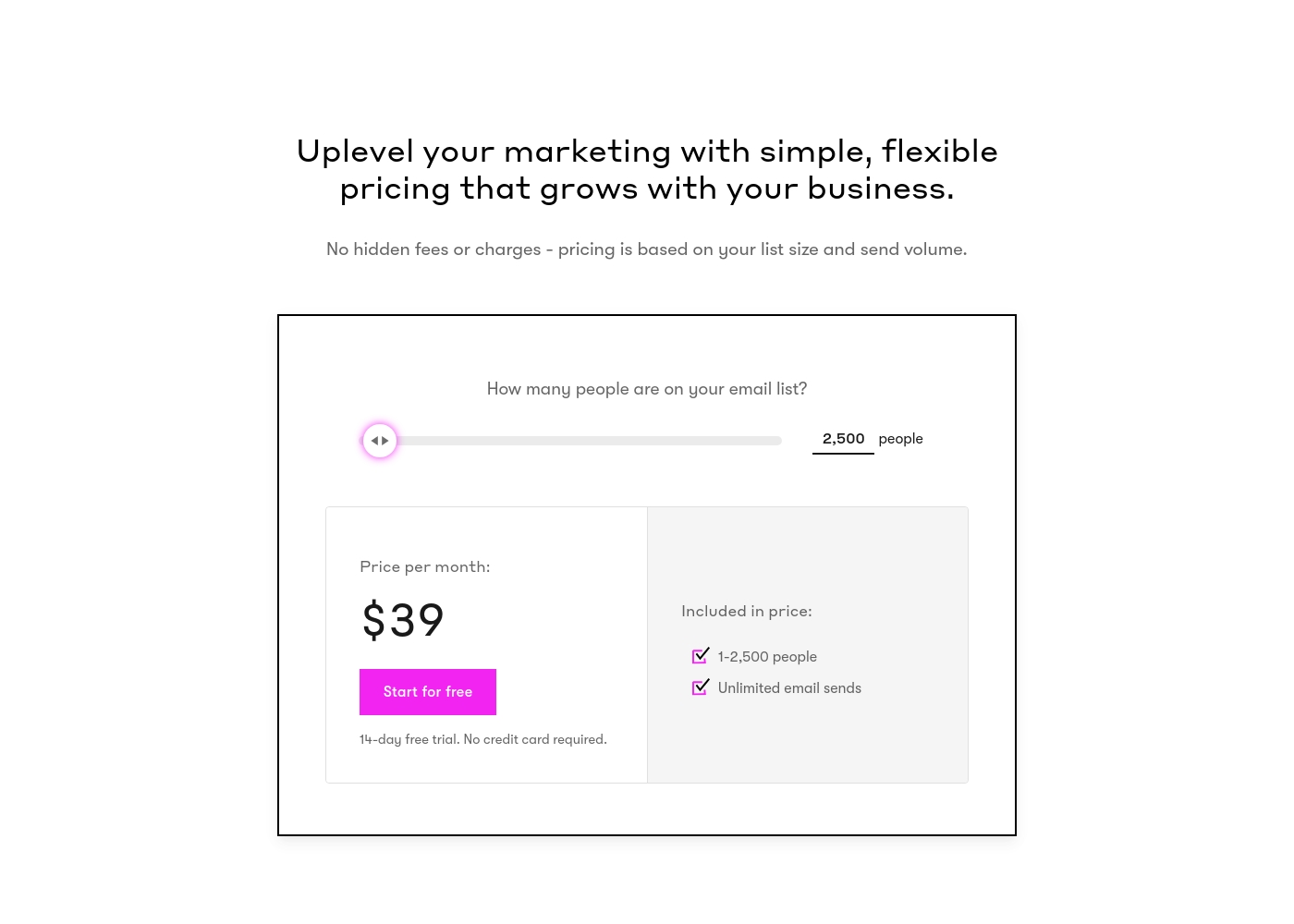
Drip pricing: Drip offers a flexible, usage-based subscription starting at $39/month for up to 2,500 people. Pricing scales based on your email list size and includes a 14-day free trial with no credit card required to start browsing its powerful automation tools tool and visual builder.
Your monthly cost increases as your audience grows, but you always get features like unlimited email sends and onsite campaigns. This ensures you only pay for what you actually use while accessing expert support and pre-built marketing playbooks right from the start.
You can cancel your subscription at any time within your billing settings if your business needs change. This model is specifically designed for e-commerce brands looking for deep segmentation and personalized customer journeys without enterprise-level complexity or hidden fees.
Mailchimp cuesta entre $0 y $350 al mes con cuatro planes principales: Free por $0, Essentials a partir de $13/mes, Standard a partir de $20/mes y Premium que requiere contacto con ventas para presupuestos de alto volumen.
Aquí tienes los detalles sobre lo que ofrece cada plan. Ten en cuenta que los precios que se muestran aquí son típicamente para el nivel mínimo de 500 contactos, o donde se indica, tarifas con descuento para niveles de contacto más altos.
Free
Precio: $0/mes Sitios web compatibles: No indicado explícitamente Ideal para: Crear fácilmente campañas de correo electrónico y aprender sobre tus clientes. Política de reembolso: No indicado explícitamente Otras características:
- 1.000 correos electrónicos por mes como máximo (límite de 500/día)
- 1 Asiento (Usuario)
- 1 Audiencia
- Soporte por correo electrónico durante los primeros 30 días
- Crea campañas de correo electrónico fácilmente
- Aprende más sobre tus clientes
- Soporte por correo electrónico durante los primeros 30 días
- Envía el contenido correcto en el momento adecuado
- Funciones de prueba y programación
- Soporte 24/7 por Email y Chat
- Hasta 3 usuarios
- Vende aún más con la personalización
- Herramientas de optimización
- Automatizaciones mejoradas
- Funciones de IA generativa
- Plantillas de correo electrónico con código personalizado
- Escala rápido con incorporación dedicada
- Contactos ilimitados
- Soporte prioritario; diseñado para equipos
- Funciones de IA generativa
- Acceso basado en roles (5 roles)
Pricing Notes
- Drip's pricing starts at $39/month for up to 2,500 contacts. There's no free plan, but the 14-day trial requires no credit card.
- Mailchimp offers a free plan for up to 500 contacts. Paid plans start at $13/month (Essentials). A 14-day trial is available for paid tiers.
- Drip includes unlimited email sends on all paid plans. Mailchimp has monthly send limits (10x, 12x, or 15x your contact count) and overage fees.
- Drip has no per-user fees. Mailchimp's Essentials plan allows 3 users, Standard 5, and Premium unlimited.
- Both platforms increase cost as your contact list grows. Drip's model is more direct; Mailchimp's involves plan tiers and potential overages.
Pricing Head-to-Head
Reseñas de usuarios
We found a mixed bag of user sentiment from Trustpilot, as the Capterra link was inaccessible. Reviews praise Drip's powerful automation and segmentation for driving revenue, with many noting its ease of use for e-commerce.
💡 On the downside, several users report frustration with customer support responsiveness and occasional platform glitches. Pricing is frequently cited as a concern, with some feeling the cost can escalate quickly as contacts grow.
Drip's automation tools are top-notch. We set up abandoned cart sequences that really boosted our recovery rate. The visual builder makes it easy to see the customer journey.
Mailchimp recibe comentarios externos polarizados, destacando una división entre las excelentes características del producto y las frustrantes experiencias de soporte. Los usuarios elogian constantemente la interfaz intuitiva de la plataforma y la facilidad de uso, confirmando que el constructor de arrastrar y soltar y las amplias funciones de automatización son ahorros de tiempo significativos para las empresas en crecimiento.
Los revisores a menudo aprecian la calidad de las plantillas disponibles y las robustas integraciones de la plataforma con sistemas de CRM y sitios web. Sin embargo, una preocupación importante relacionada con el soporte al cliente se informa ampliamente.
La interfaz de usuario es fácil de navegar y la función de construcción de correos electrónicos de arrastrar y soltar está extremadamente bien diseñada y es sencilla de usar. Usamos Mailchimp para todas nuestras campañas de clientes potenciales y actuales. Nos ahorra mucho tiempo en la producción.
Nuestro Veredicto
It's not a clear knockout—this battle depends entirely on what you sell. Drip is the specialist, while Mailchimp is the generalist. Your choice should hinge on one question: are you an e-commerce brand or a broader business? Drip's superpower is its deep integration with e-commerce platforms. It connects directly to your Shopify or BigCommerce store. Its automations are built to recover carts and turn browsers into buyers. It's a revenue machine. Mailchimp's superpower is its breadth and accessibility. It offers a free plan, hundreds of integrations, and helpful AI tools. It's designed to be the central hub for all your marketing, not just email. It's a marketing Swiss Army knife. The deciding factor is your primary goal. If maximizing online store revenue is your #1 priority, Drip's specialized tools are likely worth the higher cost. If you need an affordable, all-in-one platform to manage your whole marketing stack, Mailchimp is the safer, more flexible bet. Choose Drip if you're an e-commerce brand ready to invest in powerful automation to boost sales. Choose Mailchimp if you're a startup, small business, or non-e-commerce brand that values simplicity, a free entry point, and broad functionality.
Preguntas Frecuentes
Which is better for Shopify stores, Drip or Mailchimp?
Both integrate well with Shopify. Drip is built specifically for e-commerce and its automations are more deeply tailored for store data. Mailchimp also offers strong Shopify sync but is a broader marketing platform.
Does Drip have a free plan like Mailchimp?
No, Drip does not offer a free plan. Its pricing starts at $39/month. It does offer a 14-day free trial without requiring a credit card. Mailchimp provides a free plan for up to 500 contacts.
Which platform is easier to set up for beginners?
Mailchimp is generally considered easier for absolute beginners due to its intuitive interface and extensive template library. Drip is straightforward but its features are more specialized for e-commerce users.
Can I send unlimited emails with Drip or Mailchimp?
Drip includes unlimited email sends on all paid plans. Mailchimp has monthly send limits on all plans, calculated as a multiple (10x, 12x, or 15x) of your contact count. Exceeding these limits incurs overage fees.
Which tool is better for advanced automation and segmentation?
Both offer advanced capabilities. Drip's strength is behavior-driven e-commerce segmentation (e.g., based on cart value). Mailchimp's strength is its broader, rule-based automations and industry benchmarking reports.
Does Mailchimp offer SMS marketing that Drip does not?
Yes. Mailchimp offers SMS marketing as a paid add-on feature on select plans in certain countries. Drip does not appear to offer a native SMS marketing feature.
¿Listo para elegir?
Ambas herramientas tienen sus fortalezas. Elige según tus necesidades específicas.